Division symbols appear in mathematics, typing, digital documents, educational materials, and military history. The familiar ÷ sign is only one way to represent division, and different contexts use different forms.
This guide covers the most useful division symbols, including the division sign, slash, horizontal division notation, keyboard methods, and related multiplication symbols. You will also find copy-and-paste examples and explanations of how these symbols are used.
The later sections focus on military and historical markings, including Panzer, Wehrmacht, NATO, and World War II German division symbols. These markings can have very different meanings from mathematical symbols, so understanding their context is essential.
Division Symbols In Math
Division symbols are used to show that one quantity is being divided by another. The most familiar symbol is ÷, commonly called the division sign.
For example:
12 ÷ 3 = 4
Other common ways to write division include:
- ÷ — division sign
- / — slash used for division
- ⁄ — fraction slash
- a : b — ratio notation, which can sometimes represent division depending on context
- a/b — fraction-style division
The exact notation depends on the setting. Elementary arithmetic often uses ÷, while programming, calculators, spreadsheets, and technical writing commonly use /.
Mathematical Division Symbols
Mathematical division can be represented in several forms rather than through a single character.
| Symbol | Common name | Example |
| ÷ | Division sign | 20 ÷ 5 = 4 |
| / | Slash | 20 / 5 = 4 |
| ⁄ | Fraction slash | 20⁄5 |
| — | Horizontal fraction bar | 20 over 5 |
| : | Colon | 20:5 |
The fraction bar is especially important in traditional mathematical notation. Instead of placing the numbers on the same line, the dividend can appear above the divisor.
For example:
20
―
5
This represents the same basic operation as 20 ÷ 5.
Different Division Symbols
There are several visually different forms of division notation, although they do not all have exactly the same technical status.
The Division Sign
÷
This is the familiar obelus used in arithmetic.
The Slash
/
The slash is extremely common in keyboards, calculators, programming languages, and digital text.
The Fraction Slash
⁄
The Unicode character ⁄ is known as the fraction slash. It is visually similar to the ordinary slash but is a distinct character.
The Fraction Bar
A horizontal bar is used to separate the numerator and denominator in a conventional fraction. It is generally created through mathematical formatting rather than by using one ordinary keyboard character.
All Division Symbols
Here is a practical collection of common division representations:
- ÷ — division sign
- / — slash
- ⁄ — fraction slash
- a/b — inline fraction notation
- a ÷ b — arithmetic division
- a : b — ratio notation, when context treats the relationship as division
- a over b — verbal or formatted fraction notation
For everyday copy-and-paste use, ÷ is usually the easiest standalone division character.
Division Symbol Name

The most common division symbol ÷ is called the division sign or obelus.
The word obelus has historical roots in proofreading and scholarly notation. The character eventually became associated with division in arithmetic.
The slash / is usually called a slash or forward slash, rather than a division sign. It can nevertheless represent division in many contexts.
The character ⁄ has the Unicode name FRACTION SLASH. It is designed specifically for use in fraction-style expressions.
Divide Symbol On Keyboard
The standard division sign ÷ is not printed as a dedicated key on many regular laptop keyboards. However, several methods can be used to enter it.
Windows
In applications that support Alt codes, users can often type:
Alt + 0247 → ÷
This method depends on using the numeric keypad and appropriate keyboard settings.
Mac
On many Mac keyboard layouts, the division sign can be entered using:
Option + /
Keyboard shortcuts can vary by language and keyboard layout, so the easiest alternative is often to copy ÷ directly.
Using The Character Map
Windows users can also search for the division sign through Character Map or the operating system’s symbol-selection tools.
Copy And Paste
For the simplest method, copy this:
÷
You can paste it into documents, messages, notes, websites, and other applications that support the character.
Division Symbols On Keyboard
If you need division notation regularly, several keyboard-friendly options are available.
| What you need | Easy option |
| Standard division sign | ÷ |
| Keyboard-friendly division | / |
| Fraction notation | 1/2 |
| Fraction slash | ⁄ |
| Formatted fraction | Use your editor’s equation or fraction tool |
The slash is usually the most convenient option when working in plain text because it is available directly on standard keyboards.
For example:
100 / 4 = 25
In a math document, however, 100 ÷ 4 = 25 may be easier for general readers to recognize.
Long Division Symbol
Long division uses a special arrangement rather than a single standalone Unicode character.
A typical long-division layout places the divisor outside a division bracket and the dividend inside it. The quotient is written above the dividend.
For example, when dividing 84 by 4:
4 ) 84
The completed long-division process gives:
84 ÷ 4 = 21
The bracket-like long-division shape is usually produced with mathematical formatting or drawing tools rather than copied as one universal Unicode character.
This distinction matters because there is no single standard Unicode character that universally represents the entire traditional long-division layout.
Curved Division Symbol
The curved or bracket-like shape associated with long division is a visual part of the long-division notation.
It may look similar to:
4 ) 84
The exact appearance changes between textbooks, fonts, equation editors, and regions. Some systems use a curved division bracket, while others use a more angular construction.
It should not be confused with ÷, because the two serve different visual purposes. The division sign is a single arithmetic operator, while the long-division bracket is part of a larger layout.
Division Symbol Horizontal Line
A horizontal line is one of the oldest and clearest ways to show division through a fraction.
For example:
18
―
3
means the same basic operation as:
18 ÷ 3
In typeset mathematics, the horizontal fraction bar separates the numerator from the denominator. Unlike ÷, it does not normally appear as a standalone division character.
This format is especially useful when expressions become more complicated:
a + b
─────
c + d
The horizontal bar makes it clear that the entire expression above is being divided by the expression below.
Multiplication And Division Symbols
Multiplication and division are related arithmetic operations and are often taught together.
| Operation | Symbol | Example |
| Multiplication | × | 6 × 4 = 24 |
| Division | ÷ | 24 ÷ 4 = 6 |
| Multiplication | · | 6 · 4 = 24 |
| Division | / | 24 / 4 = 6 |
The multiplication sign × should not be confused with the lowercase letter x. Similarly, ÷ is different from a slash, even though both can represent division.
In plain text, users often write:
6 * 4
for multiplication and:
24 / 4
for division, particularly in programming and technical environments.
Multiplication Symbol
The standard multiplication symbol is:
×
It is called the multiplication sign.
Other multiplication notations include:
- × — multiplication sign
- · — middle dot
- * — asterisk, commonly used in programming and plain text
- ⋅ — dot operator
For ordinary mathematical writing, × is easy to recognize. In algebra, multiplication is often shown through juxtaposition instead, such as 2x, where no multiplication symbol is necessary.
Other Division Symbols
Some division-related notation looks different because it belongs to a specific mathematical or typographical context.
Examples include:
- ÷ — standard division sign
- / — forward slash
- ⁄ — fraction slash
- ∕ — division slash
- A horizontal fraction bar — used in formatted fractions
The characters /, ⁄, and ∕ may look very similar, but they are separate Unicode characters with different typographical purposes.
For normal copy-and-paste needs, using ÷ or / is usually sufficient. Specialized mathematical typesetting should use the character or formatting system appropriate for the expression.
Military Division Symbols
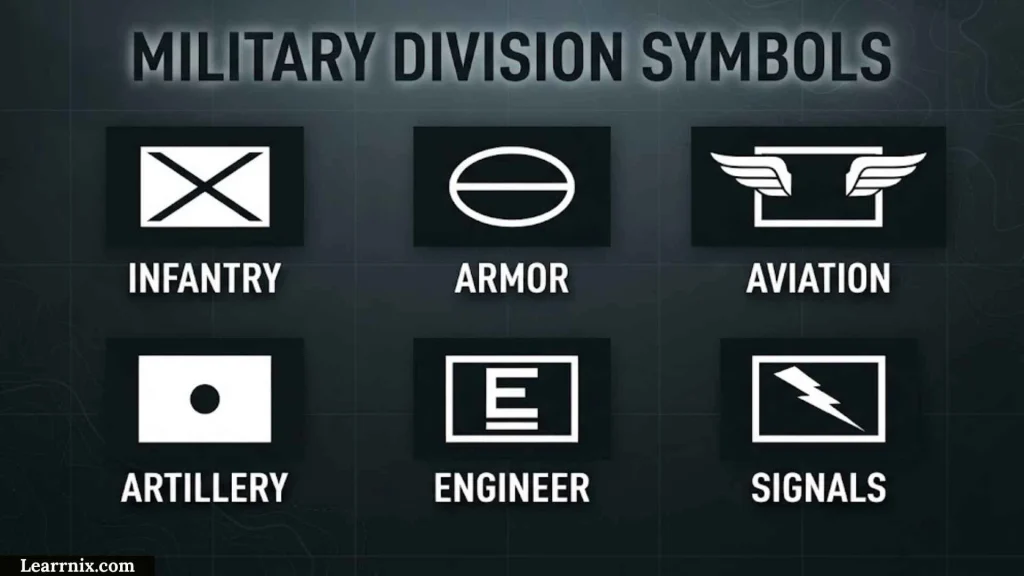
Military division symbols are completely different from mathematical division signs. They are graphical markings used to identify military units, formations, functions, or command relationships.
Modern military map symbols are often based on standardized systems such as NATO’s APP-6 family of symbology. A military division may be represented by a standardized frame and additional markings rather than by one decorative emblem.
The exact symbol can vary according to:
- Country
- Military branch
- Historical period
- Map-symbol standard
- Unit type
- Operational context
A historical unit emblem should therefore not automatically be treated as the same thing as a formal tactical map symbol.
Army Division Symbols
Army division symbols generally identify a formation or communicate information about its organization on military maps and documents.
In standardized tactical symbology, the frame and internal markings can communicate information such as the unit’s type and echelon. A division is an organizational level, while its identifying emblem or insignia can be a separate visual element.
Historical armies also used distinctive badges, patches, numbers, colors, and geometric designs to identify divisions. These are best understood as unit insignia rather than universal mathematical-style symbols.
NATO Division Symbols
NATO military symbology uses standardized graphical conventions for representing military organizations and capabilities.
A division symbol is normally interpreted in relation to its frame, echelon indicator, nationality or affiliation, and other modifiers. The system is designed for military planning and map-based communication rather than decoration.
This means there is no single decorative “NATO division symbol” that represents every division. Different divisions and unit types can be represented by combinations of standardized elements.
Fire Division Symbols
The phrase “fire division symbols” can refer to military symbols associated with fire support, artillery, or fire-related tactical functions. It can also be used informally when discussing firefighting or emergency-service symbols.
In military symbology, the exact meaning depends on the applicable symbol standard and the surrounding markings. A symbol should therefore be interpreted as part of the complete tactical graphic rather than in isolation.
For historical material, the same principle applies: a marking used by one army or period may have a completely different meaning elsewhere.
Military Fire Division Symbols Meaning
Military fire-related symbols are generally interpreted according to the tactical-symbology system in which they appear.
For example, artillery and fire-support formations may use standardized tactical graphics to identify their function. Additional symbols can communicate equipment, organization, affiliation, or status.
When researching a particular historical map or document, check:
- The country or military force.
- The date or historical period.
- The symbol standard being used.
- Nearby unit markings.
- The map legend, if available.
Without that context, a visually similar symbol can easily be misidentified.
Panzer Division Symbols
Panzer divisions were armored formations of the German armed forces, particularly associated with World War II. Their visual identification can include unit insignia, tactical markings, numbers, and other historical identifiers.
There was not one universal “Panzer division symbol” shared by every Panzer division. Individual formations could have their own distinctive insignia.
Historical Panzer-related markings may therefore include:
- Division insignia
- Tactical vehicle markings
- Formation numbers
- National markings
- Period-specific identification signs
When using these symbols in historical research, it is useful to identify the exact division and date rather than assuming a single symbol represented all Panzer units.
German Panzer Division Symbols
German Panzer division symbols varied between formations and periods. A division might use a distinctive emblem that appeared on vehicles, documents, signs, or other equipment.
These insignia are different from standardized NATO-style tactical symbols. A divisional emblem identifies a particular historical formation, whereas a tactical symbol is designed to communicate organizational information on maps and operational graphics.
For accurate identification, researchers should compare the marking with period photographs, unit histories, archival material, and established military reference works.
Wehrmacht Division Symbols
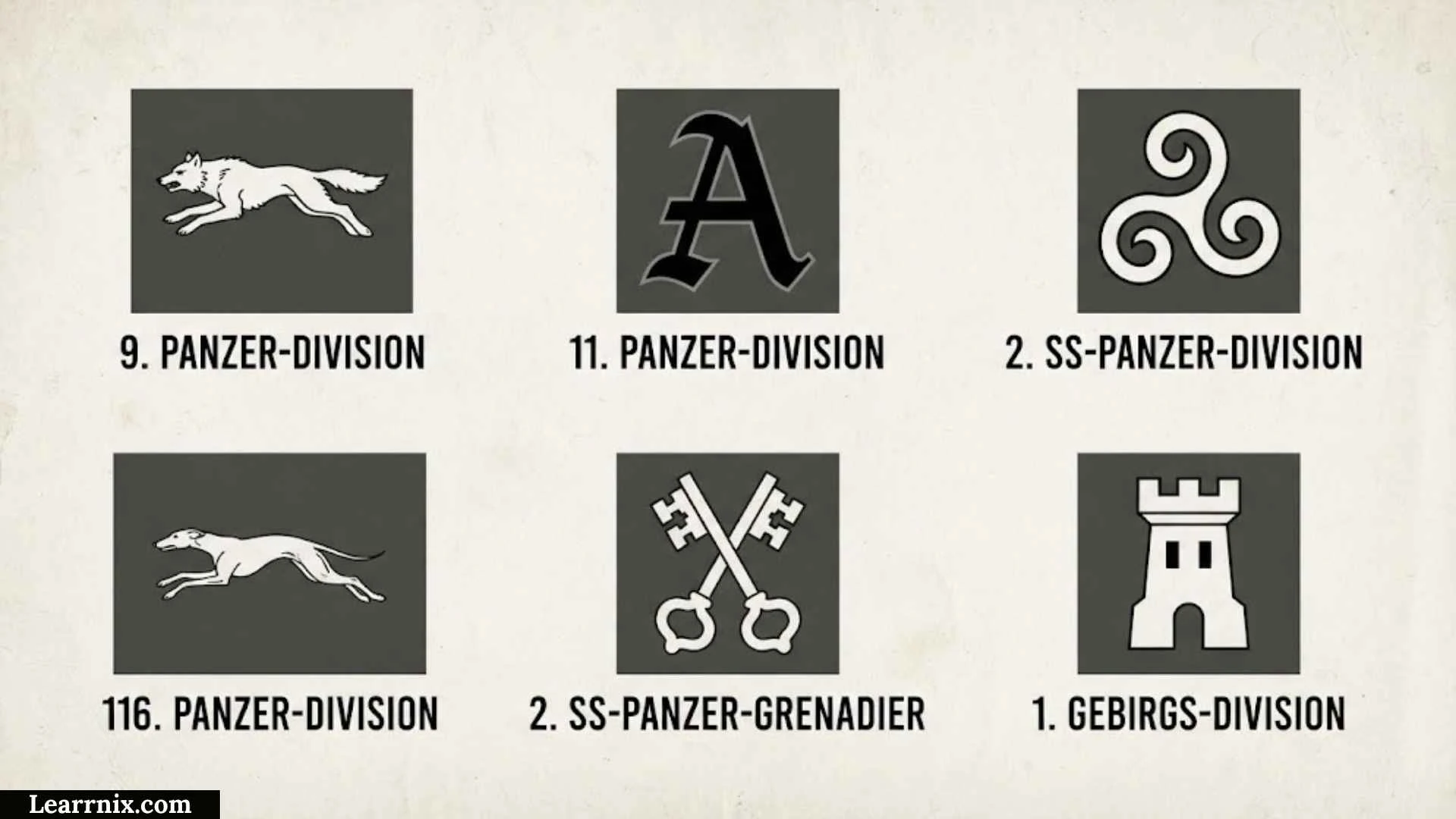
The Wehrmacht consisted of Germany’s armed forces during the Nazi era and included the Heer, Kriegsmarine, and Luftwaffe. The term is therefore broader than the German Army alone.
Division markings used by German forces varied according to branch, unit, period, and purpose. Army formations could have distinctive divisional insignia, while operational maps used tactical symbols to communicate military information.
A historical marking should be identified by its documented context rather than by appearance alone.
WW2 German Division Symbols
World War II German division symbols are a broad historical category rather than one standardized collection.
German formations used different types of visual identification, including:
- Divisional insignia
- Tactical signs
- Unit numbers
- Vehicle markings
- National markings
- Formation-specific emblems
Symbols changed over time, and some formations changed insignia or used multiple identification methods.
It is also important to distinguish official military markings from later reproductions. A symbol seen on a modern website, model kit, or game may not accurately represent how the marking was used during the war.
SS Division Symbols
The Waffen-SS included numerous divisions and formations that used different identifying insignia and symbols. These markings are part of the history of Nazi Germany and the Waffen-SS.
Historical research should distinguish between a unit’s documented insignia and broader Nazi or SS symbols. A particular division emblem does not necessarily represent every formation within the organization.
Because historical reproductions can be inaccurate, identification is best based on the specific division, time period, and primary or reputable historical sources.
Military Division Symbols
Military division symbols can be divided broadly into two categories: standardized tactical symbology and unit-specific insignia.
Standardized tactical symbols are designed to communicate information quickly on maps and operational graphics. Unit insignia, by contrast, often serve an identification or heraldic purpose.
| Type | Main purpose |
| Tactical symbol | Communicate military organization or function |
| Division insignia | Identify a particular formation |
| Vehicle marking | Help identify or distinguish equipment or units |
| Heraldic emblem | Represent a unit’s identity or history |
Understanding this distinction makes military symbol research much easier.
FAQ
What Is The Main Division Symbol?
The most familiar division symbol is ÷, known as the division sign or obelus. The slash / is another common way to represent division, especially in plain text and digital applications.
How Do I Type The Division Symbol?
You can copy and paste ÷, use a system symbol picker, or use a keyboard shortcut supported by your operating system and keyboard layout. The slash / is available directly on most standard keyboards.
Is There A Unicode Division Symbol?
Yes. The division sign ÷ is a Unicode character with the code point U+00F7. Unicode also contains other division-related characters, including the fraction slash ⁄.
Are Panzer Division Symbols The Same As NATO Symbols?
No. Panzer divisional insignia are historical unit-specific markings associated with German armored formations, while NATO tactical symbols belong to a standardized military symbology system.
What Is The Difference Between ÷ And /?
Both can represent division, but they are different characters and are commonly used in different contexts. ÷ is the traditional division sign, while / is a slash commonly used in plain text, computing, and technical notation.
Conclusion
Division symbols are more varied than the familiar ÷ sign suggests. Depending on the context, division can be written with a division sign, slash, fraction slash, or a formatted horizontal fraction bar.
For everyday typing, ÷ is useful when you want a clear mathematical division sign, while / is convenient on a standard keyboard. Understanding the differences between these characters also helps prevent confusion when working with mathematical or Unicode text.
Military division symbols require a different approach because they belong to organizational and historical systems rather than arithmetic. Panzer, Wehrmacht, Waffen-SS, and NATO markings can have distinct meanings, so identifying the country, period, unit, and symbol system is essential for accurate interpretation.

I am Michael Carter, an educational content creator who believes that knowledge has the power to transform lives.
I create resources focused on modern education, digital learning, and building essential skills for the future.
I love helping readers discover simple and effective ways to improve their learning journey.
Books by Michael Carter:
- Modern Education for Tomorrow’s World
- Learning Skills for Future Success
 Charlotte Anderson