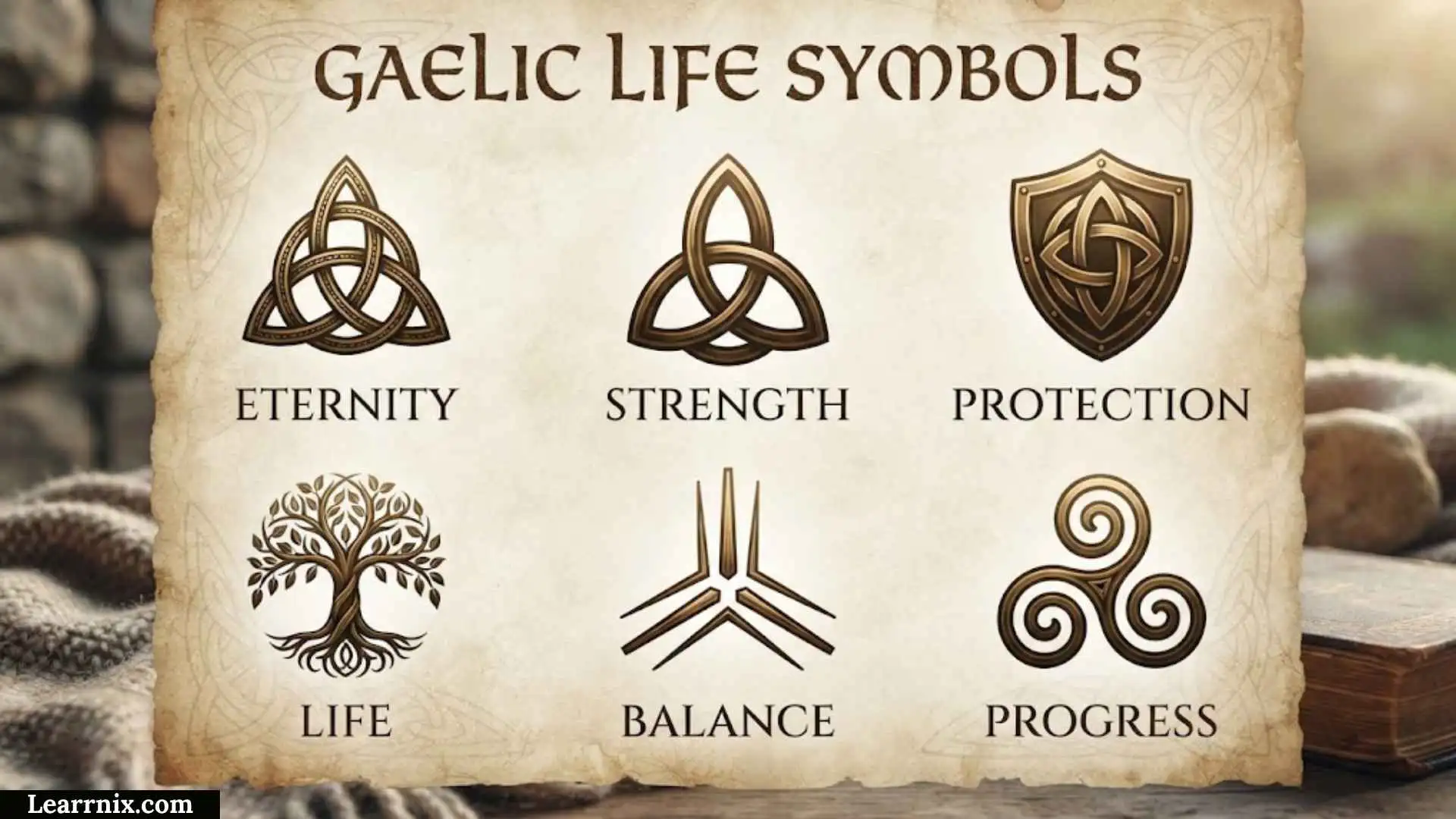
If you are searching for Gaelic symbols, you may be looking for the meanings behind Irish and Scottish cultural signs, ancient writing, Celtic designs, religious symbols, or symbols that represent love, protection, family, heritage, and identity. The challenge is that “Gaelic symbols” is a broad term. Some symbols are genuinely connected with early Gaelic culture, while others are Irish national symbols, Christian traditions, medieval artwork, or much later Celtic Revival designs.
The most important examples include Ogham, the Irish harp, shamrock, St. Brigid’s Cross, the Claddagh, Celtic crosses, and Celtic interlace. Each has a different historical background, and not every popular meaning found online can be traced to an ancient Gaelic source.
This guide explains what Gaelic symbols are, where they come from, what they can represent today, and how to tell historical evidence from modern interpretation.
What Are Gaelic Symbols?
Gaelic symbols are symbols, designs, writing systems, and cultural emblems associated with Gaelic-speaking traditions, particularly those of Ireland and Scotland.
The word Gaelic is important because it does not simply mean “anything Celtic.” Gaelic refers primarily to the Goidelic branch of Celtic languages, including Irish and Scottish Gaelic. As a result, a symbol can be Celtic without being specifically Gaelic.
Some of the most relevant Gaelic and Irish symbols include:
| Symbol | Main Historical or Modern Association |
| Ogham | Early Irish writing and inscriptions |
| Irish harp | Ireland, national identity, music |
| Shamrock | Irish identity and St. Patrick’s Day |
| St. Brigid’s Cross | Blessing, protection, Irish folk tradition |
| Claddagh | Love, friendship, loyalty |
| Celtic cross | Christianity and Irish/Celtic heritage |
| Celtic interlace | Medieval Insular art and later Celtic design |
| Triskele | Ancient three-part spiral motif |
| Irish wolfhound | Irish heritage and cultural imagery |
The key point is that these symbols do not all belong to the same historical period. Ogham, for example, is an early writing system, while the Claddagh is a much later Irish tradition.
Gaelic vs. Celtic: Why the Difference Matters
One of the biggest sources of confusion is treating “Gaelic” and “Celtic” as interchangeable terms.
What Does Gaelic Mean?
Gaelic usually refers to the Goidelic language and cultural traditions of Ireland and Scotland. Irish is called Gaeilge, while Scottish Gaelic is Gàidhlig.
This means that Gaelic identity is connected to language, history, communities, literature, folklore, music, and cultural traditions.
A symbol associated with Gaelic heritage may therefore be Irish or Scottish without being a universal symbol of all Celtic peoples.
What Does Celtic Mean?
Celtic is a wider term covering related languages and cultures across different parts of Europe.
In discussions of art and symbolism, “Celtic” may refer to:
- Irish art
- Scottish traditions
- Welsh traditions
- Insular manuscript decoration
- Iron Age archaeological material
- Medieval Christian art
- Modern Celtic Revival designs
This wider category includes many things that should not automatically be called Gaelic.
A Simple Way to Classify a Symbol
When researching a symbol, ask:
Is it specifically Irish?
↓
Look for Irish historical, cultural, or national sources.
Is it specifically Scottish Gaelic?
↓
Check Scottish Gaelic and Highland cultural sources.
Is it medieval Insular art?
↓
Use archaeological and art-history sources.
Is it a modern Celtic design?
↓
Do not automatically assign it an ancient meaning.
This distinction improves both historical accuracy and cultural understanding.
Ogham: The Ancient Irish Writing System
Ogham is one of the most important subjects for anyone interested in Gaelic symbols.
What Is Ogham?
Ogham is an early writing system used primarily in Ireland and parts of Britain. Its characters are formed from groups of lines or notches arranged around a central stemline.
Heritage Ireland describes Ogham inscriptions, many of which date to around the fourth century, as among the earliest written examples of the Irish language.
The National Museum of Ireland likewise identifies Ogham as the earliest form of writing found in Ireland, with surviving inscriptions concentrated in the early medieval period.
What Were Ogham Inscriptions Used For?
Many surviving Ogham inscriptions are associated with personal names, family relationships, and commemorative or territorial contexts.
This is important because Ogham was not originally created as a collection of decorative symbols with individual mystical meanings.
A modern Ogham tattoo can have personal symbolism, but that does not mean every letter had a separate ancient spiritual meaning.
Why Ogham Matters Today
Ogham is useful for people interested in:
- Irish ancestry
- Ancient Irish language
- Archaeology
- Historical writing
- Irish tattoos
- Heritage jewelry
- Celtic history
If historical accuracy is your priority, Ogham is one of the strongest choices because its use is supported by surviving inscriptions and archaeological evidence.
The Irish Harp: A Powerful National Symbol
The harp is one of the clearest symbols associated with Ireland.
Historical Background of the Harp
The National Museum of Ireland explains that the harp has represented Ireland since the medieval period and was adopted as a national symbol with the establishment of the Irish Free State in 1922. The national harp design is based on the medieval harp traditionally associated with Brian Boru and now held at Trinity College Dublin.
The harp has also appeared on coins, official documents, seals, and other forms of state symbolism.
What Does the Irish Harp Represent?
Depending on the context, the harp can represent:
- Ireland
- Irish national identity
- Music
- Irish history
- Cultural heritage
- Independence
Unlike many modern “Celtic meaning” lists, the harp has a clearly documented political and national history.
Harp vs. Celtic Decorative Symbols
A harp is particularly useful when someone wants a symbol that unmistakably identifies Ireland rather than a general Celtic aesthetic.
For an Irish-themed logo, jewelry piece, educational project, or heritage design, the harp can communicate Irish identity without requiring a complicated interpretation.
The Shamrock and Irish Identity
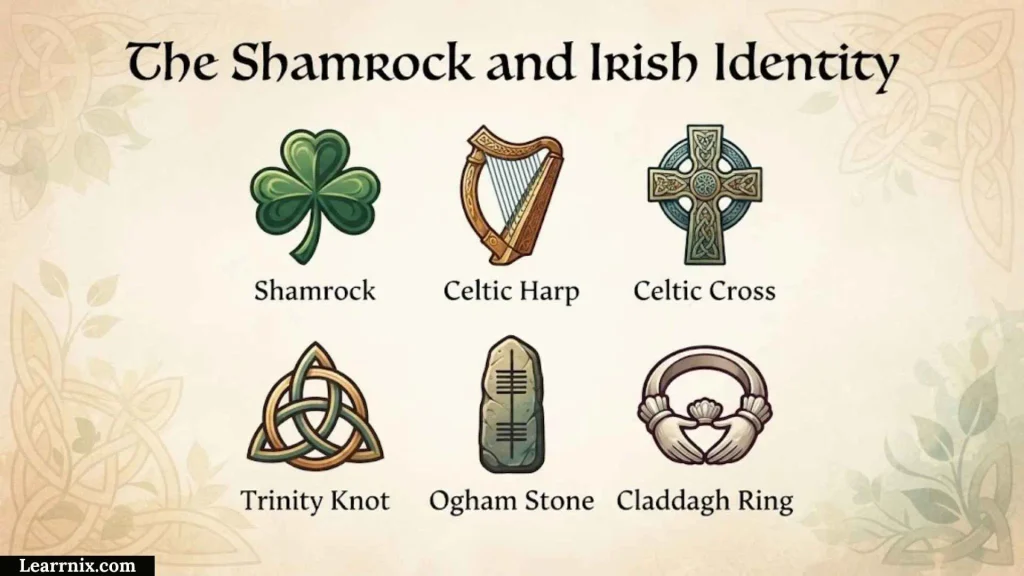
The shamrock is another famous Irish symbol.
What Does the Shamrock Represent?
Today the shamrock is strongly associated with:
- Ireland
- Irish identity
- St. Patrick’s Day
- Irish culture
- Luck in popular culture
The traditional story says St. Patrick used the three leaves of the shamrock to explain the Christian Trinity.
However, the historical status of that story needs some care.
Was the Shamrock Story Really Used by St. Patrick?
The National Museum of Ireland describes the association between St. Patrick and the Trinity explanation as a relatively late tradition. Historical evidence does not establish that St. Patrick actually used the shamrock in this way.
That does not make the tradition unimportant. It means there is a difference between cultural tradition and documented historical evidence.
This is a useful example of why Gaelic and Irish symbols should be researched with context rather than relying only on modern symbol-meaning lists.
St. Brigid’s Cross: Irish Tradition, Blessing, and Protection
St. Brigid’s Cross is one of the most interesting Irish symbols because its history connects religious practice, seasonal traditions, craft, and household customs.
What Is St. Brigid’s Cross?
St. Brigid’s Cross is traditionally made from materials such as:
- Rushes
- Straw
- Reeds
- Grass
- Hay
- Wood
- Fabric
- Other available materials
The National Museum of Ireland records several forms, including diamond-shaped, interlaced, wheel-shaped, and crosses with two, three, or four arms.
What Does It Mean?
St. Brigid’s Cross has traditionally been associated with:
- Blessing
- Protection
- Home
- Family
- Farming
- Seasonal renewal
- St. Brigid
Crosses were traditionally placed in homes and animal sheds to invoke St. Brigid’s blessing.
The tradition also shows how religious belief and older seasonal customs became intertwined in Irish folk culture.
Why February 1 Matters
St. Brigid’s Day falls on February 1 and is associated with the beginning of spring in traditional Irish seasonal culture.
The National Museum of Ireland connects the festival with older seasonal traditions surrounding Imbolc and describes customs focused on fertility, new life, protection, and blessing.
This gives St. Brigid’s Cross a much richer context than simply calling it an “ancient protection symbol.”
The Claddagh: Love, Friendship, and Loyalty
The Claddagh is among the best-known Irish symbols in modern jewelry.
What Are the Three Parts of the Claddagh?
The design contains:
- Heart — love
- Hands — friendship
- Crown — loyalty
The three elements together create a recognizable Irish emblem frequently used in rings, necklaces, bracelets, and other jewelry.
Is the Claddagh an Ancient Celtic Symbol?
No. This is an important distinction.
The Claddagh should be understood as a traditional Irish symbol, not as a prehistoric Celtic or ancient Gaelic religious emblem.
Its popularity today makes it relevant to Irish identity, relationships, family heritage, and personal jewelry, but its historical period is much later than Ogham or early medieval Celtic art.
When Is a Claddagh Appropriate?
A Claddagh is especially suitable when the intended message involves:
- Romantic love
- Friendship
- Loyalty
- Family
- Irish heritage
- Personal relationships
If someone wants a symbol specifically connected to ancient Irish writing, Ogham would be a more historically appropriate category.
Celtic Interlace and Knotwork
Celtic interlace is one of the most recognizable visual features associated with Irish and Celtic-inspired art.
What Is Interlace?
Interlace consists of strands that appear to weave over and under each other.
It became an important feature of medieval Insular art and later Celtic Revival design.
The National Museum of Ireland notes that Neo-Celtic objects drew inspiration from older Irish metalwork and manuscript traditions, including interlace and stylized animal forms.
Do Celtic Knots Have Fixed Ancient Meanings?
This is one of the most common misconceptions.
Modern websites often assign meanings such as:
- Eternal love
- Friendship
- Family
- Eternity
- Protection
- Strength
Some of these meanings can be useful as modern interpretations, but they should not automatically be presented as documented meanings from ancient Gaelic society.
The safest description is that interlace represents a major artistic tradition, while individual symbolic interpretations vary by period and modern context.
Why Knotwork Is Still Popular
Celtic-inspired knotwork works well for:
- Tattoo borders
- Wedding rings
- Jewelry
- Family designs
- Logos
- Book illustrations
- Heritage artwork
- Decorative patterns
Its continuous structure can also make it visually useful for circular or repeating designs.
Celtic Crosses and Christian Heritage
The Celtic cross combines Christian symbolism with artistic traditions associated with Ireland and the wider Celtic world.
What Is a Celtic Cross?
A typical Celtic cross consists of a Christian cross with a circular ring around the intersection.
Irish high crosses and medieval monuments provide important historical examples of Christian art combined with local artistic traditions.
Is a Celtic Cross Pagan?
Not simply because it has Celtic decoration.
A Celtic cross is fundamentally a Christian cross form. Its historical context should be considered before assigning it a pre-Christian meaning.
The wider medieval Irish artistic tradition included Christian imagery, interlace, animals, inscriptions, and other decorative elements.
What Can It Represent Today?
Modern uses can include:
- Christian faith
- Irish heritage
- Memorials
- Medieval Irish history
- Celtic cultural identity
- Family ancestry
The meaning depends strongly on the person and context.
The Triskele and Three-Part Designs
The triskele, or triskelion, is a three-part spiral motif with ancient origins.
What Does a Triskele Look Like?
A typical triskele has three curved arms or spirals extending from a central point.
Three-part motifs appear in different historical cultures, so the triskele should not automatically be described as exclusively Gaelic.
What Does the Triskele Mean?
Modern interpretations may connect it with:
- Cycles
- Movement
- Growth
- Life
- Threefold relationships
- Continuity
However, these meanings should be treated carefully because the motif has a much wider historical distribution than modern Gaelic symbolism alone.
How It Relates to Irish Tradition
Three-armed forms also occur within Irish folk traditions. The National Museum of Ireland documents three-armed forms of St. Brigid’s Cross alongside two- and four-armed examples.
This illustrates why a visual similarity does not necessarily prove that two symbols had identical historical meanings.
Gaelic Animal Symbols and Irish Heritage
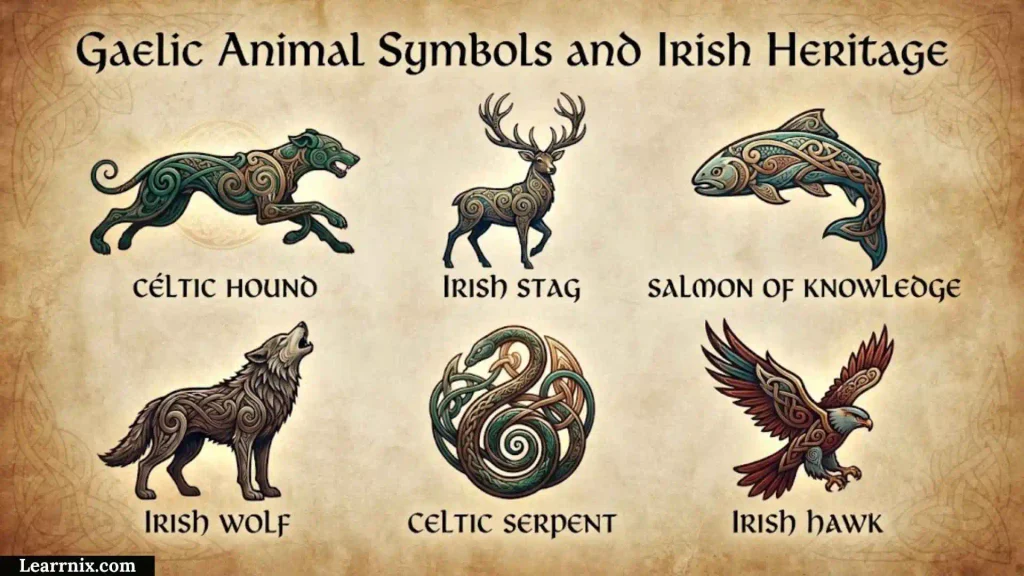
Animals are another important part of Celtic and Irish visual culture.
Irish Wolfhound
The Irish wolfhound has a strong place in Irish cultural imagery.
The National Museum of Ireland includes Irish wolfhounds among Irish motifs in its educational material on national and cultural symbols.
The animal can therefore work well in modern designs representing:
- Ireland
- Irish heritage
- Strength
- Dogs and companionship
- Traditional Irish culture
However, the exact meaning depends on the historical and artistic context.
Other Animal Motifs
Irish and Celtic art can include:
- Birds
- Horses
- Dogs or hounds
- Serpents
- Deer
- Mythological creatures
An animal appearing in medieval artwork should not automatically be given a modern symbolic definition. Its role may have been decorative, narrative, religious, heraldic, or culturally specific.
Gaelic Symbols of Protection
Protection is one of the most common reasons people search for Gaelic symbols.
St. Brigid’s Cross
St. Brigid’s Cross has some of the clearest documented associations with blessing and protection.
Traditionally, crosses were hung in homes and animal shelters, and families sought St. Brigid’s blessing for people, animals, crops, and the household.
Irish Folk Protection Traditions
Protection was not limited to one object.
Irish seasonal traditions included:
- Blessed materials
- Household customs
- Crosses
- Ribbons
- Prayers
- Holy wells
- Seasonal rituals
The National Museum of Ireland records the tradition of leaving a cloth or ribbon associated with St. Brigid outside overnight, with the belief that it could later provide protection from illness and pain.
This demonstrates that Irish protective symbolism often existed as part of a larger folk tradition rather than as an isolated “magic symbol.”
Gaelic Symbols of Love and Family
Different symbols work better for different meanings.
Love
The Claddagh is the clearest modern Irish choice because the heart is part of its established design.
Family Heritage
Ogham can be appropriate when the goal is to represent Irish language, ancestry, or an ancestral name.
Loyalty
The crown of the Claddagh is traditionally associated with loyalty.
Home and Protection
St. Brigid’s Cross has a stronger documented connection with household blessing and protection.
This distinction makes symbol selection more meaningful than simply choosing the most visually attractive design.
Irish and Scottish Gaelic Symbols: Key Differences
Gaelic culture includes both Ireland and Scotland, but their symbols are not identical.
| Area | Examples | Main Context |
| Ireland | Harp, shamrock, Ogham, Claddagh | Irish national and cultural heritage |
| Irish folk tradition | St. Brigid’s Cross | Blessing, seasonal customs, household tradition |
| Scottish Gaelic culture | Gaelic language, Highland traditions, clan-related heraldry | Scottish cultural identity |
| Broader Celtic art | Interlace, spirals, animal motifs | Artistic and historical traditions |
| Modern Celtic design | Knotwork, stylized lettering | Contemporary decorative use |
Why Scottish Gaelic Symbols Need Separate Research
Scottish Gaelic culture developed in a different historical and geographic environment from Irish Gaelic culture.
Although the languages are related and both belong to the Goidelic branch, a Scottish clan emblem, Highland heraldic device, or Gaelic-language design should not automatically be labeled an Irish symbol.
For a Scottish project, it is better to identify the specific region, clan, language, or tradition involved.
Gaelic Symbols in Tattoos
Gaelic-inspired tattoos are popular because they can combine personal meaning with heritage.
Ogham Tattoos
Ogham can be used for:
- Names
- Words
- Family references
- Ancestry
- Short inscriptions
Accuracy is essential. A tattoo should be checked against a reliable linguistic or scholarly source before it is permanently applied.
Claddagh Tattoos
A Claddagh works well for themes involving:
- Love
- Friendship
- Loyalty
- Irish heritage
Celtic Knot Tattoos
Knotwork can be used as:
- Bands
- Borders
- Circular designs
- Family artwork
- Decorative elements
But avoid claiming that a particular knot has a guaranteed ancient meaning unless reliable evidence supports that claim.
St. Brigid’s Cross Tattoos
This can be meaningful for people interested in:
- Irish heritage
- St. Brigid
- Household protection
- Blessing
- Traditional Irish culture
Gaelic Symbols in Jewelry and Gifts
Jewelry is one of the easiest ways to use Irish and Gaelic-inspired symbolism.
Choosing a Symbol by Meaning
| Your Goal | Symbol to Consider | Why |
| Irish national identity | Harp | Official national emblem |
| Love | Claddagh | Heart is central to the design |
| Friendship | Claddagh | Hands are traditionally associated with friendship |
| Loyalty | Claddagh | Crown is traditionally associated with loyalty |
| Early Irish writing | Ogham | Historical writing system |
| Protection | St. Brigid’s Cross | Documented folk association with blessing |
| Christian heritage | Celtic cross | Christian cross form |
| Decorative Celtic style | Interlace | Major Insular/Celtic artistic tradition |
This type of decision framework helps match the symbol to the intended message rather than relying on vague “Celtic meaning” claims.
How to Choose the Right Gaelic Symbol
Start with the meaning rather than the design.
Decision Tree for Gaelic Symbols
Do you want to represent Ireland itself?
↓
Consider the Irish harp.
Do you want love, friendship, or loyalty?
↓
Consider the Claddagh.
Do you want early Irish language or ancestry?
↓
Consider Ogham.
Do you want household blessing or protection?
↓
Consider St. Brigid’s Cross.
Do you want Christian Irish heritage?
↓
Consider a Celtic cross.
Do you want a repeating decorative pattern?
↓
Consider Celtic interlace.
Do you want a broader ancient spiral motif?
↓
Research the triskele, while remembering that it is not exclusively Gaelic.
Common Misconceptions About Gaelic Symbols
Every Celtic Symbol Is Gaelic
Not true.
“Celtic” is a broad category. Gaelic traditions are more specific.
Every Celtic Knot Has an Ancient Meaning
There is no reliable basis for assigning one fixed ancient meaning to every modern Celtic knot.
Many popular interpretations are modern.
Ogham Is a Magical Alphabet
Ogham was a real writing system. Its surviving inscriptions provide historical evidence of early writing associated with Ireland and Britain. Heritage Ireland describes Ogham inscriptions as some of the earliest written examples of the Irish language.
Modern spiritual uses are separate from the historical function of the script.
The Shamrock Story Is Completely Proven
The association between St. Patrick and the Trinity explanation is a later tradition, according to the National Museum of Ireland.
It remains culturally important, but cultural importance and historical proof are not the same thing.
Celtic Crosses Are Automatically Pagan
A Celtic cross is a Christian cross form. Its Celtic visual context does not automatically make it a pre-Christian symbol.
The Claddagh Is an Ancient Celtic Symbol
The Claddagh is a traditional Irish symbol, but it should not be placed in the same historical category as ancient or early medieval Celtic motifs.
How to Research Gaelic Symbols Accurately
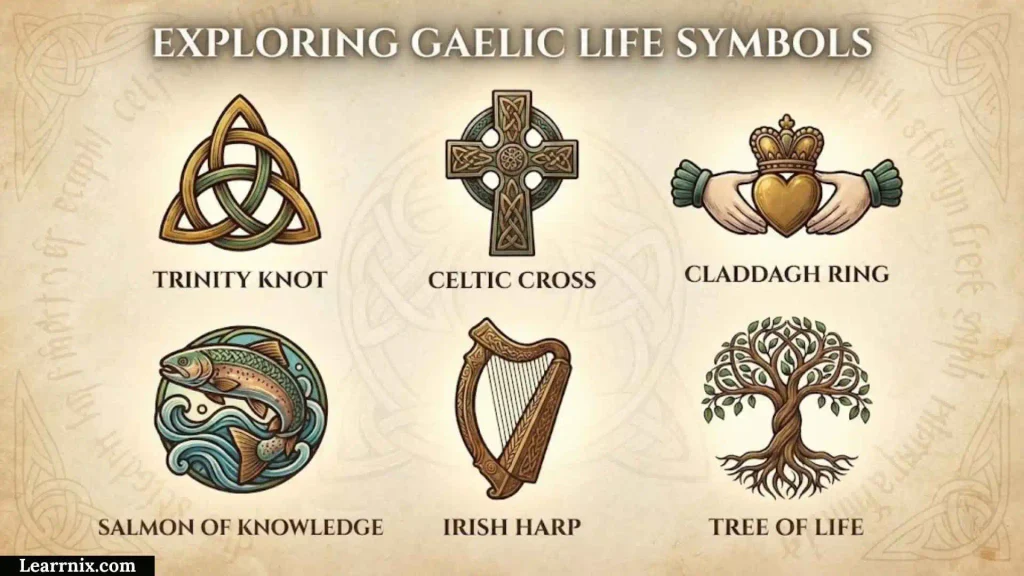
Historical symbolism is easy to oversimplify, so use a source-first approach.
Check the Historical Period
Determine whether the symbol comes from:
- Prehistoric archaeology
- Early medieval Ireland
- Medieval Christianity
- Early modern Irish culture
- Celtic Revival
- Modern commercial design
A symbol’s meaning can change substantially across these periods.
Check the Geographic Origin
Ask whether it is:
- Irish
- Scottish
- Manx
- Welsh
- Continental Celtic
- Medieval Insular
- Modern Celtic-inspired
This prevents different cultures from being combined incorrectly.
Separate Historical Evidence From Modern Meaning
A museum artifact demonstrates historical evidence.
A modern jewelry company may describe what a design means to contemporary customers.
Those are two different kinds of information.
For SEO content, educational material, tattoos, or heritage projects, keeping that distinction clear makes the information more trustworthy.
Use Museums and Heritage Organizations
Reliable starting points include the National Museum of Ireland and Heritage Ireland.
The National Museum provides documentation on Irish symbols, St. Brigid’s traditions, the harp, shamrock customs, and other elements of Irish material and folk culture.
Heritage Ireland also provides historical information on Ogham and early Irish writing.
Key Takeaways About Gaelic Symbols
Gaelic symbols are not one single group with one shared meaning. They come from different periods, regions, languages, religions, and artistic traditions.
The most useful examples to remember are:
- Ogham — early Irish writing and inscriptions
- Irish harp — Ireland and national identity
- Shamrock — Irish cultural identity and St. Patrick’s Day
- St. Brigid’s Cross — blessing, protection, and Irish folk tradition
- Claddagh — love, friendship, and loyalty
- Celtic cross — Christian heritage and Celtic/Irish visual tradition
- Celtic interlace — medieval Insular art and later Celtic-inspired design
- Triskele — ancient three-part spiral motif with a wider geographic history
- Irish wolfhound — Irish cultural and national imagery
The most important lesson is to ask where, when, and why a symbol was used before assigning it a meaning.
Frequently Asked Questions About Gaelic Symbols
What Is the Most Famous Gaelic Symbol?
There is no single symbol that represents every Gaelic tradition. For Ireland, the Irish harp is especially significant because it is the national symbol. The shamrock, Claddagh, Ogham, and St. Brigid’s Cross are also strongly associated with Irish culture.
What Is the Oldest Gaelic Symbol?
There is no single universally accepted “oldest Gaelic symbol.” Ogham is particularly important because surviving inscriptions provide very early evidence of written Irish. Heritage Ireland describes Ogham inscriptions from around the fourth century as some of the earliest written examples of the Irish language.
What Gaelic Symbol Means Protection?
St. Brigid’s Cross has a documented association with blessing and protection. Traditionally, crosses were placed in homes and animal sheds to invoke St. Brigid’s blessing.
What Gaelic Symbol Means Love?
The Claddagh is the best-known Irish symbol associated with love because the heart is one of its three central elements. The hands and crown are traditionally associated with friendship and loyalty.
What Symbol Represents Ireland?
The Irish harp is the national symbol of Ireland. It has a long history as an Irish emblem and was adopted as a national symbol following the establishment of the Irish Free State in 1922.
Is Ogham Irish or Celtic?
Ogham belongs within the broader Celtic historical context but has a particularly strong connection with early Ireland and the Irish language. Ogham inscriptions are also found in parts of Britain.
Are Celtic Knots Gaelic Symbols?
Celtic interlace is strongly connected with Irish and other Insular artistic traditions, but the modern term “Celtic knot” covers a broad range of designs. Specific modern meanings should not automatically be described as ancient Gaelic beliefs.
Is a Celtic Cross a Gaelic Symbol?
A Celtic cross can be associated with Irish and Celtic heritage, particularly through medieval Christian art. However, it is more accurate to describe it as a Christian symbol developed within Celtic artistic traditions rather than claiming that it represents one universal Gaelic belief.
Is the Shamrock an Ancient Gaelic Symbol?
The shamrock is an important Irish cultural symbol, but the popular story that St. Patrick used it to explain the Trinity is a later tradition rather than a securely documented event from his lifetime.
What Gaelic Symbol Is Best for a Tattoo?
It depends on the intended meaning. Ogham can represent early Irish writing or ancestry; the Claddagh can represent love, friendship, or loyalty; and St. Brigid’s Cross can represent Irish folk tradition and protection.
Are Gaelic Symbols the Same as Irish Symbols?
No. Gaelic refers to a language and cultural tradition, while Irish symbols can include national, religious, historical, and cultural symbols from many different periods.
Are Gaelic Symbols the Same as Celtic Symbols?
No. Gaelic is narrower. Celtic is a broader cultural and linguistic category that includes Gaelic traditions as well as other Celtic cultures.
Conclusion
Gaelic symbols bring together language, art, religion, folklore, national identity, and historical memory. Ogham provides evidence of early Irish writing, the harp represents Ireland at a national level, the Claddagh remains a powerful modern Irish emblem of relationships, and St. Brigid’s Cross connects household tradition with blessing and protection.
Celtic interlace and crosses add another layer because they show how Irish artistic traditions developed through medieval Christianity and later Celtic Revival movements.
The most reliable way to understand these symbols is to avoid treating every modern “Celtic meaning” as an ancient fact. Instead, look at the symbol’s origin, date, region, historical use, and available evidence.
That approach gives you a more accurate understanding whether you are researching Gaelic symbols for education, genealogy, tattoos, jewelry, artwork, cultural heritage, or personal meaning.
References
- National Museum of Ireland — St. Patrick and Shamrock Traditions: Historical context for St. Patrick’s Day customs and the later tradition connecting the shamrock with the Trinity.
- National Museum of Ireland — St. Brigid’s Crosses: Documentation of traditional St. Brigid’s Cross forms, materials, household use, and associations with blessing.
- National Museum of Ireland — St. Brigid’s Day: Historical and folkloric context for St. Brigid’s Day, Imbolc, protection, seasonal customs, and crosses.
- National Museum of Ireland — Harps, Hounds and Hibernia: History of the Irish harp as a national symbol and examples of Irish cultural imagery.
- National Museum of Ireland — O’Carolan’s Harp: Additional historical information about the harp’s use as an Irish national emblem.
- Heritage Ireland — Irish School of Illumination: Historical information about Ogham and early Irish writing.
- Heritage Ireland — Ogham Stones: Examples of surviving Ogham inscriptions and their historical context.
- National Museum of Ireland — Symbols Book: Educational material covering Irish cultural symbols including the harp, shamrock, wolfhound, and representations of Gaelic Ireland.

I am Charlotte Anderson, an education writer who is passionate about creating meaningful learning resources for students and lifelong learners.
I enjoy researching new educational approaches and sharing ideas that make studying easier and more effective.
Through my work, I aim to inspire curiosity, confidence, and a love for learning.
Books:
- The Complete Guide to Better Learning
- Building Skills for Academic Success
 Michael Carter