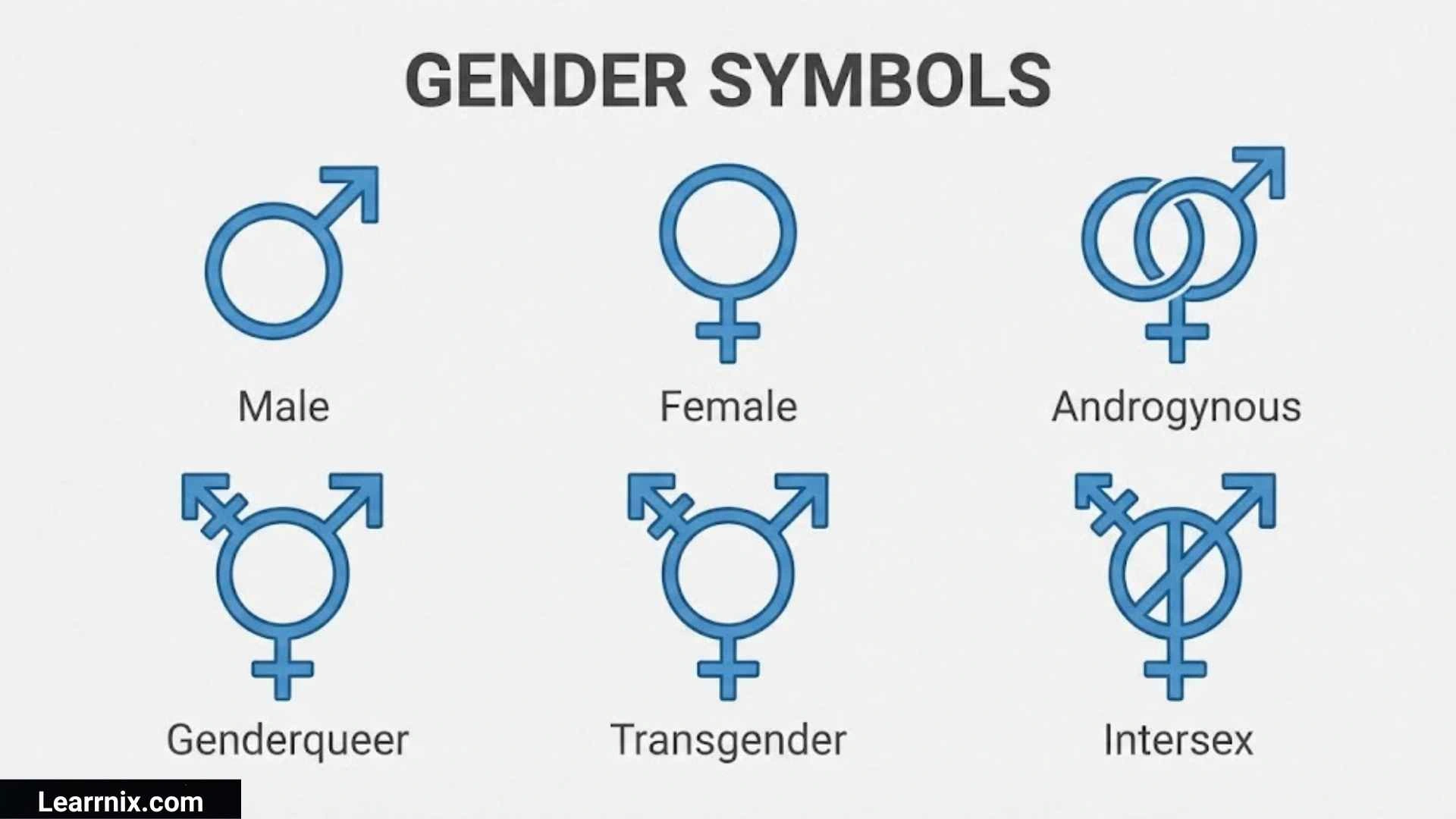
Gender symbols are familiar signs used to represent male, female, transgender, nonbinary, and other gender-related identities. You can find them in biology, public spaces, forms, social media profiles, games, apps, and everyday text.
Some symbols are widely recognized, such as ♂ for male and ♀ for female, while others represent more specific identities or modern gender concepts. Their meanings can also change depending on context, so understanding the difference between traditional, inclusive, and fictional uses is helpful.
This guide explains gender symbols, their meanings, Unicode characters, copy-and-paste options, bathroom signs, LGBTQ+ symbols, and examples from games such as Pokémon and Planet Zoo. It also covers where these symbols came from and how they are commonly used today.
Female Gender Symbols
The most recognizable female gender symbol is ♀, commonly called the female symbol or Venus symbol. It is traditionally used to represent women, females, or the female sex.
The symbol can be copied easily:
♀
Its Unicode code point is U+2640, and its Unicode name is FEMALE SIGN.
The symbol is often seen in biology, medicine, demographic information, public signage, and digital profiles. A female symbol may also appear alongside a male symbol when a design needs to distinguish between two traditional sex or gender categories.
Other gender-related symbols may incorporate the female sign with additional elements to represent broader identities. However, the plain ♀ remains the standard and most widely recognized female sign.
It is worth remembering that the female symbol can describe biological sex in scientific contexts or gender identity in everyday contexts. The intended meaning depends on where it appears.
Male Symbol
The standard male symbol is ♂, commonly known as the male symbol or Mars symbol.
♂
Its Unicode code point is U+2642, with the Unicode name MALE SIGN.
The male symbol is commonly used for men, males, or the male sex. Like the female sign, it appears in scientific diagrams, medical information, public signs, forms, and digital communication.
The visual design consists of a circle with an arrow extending toward the upper right. The symbol has a long historical association with the planet Mars and the Roman god Mars.
In modern everyday use, ♂ is usually understood immediately as a male or masculine symbol. However, its exact interpretation depends on context.
Gender Symbols Copy And Paste
If you need gender symbols for a profile, message, document, website, username, or graphic, the following characters are easy to copy and paste.
| Symbol | Common Use |
| ♂ | Male |
| ♀ | Female |
| ⚥ | Male and female / intersex-related usage |
| ⚧ | Transgender |
| ⚲ | Transgender-related symbol in some contexts |
| ⚢ | Double female symbol |
| ⚣ | Double male symbol |
| ⚤ | Male and female pairing |
| ⚦ | Male with stroke |
| ⚧ | Transgender symbol |
The most useful everyday choices are ♂, ♀, and ⚧. Some of the other characters have more specialized or historical uses and should not automatically be treated as universal identity symbols.
For simple copy-and-paste needs:
Male: ♂
Female: ♀
Transgender: ⚧
Symbol appearance can vary slightly between fonts, operating systems, browsers, and applications. If a character appears as an empty box, the selected font or platform may not support it correctly.
Gender Symbols Meaning
Gender symbols communicate ideas about sex, gender identity, gender expression, or relationships between gender categories. Their meaning is not always identical across every situation.
The two traditional symbols are:
- ♂ — Male: commonly represents men, boys, males, or masculinity.
- ♀ — Female: commonly represents women, girls, females, or femininity.
- ⚧ — Transgender: commonly represents transgender identity or transgender people.
- ⚥ — Male and female: historically and contextually associated with combinations of male and female characteristics and is sometimes used in discussions of intersex or gender.
- ⚢ — Double female: can represent female-female relationships or related concepts depending on context.
- ⚣ — Double male: can represent male-male relationships or related concepts depending on context.
A symbol does not always provide a complete definition of someone’s identity. For example, ♂ and ♀ are traditional sex symbols, while modern gender discussions can involve identities that are not represented by only two categories.
This distinction matters when symbols are used in inclusive communication. A symbol may be technically correct in one setting while being too limited for another.
Gender Symbols Text
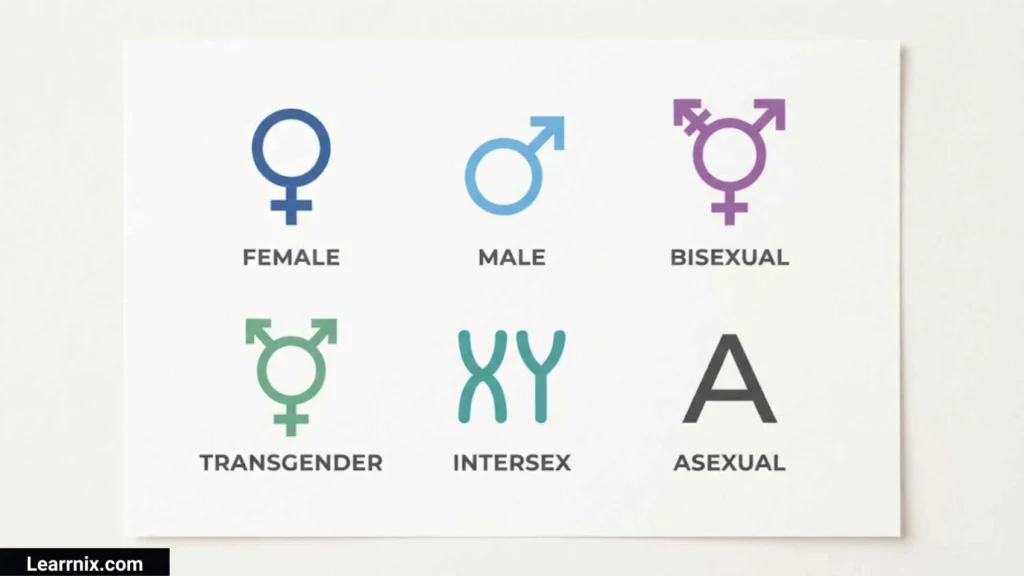
Gender symbols can be used as text characters rather than images. This makes them convenient for social media, messaging, profiles, notes, websites, and digital documents.
Examples include:
♀ Female
♂ Male
⚧ Transgender
⚢ Female-female
⚣ Male-male
You can place them beside words, names, labels, or categories:
- Alex ♀
- Jordan ♂
- Trans rights ⚧
- Gender: ♀ / ♂
- Inclusive spaces ⚧
Decorative text combinations are also common online, although their meaning should remain clear. When using less familiar symbols, adding a text label can prevent confusion.
For websites and applications, an icon can also be paired with accessible text. This is especially useful because not every visitor will recognize a less common gender character immediately.
What Are The Gender Symbols
The most familiar gender symbols are ♂ and ♀. They are traditionally associated with male and female respectively.
Modern gender communication can include additional symbols, particularly ⚧, which is commonly recognized as a transgender symbol. Other combinations and designs are used by different communities, organizations, artists, and platforms.
Gender symbols can serve several purposes:
- Identification — showing or labeling a gender category.
- Information — communicating sex or gender on forms and signs.
- Representation — expressing gender identity or community membership.
- Wayfinding — identifying facilities such as restrooms.
- Decoration — adding gender-related imagery to profiles or designs.
- Education — explaining biological, social, or cultural concepts.
There is no single symbol that represents every gender identity. Symbol use has expanded as language and public understanding of gender have developed.
What Do The Gender Symbols Mean
The meaning of a gender symbol depends heavily on its context.
On a restroom door, ♂ and ♀ generally indicate men’s and women’s facilities. On a scientific chart, they may identify male and female organisms. On a social profile, they may communicate gender identity or presentation.
The transgender symbol ⚧ is generally associated with transgender people and transgender identity. It combines elements traditionally associated with male and female symbolism and is now widely recognized in LGBTQ+ contexts.
Some gender symbols are also used to represent relationships. For example, paired male or female symbols may appear in LGBTQ+ contexts, although modern communities often use words and flags alongside symbols because symbols alone can be ambiguous.
The safest approach is to interpret a symbol according to its surrounding text, setting, and purpose rather than assuming that every symbol has one universal meaning.
Where Did The Gender Symbols Come From
The traditional male and female symbols have ancient astronomical and mythological associations. ♂ became associated with Mars, while ♀ became associated with Venus.
These planetary associations were connected with the Roman gods Mars and Venus. Over time, the signs became widely used to identify male and female organisms in biological and scientific contexts.
Their use in biology became especially influential because they offered compact visual markers for sex. Scientists could place the symbols next to organisms, diagrams, or genetic information without writing the full words every time.
Modern gender symbols developed from these traditional signs but have expanded beyond their original astronomical meanings. The transgender symbol, for example, emerged much later as a visual representation connected with transgender identity.
Today, gender symbolism combines historical signs with newer community-created and widely adopted forms. This is why the same basic characters can appear in science, public signage, identity-related discussions, and digital communication.
Nonbinary Gender Symbols
Nonbinary people may use different symbols to represent identities outside the traditional male-female binary. There is no single universally required nonbinary symbol.
The transgender symbol ⚧ is sometimes used broadly in gender-diversity contexts, but it should not automatically be treated as a dedicated nonbinary symbol. Nonbinary identity and transgender identity can overlap, but they are not interchangeable terms.
Some people use symbols such as ⚲ or custom variations of traditional gender symbols in nonbinary contexts. However, their recognition can vary considerably between communities and platforms.
The word nonbinary itself is often clearer than a symbol. In digital communication, someone may therefore combine text and symbolism, such as:
Nonbinary ⚧
or simply:
Nonbinary
For inclusive design, it is better to provide clear labels rather than relying only on unfamiliar symbols.
Boy And Girl Gender Symbols
The traditional symbols for boys and girls are usually the same male and female signs used for men and women:
♂ — Boy / male
♀ — Girl / female
There are no universally standardized Unicode characters specifically named “boy gender symbol” and “girl gender symbol” that function as direct equivalents of ♂ and ♀.
For children’s signs, educational materials, forms, or illustrations, designers may combine these symbols with words, colors, clothing icons, or child figures.
For example:
- Boy — ♂
- Girl — ♀
- Boys’ restroom — ♂
- Girls’ restroom — ♀
Context is particularly important with children because the traditional symbols describe male and female categories but do not necessarily communicate a child’s complete gender identity.
LGBTQ+ Gender Symbols
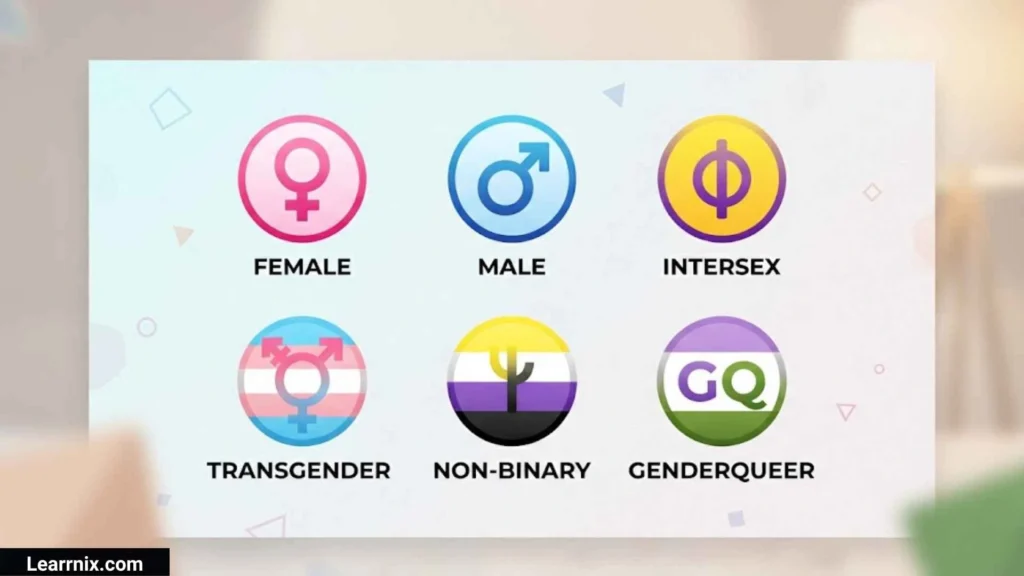
LGBTQ+ communities use many different symbols, and not all of them are strictly gender symbols. Some represent sexual orientation, gender identity, community history, or pride.
The transgender symbol ⚧ is one of the clearest gender-related symbols associated with LGBTQ+ representation.
Other commonly recognized LGBTQ+ imagery includes pride flags, the rainbow symbol, and various community-specific signs. These should not be confused with the basic male and female symbols.
For example:
- ⚧ — Transgender
- 🏳️🌈 — Rainbow flag / LGBTQ+ pride
- ♂ — Traditional male symbol
- ♀ — Traditional female symbol
LGBTQ+ symbolism is broader than gender symbolism alone. A pride symbol can represent a community without identifying a particular gender.
When creating inclusive content, using a written identity label alongside a symbol can make the message more precise and accessible.
Pokémon Gender Symbols
In Pokémon games, gender is commonly displayed using the familiar male and female symbols:
♂ — Male Pokémon
♀ — Female Pokémon
These symbols are useful because players can quickly identify a Pokémon’s gender without reading a separate word.
Gender can matter in Pokémon for breeding and for certain species-specific differences. However, not every Pokémon species has both male and female forms, and some species are genderless.
The symbols shown in a particular Pokémon game can vary slightly in visual presentation because the game interface controls their appearance. The underlying concept remains simple: ♂ indicates male and ♀ indicates female when a Pokémon has a recognized gender.
Some Pokémon are genderless, meaning neither of these traditional gender indicators applies. This is an important distinction when interpreting gender information in the series.
Bathroom Gender Symbols
Bathroom signs commonly use simple visual symbols to help people identify facilities quickly. The traditional signs are:
♂ — Men’s restroom
♀ — Women’s restroom
Public signs may use full-body silhouettes instead of the Unicode characters themselves, but the concept is similar.
You may also see:
- Male and female figures together
- A wheelchair accessibility symbol
- A family or baby-changing icon
- A gender-neutral restroom sign
- Text labels such as “Men,” “Women,” or “All Gender”
Bathroom symbols are primarily wayfinding signs, so clarity matters more than decorative detail. In locations offering gender-neutral facilities, signs may use text or inclusive figures instead of relying only on ♂ and ♀.
A Unicode symbol such as ♂ or ♀ is therefore not necessarily identical to the pictogram printed on a restroom door. They communicate related ideas, but their visual design can be different.
Planet Zoo Gender Symbols
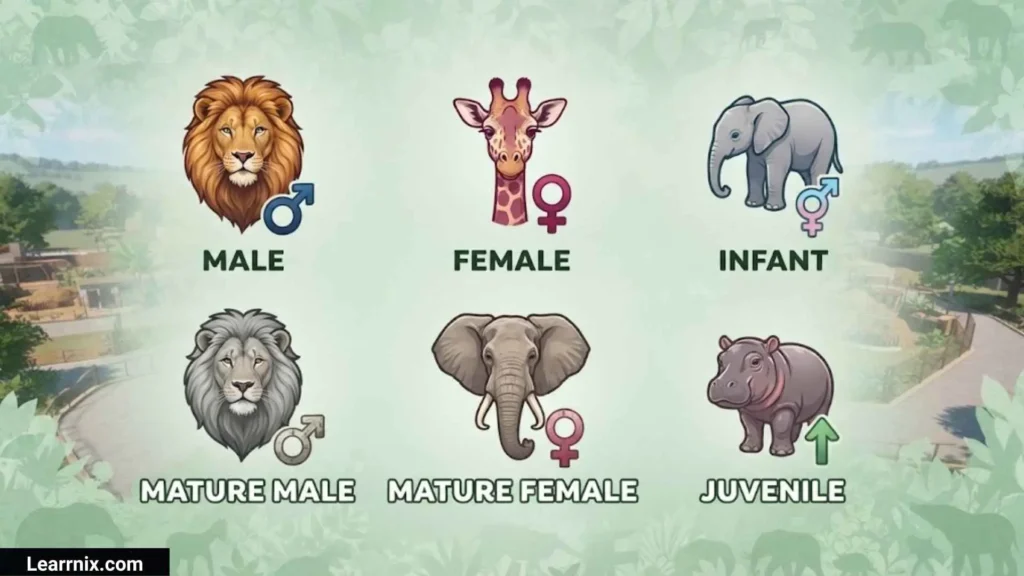
Planet Zoo uses animal information displays and interface elements to communicate details about animals, including sex. Players may encounter male and female indicators while managing animals in their zoos.
The familiar concepts are:
♂ — Male
♀ — Female
These indicators are especially useful when managing breeding populations. Knowing an animal’s sex can help players understand breeding groups, population management, and animal information.
Planet Zoo’s user interface may use its own visual styling rather than displaying plain Unicode characters in every location. Therefore, a symbol seen in the game should be interpreted as part of the game’s interface rather than assumed to be a separate Unicode character.
For players searching specifically for “Planet Zoo gender symbols,” the key idea is that the game uses visual indicators to distinguish animal sexes and help with management.
Gender Symbols Text And Unicode
Unicode makes many commonly used gender characters available as standard text characters. This is why symbols such as ♂ and ♀ can often be copied from a webpage and pasted into another application.
Important examples include:
| Symbol | Unicode Code Point | Unicode Name |
| ♂ | U+2642 | MALE SIGN |
| ♀ | U+2640 | FEMALE SIGN |
| ⚧ | U+26A7 | MALE WITH STROKE AND MALE AND FEMALE SIGN |
Unicode support does not guarantee identical visual styling everywhere. Fonts can change the appearance of a character, and some applications may display unsupported characters differently.
When you need a symbol for a website or document, test it in the exact environment where it will appear. This is particularly useful for less common gender-related characters.
How To Use Gender Symbols Online
Gender symbols can be useful in social profiles, usernames, messages, educational posts, forms, and graphic designs. The simplest approach is to copy a recognized character and place it next to a clear label.
For example:
♀ Female
♂ Male
⚧ Transgender
On social media, symbols can be used as compact profile decorations or alongside identity descriptions. In educational content, they can make diagrams and lists easier to scan.
Avoid using an unfamiliar symbol without context when accuracy matters. A short label can explain exactly what you mean and reduce the chance of misunderstanding.
FAQ
What is the symbol for male and female?
The traditional male symbol is ♂, while the traditional female symbol is ♀. They are widely used in science, signs, forms, and digital text.
What symbol represents transgender?
The Unicode character ⚧ is commonly used as a transgender symbol. Its Unicode name is MALE WITH STROKE AND MALE AND FEMALE SIGN.
Can I copy and paste gender symbols?
Yes. Characters such as ♂, ♀, and ⚧ can usually be copied and pasted like ordinary text. Their appearance may vary by font or platform.
Is there one symbol for every gender?
No. There is no single Unicode symbol representing every gender identity. Different communities may use different symbols, and written labels are often clearer.
Why are male and female symbols linked to planets?
The symbols ♂ and ♀ have historical associations with Mars and Venus. Their astronomical and mythological connections later influenced their use as signs for male and female categories.
Conclusion
Gender symbols provide a compact way to communicate information about male, female, transgender, and other gender-related concepts. The familiar ♂ and ♀ remain widely recognized, while ⚧ provides an important symbol associated with transgender representation.
Their uses range from scientific diagrams and public bathrooms to social media, games, and digital text. Pokémon and Planet Zoo also demonstrate how simple gender indicators can help users quickly understand information about characters or animals.
The most useful symbols to remember are ♂, ♀, and ⚧, but context should always guide interpretation. If a symbol may be unfamiliar, pairing it with a written label is the clearest and most inclusive approach.

I am Michael Carter, an educational content creator who believes that knowledge has the power to transform lives.
I create resources focused on modern education, digital learning, and building essential skills for the future.
I love helping readers discover simple and effective ways to improve their learning journey.
Books by Michael Carter:
- Modern Education for Tomorrow’s World
- Learning Skills for Future Success
 Charlotte Anderson