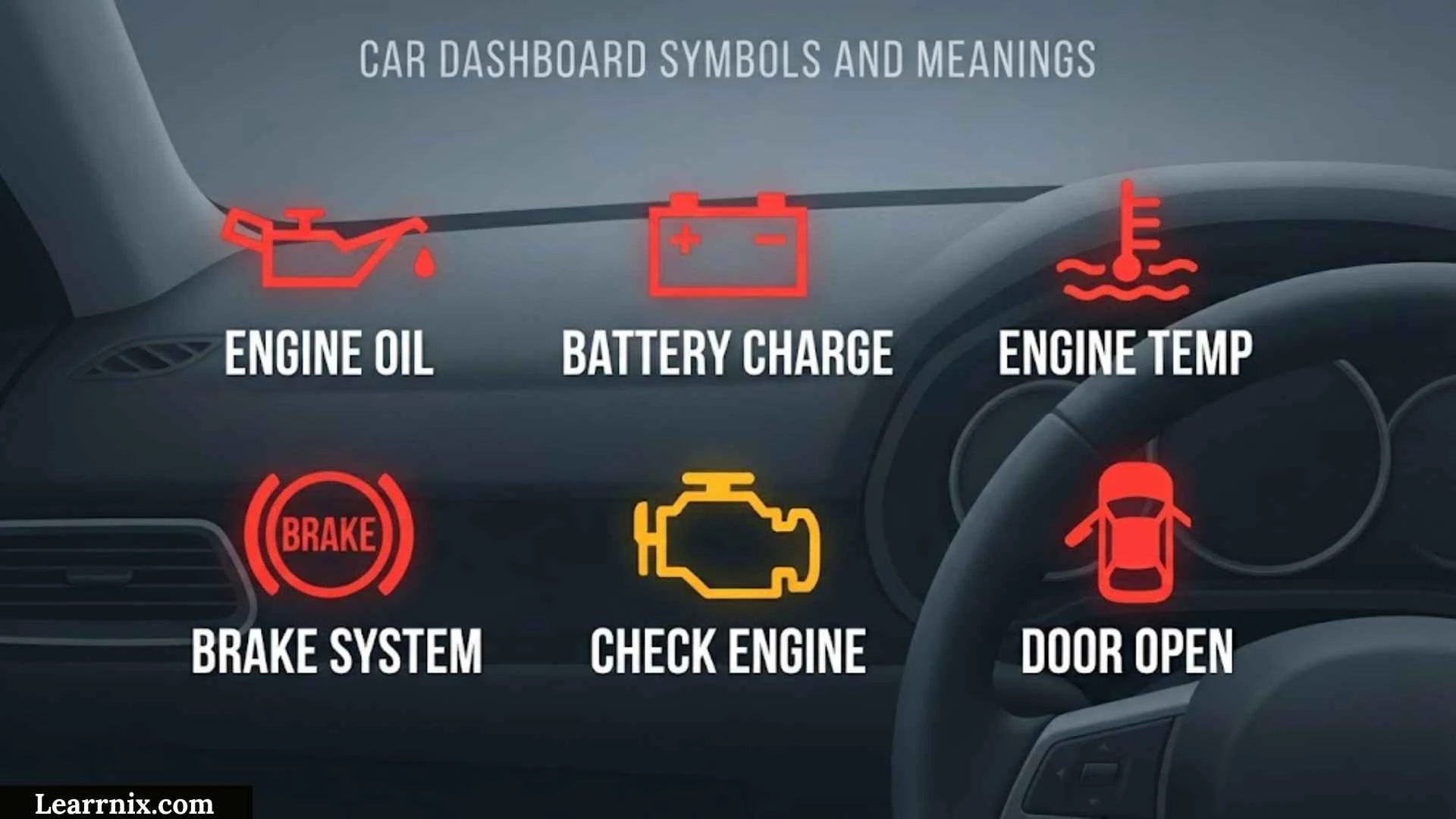
Your car dashboard uses symbols and warning lights to communicate what is happening inside the vehicle. Some indicators simply show that a feature is active, while others can point to a problem that needs attention. Knowing what these symbols mean can help you react correctly instead of guessing when an unfamiliar light appears.
This guide covers common car dashboard symbols and meanings with names, visual references, warning-light colors, and practical explanations. It also includes manufacturer-specific information for Toyota, Hyundai, Nissan, Ford, Honda, and Lexus, along with important symbols found in gasoline and diesel vehicles.
The most useful way to read a dashboard warning is to consider three things together: the symbol itself, its color, and whether it is steady or flashing. Your vehicle’s owner’s manual remains the final reference because dashboard symbols and their behavior can vary by model, year, engine, and equipment.
Car Dashboard Symbols With Names
Car dashboard symbols are small pictograms designed to communicate information quickly. Although manufacturers may use slightly different graphics, many symbols represent the same basic vehicle systems.
| Symbol | Common Name | Meaning |
| 🛢️ | Oil Pressure Symbol | Possible low engine oil pressure |
| 🔋 | Battery Warning | Possible charging-system problem |
| 🌡️ | Engine Temperature | Engine coolant temperature may be too high |
| 🛞 | Tire Pressure | Low tire pressure or TPMS warning |
| 🔧 | Wrench/Service Symbol | Service or maintenance may be required |
| ABS | ABS Warning | Possible anti-lock braking system fault |
| ⛽ | Fuel Warning | Fuel level is low |
| ! | Brake Warning | Brake, parking brake, or brake-fluid warning |
| 🚗 | Door Warning | A door, trunk, or hood may be open |
| 👤 | Seat Belt | Seat belt is not fastened |
| ⚠️ | General Warning | A vehicle system requires attention |
| 🚘 | Stability/Traction Symbol | Stability or traction-control status |
The emoji-style examples above are only visual approximations. Actual dashboard indicators normally use manufacturer-specific pictograms.
Some symbols are warning lights, while others are status indicators. For example, a blue high-beam indicator usually tells you that the high beams are active rather than indicating a fault. Similarly, a green turn-signal arrow confirms that the indicator is operating.
Common symbols worth recognizing include the engine-shaped check-engine light, oil-can symbol, battery symbol, tire-pressure symbol, brake warning, ABS indicator, airbag warning, coolant-temperature warning, and stability-control symbol.
Car Dashboard Symbols And Meanings With Pictures
Dashboard symbols are easier to understand when they are divided into categories. The same basic pictogram may appear on different vehicles with small design changes.
Engine And Powertrain Symbols
The engine-shaped symbol is commonly known as the check-engine or malfunction indicator light. It can indicate a problem involving the engine, emissions system, or related powertrain components.
The oil-can symbol generally relates to engine oil pressure. If it illuminates while driving, the vehicle should be handled according to the manufacturer’s instructions because low oil pressure can cause engine damage.
The thermometer symbol is associated with engine coolant temperature. A red or high-temperature warning can indicate overheating.
Brake And Safety Symbols
The ABS symbol normally consists of the letters ABS inside a circle or similar graphic. A warning that remains illuminated can indicate an ABS fault.
The airbag/SRS symbol can indicate a problem with the supplemental restraint system when it remains illuminated after startup.
The seat-belt symbol reminds the driver or passenger to fasten a seat belt.
Tire And Stability Symbols
The familiar tire-pressure symbol looks similar to a horseshoe with an exclamation mark. It is commonly used by tire-pressure monitoring systems.
The skidding-car symbol is associated with electronic stability control or traction control. Depending on the vehicle, a flashing indicator may show that the system is actively working, while a continuously illuminated warning may indicate that the system is disabled or has detected a fault.
Lighting Symbols
A blue high-beam indicator normally tells you that high beams are switched on. Green turn arrows indicate that a turn signal is operating. Fog-light symbols can indicate that front or rear fog lamps are active, depending on the vehicle.
The exact color and design should always be checked against the owner’s manual.
Yellow Car Warning Lights Meaning
Yellow or amber dashboard lights generally tell you that a system needs attention. They are often less immediately urgent than red warnings, but they should not automatically be ignored.
Common yellow or amber indicators include:
- Check-engine light
- Tire-pressure warning
- ABS warning
- Traction-control warning
- Stability-control warning
- Service or maintenance indicator
- Steering-system warning
- Certain driver-assistance warnings
A yellow light can sometimes appear briefly when the ignition is switched on because the vehicle is performing a system check. If it remains illuminated after the engine starts, the vehicle may have detected a condition that needs investigation.
The check-engine light deserves special attention. A steady light can have many causes, including emissions or engine-management faults. A flashing check-engine light can indicate a more serious condition and should not be treated the same way as an ordinary steady warning.
The color system is useful, but it is not universal enough to replace the owner’s manual. Toyota, for example, explains that dashboard icons can use different colors depending on the system and vehicle, and that red icons can indicate conditions requiring immediate attention.
Toyota Car Dashboard Symbols And Meanings
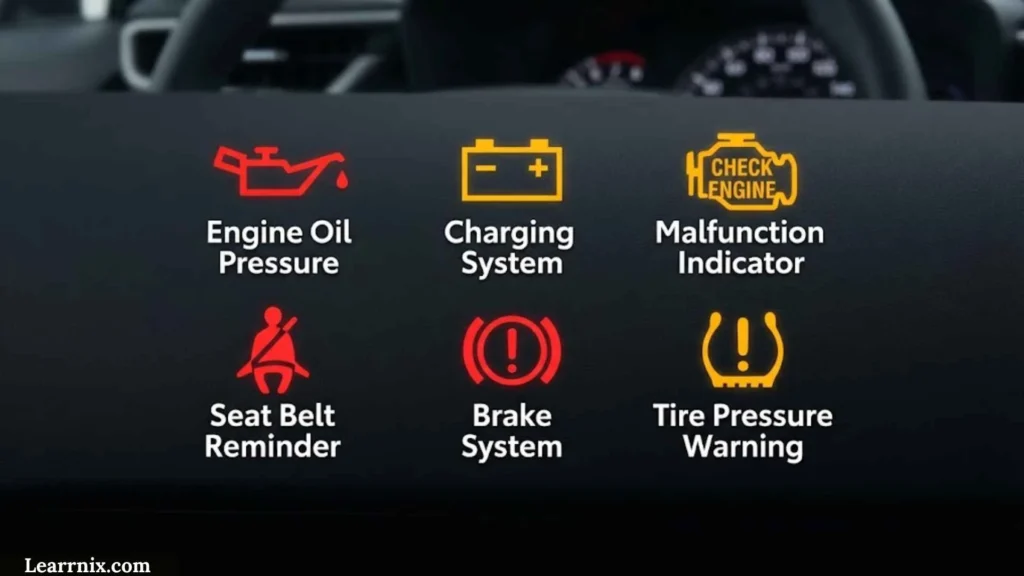
Toyota vehicles use a broad selection of standard warning symbols along with indicators for Toyota-specific technologies. The exact symbols vary according to model and equipment.
Common Toyota dashboard symbols include:
- Check-engine light — indicates a detected engine, emissions, or related system fault.
- Tire-pressure warning — indicates low tire pressure or a possible TPMS issue.
- ABS warning — indicates a possible anti-lock braking system problem.
- Brake warning — may relate to the parking brake or brake system.
- Master warning — alerts the driver that an important message may be available.
- Hybrid-system indicators — appear on applicable hybrid models.
- Driver-assistance indicators — show the status of applicable safety systems.
- Charging-system warning — can indicate an electrical charging problem.
Toyota also uses different colors to communicate system status and warning severity. Yellow does not always mean a critical fault; it can also identify an item that needs attention, such as low fuel.
Because Toyota produces many different models, the best way to identify an unfamiliar symbol is to compare it with the owner’s manual for the exact vehicle.
Car Dashboard Symbols And Meanings Hyundai
Hyundai dashboards contain common warning lights as well as indicators for systems such as electronic stability control, driver assistance, parking systems, and electric or hybrid technology.
Common Hyundai symbols include:
- Malfunction Indicator Lamp (MIL) — can indicate a problem with the engine, emissions system, or powertrain.
- Engine oil pressure warning — indicates low engine oil pressure.
- Low tire pressure warning — indicates significantly low tire pressure or a TPMS issue.
- ABS warning — indicates a possible ABS fault.
- Parking brake and brake-fluid warning — can indicate the parking brake or brake system needs attention.
- Airbag warning — can indicate a problem with the SRS system.
- Battery charging-system warning — indicates an electrical charging-system problem.
- Motor Driven Power Steering warning — can indicate a power-steering system malfunction.
- Master warning — may relate to several vehicle or driver-assistance systems.
Hyundai’s current owner’s information explains that warning-light shapes and locations can vary by vehicle specifications and software version. It also advises inspection when certain warning lights remain illuminated after starting or appear while driving.
This is particularly useful for newer Hyundai models because the dashboard can combine traditional warning lights with electronic driver-assistance notifications.
Engine Light Car Dashboard Symbols And Meanings
The check-engine light is one of the most recognized car dashboard symbols. It is usually represented by an outline resembling an engine.
When the light remains steadily illuminated, the vehicle’s onboard diagnostic system has detected a fault. Possible causes range from emissions-related problems to engine sensors, fuel-system issues, ignition problems, or other powertrain conditions.
A flashing check-engine light is different. It can indicate a severe engine misfire or another condition that may cause additional damage if the vehicle continues operating.
The light itself cannot tell you the exact problem. A diagnostic scan can retrieve a diagnostic trouble code, but a code is not necessarily a complete diagnosis. Proper testing may still be needed to determine why the fault occurred.
If the check-engine light appears with rough running, loss of power, smoke, overheating, unusual noises, or other serious symptoms, the vehicle should be assessed promptly.
Diesel Car Dashboard Symbols And Meanings
Diesel vehicles share many dashboard symbols with gasoline-powered vehicles, but they can also have indicators for diesel-specific systems.
Glow Plug Symbol
The glow-plug indicator usually resembles a small coil. It is associated with the diesel engine’s preheating system. On many diesel vehicles, it illuminates before starting and goes out when the system is ready.
If it remains illuminated or behaves differently from the normal startup sequence, consult the vehicle manual.
Diesel Particulate Filter Symbol
The DPF symbol is associated with the diesel particulate filter. It can indicate that the filter or its regeneration process requires attention.
The correct response depends on the vehicle. Drivers should follow the manufacturer’s DPF instructions rather than assuming every DPF warning requires the same procedure.
Water-In-Fuel Warning
Some diesel vehicles have a warning for water detected in the fuel system or fuel filter. This symbol is not present on every diesel vehicle.
AdBlue Or DEF Warning
Many modern diesel vehicles use diesel exhaust fluid, often called DEF or AdBlue depending on the market and manufacturer. A dedicated warning can indicate low fluid level or a system issue.
Because diesel emission systems differ substantially between models, always use the vehicle-specific instructions.
Car Dashboard Symbols And Meanings Nissan
Nissan vehicles use familiar warning symbols alongside indicators for Nissan-specific safety and convenience systems.
Common Nissan dashboard warnings include:
- Master warning light — can alert the driver that a dashboard message needs attention.
- Check-engine light — indicates a detected engine or emissions-related fault.
- ABS warning — indicates a possible anti-lock braking system issue.
- Brake warning — may relate to the parking brake or braking system.
- Tire-pressure warning — indicates low pressure or a TPMS issue.
- Airbag warning — can indicate a supplemental restraint system fault.
- Slip indicator — may relate to traction or stability control.
- Intelligent Key indicators — applicable models can display key-system warnings.
Nissan models vary significantly in dashboard design. Some vehicles also use a multi-information display to provide a text message alongside the symbol, which can make identification easier.
If an unfamiliar Nissan warning appears, note both the pictogram and any accompanying message before checking the model-specific manual.
Ford Car Dashboard Symbols And Meanings
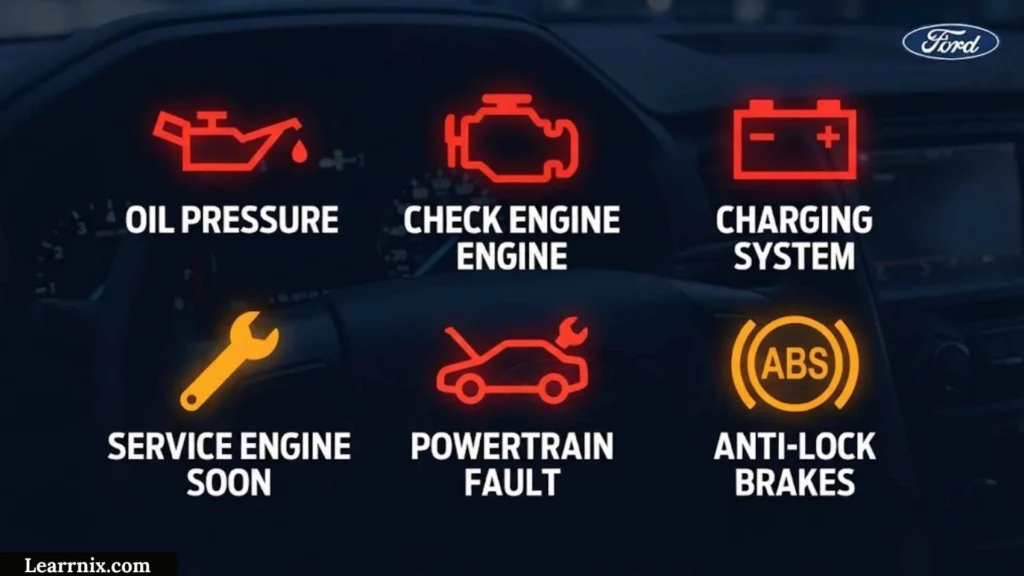
Ford vehicles use standard dashboard warnings along with indicators for powertrain systems, stability control, driver assistance, and other features.
Common Ford dashboard indicators include:
- Check-engine light — indicates an engine or emissions-related fault.
- Oil-pressure warning — indicates a possible low oil-pressure condition.
- Battery/charging warning — may indicate a charging-system problem.
- Brake warning — can relate to the parking brake or braking system.
- ABS warning — indicates a possible ABS fault.
- Tire-pressure warning — indicates low tire pressure or a TPMS issue.
- Stability-control symbol — relates to electronic stability or traction control.
- Powertrain warning — applicable models may use a dedicated indicator for powertrain faults.
- Service-related indicators — can alert the driver to maintenance or system conditions.
Ford dashboards can differ considerably between models. A newer vehicle may display a warning symbol together with a written message, while another model may rely more heavily on the instrument-cluster indicator.
For that reason, the exact Ford model and year matter when identifying a symbol.
Warning Car Dashboard Symbols And Meanings
Dashboard warnings can be easier to understand when separated by color and behavior.
Red Dashboard Warnings
Red commonly indicates a warning that deserves immediate attention. Examples can include:
- Oil-pressure warning
- Engine-temperature warning
- Brake-system warning
- Charging-system warning
- Certain safety-system warnings
If a serious red warning appears while driving, safely stopping the vehicle and following the owner’s manual instructions may be necessary.
Yellow Or Amber Warnings
Yellow or amber indicators commonly identify conditions that require attention or checking. Examples include:
- Check engine
- Low tire pressure
- ABS
- Traction or stability control
- Service warnings
- Some driver-assistance faults
Green And Blue Indicators
Green and blue indicators are commonly informational.
For example:
- Green turn arrow — turn signal is active.
- Green cruise indicator — cruise-control function may be active.
- Blue high-beam indicator — high beams are on.
- Green lighting indicator — certain exterior lights may be active.
Color meanings can vary by manufacturer, so the exact vehicle manual should take priority.
Red Car Dashboard Symbols And Meanings
Red dashboard symbols usually deserve more immediate attention than ordinary information indicators.
Oil Pressure Warning
The oil-can symbol can indicate low engine oil pressure. Continuing to drive with inadequate oil pressure can cause serious engine damage.
Engine Temperature Warning
A temperature warning can indicate that the engine coolant temperature is too high. An overheating engine should not simply be driven until the warning disappears.
Brake Warning
A red brake symbol may indicate that the parking brake is engaged, low brake fluid, or another brake-system condition depending on the vehicle.
Battery Or Charging Warning
A battery-shaped warning can indicate a charging-system problem rather than simply meaning that the battery itself is defective.
Door Or Hood Warning
Some vehicles use red indicators to show that a door, trunk, or hood is not properly closed.
The exact meaning depends on the vehicle. For example, Hyundai manuals describe specific red warnings for brake, oil pressure, temperature, and other systems and provide model-specific instructions for responding to them.
Honda Car Dashboard Symbols And Meanings
Honda vehicles use many familiar dashboard symbols, with newer models adding indicators for Honda Sensing and other electronic systems.
Common Honda indicators include:
- Check-engine light — indicates an engine or emissions-related fault.
- Oil-pressure warning — indicates possible low oil pressure.
- Charging-system warning — indicates a possible charging-system issue.
- Brake warning — can relate to the parking brake or brake system.
- ABS warning — indicates a possible anti-lock braking fault.
- Tire-pressure warning — indicates low tire pressure or a TPMS-related condition.
- VSA indicator — relates to Vehicle Stability Assist.
- Airbag/SRS warning — may indicate a restraint-system fault.
- Driver-assistance indicators — show the status of applicable safety features.
A Honda dashboard can also display a text message in the information screen. Reading that message together with the warning symbol can provide more context.
Lexus Car Dashboard Symbols And Meanings
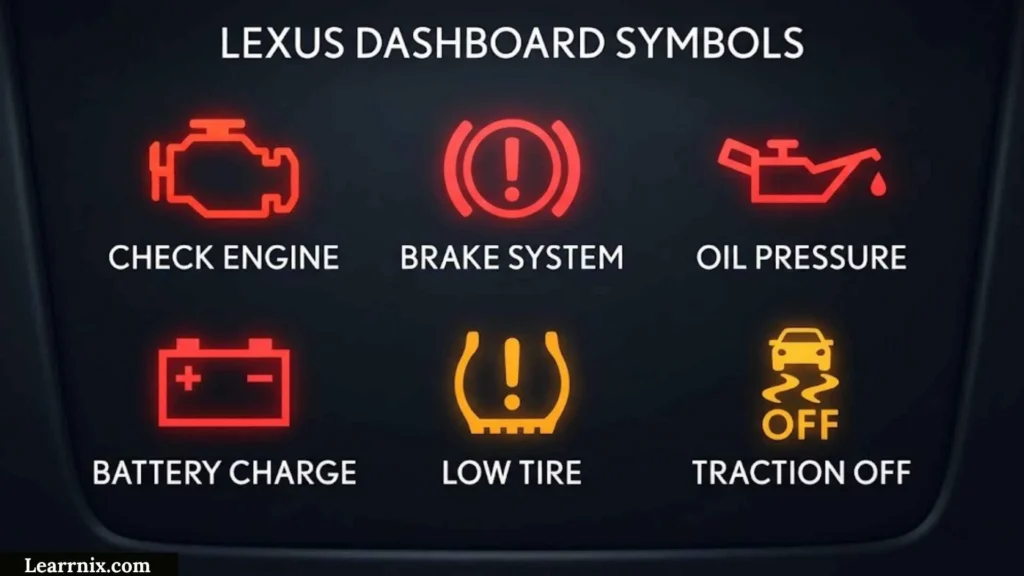
Lexus vehicles use standard warning symbols along with indicators for hybrid systems, driver-assistance technology, and other vehicle-specific features.
Common Lexus symbols include:
- Master warning light — indicates that a dashboard message requires attention.
- Check-engine light — indicates a detected engine or emissions-related fault.
- Brake warning — may indicate a parking-brake or brake-system condition.
- ABS warning — indicates a possible ABS problem.
- Tire-pressure warning — indicates low tire pressure or a TPMS issue.
- Hybrid-system warning — applies to Lexus hybrid models.
- Charging-system warning — can indicate an electrical charging-system problem.
- Driver-assistance indicators — show the status of applicable safety technologies.
Lexus models can differ significantly in the number of electronic systems included. Hybrid models may therefore have additional indicators that are not found on conventional gasoline vehicles.
Sign On Car Dashboard Symbols And Meanings
A sign on the dashboard may be a warning, status indicator, reminder, or information symbol. Identifying it correctly requires more than simply looking at its shape.
Start by checking the color. Then look at whether the symbol is steady or flashing. Next, check whether the dashboard displays a written message.
For example, a tire-shaped symbol with an exclamation mark commonly relates to tire pressure. An engine-shaped symbol is commonly associated with the malfunction indicator system. A steering-wheel symbol may relate to power steering, while a skidding-car symbol can relate to stability or traction control.
How To Identify An Unknown Dashboard Symbol
- Check the color — red, amber, yellow, green, and blue can provide useful context.
- Identify the pictogram — look for recognizable shapes such as an engine, oil can, battery, tire, brake, or steering wheel.
- Check whether it flashes — flashing can indicate a different or more urgent condition.
- Read the information display — many modern cars provide a written explanation.
- Check the owner’s manual — use the manual for your exact model and year.
- Notice vehicle symptoms — overheating, smoke, unusual noises, loss of power, or braking changes can affect the appropriate response.
Modern vehicles can have dozens of indicators, and their shape or location may vary according to vehicle specifications and software. Hyundai, for example, explicitly notes that warning-light shapes and locations can vary between vehicles.
A dashboard symbol guide is therefore useful for identification, but the manufacturer’s manual should be used for the final interpretation and recommended action.
FAQ
What does a red dashboard light mean?
A red dashboard light usually indicates a condition that deserves prompt attention, although the exact meaning depends on the vehicle and symbol. Oil pressure, overheating, and brake warnings can require immediate action.
What does a yellow car warning light mean?
A yellow or amber warning commonly indicates that a system needs attention or has detected a condition that should be checked. The owner’s manual can explain the exact warning for your vehicle.
Can I drive with a check engine light on?
A steady check-engine light may sometimes allow continued driving, but the cause should be investigated. If the light flashes or the vehicle runs poorly, loses power, overheats, or develops unusual symptoms, treat the situation as more urgent.
Why do dashboard lights come on when I start my car?
Many vehicles illuminate dashboard indicators briefly during startup as part of their normal system checks. Lights that remain on after startup can indicate a warning or system condition.
Are dashboard symbols the same on every car?
No. Many basic symbols are widely recognized, but manufacturers can use different designs, colors, messages, and warning strategies. The model-specific owner’s manual is the most reliable source.
Conclusion
Car dashboard symbols and meanings become much easier to understand once you recognize the major categories. Engine, oil, temperature, brake, battery, tire-pressure, ABS, airbag, and stability-control symbols are among the most useful indicators for everyday drivers.
Manufacturer-specific information also matters. Toyota, Hyundai, Nissan, Ford, Honda, and Lexus can add their own indicators for hybrid systems, driver assistance, electronic controls, emissions equipment, and other technologies. Diesel vehicles can have additional symbols for glow plugs, DPF systems, and diesel exhaust fluid.
When an unfamiliar light appears, do not rely on color alone. Look at the symbol, check whether it is flashing, read any accompanying message, and consult the owner’s manual for your exact vehicle. That combination gives you a much clearer understanding of what your dashboard is trying to tell you.

I am Michael Carter, an educational content creator who believes that knowledge has the power to transform lives.
I create resources focused on modern education, digital learning, and building essential skills for the future.
I love helping readers discover simple and effective ways to improve their learning journey.
Books by Michael Carter:
- Modern Education for Tomorrow’s World
- Learning Skills for Future Success
 Charlotte Anderson