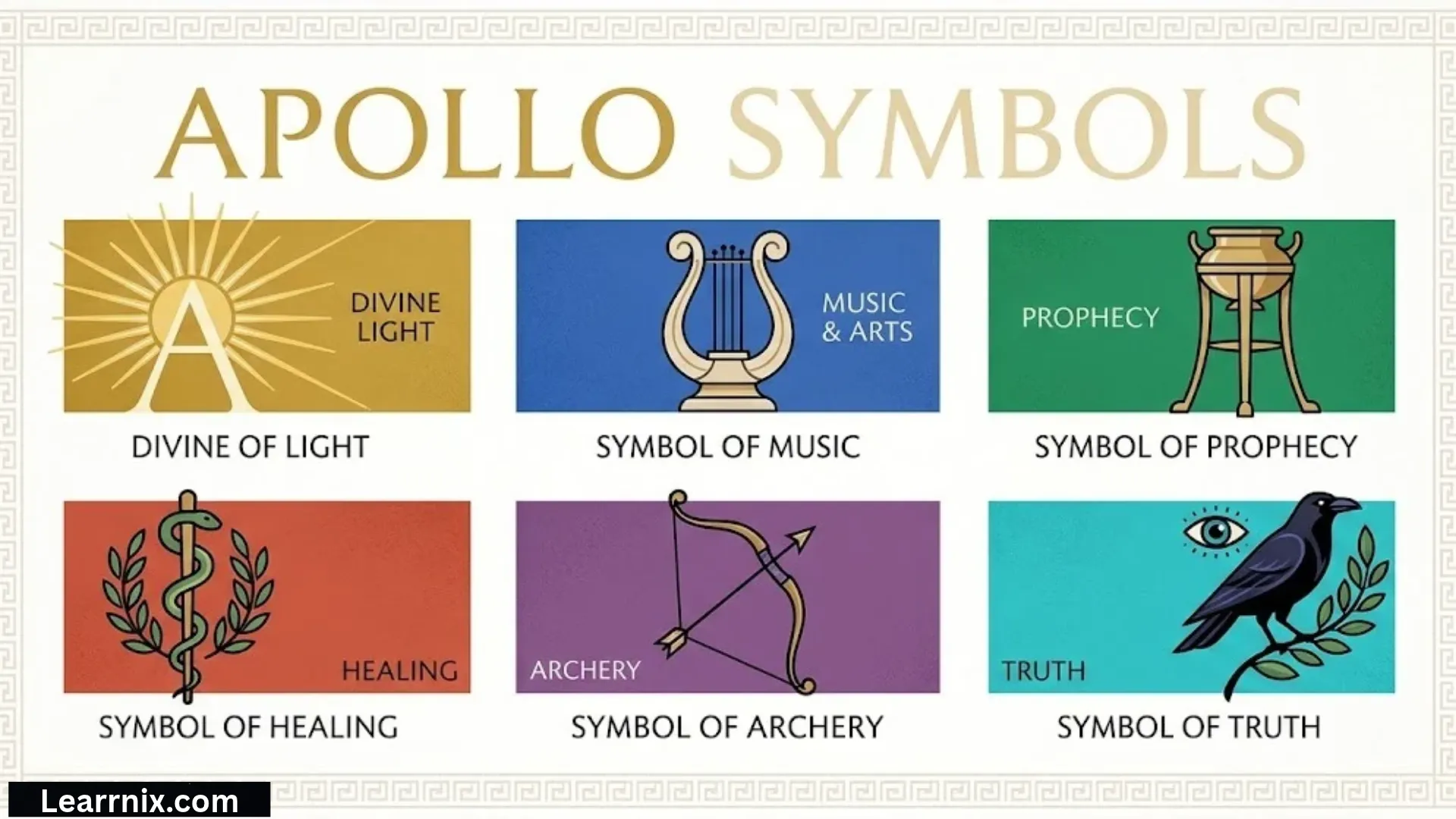
Apollo is one of the most important gods in ancient Greek mythology, known for music, prophecy, healing, archery, and his connection with the sun. His symbols reveal different sides of his personality, from the creative power of the lyre to the accuracy of his bow and arrow.
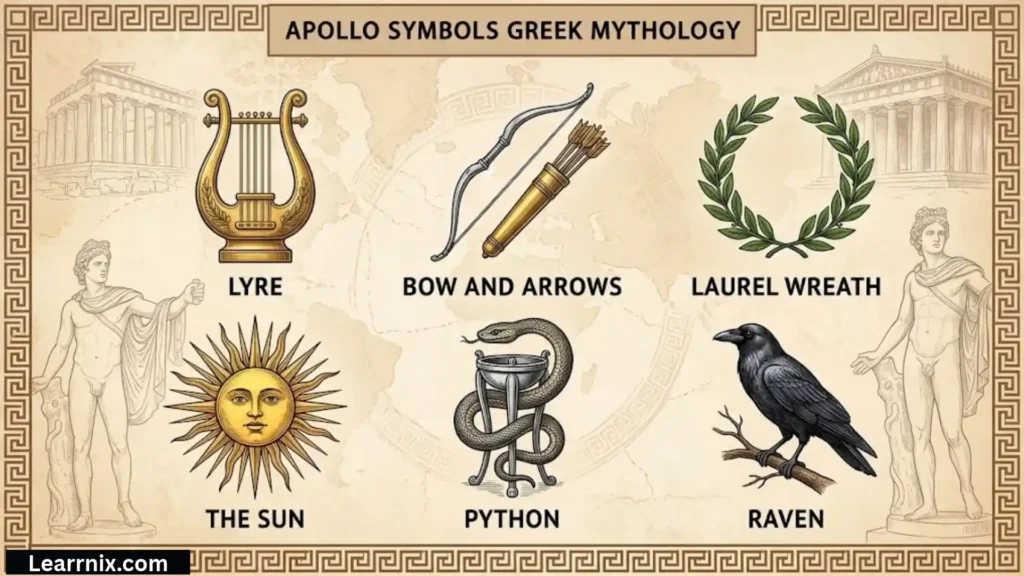
The most recognizable Apollo symbols include the lyre, laurel wreath, bow and arrow, sun, tripod, and sacred animals such as the raven, wolf, and swan. Each has a different meaning connected to his myths, divine responsibilities, and role in Greek religious life.
If you are looking for Apollo symbols to copy and paste, researching their historical meanings, or choosing an idea for a tattoo, this guide explains the major symbols, their significance, and how they are used today. It also explores Apollo’s relationship with Artemis and his connection to medicine and healing.
What Is Apollo Symbols
Apollo symbols are objects, animals, and visual signs associated with Apollo, the ancient Greek god of music, prophecy, healing, archery, and other divine powers. They help people recognize him in ancient statues, pottery, paintings, literature, and modern artwork.
The most famous Apollo symbols are:
- Lyre (♬): Represents music, poetry, harmony, and artistic skill.
- Bow and Arrow (🏹): Represents archery, precision, protection, and divine punishment.
- Laurel Wreath (🌿): Represents victory, honor, achievement, and Apollo’s connection with the nymph Daphne.
- Sun (☀): Represents light and Apollo’s later, well-known association with the sun.
- Tripod: Represents prophecy and the Oracle of Delphi.
- Raven (🐦): Associated with Apollo through myths involving prophecy and divine messages.
- Swan (🦢): Connected with beauty, music, and artistic inspiration.
- Wolf (🐺): Associated with Apollo in some ancient traditions and cult titles.
These representations do not all have dedicated Unicode characters. Emojis and text symbols are modern visual substitutes, while the lyre, bow, laurel, and tripod have stronger roots in ancient Greek art and mythology.
Apollo Symbols and Meanings
Apollo’s symbols reflect the different responsibilities and qualities attributed to him. Some represent his artistic nature, while others reveal his role as an archer, healer, or source of prophecy.
| Apollo Symbol | Meaning | Mythological Connection |
| Lyre | Music, poetry, harmony | Apollo’s role as a divine musician |
| Bow and Arrow | Accuracy, strength, punishment | His skill as an archer |
| Laurel Wreath | Victory, honor, achievement | The myth of Apollo and Daphne |
| Sun | Light, clarity, life | Apollo’s later association with solar power |
| Tripod | Prophecy and wisdom | The Oracle of Delphi |
| Raven | Prophecy and divine messages | Stories connecting Apollo with the bird |
| Swan | Beauty and music | Apollo’s artistic and poetic associations |
| Wolf | Protection and wild nature | Certain local cult traditions |
| Python | Prophecy and sacred territory | Apollo’s victory at Delphi |
| Omphalos | Sacred center | Delphi’s status as a spiritual center |
The lyre and bow are particularly useful for identifying Apollo because they communicate two contrasting sides of his character. He could represent peaceful creativity through music and poetry, yet his arrows could also bring destruction or punishment.
The laurel wreath has a more personal meaning. In Greek mythology, Daphne transformed into a laurel tree while fleeing Apollo. Apollo subsequently adopted laurel as a sacred plant, and it became a symbol of honor and victory in the wider Greek world.
The tripod points toward Apollo’s prophetic role at Delphi, where people consulted the famous oracle for divine guidance. These symbols work together to portray Apollo as a god of knowledge, discipline, beauty, and powerful action.
Greek God Apollo Symbols
The symbols of the Greek god Apollo developed through centuries of worship, storytelling, and artistic representation. Ancient Greeks did not rely on one single emblem to identify him. Instead, artists used recognizable objects and attributes to communicate which god appeared in a scene.
A statue showing a young man holding a lyre would suggest Apollo’s musical identity. A figure carrying a bow might emphasize his archery, while a laurel wreath could indicate his sacred connection with victory and the Daphne myth.
Apollo was also strongly associated with Delphi, one of the most important religious centers in ancient Greece. The tripod and other objects connected with divination became important visual references to his prophetic authority.
It is useful to distinguish ancient religious symbols from modern illustrations. A yellow sun emoji may communicate Apollo’s solar association today, but it is not an ancient Greek character or an official Unicode symbol for the god. Likewise, the familiar lyre and bow are mythological attributes rather than a single standardized logo.
Apollo Symbols Greek Mythology
Apollo’s role in Greek mythology goes far beyond his connection with music and sunlight. He was the son of Zeus and Leto and the twin brother of Artemis, the goddess associated with hunting, wilderness, and childbirth. His stories explain why particular animals, plants, and objects became connected with him.
One important myth describes Apollo’s arrival at Delphi. According to the tradition, he defeated Python, a serpent associated with the sanctuary, and established his prophetic authority there. This story explains the connection between Apollo, Delphi, and the Oracle of Delphi.
Another famous story concerns the nymph Daphne. Apollo pursued Daphne, who was transformed into a laurel tree. The laurel subsequently became sacred to him and was used in traditions involving honor and victory.
Apollo’s musical identity is linked to the lyre, an instrument associated with Greek poetry and performance. Myths also describe his musical competition with the satyr Marsyas, highlighting his extraordinary artistic abilities and the dangers of challenging a god.
Together, these stories explain why Apollo’s symbols represent several ideas at once: artistic excellence, prophecy, healing, victory, and the power of the divine.
God Apollo Symbols
The god Apollo is usually recognized through a combination of physical attributes and symbolic objects. In Greek sculpture and vase painting, he often appears as a youthful, athletic figure with long hair, sometimes holding a lyre or bow.
Here are the most recognizable visual features associated with him:
- Lyre: Identifies Apollo as a patron of music and poetry.
- Laurel Crown: Connects him with victory and the Daphne myth.
- Bow and Arrows: Emphasize his skill as an archer and his capacity to punish.
- Tripod: Identifies his connection with prophecy and Delphi.
- Long Hair: Often appears in artistic depictions of his youthful beauty.
- Nudity or a Simple Cloak: Common in idealized Greek depictions of gods and heroes, rather than a separate symbol unique to Apollo.
Apollo’s attributes are especially helpful when studying classical art. A lyre alone might indicate music, and a bow might belong to another archer, but a combination of these objects with a laurel wreath and a recognizable mythological setting makes Apollo easier to identify.
In modern graphic design, these features are often simplified into line drawings, silhouettes, or minimalist illustrations. Such designs can communicate Apollo’s identity without reproducing an entire classical statue.
Apollo Symbols and Attributes
Apollo’s attributes include the objects, animals, plants, and abilities that distinguish him from other Greek gods. Although the terms symbol and attribute are often used interchangeably, an attribute usually refers to a recognizable feature associated with a deity in art or mythology.
His main attributes include:
- Musical Instruments: The lyre represents artistic talent, harmony, and the cultural importance of music.
- Weapons: The bow and arrows signify precision, distance, protection, and divine punishment.
- Sacred Plants: Laurel is closely connected with Apollo and symbolizes honor and achievement.
- Prophetic Objects: The tripod reflects his authority at Delphi and his association with divination.
- Sacred Animals: Ravens, swans, wolves, and other animals appear in different stories or regional traditions.
- Healing Associations: Apollo’s divine powers include healing, while his arrows can also bring disease in mythology.
- Light and Radiance: Apollo became increasingly associated with the sun, especially in later Greek and Roman traditions.
These attributes reveal why Apollo is a complex figure. He is not simply a god of music or sunlight. His identity includes artistic achievement, sacred knowledge, physical skill, and the ability to bring both healing and harm.
Apollo Symbols and Animals
Several animals are associated with Apollo, although their significance varies between myths, regions, and historical periods. Unlike the lyre, not every animal connection is equally prominent in ancient art.
Raven
The raven is connected with Apollo through a myth in which the bird brings news about Coronis, a woman associated with the god. The story links the bird with messages, knowledge, and the consequences of disobedience.
Swan
The swan is associated with beauty, song, and music. Its graceful appearance suits Apollo’s artistic identity, although swans also appear in stories connected with other Greek gods.
Wolf
The wolf appears in certain traditions associated with Apollo, including his cult title Apollo Lykeios. Interpretations vary, so the wolf should not be treated as his single universal animal emblem.
Python
Python is the serpent Apollo defeated at Delphi in a famous myth. The story explains Apollo’s connection with the sanctuary and his prophetic authority there.
Bull
Bulls appear in Greek religious sacrifice and some traditions connected with Apollo. This association depends more on the specific myth or cult than his familiar lyre and laurel attributes.
When choosing an animal for an Apollo-inspired design, consider the meaning you want to express. A raven can suggest mystery and prophecy, a swan can communicate beauty and artistic expression, and a wolf can represent strength or a connection with ancient religious traditions.
Apollo Powers
Apollo’s powers cover several areas of divine life. His abilities vary between myths, and ancient stories do not always present them as a single consistent system.
- Prophecy: Apollo could reveal divine knowledge through oracles, especially at Delphi.
- Archery: He was a highly skilled archer whose arrows could cause death or punishment.
- Healing: Apollo had a major role in healing and medicine, although he could also send disease.
- Music: He was a master musician associated with the lyre, song, and poetry.
- Plagues and Disease: Some myths describe Apollo sending disease with his arrows.
- Purification: Apollo was connected with cleansing and religious purification after certain forms of wrongdoing.
- Protection: His worship could include appeals for protection and the well-being of communities.
- Light: His association with brightness and radiance became increasingly prominent in later traditions.
Apollo’s powers are sometimes misunderstood because modern retellings simplify him into a sun god. In classical Greek religion, his prophetic, musical, and healing roles were equally important. His connection with the sun also developed over time, particularly through later identification with Helios, the Greek personification of the sun.
These powers explain the wide range of modern interpretations of Apollo. His imagery can represent creativity, wisdom, discipline, health, or the pursuit of excellence, depending on which aspect of the god a person emphasizes.
Apollo Bow and Arrow Symbol
The bow and arrow is one of Apollo’s most recognizable attributes. It represents his exceptional accuracy, physical skill, and ability to act from a distance. In Greek mythology, Apollo’s arrows can bring death, disease, or divine punishment, so this symbol has a more serious meaning than an ordinary hunting weapon.
The bow is generally associated with readiness, while the arrow suggests direction and a focused strike. Together, they can represent:
- Precision and concentration.
- Strength and self-discipline.
- Protection and the ability to defend.
- Justice or punishment in a mythological context.
- The pursuit of a clear goal.
There is no single official Unicode character specifically representing Apollo’s bow and arrow. The following characters can be used as approximate visual alternatives:
| Symbol | Unicode Name | Possible Use |
| ➶ | Three-Headed Rightwards Arrow | Decorative arrow |
| ➳ | White-Feathered Rightwards Arrow | Artistic or profile decoration |
| ↗ | North East Arrow | Direction and upward movement |
| 🏹 | Bow and Arrow | Archery and myth-inspired designs |
| ➵ | Black-Feathered Rightwards Arrow | Decorative arrow |
The arrow characters are general symbols, not dedicated Apollo symbols. The 🏹 emoji is a more direct visual representation of archery, although its appearance varies by platform.
For a historically inspired design, a classical bow paired with a laurel wreath or lyre will usually communicate Apollo more clearly than an arrow character by itself.
Lyre Apollo Symbol
The lyre is one of the strongest symbols associated with Apollo. It is an ancient stringed instrument used in Greek musical culture and frequently appears in representations of the god. Apollo’s lyre symbolizes music, poetry, harmony, education, and artistic excellence.
In Greek mythology, Hermes is associated with the invention of the lyre and gives the instrument to Apollo in a famous story. Apollo’s mastery of music subsequently becomes a central part of his identity.
The lyre also represents balance. Its strings must be tuned and played with care, making it a useful modern metaphor for discipline, creativity, and the relationship between skill and beauty.
For digital use, consider these text characters:
- ♬ — Beamed sixteenth notes; useful for a musical theme.
- ♫ — Beamed eighth notes; suitable for music-related profiles.
- ♪ — Eighth note; a simple musical decoration.
- 𝄞 — Musical symbol G clef; associated with musical notation.
These are musical symbols, not exact images of a Greek lyre. Unicode does not provide a standard character specifically named the Apollo lyre. To show the actual instrument, use a lyre illustration rather than claiming that a music note is the ancient emblem itself.
Apollo Symbol Medicine
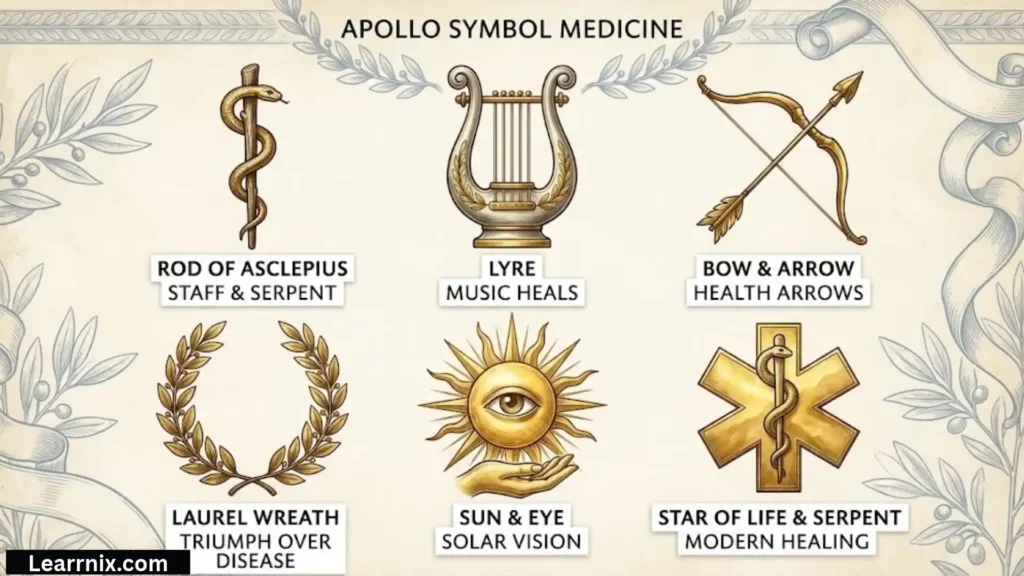
Apollo has a major place in the history of Greek healing traditions. He was associated with health, purification, and the ability to send or remove disease. His son Asclepius became especially important as a god of medicine and healing.
Apollo’s connection with medicine is sometimes confused with modern medical emblems. The Rod of Asclepius is a staff with one serpent wrapped around it and is the traditional symbol most directly associated with Asclepius and medicine. The Caduceus, which has two serpents and wings, belongs to Hermes and is often mistakenly used as a medical emblem.
Apollo is the father of Asclepius in Greek mythology, so the two figures are closely related in healing traditions. However, Apollo’s lyre, bow, and laurel wreath are not medical symbols in the same direct sense as the Rod of Asclepius.
For a design representing Apollo’s healing side, you could combine a laurel branch with a classical Greek staff or a depiction of Apollo himself. If the purpose is to represent medicine accurately, distinguish Apollo’s mythological connection with healing from the established medical emblem associated with his son.
Apollo Symbols Tattoos
Apollo-inspired tattoos are popular among people who appreciate Greek mythology, music, creativity, personal growth, and classical art. The best design depends on which part of Apollo’s story matters most to you.
Lyre Tattoo
A lyre tattoo can represent creativity, musical talent, harmony, and a love of the arts. A fine-line design works well on the forearm, wrist, or upper arm.
Laurel Wreath Tattoo
Laurel represents honor, achievement, victory, and perseverance. It can stand alone or frame a small Apollo portrait.
Bow and Arrow Tattoo
This design can express determination, focus, precision, and readiness to face challenges.
Sun-Inspired Tattoo
Sun rays can represent light, renewal, vitality, and personal growth. This design emphasizes Apollo’s solar association.
Apollo Portrait Tattoo
A classical bust can represent wisdom, idealized beauty, artistic achievement, and an interest in ancient Greek culture.
Before choosing a design, decide whether you want historical accuracy, a personal interpretation, or a decorative symbol inspired by mythology. A lyre and laurel wreath have clear connections to Apollo, while a sun design emphasizes his later solar identity.
Remember that tattoos do not have one universal meaning. The same symbol can represent music to one person, achievement to another, and a personal connection with Greek mythology to someone else.
Apollo Symbols Copy and Paste
If you want Apollo-inspired symbols for a social media bio, username, message, caption, or decorative heading, the following characters are easy to copy.
| Symbol | Name | Common Use |
| ☀ | Sun | Light and solar themes |
| ☼ | White Sun With Rays | Sunlight and radiance |
| 🌞 | Sun With Face | Warmth and positivity |
| 🌿 | Herb | Laurel-like decoration |
| 🏹 | Bow and Arrow | Archery and mythology |
| ♬ | Musical Notes | Music and creativity |
| ♫ | Beamed Musical Note | Music-related profiles |
| ♪ | Musical Note | Simple decoration |
| 🦢 | Swan | Beauty and grace |
| 🐺 | Wolf | Strength and mythology |
| 🐦 | Bird | Animal-inspired designs |
| ✧ | Four-Pointed Star | Decorative designs |
| ✦ | Black Four-Pointed Star | Decorative emphasis |
| ☽ | First Quarter Moon | Mythology-inspired designs |
These are general Unicode characters and emojis inspired by Apollo’s attributes, not a set of official Apollo-specific Unicode symbols.
Ready-To-Use Apollo Symbol Combinations
You can combine characters to create a decorative design:
- ☀ ♬ ☀ — Sun and music theme
- 🌿 ☀ 🌿 — Nature and light theme
- 🏹 ✦ ☀ — Archery and solar theme
- ♬ 🌿 ♬ — Music and laurel-inspired theme
- ☀ ✧ ☀ — Minimalist sun decoration
- 🏹 ♬ 🌿 — A combination of Apollo’s major attributes
For example, a profile description could read: Apollo ☀ ♬ | Music, Mythology & Light
These combinations are modern decorative arrangements, not ancient Greek inscriptions. Some characters or emojis may look different on Android, iOS, Windows, and individual social platforms. If a symbol appears as an empty box, try another font or a simpler character.
Sun Apollo Symbols
The sun is among the most familiar modern representations of Apollo. However, the historical relationship between Apollo and the sun requires a little context.
In early Greek religion, Helios was the god who personified the sun. Apollo was primarily associated with music, prophecy, archery, and healing. Over time, Apollo became increasingly identified with solar light, particularly in later Greek and Roman traditions. This is why modern art often depicts him with a radiant crown, sun rays, or a bright golden halo.
Useful sun characters include:
| Symbol | Unicode Name | Common Interpretation |
| ☀ | Black Sun With Rays | Sun, daylight, warmth |
| ☼ | White Sun With Rays | Sunlight and radiance |
| 🌞 | Sun With Face | Warmth and positivity |
| 🌅 | Sunrise | New beginnings |
| 🌄 | Sunrise Over Mountains | Dawn and renewal |
| ✨ | Sparkles | Light and brilliance |
The sun characters are useful for captions, profile names, digital art, and decorative text. They do not specifically identify Apollo unless you pair them with other recognizable attributes, such as a lyre or laurel wreath.
A sun design can represent clarity, vitality, hope, and renewed energy. If historical accuracy matters, explain that the solar connection became more prominent as Apollo and Helios were increasingly associated with one another.
Artemis and Apollo Symbols
Artemis and Apollo are twin siblings in Greek mythology, both children of Zeus and Leto. Their symbols share some similarities because both are associated with archery, but their identities and divine responsibilities are distinct.
| Feature | Apollo | Artemis |
| Main Attributes | Lyre, bow, laurel, tripod | Bow, arrows, deer, moon associations |
| Major Roles | Music, prophecy, healing, archery | Hunting, wilderness, protection of young people |
| Common Animal Associations | Raven, swan, wolf | Deer, hunting dogs, bear in certain traditions |
| Plant Association | Laurel | Cypress and other plants in particular traditions |
| Solar or Lunar Connection | Later solar association | Strong lunar association in later traditions |
A shared bow-and-arrow motif can symbolize their connection as skilled divine archers. A paired design featuring Apollo’s lyre and Artemis’s bow emphasizes the difference between his artistic and prophetic identity and her association with hunting and wilderness.
Modern artwork often portrays Apollo as the sun and Artemis as the moon. This is a recognizable contemporary interpretation, but it simplifies the ancient religious traditions. Helios and Selene were the original Greek personifications of the sun and moon, and the relationships among these deities changed across periods and local traditions.
For a matching tattoo or decorative design, use a lyre and laurel wreath for Apollo and a bow with a deer or crescent moon for Artemis. These combinations provide clearer distinctions than using the sun and moon alone.
Apollo Symbols and Signs
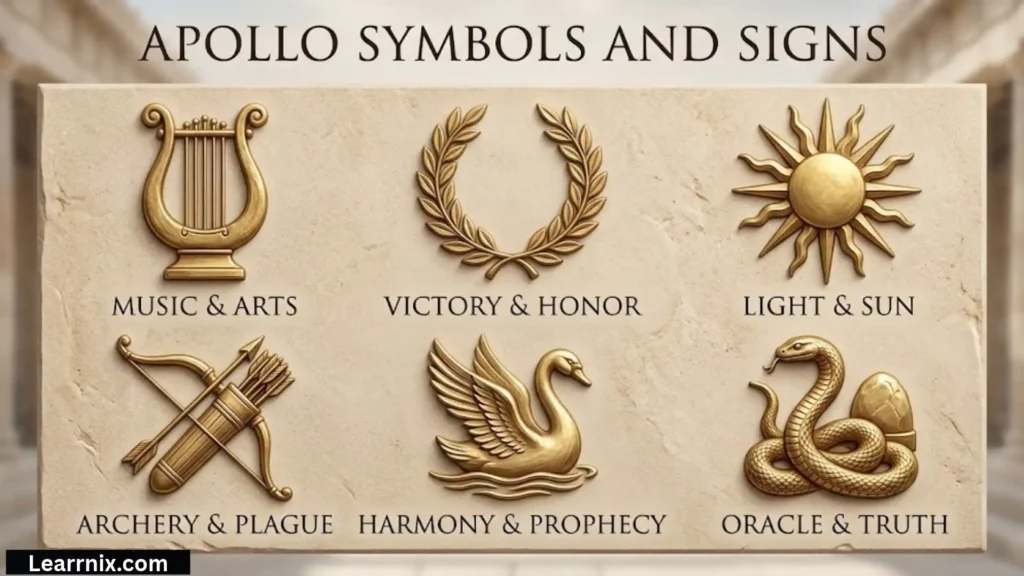
Apollo symbols and signs appear in mythology books, classical artwork, museum collections, educational materials, and modern designs. Some are actual mythological attributes, while others are modern visual shorthand for his qualities.
Here is how to interpret the most common signs:
- Lyre: A sign of music, poetry, harmony, and creative expression.
- Laurel Wreath: A sign of victory, achievement, honor, and Apollo’s sacred association with the laurel tree.
- Bow and Arrow: A sign of precision, archery, and divine power.
- Tripod: A sign of prophecy and the Oracle of Delphi.
- Sun Disc: A modern shorthand for light and Apollo’s solar association.
- Raven: A sign connected with a myth about a divine message and the consequences of betrayal.
- Greek Temple: A general sign of ancient worship; a temple at Delphi may specifically evoke Apollo’s sanctuary.
A useful distinction is that a sign can communicate an idea without being an official symbol. A sun emoji can suggest Apollo’s connection with light, but it is not a historically exclusive emblem. A lyre or laurel wreath usually provides a stronger mythological reference.
When studying a symbol in ancient art, consider the surrounding objects, the location, and the story being depicted. A single object may have different meanings depending on the context.
Apollo Symbols and Meanings
Apollo’s symbols can also be understood through the broader ideas they communicate. This is particularly useful if you are comparing designs for personal expression, educational work, or mythology-inspired art.
| Symbol | Traditional Connection | Modern Interpretation |
| Lyre | Music and poetry | Creativity and self-expression |
| Laurel Wreath | Daphne and victory | Achievement and perseverance |
| Bow and Arrow | Divine archery | Focus and determination |
| Tripod | Prophecy at Delphi | Wisdom and insight |
| Raven | Mythological messages | Mystery and knowledge |
| Swan | Music and beauty | Grace and artistic talent |
| Sun | Later solar association | Vitality and clarity |
| Python | Apollo’s victory at Delphi | Triumph over challenges |
The difference between a traditional connection and a modern interpretation matters. Ancient myths explain how a symbol became associated with Apollo, while modern users may attach additional personal meanings to it.
For example, a person might choose a laurel wreath to celebrate an academic achievement. Someone else might select a lyre because music is an important part of their life. Both interpretations are understandable, even though the personal meaning goes beyond the original mythology.
To create an accurate design, combine a historically grounded attribute with a clear explanation of what it represents. This gives the symbol meaning without suggesting that every modern interpretation was part of ancient Greek belief.
Greek Mythology Apollo Symbols
In Greek mythology, Apollo’s symbols connect him to the stories of gods, heroes, sacred places, and divine relationships. They are especially useful for understanding how ancient Greeks represented abstract qualities such as prophecy, artistic skill, and victory.
Three myths explain several of his best-known attributes.
First, the story of Apollo and Daphne explains his association with laurel. Daphne becomes a laurel tree while fleeing Apollo, and the god subsequently adopts the plant as sacred.
Second, the story of Apollo at Delphi explains the importance of the tripod and the sanctuary’s oracle. Apollo defeats Python and establishes his connection with the site, which becomes one of the most famous centers of prophecy in the Greek world.
Third, the stories involving Apollo and musical contests highlight his relationship with the lyre. His musical skill distinguishes him as a patron of artistic excellence, although some of these myths also explore the consequences of pride and competition.
These stories show that Apollo’s symbols were not selected randomly. They developed through mythology, worship, and artistic traditions. Understanding the stories behind them makes it easier to distinguish authentic mythological attributes from modern decorative interpretations.
FAQs About Apollo Symbols
What is the main symbol of Apollo?
The lyre is one of Apollo’s most recognizable symbols, representing music, poetry, and artistic excellence. His bow and arrow, laurel wreath, and tripod are also important attributes.
Why is the laurel wreath associated with Apollo?
The laurel wreath is associated with the myth of Daphne, who transformed into a laurel tree while fleeing Apollo. The god adopted the laurel as a sacred plant, and it later became a wider symbol of victory and honor.
Is Apollo the Greek god of the sun?
Apollo became strongly associated with the sun in later Greek and Roman traditions. However, Helios was originally the Greek personification of the sun, while Apollo was also known for music, prophecy, healing, and archery.
Which animal represents Apollo?
The raven, swan, and wolf are among the animals associated with Apollo in different myths and traditions. The raven is linked with a story involving a divine message, while the swan reflects associations with beauty and music.
What Apollo symbol is best for a tattoo?
The lyre is a good choice for creativity, the laurel wreath for achievement, and the bow and arrow for precision and determination. A sun-inspired design can represent light and renewal, while a classical Apollo portrait can express an interest in Greek mythology.
Conclusion
Apollo’s symbols reveal the many sides of one of ancient Greece’s most influential gods. The lyre represents music and creativity, the bow and arrow reflect precision and divine power, the laurel wreath signifies victory, and the tripod connects Apollo with prophecy at Delphi. His animal associations and solar imagery add further layers of meaning.
For modern uses, such as tattoos, social media profiles, artwork, and decorative text, choose a symbol that reflects the quality you want to express. Copy-and-paste characters and emojis can create attractive designs, but they are modern representations rather than official ancient Greek emblems.
The most useful way to understand Apollo symbols is to connect each attribute with its mythology and historical context. Knowing the story behind a lyre, laurel wreath, or bow makes the symbol more meaningful and helps you use it accurately in personal designs or educational projects.

I am Michael Carter, an educational content creator who believes that knowledge has the power to transform lives.
I create resources focused on modern education, digital learning, and building essential skills for the future.
I love helping readers discover simple and effective ways to improve their learning journey.
Books by Michael Carter:
- Modern Education for Tomorrow’s World
- Learning Skills for Future Success
 Charlotte Anderson
 Daniel Harper