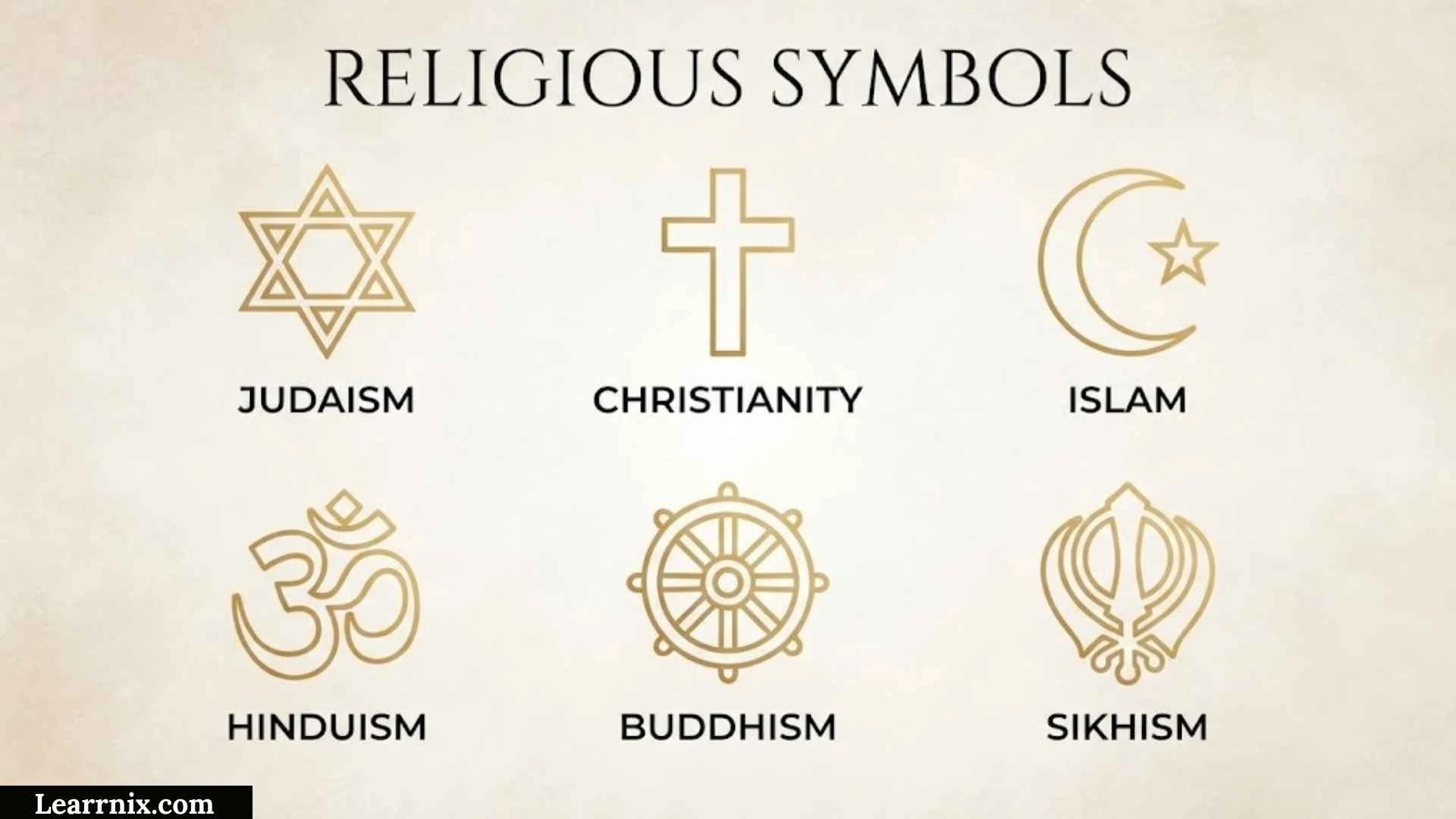
Religious symbols have been used for centuries to express faith, identity, spiritual ideas, sacred stories, and important traditions. A simple shape such as a cross, star, crescent, wheel, or sacred letter can carry a much deeper meaning when it is connected with a particular religion or culture.
This guide explores religious symbols from Christianity, Catholicism, Lutheranism, Judaism, Islam, Hinduism, Japan, Egypt, and India. It also covers symbols commonly found on gravestones, explains their meanings, and highlights Unicode characters that can be copied and pasted.
For people interested in text symbols, Unicode provides several recognizable religious characters, including ✝ Latin Cross, ☦ Orthodox Cross, ✡ Star of David, ☪ Star And Crescent, 🕉 Om, ☸ Wheel Of Dharma, and 🕎 Menorah. These characters are useful for messages, websites, social media posts, profiles, educational content, and decorative text.
Religious Symbols And Meanings
Religious symbols can represent beliefs, sacred teachings, religious communities, important people, places, rituals, or spiritual concepts. However, a symbol does not always have one universal meaning. Its interpretation can change according to the religion, denomination, historical period, and cultural setting.
Here are some widely recognized religious symbols:
| Symbol | Name | Common Association |
| ✝ | Latin Cross | Christianity |
| ☦ | Orthodox Cross | Eastern Christianity |
| ✡ | Star Of David | Judaism |
| ☪ | Star And Crescent | Islam |
| 🕉 | Om | Hinduism |
| ☸ | Wheel Of Dharma | Buddhism |
| ☯ | Yin Yang | Taoism |
| 🪯 | Khanda | Sikhism |
| 🕎 | Menorah | Judaism |
| ☥ | Ankh | Ancient Egypt |
| 🛐 | Place Of Worship | Religion And Worship |
Unicode officially includes many of these characters in its religious-symbol collection. The current Unicode emoji charts list Om, Star Of David, Wheel Of Dharma, Yin Yang, Latin Cross, Orthodox Cross, Star And Crescent, Menorah, and Khanda among religiously associated characters.
Some symbols are particularly useful for copy and paste:
- ✝ — Latin Cross
- ☦ — Orthodox Cross
- ✡ — Star Of David
- ☪ — Star And Crescent
- 🕉 — Om
- ☸ — Wheel Of Dharma
- ☯ — Yin Yang
- 🪯 — Khanda
- 🕎 — Menorah
A Unicode character should not be confused with a complete religious image. Unicode tells you what a character is called and provides a standardized way to represent it digitally, while its cultural or religious meaning comes from history and context.
Religious Symbols Pictures
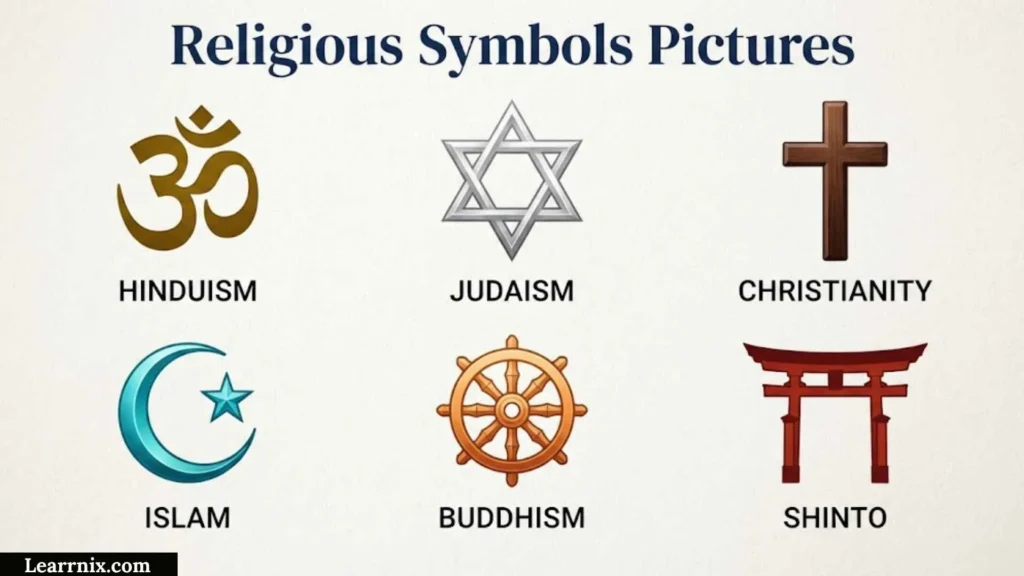
Pictures are often the easiest way to identify a religious symbol because many symbols are primarily visual rather than textual. When identifying one, look at its shape, number of points, branches, lines, and surrounding details.
For example, the ✝ Latin Cross has a long vertical line crossed by a shorter horizontal line. The ✡ Star Of David consists of two overlapping triangles. The ☪ Star And Crescent combines a crescent with a star, while ☸ Wheel Of Dharma has a circular wheel with spokes.
Some recognizable religious symbols include:
- ✝ Latin Cross — A major Christian symbol.
- ☦ Orthodox Cross — A cross associated with Eastern Christian traditions.
- ✡ Star Of David — A widely recognized Jewish symbol.
- ☪ Star And Crescent — Commonly associated with Islam.
- 🕉 Om — A sacred symbol associated with Hindu traditions.
- ☸ Wheel Of Dharma — A major Buddhist symbol.
- 🕎 Menorah — A Jewish religious symbol associated with the menorah used during Hanukkah in its Unicode emoji form.
- ☥ Ankh — An ancient Egyptian symbol associated with life.
Unicode specifically identifies ✝ as LATIN CROSS, ☦ as ORTHODOX CROSS, ✡ as STAR OF DAVID, ☪ as STAR AND CRESCENT, and ☸ as WHEEL OF DHARMA.
When searching for religious symbols pictures, remember that the same basic symbol may appear in different artistic styles. A cross carved into stone, printed in a church book, drawn as a tattoo, or rendered as a Unicode character can look very different while retaining a related identity.
Christian Religious Symbols
Christianity has a large collection of symbols connected with Jesus Christ, the Bible, salvation, worship, baptism, resurrection, the Holy Spirit, and Christian community.
The cross is the best-known Christian symbol. It represents the crucifixion of Jesus and is used across many Christian denominations. Unicode includes both the Latin cross ✝ and Orthodox cross ☦.
Other common Christian symbols include:
- ✝ Latin Cross — Associated with the crucifixion and Christian faith.
- ☦ Orthodox Cross — Used in connection with Eastern Christian traditions.
- ☧ Chi Rho — An early Christian Christogram made from Greek letters associated with Christ.
- 🐟 Fish — The fish is an ancient Christian symbol, often connected with the Greek word ichthys.
- 🕊 Dove — Commonly used to represent the Holy Spirit.
- Lamb — Often connected with Christ as the Lamb of God.
- Anchor — Historically used in Christian symbolism and associated with hope.
- Crown — Can represent victory, glory, or eternal life in Christian imagery.
The exact interpretation of a symbol can vary between denominations. A cross used in Catholic, Lutheran, Orthodox, Anglican, and Protestant settings may have different visual styles or devotional associations even though the central Christian connection remains recognizable.
Religious Symbols Catholic
Catholic religious symbols appear in churches, artwork, liturgical objects, prayer materials, jewelry, architecture, and devotional practices. Catholic tradition gives an important role to visible signs and sacred images as ways of expressing and remembering spiritual realities.
The cross and crucifix are especially important. A crucifix differs from a plain cross because it includes a representation of the body of Christ.
Common Catholic symbols include:
- ✝ Cross — Represents Christ’s crucifixion.
- Crucifix — Shows Christ on the cross and is widely used in Catholic devotion.
- ❤️ Sacred Heart — Represents the love of Christ.
- 🕊 Dove — Associated with the Holy Spirit.
- ☧ Chi Rho — A Christogram connected with Christ.
- Keys — Associated with Saint Peter in Christian and Catholic tradition.
- Lamb — Connected with Christ as the Lamb of God.
- Crown — Can represent Christ’s kingship or heavenly glory.
Catholic teaching distinguishes the veneration given to sacred images from worship directed to God. The Catechism explains the role of sacred images in Christian worship and devotion, while Catholic teaching also identifies the dove as a traditional symbol of the Holy Spirit.
This distinction is useful when researching Catholic symbols because an image can function as a reminder of a religious person, event, or teaching without the physical object itself being considered divine.
Lutheran Religious Symbols
Lutheran Christianity shares many symbols with other Christian traditions, including the cross, crucifix, dove, fish, Bible, and lamb. One symbol particularly associated with Lutheran history is the Luther Rose, also known as the Luther Seal.
The Luther Rose contains several elements that are traditionally interpreted together. A black cross appears within a red heart, surrounded by a white rose and set against a blue background with a gold ring. It is associated with Martin Luther and became a recognizable visual representation of Lutheran identity.
The crucifix is also found in Lutheran worship. Although different Lutheran communities can have different approaches to church decoration and worship style, the cross remains central to Lutheran theology and visual tradition.
Useful Christian characters for digital text include:
- ✝ — Latin Cross
- ☦ — Orthodox Cross
- ✞ — Shadowed White Latin Cross
- ✠ — Maltese Cross
Not every Christian cross should be described as specifically Lutheran. When accuracy matters, the surrounding design and denominational context should be considered.
Jewish Religious Symbols
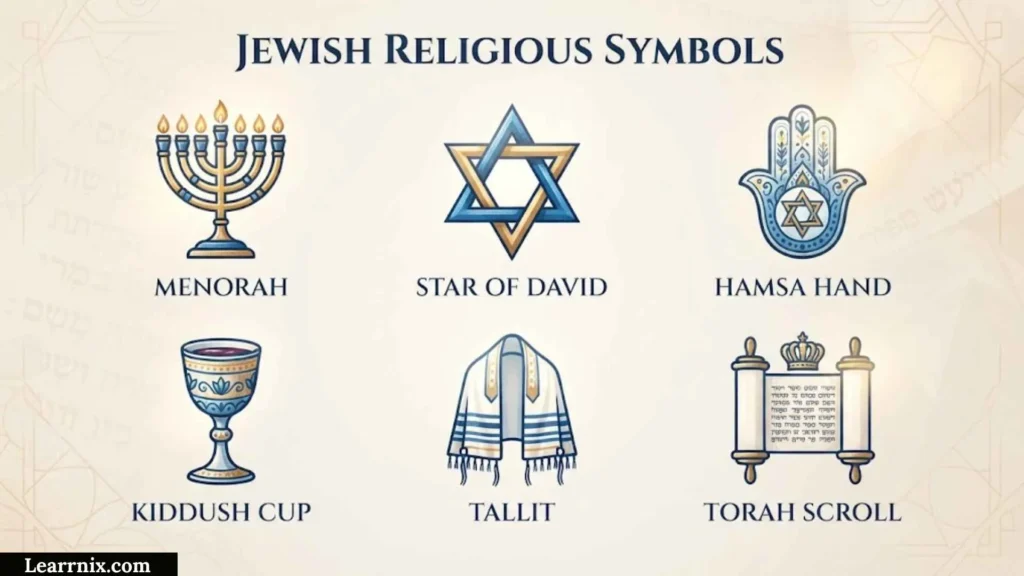
Judaism has a broad range of religious symbols and ritual objects. Two of the most recognizable are the Star Of David and the menorah.
The Star Of David, represented digitally as ✡, is a six-pointed hexagram made from two overlapping triangles. It is strongly associated with Jewish identity and Judaism today. Unicode officially identifies U+2721 as STAR OF DAVID.
Important Jewish symbols and objects include:
- ✡ Star Of David — A widely recognized Jewish symbol.
- 🕎 Menorah — A Jewish candelabrum represented in Unicode by the menorah emoji.
- Mezuzah — A case containing parchment with biblical passages, traditionally attached to a Jewish doorway.
- Torah Scroll — Represents the central sacred scripture of Judaism.
- Priestly Hands — A hand gesture associated with the priestly blessing and Kohanim.
- Dreidel — A four-sided spinning top associated with Hanukkah.
The Star Of David and menorah should not be treated as historically identical symbols. The menorah has ancient Jewish roots, while the widespread modern use of the Star Of David as a Jewish emblem developed much later.
The Unicode 🕎 character is specifically called MENORAH and is associated with Jewish, Judaism, Hanukkah, and religious keywords in Unicode’s current annotations.
Islamic Religious Symbols
Islamic symbolism requires some context because Islam does not have one universally required visual emblem comparable to the Christian cross. Nevertheless, several symbols and images have become strongly associated with Islam in modern culture.
The most recognizable is ☪ Star And Crescent. Unicode officially identifies U+262A as STAR AND CRESCENT and provides Islam and Muslim-related annotations for it.
Other commonly encountered Islamic-associated imagery includes:
- ☪ Star And Crescent — A widely recognized cultural symbol associated with Islam.
- 🕋 Kaaba — Represents the Kaaba in Mecca.
- 🕌 Mosque — Represents a mosque or place of Islamic worship.
- Crescent Moon — Frequently appears in Islamic cultural and architectural contexts.
- Arabic Calligraphy — Quranic verses and religious phrases are often presented through calligraphy.
- Prayer Beads — Commonly associated with devotional practice in many Muslim communities.
It is useful to distinguish religious doctrine from cultural representation. The star and crescent, for example, is strongly recognized as an Islamic symbol today, but its modern association with Islam developed through historical and cultural use rather than functioning as a universal requirement of Islamic belief.
Religious Symbols Hinduism
Hinduism contains an extensive range of sacred signs, objects, letters, images, and ritual markings. Their meanings can vary among different Hindu traditions.
The most recognizable is 🕉 Om. Unicode identifies 🕉 as OM, with Hindu and religion-related keywords.
Other important Hindu symbols include:
- 🕉 Om — Associated with sacred sound and Hindu spiritual traditions.
- ॐ Devanagari Om — A distinct Unicode character representing the Om sign in Devanagari.
- Swastika — An ancient auspicious symbol used in Hinduism and other South Asian traditions.
- 🔱 Trishula — A three-pronged weapon strongly associated with Shiva.
- Lotus — Frequently associated with purity, spiritual growth, and divine imagery.
- Tilaka — A forehead mark used in different Hindu traditions.
- Nandi — The bull associated with Shiva.
- Shankha — A conch shell used in Hindu religious practice and imagery.
An important Unicode detail is that 🕉 and ॐ are different characters. Unicode identifies 🕉 as OM SYMBOL and ॐ as DEVANAGARI OM.
The traditional South Asian swastika also requires historical context. Its use in Hindu traditions predates and is distinct from the Nazi appropriation of a similar-looking sign in 20th-century Europe.
Indian Religious Symbols
India is home to several major religious traditions, so Indian religious symbols include more than Hindu symbols. Hinduism, Buddhism, Jainism, Sikhism, and other traditions have developed distinctive visual languages.
| Symbol | Religious Association | Common Association |
| 🕉 | Hinduism | Om and sacred sound |
| ☸ | Buddhism | Wheel Of Dharma |
| 🪯 | Sikhism | Khanda |
| Swastika | Hinduism, Jainism, Buddhism | Auspiciousness in South Asian traditions |
| Lotus | Hinduism, Buddhism, Jainism | Spiritual and religious symbolism |
| Jain Hand | Jainism | Ethical and spiritual teachings |
| Khanda | Sikhism | Sikh religious identity |
Unicode currently includes the Khanda 🪯, Wheel Of Dharma ☸, and Om 🕉 among its religiously associated characters.
The Wheel Of Dharma ☸ is particularly associated with Buddhism, while the Khanda 🪯 is associated with Sikhism. Therefore, describing every Indian religious symbol as Hindu would erase important differences between India’s religious traditions.
Japanese Religious Symbols
Japanese religious symbolism is closely connected with Shinto and Buddhism. These traditions have influenced Japanese art, architecture, festivals, rituals, and everyday culture for centuries.
The most recognizable Shinto symbol is the torii gate, represented digitally by ⛩️. A torii commonly marks the entrance or approach to a Shinto shrine.
Other Japanese religious symbols and visual elements include:
- ⛩️ Torii — Associated with Shinto shrine entrances.
- Shimenawa — A sacred rope used to mark something regarded as sacred.
- Shide — Zigzag-shaped paper strips commonly attached to sacred ropes.
- ☸ Wheel Of Dharma — Associated with Buddhism.
- Lotus — Common in Buddhist imagery.
- Buddhist Prayer Beads — Used in various Buddhist practices.
- Mandalas — Used in certain Japanese Buddhist traditions.
The torii should not be described as a universal symbol of every Japanese religion. It is specifically associated with Shinto shrine spaces, while Buddhist symbolism has its own visual traditions.
Japanese religious imagery is also often highly contextual. A symbol appearing at a shrine, temple, cemetery, household altar, or festival may have a different purpose even when the general religious tradition is recognizable.
Egyptian Religious Symbols
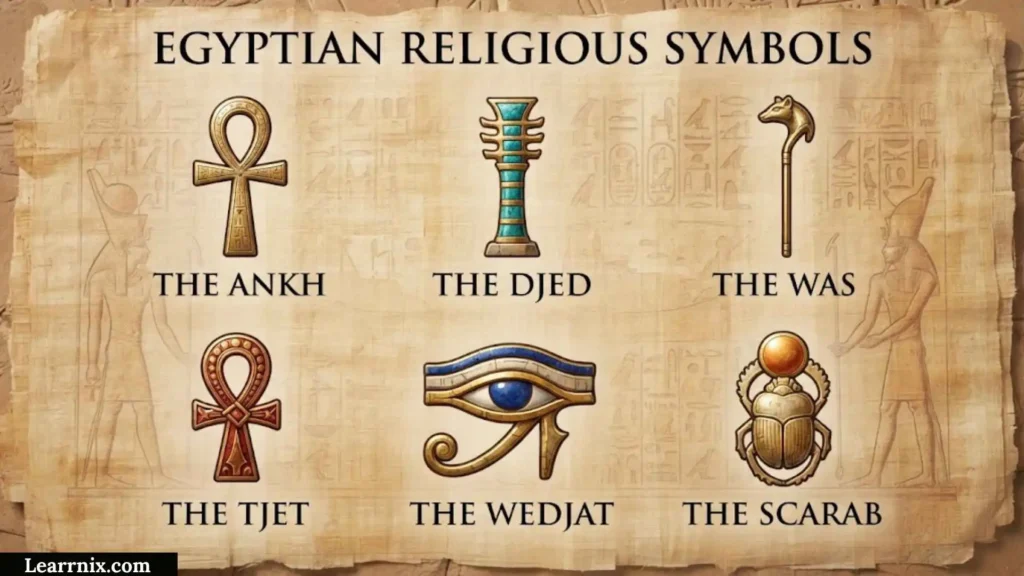
Ancient Egyptian religion used a large collection of sacred signs, amulets, divine symbols, and hieroglyphic imagery. Several remain popular today in jewelry, tattoos, artwork, historical education, and decorative designs.
The most recognizable include:
- ☥ Ankh — A famous ancient Egyptian sign associated with life.
- Eye Of Horus — Associated with Horus and commonly connected with protection, healing, and restoration.
- Scarab — Connected with ideas of becoming, renewal, and rebirth.
- Djed — A pillar-like symbol associated with stability and endurance.
- Was Scepter — A staff-like emblem associated with power and authority.
- Shen Ring — A looped symbol associated with protection and eternity.
The ankh is especially recognizable because of its looped cross-like shape. Museum collections describe it as a sign associated with life. The scarab also had important religious associations with becoming and rebirth in ancient Egyptian thought.
One practical point for a symbols website is that not every ancient Egyptian hieroglyph has a convenient standard Unicode character. Egyptian hieroglyphs have their own Unicode blocks, and displaying them correctly can depend on font support. It is therefore better to use verified characters instead of assigning a random Unicode code point to an image.
Religious Symbols On Gravestones
Religious symbols on gravestones can provide clues about a person’s faith, community, family tradition, or beliefs. However, a symbol should never be interpreted in isolation.
Common gravestone symbols include:
- ✝ Cross — Frequently found on Christian memorials.
- ✡ Star Of David — Commonly associated with Jewish graves.
- Menorah — May indicate Jewish identity or tradition.
- Dove — Can symbolize peace, the Holy Spirit, or spiritual themes depending on context.
- Lamb — Can represent Christ in Christian memorial art.
- Anchor — Historically associated with Christian hope.
- Open Bible — Can represent scripture and Christian faith.
- Praying Or Blessing Hands — May identify Jewish priestly heritage when shown in the traditional Kohen gesture.
- Palm Branch — Can have Christian associations with victory and eternal life.
- Heart — May represent love, devotion, or remembrance.
Jewish gravestones are a useful example of how symbols can communicate information about the deceased. A menorah can identify Jewish tradition, while the distinctive priestly hand symbol may indicate that a person belonged to the Kohanim.
Christian memorial art has also used many symbolic images throughout history, including crosses, fish, anchors, lambs, doves, palms, and crowns.
When identifying a gravestone symbol, examine the complete design. The inscription, language, dates, location, religious wording, and nearby symbols can provide valuable context and help distinguish between similar signs.
Frequently Asked Questions
What are the most common religious symbols?
Some widely recognized religious symbols include the cross ✝, Star Of David ✡, Star And Crescent ☪, Om 🕉, Wheel Of Dharma ☸, menorah 🕎, and ankh ☥. Their meanings depend on the religious and historical context in which they are used.
Is there a Unicode symbol for religious symbols?
Yes. Unicode contains many religiously associated characters, including ✝, ☦, ✡, ☪, ☸, 🕉, 🕎, 🪯, and ☯. Unicode also contains religious buildings and other related symbols.
What is the symbol for Christianity?
The cross is the most widely recognized Christian symbol. Unicode includes several cross characters, including ✝ Latin Cross and ☦ Orthodox Cross. Different Christian denominations may use different cross designs and imagery.
What is the difference between the Star Of David and a six-pointed star?
The Star Of David is a specific six-pointed hexagram formed from two overlapping triangles and is strongly associated with Judaism. Unicode specifically identifies ✡ as STAR OF DAVID, while other six-pointed star characters may have different designs or uses.
Can I copy and paste religious symbols?
Yes. Many Unicode religious symbols can be copied directly into websites, messages, documents, profiles, and social media posts. Examples include ✝ ✡ ☪ 🕉 ☸ 🕎 and 🪯, although their appearance can vary by font and platform.
Conclusion
Religious symbols give visual form to ideas about faith, worship, identity, history, remembrance, and spirituality. Symbols such as the Christian cross, Jewish Star Of David, Islamic Star And Crescent, Hindu Om, Buddhist Wheel Of Dharma, and ancient Egyptian ankh are recognizable examples, but their meanings become clearer when they are studied within their own traditions.
For digital use, Unicode makes many religious symbols easy to copy and paste. Characters such as ✝, ✡, ☪, 🕉, ☸, 🕎, and 🪯 can be useful in educational material, social media, websites, messages, and decorative text. However, Unicode availability does not mean that every religious symbol has an official character.
When identifying a religious symbol, always consider its shape, historical background, religious tradition, and surrounding context. This is particularly important for symbols found on gravestones, religious buildings, artwork, jewelry, tattoos, and cultural objects, where a small visual detail can change the interpretation.

I am Charlotte Anderson, an education writer who is passionate about creating meaningful learning resources for students and lifelong learners.
I enjoy researching new educational approaches and sharing ideas that make studying easier and more effective.
Through my work, I aim to inspire curiosity, confidence, and a love for learning.
Books:
- The Complete Guide to Better Learning
- Building Skills for Academic Success
 Michael Carter