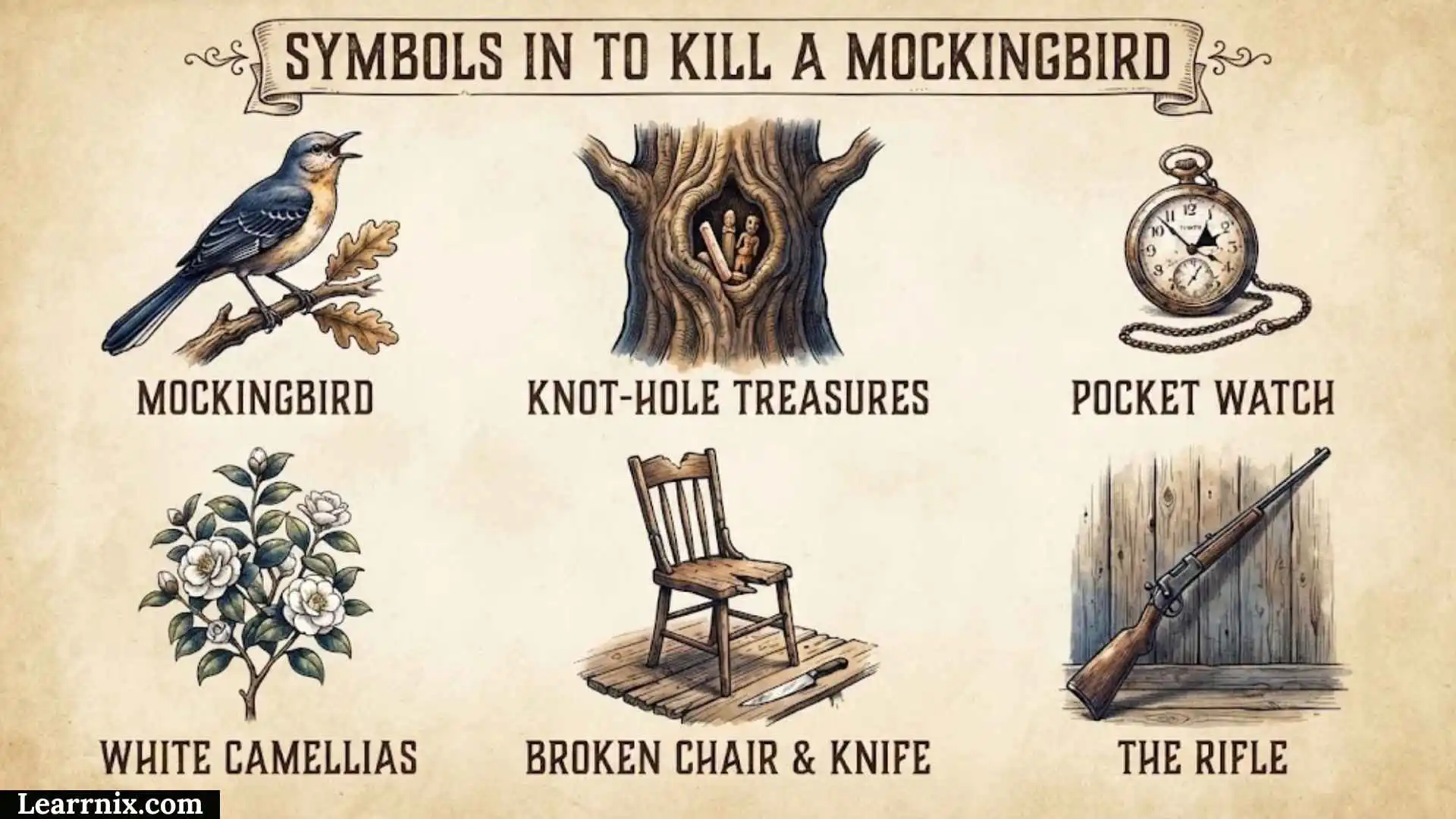
Harper Lee’s To Kill a Mockingbird uses ordinary objects, animals, places, and events to express deeper ideas about innocence, prejudice, justice, courage, and growing up. Many of the novel’s most memorable details become symbols because they represent ideas that go beyond their literal meaning.
The mockingbird is the central symbol, but it is far from the only one. The mad dog, the courthouse, Boo Radley’s house, flowers, snow, fire, the tree, and even characters can carry symbolic meaning. Some symbols become clearer as Scout learns to understand the people and events around her.
This guide explains the major symbols in To Kill a Mockingbird, including their meanings, chapter connections, motifs, themes, and important examples. It also distinguishes between symbols, motifs, themes, and foreshadowing so the novel’s symbolism is easier to analyze.
Symbols in to Kill a Mockingbird Meaning
Symbols in To Kill a Mockingbird often represent ideas connected to innocence, prejudice, morality, empathy, and social injustice. Lee does not always give a symbol only one meaning; its significance can develop as the story progresses.
The mockingbird represents innocent people who cause no harm but suffer because of the actions or prejudices of others. Tom Robinson is the clearest example, while Boo Radley also connects to the idea because he is misunderstood and ultimately protects Scout and Jem.
The mad dog represents a threat that society may prefer to ignore. When Atticus shoots Tim Johnson, the event also reveals that courage is not always loud or aggressive.
The camellia flowers associated with Mrs. Dubose can symbolize complexity, dignity, and the possibility of forgiveness. Her behavior toward Jem is cruel, but Atticus explains that she was fighting her own addiction and wanted to die free from it.
The snow during the unusual snowfall in May represents temporary change and disruption. Scout and Jem build a snowman, but its transformation into a representation of Mr. Avery reflects how children can imitate the adult world without fully understanding it.
The fire at Miss Maudie’s house can represent destruction and renewal. After the fire, Miss Maudie loses her home but remains determined to rebuild and continue living according to her own values.
Together, these symbols make the novel more than a story about one trial. They help Lee explore how people understand morality, innocence, prejudice, and human character.
Themes in To Kill a Mockingbird
The symbols in the novel are closely connected to its major themes. Understanding those themes makes the symbolism much easier to interpret.
Innocence And Experience
Scout and Jem begin the novel with relatively simple ideas about good and bad. Their experiences with the trial, Boo Radley, and Maycomb’s racial prejudice gradually make their understanding more complicated.
The mockingbird is especially important to this theme because it represents innocence exposed to an unfair world.
Prejudice And Injustice
The trial of Tom Robinson demonstrates how racial prejudice can influence a community’s treatment of an innocent person. The courthouse, the courtroom crowd, and the mockingbird symbol all contribute to this theme.
Empathy And Understanding
Atticus teaches Scout that understanding another person requires seeing the world from that person’s perspective. Boo Radley becomes especially important here because Scout eventually discovers that the frightening figure created by neighborhood rumors is very different from the real person.
Moral Courage
Atticus’s defense of Tom Robinson and Mrs. Dubose’s attempt to overcome her addiction show different forms of courage. The novel suggests that courage is not simply physical strength.
Childhood And Growing Up
Scout’s changing understanding of Maycomb forms the emotional center of the novel. Objects and events that seem mysterious or ordinary to her often gain deeper meaning as she matures.
Symbolism in To Kill a Mockingbird Quotes
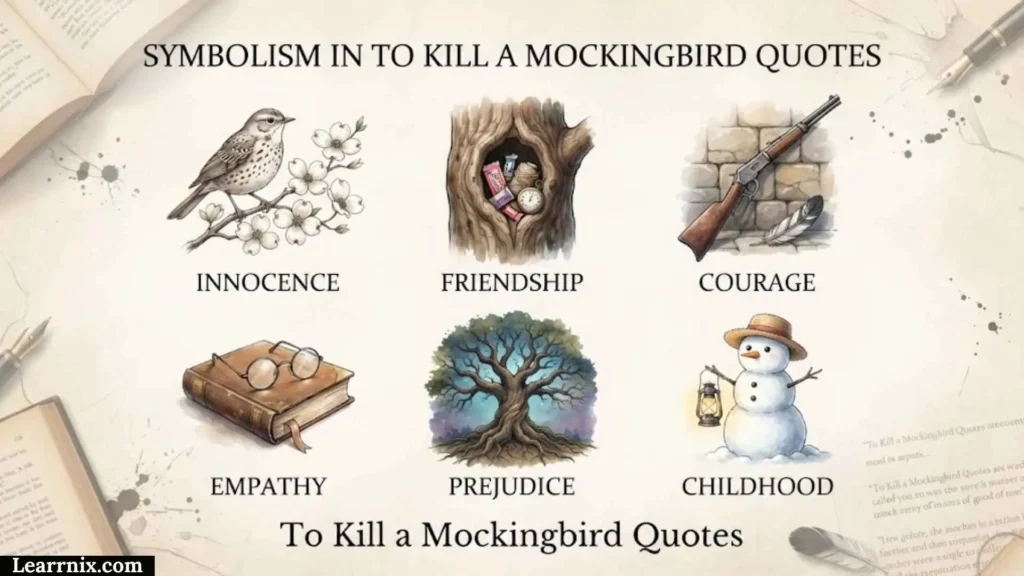
Several important quotations help reveal the novel’s symbolism. The most famous is Atticus’s statement that it is a sin to kill a mockingbird.
“Mockingbirds don’t do one thing but make music for us to enjoy.”
This explanation establishes the basic symbolic idea. A mockingbird gives something beneficial without harming others, so destroying it represents unnecessary harm to innocence.
Another important passage appears when Atticus explains courage to Jem:
“Real courage is … when you know you’re licked before you begin but you begin anyway.”
This quotation connects Mrs. Dubose’s story with the broader theme of moral courage. Courage in the novel is often symbolic rather than purely physical.
Atticus also gives Scout a lesson about empathy:
“You never really understand a person until you consider things from his point of view.”
This idea helps explain the symbolism surrounding Boo Radley. Scout eventually learns that people can be misunderstood when others judge them without knowing their real circumstances.
When using quotations in an essay, it is useful to explain both the literal event and the larger idea it represents. A quotation becomes evidence of symbolism when you connect its language, context, character, and consequences to a broader theme.
Motifs in To Kill a Mockingbird
A motif is a recurring image, idea, situation, or pattern that reinforces a larger theme. A symbol may appear as a particular object with a deeper meaning, while a motif can appear repeatedly throughout the story.
Important motifs include:
- Mockingbirds: Innocence and undeserved suffering.
- Boo Radley: Fear, misunderstanding, and empathy.
- The mad dog: Hidden danger and moral responsibility.
- Childhood games: The children’s attempts to understand the adult world.
- The courthouse: Justice, law, and social inequality.
- The neighborhood: Community judgment and social expectations.
- Guns: Responsibility, restraint, and power.
- Walking and observing: Scout’s gradual movement toward greater understanding.
These recurring patterns support the novel’s major themes without always functioning as individual symbols.
What Does a Mockingbird Symbolize in To Kill a Mockingbird
The mockingbird symbolizes innocence and harmlessness. Atticus explains that mockingbirds do not destroy crops or cause trouble; they simply make music for people to enjoy. Because of this, harming one becomes a metaphor for harming someone who has done nothing wrong.
Tom Robinson is the clearest human representation of the mockingbird. He helps Mayella Ewell but is later falsely accused and convicted because of racial prejudice.
Boo Radley also connects strongly to the symbol. Although Maycomb imagines him as frightening, Boo quietly watches over Scout and Jem and ultimately saves them from Bob Ewell.
The symbol can therefore be understood broadly: the mockingbird represents innocent people who are harmed, judged, or misunderstood despite causing no real harm.
Mockingbird Symbolism
Mockingbird symbolism develops throughout the novel rather than appearing only when Atticus gives his famous lesson.
The symbol first becomes explicit through Atticus and Miss Maudie’s discussion. Later, readers can apply it to several characters and situations.
| Character or Element | Connection to Mockingbird Symbolism |
| Tom Robinson | Innocent person harmed by prejudice |
| Boo Radley | Misunderstood person who ultimately protects others |
| Scout | Child whose innocence is challenged by adult prejudice |
| Jem | Young person forced to confront injustice |
| The mockingbird itself | Innocence that causes no harm |
| Mr. Underwood’s response to Tom’s death | Recognition of the injustice done to an innocent person |
Tom Robinson is the strongest example because the trial demonstrates the consequences of racial prejudice directly. Boo’s connection is different: his story focuses more on misunderstanding, isolation, and society’s tendency to create frightening stories about people it does not know.
Foreshadowing in To Kill a Mockingbird
Foreshadowing gives readers clues about events that become important later. Lee uses several details early in the novel to prepare readers for later developments.
One example is the children’s fascination with Boo Radley. At first, Boo seems like a frightening legend created by neighborhood rumors. His presence gradually becomes more important until he plays a direct role in saving Scout and Jem.
The mad dog episode also foreshadows Atticus’s hidden ability as a marksman. Scout and Jem know their father as an older, quiet lawyer. When he shoots Tim Johnson, they discover a side of him they did not expect.
The novel’s early references to the mockingbird also prepare readers for the trial and its consequences. The symbolic meaning becomes increasingly clear as Scout and Jem witness how prejudice affects Tom Robinson.
Foreshadowing and symbolism often overlap, but they are not the same. Foreshadowing points toward a future event, while symbolism gives an object, character, or event a deeper meaning.
What Does the Mockingbird Symbolize in Hunger Games
The mockingbird in To Kill a Mockingbird should not be confused with the mockingjay in Suzanne Collins’s The Hunger Games series.
In The Hunger Games, the mockingjay becomes a symbol associated with resistance, identity, survival, and opposition to the Capitol. The bird develops from the fictional history of jabberjays and mockingbirds in the series.
The two symbols have a connection in name and in their association with innocence and power, but their literary roles are different.
In To Kill a Mockingbird, the mockingbird primarily represents innocent people who are harmed or misunderstood. In The Hunger Games, the mockingjay becomes closely connected with rebellion and resistance to political control.
Keeping the two symbols separate is important when writing a literary analysis.
Symbols in to Kill a Mockingbird
The novel contains several major symbols that help readers understand its characters and themes.
| Symbol | Main Meaning |
| 🐦 Mockingbird | Innocence and undeserved suffering |
| 🐕 Mad dog | Hidden danger and moral responsibility |
| 🌸 Camellias | Complexity, dignity, and forgiveness |
| ❄ Snow | Change and temporary disruption |
| 🔥 Fire | Destruction and renewal |
| 🏠 Boo Radley’s house | Fear, mystery, and misunderstanding |
| ⚖ Courthouse | Justice and social inequality |
| 🌳 Tree and treehouse | Childhood, imagination, and communication |
| 🔫 Atticus’s rifle | Responsibility and restrained power |
| 🌹 Mrs. Dubose’s flowers | Human complexity and difficult moral choices |
The emoji icons above are only modern visual representations for scanning; they are not symbols used in Harper Lee’s original text.
Important Symbols in to Kill a Mockingbird
Some symbols are particularly useful when analyzing the novel because they connect directly to major characters and themes.
The Mockingbird
The central symbol represents innocence harmed without justification. Tom Robinson and Boo Radley are the most important examples.
The Mad Dog
Tim Johnson represents a danger that the community cannot simply ignore. Atticus’s response also reveals his sense of responsibility.
The Courthouse
The courthouse represents the legal system and the gap between the ideal of justice and the reality of prejudice in Maycomb.
Boo Radley’s House
The Radley house represents mystery and the danger of judging people based on rumors.
Flowers
Flowers appear in several contexts, particularly around Mrs. Dubose and Miss Maudie. Their meanings depend on the specific scene rather than having one fixed interpretation.
Fire
The fire at Miss Maudie’s home represents destruction, but her determination to rebuild gives the event a sense of renewal.
What Are Some Symbols in to Kill a Mockingbird
Some of the most useful symbols to identify in an essay are the mockingbird, mad dog, courthouse, flowers, snow, fire, Boo Radley’s house, guns, and the tree.
The easiest way to analyze them is to ask three questions:
- What is the literal object or event?
- What happens around it?
- What larger idea does it help readers understand?
For example, a mockingbird is literally a bird. Within the novel, however, it becomes connected to harmlessness and innocence. Tom Robinson’s story gives that symbolism its strongest human meaning.
The same method works for the mad dog. Tim Johnson is literally a sick animal, but the episode also reveals how courage, responsibility, and hidden abilities can operate beneath ordinary appearances.
Symbols in to Kill a Mockingbird Chapter 9
Chapter 9 is particularly important because Scout begins to face direct pressure from people who disagree with Atticus defending Tom Robinson.
One significant symbol is the mockingbird, although its full meaning becomes more explicit later. The events surrounding Tom’s case begin establishing the connection between innocence and unjust treatment.
Chapter 9 also develops the symbolic meaning of Atticus’s moral courage. Scout learns that her father is willing to stand by his principles even when other people insult him.
The chapter also introduces the importance of social pressure. Scout is still young, but she begins to recognize that Maycomb has rules about race, family reputation, and acceptable behavior.
For an essay about Chapter 9, it is useful to connect the events to the larger symbols of innocence, prejudice, courage, and justice rather than treating the chapter as an isolated episode.
Mockingbird Symbols in to Kill a Mockingbird
The phrase “mockingbird symbols” can refer both to the central mockingbird itself and to the characters or events connected with its meaning.
Tom Robinson is the clearest example because he is harmed despite not deserving the treatment he receives. Boo Radley is another major example because the community misunderstands him and creates a frightening identity around him.
Jem and Scout also have a more indirect relationship to the symbol. They begin with childhood innocence and gradually lose some of that innocence as they encounter racism and injustice.
This makes the mockingbird symbol more powerful than a simple one-to-one comparison. It becomes a way of examining what happens when an innocent person encounters a society shaped by fear and prejudice.
Prejudice Symbols in to Kill a Mockingbird
Prejudice is represented through several settings, characters, and recurring situations rather than through one single object.
The courthouse symbolizes the formal system in which justice is supposed to operate, while Tom Robinson’s trial reveals the limitations of that system when social prejudice influences judgment.
The Radley house represents another kind of prejudice. Maycomb residents create stories about Boo without truly knowing him.
The mad dog can also be connected indirectly to prejudice because the episode challenges appearances. Atticus seems weak to his children because they judge him by what they see. The mad dog reveals that appearances do not always show a person’s full character.
These symbols demonstrate that prejudice can involve race, reputation, class, fear, and assumptions about other people.
Innocence Symbols in to Kill a Mockingbird
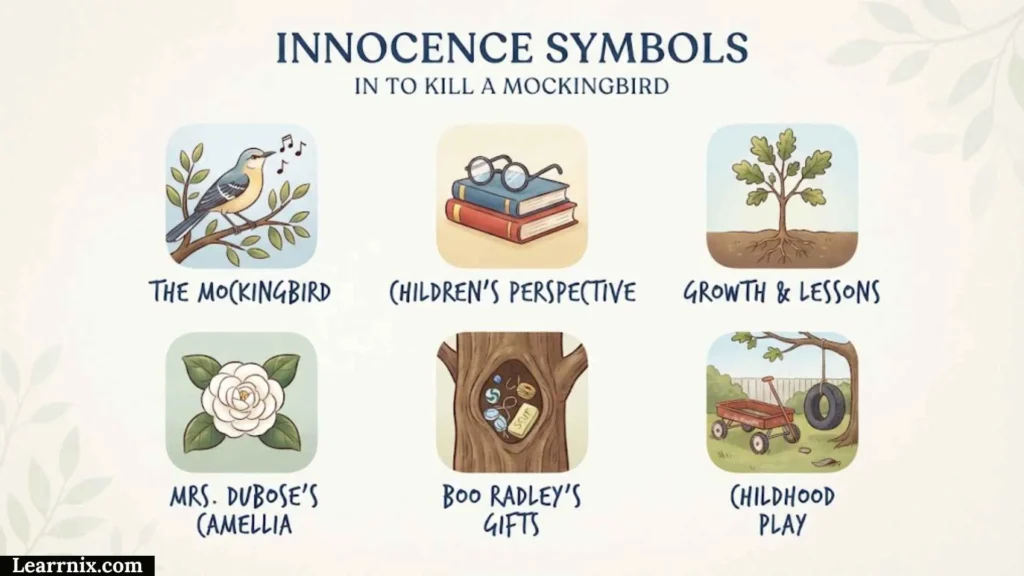
The mockingbird is the strongest innocence symbol, but several other elements contribute to the novel’s treatment of innocence.
Scout and Jem’s childhood represents a stage before they fully understand Maycomb’s social divisions. Their games and stories show their attempts to make sense of the adult world.
Boo Radley represents another form of innocence because the frightening reputation surrounding him does not match the person Scout eventually encounters.
Tom Robinson represents innocence in a much more tragic sense. His story demonstrates what can happen when prejudice overrides evidence and fairness.
The innocence theme therefore operates at several levels: childhood innocence, personal innocence, and innocence destroyed by social injustice.
3 Symbols in to Kill a Mockingbird
If you need only three symbols for a short assignment, the strongest choices are the mockingbird, mad dog, and courthouse.
1. The Mockingbird
The mockingbird represents innocence and people who are harmed despite causing no harm themselves. Tom Robinson provides the clearest example.
2. The Mad Dog
The mad dog represents danger that must be confronted. The scene also reveals Atticus’s courage and responsibility.
3. The Courthouse
The courthouse represents the ideal of justice while also exposing how prejudice can affect the practical operation of the legal system.
These three symbols allow a student to discuss innocence, courage, justice, and prejudice without trying to cover every symbolic detail in the novel.
Meaning of Symbols in to Kill a Mockingbird
The meaning of a symbol depends on its context. It is better to explain how a symbol works in the story than to assign it a single definition.
For example, the mockingbird generally represents innocence, but its importance comes from the specific characters associated with it. Tom Robinson shows how innocence can be destroyed by prejudice, while Boo Radley shows how an innocent and caring person can be misunderstood.
Similarly, flowers do not always have one universal meaning. Mrs. Dubose’s camellias are connected to her character and her relationship with Jem, while Miss Maudie’s flowers are connected to her personality and response to adversity.
A strong literary analysis should therefore use the pattern symbol → context → character or event → larger theme.
What Are the Symbols in to Kill a Mockingbird
The major symbols include:
- Mockingbird — innocence and undeserved harm.
- Mad dog — danger, courage, and responsibility.
- Courthouse — law, justice, and inequality.
- Boo Radley’s house — mystery, fear, and social judgment.
- Camellias — complexity, dignity, and forgiveness.
- Snowman — imagination and the imitation of adult conflicts.
- Fire — destruction followed by renewal.
- Guns — power, restraint, and responsibility.
- Trees and treehouse — childhood, imagination, and communication.
- Flowers — beauty, character, resilience, and complicated relationships depending on context.
Not every object in the novel is necessarily a formal symbol. Literary analysis is strongest when it explains recurring patterns supported by the text.
Key Symbols in to Kill a Mockingbird
The key symbols can be grouped according to the ideas they help readers explore.
| Theme | Related Symbols |
| Innocence | Mockingbird, children, Boo Radley |
| Prejudice | Courthouse, trial, Radley rumors |
| Courage | Mad dog, rifle, Mrs. Dubose |
| Justice | Courthouse, courtroom |
| Empathy | Boo Radley, Scout’s changing perspective |
| Change | Snow, fire, childhood experiences |
| Responsibility | Atticus’s rifle, mad dog |
| Human complexity | Flowers, Mrs. Dubose, Boo Radley |
This approach is useful for essays because it prevents a symbol from being treated as an isolated object. Symbols become meaningful because they interact with the novel’s larger ideas.
Motifs and Symbols in to Kill a Mockingbird
Motifs and symbols are related but should not be treated as identical.
A symbol is an object, person, place, or event that carries a deeper meaning. A motif is a recurring element that repeatedly supports a theme.
For example, the mockingbird functions primarily as a symbol. The repeated stories, rumors, and encounters involving Boo Radley form a broader motif of misunderstanding and empathy.
The novel also repeatedly returns to childhood games, stories, community gossip, and encounters with people who do not fit Maycomb’s expectations. These recurring patterns strengthen the themes of prejudice and moral growth.
When writing an essay, you can explain that symbols provide concentrated meaning, while motifs create patterns across the narrative.
Analyzing Symbols in to Kill a Mockingbird
A strong symbolism analysis should move beyond simply naming an object and stating what it represents.
Step 1: Identify The Symbol
Choose an object, character, place, or event that has significance beyond its literal role.
Step 2: Examine The Context
Look at what happens before, during, and after the symbol appears.
Step 3: Connect It to a Character
Ask which character is most closely associated with the symbol and why.
Step 4: Connect It to a Theme
Determine whether the symbol develops ideas such as innocence, prejudice, courage, justice, or empathy.
Step 5: Use Textual Evidence
A quotation or specific scene can demonstrate how the symbol works. Explain the evidence rather than simply inserting a quotation.
For example, an analysis of the mockingbird might argue that the symbol transforms the novel’s discussion of Tom Robinson from an individual tragedy into a broader reflection on the harm caused when innocent people are judged unfairly.
Character Symbols in to Kill a Mockingbird
Several characters can be interpreted symbolically, although their meanings are more complex than a simple one-word label.
Tom Robinson
Tom is strongly associated with the mockingbird because he is presented as a person who helps others yet suffers because of racial prejudice.
Boo Radley
Boo symbolizes the danger of judging someone through rumor and appearance. His actions eventually force Scout to reconsider everything she thought she knew about him.
Atticus Finch
Atticus can represent moral responsibility and principled courage. His importance comes from his actions and lessons rather than from being a perfect or symbolic figure without complexity.
Mrs. Dubose
Mrs. Dubose represents a complicated form of courage. Her struggle with morphine addiction gives greater depth to Atticus’s lesson that courage can involve facing a difficult personal battle.
Scout
Scout symbolizes the process of learning. Through her perspective, readers see how a child gradually recognizes the contradictions in her community.
Jem
Jem represents the painful movement from childhood idealism toward a more complicated understanding of justice and society.
Symbols in to Kill a Mockingbird Chapter 1
Chapter 1 introduces several elements that later become important symbols or motifs.
The Radley house immediately establishes mystery and fear. Scout describes the house through the stories and beliefs of Maycomb, which helps introduce the theme of judging people without knowing them.
Boo Radley is introduced as a mysterious figure rather than as the person Scout later discovers him to be. This creates an important contrast between reputation and reality.
The tree near the Radley property also becomes significant because it eventually provides a place where small objects are left for Scout and Jem. The tree becomes a point of communication between the children and Boo.
The chapter also introduces the Finch family history and the setting of Maycomb. These details establish the social environment in which later symbols of prejudice, class, and reputation become meaningful.
What Are Symbols in to Kill a Mockingbird
Symbols in To Kill a Mockingbird are elements of the story that carry meanings beyond their literal roles.
A bird can be a literal bird, but the mockingbird becomes a representation of innocence. A courthouse is a real building, but it can also represent the ideals and failures of justice. A house can simply be a home, but the Radley house becomes connected to fear, rumor, and misunderstanding.
The key is context. A reader should not assume that every object is automatically symbolic. Strong symbolism is supported by repetition, emphasis, character associations, dialogue, or the consequences of an event.
5 Symbols in to Kill a Mockingbird
For a five-symbol assignment, these choices provide a broad range of themes:
- Mockingbird — Innocence: Represents people who are harmed despite causing no harm.
- Mad Dog — Courage And Responsibility: Shows that difficult threats sometimes require someone to act.
- Courthouse — Justice And Inequality: Represents the legal ideal while exposing social prejudice.
- Boo Radley’s House — Fear And Misunderstanding: Shows how rumors can shape a community’s view of a person.
- Fire — Destruction And Renewal: Miss Maudie’s house burns, but she responds by planning to rebuild.
Together, these five symbols cover some of the novel’s central concerns without relying on several versions of the same idea.
All Symbols in to Kill a Mockingbird
There is no universally agreed official list of “all” symbols in the novel because literary symbolism depends partly on interpretation. Some objects have strong textual support as symbols, while others can be interpreted symbolically depending on the argument.
Major and commonly discussed examples include:
- Mockingbird: Innocence and undeserved suffering.
- Mad dog: Danger, courage, and responsibility.
- Courthouse: Justice and inequality.
- Radley house: Fear and misunderstanding.
- Tree: Communication, childhood, and connection.
- Snowman: Childhood imagination and social imitation.
- Fire: Destruction and renewal.
- Camellias: Complexity, dignity, and forgiveness.
- Guns: Power, responsibility, and restraint.
- Flowers: Beauty, resilience, and complicated human character.
- The trial: A broader representation of prejudice and the limits of justice.
- The mockingbird song: Harmless beauty and innocence.
These symbols should not be treated as fixed dictionary definitions. Their meaning becomes strongest when supported with scenes, dialogue, character development, and themes.
Themes and Symbols in to Kill a Mockingbird
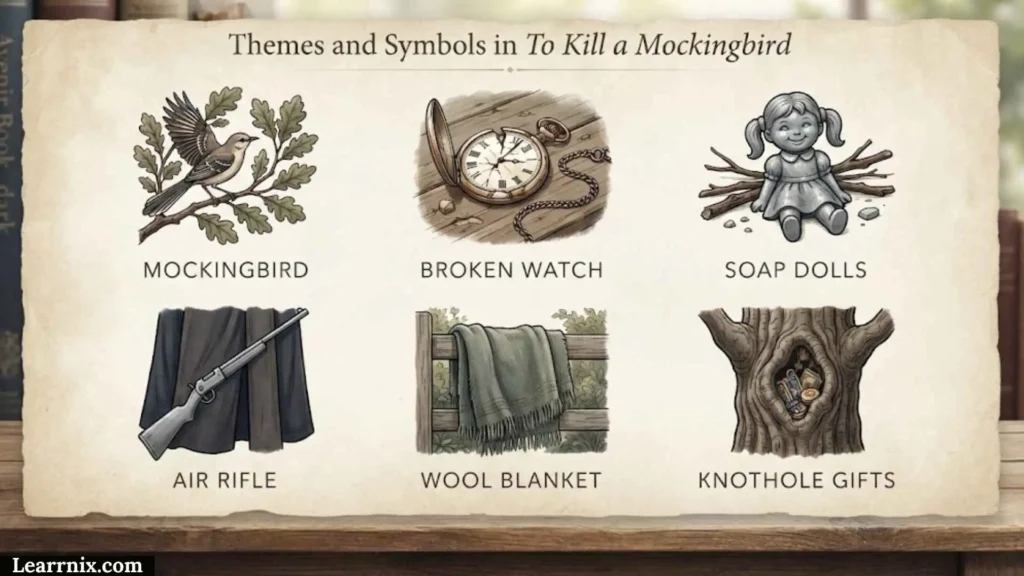
The novel’s themes and symbols work together. Symbols give concrete form to abstract ideas, while themes explain the larger questions raised by the story.
Innocence is represented most clearly by the mockingbird and through characters such as Tom Robinson and Boo Radley.
Prejudice is developed through the trial, Maycomb’s racial attitudes, and the rumors surrounding Boo.
Courage appears through the mad dog episode, Atticus’s defense of Tom, and Mrs. Dubose’s personal struggle.
Empathy becomes especially important as Scout changes her understanding of Boo and learns to consider situations from other people’s perspectives.
Growing up connects many of these ideas. Scout and Jem begin by seeing the world through childhood assumptions. Their experiences gradually teach them that morality, justice, and human character are more complicated than they first believed.
The symbols therefore work as a network rather than as separate decorative details. The mockingbird, courthouse, Radley house, mad dog, flowers, snow, and fire all contribute to a larger examination of how people respond to innocence, fear, prejudice, responsibility, and change.
Frequently Asked Questions
What Is the Most Important Symbol in To Kill a Mockingbird?
The mockingbird is generally the novel’s central symbol. Atticus explains that mockingbirds cause no harm and instead provide something valuable, making the bird a representation of innocence and undeserved suffering.
Why Is the Mockingbird a Symbol of Innocence?
The mockingbird is described as harmless because it does not destroy crops or cause trouble. This makes it a metaphor for innocent people who are hurt even though they have done nothing wrong.
Is Boo Radley a Symbol in To Kill a Mockingbird?
Yes. Boo Radley can be interpreted as a symbol of misunderstanding and the danger of judging people through rumors. Scout’s changing view of Boo is closely connected to her developing empathy.
What Does the Mad Dog Symbolize?
The mad dog can represent a dangerous problem that must be confronted. The episode also reveals Atticus’s courage, responsibility, and ability to act when necessary despite his normally quiet appearance.
What Are the Main Themes Connected to the Symbols?
The major themes include innocence, prejudice, justice, empathy, courage, moral responsibility, and growing up. The symbols help turn these abstract themes into concrete images and events.
Conclusion
The symbols in To Kill a Mockingbird give deeper meaning to the novel’s characters, conflicts, and important events. The mockingbird remains the central image of innocence, while the courthouse, mad dog, Radley house, flowers, snow, fire, and other elements expand the story’s discussion of justice, prejudice, courage, and empathy.
Understanding symbolism also makes the novel’s character development easier to follow. Tom Robinson and Boo Radley reveal different forms of the mockingbird idea, while Scout and Jem show how experiences with prejudice and injustice change a person’s understanding of the world.
For literary analysis, the strongest approach is to connect each symbol to its specific context and then explain how that context supports a larger theme. Rather than memorizing one definition for every object, look at how the symbol develops through the characters, events, and language of the novel.

I am Charlotte Anderson, an education writer who is passionate about creating meaningful learning resources for students and lifelong learners.
I enjoy researching new educational approaches and sharing ideas that make studying easier and more effective.
Through my work, I aim to inspire curiosity, confidence, and a love for learning.
Books:
- The Complete Guide to Better Learning
- Building Skills for Academic Success
 Michael Carter