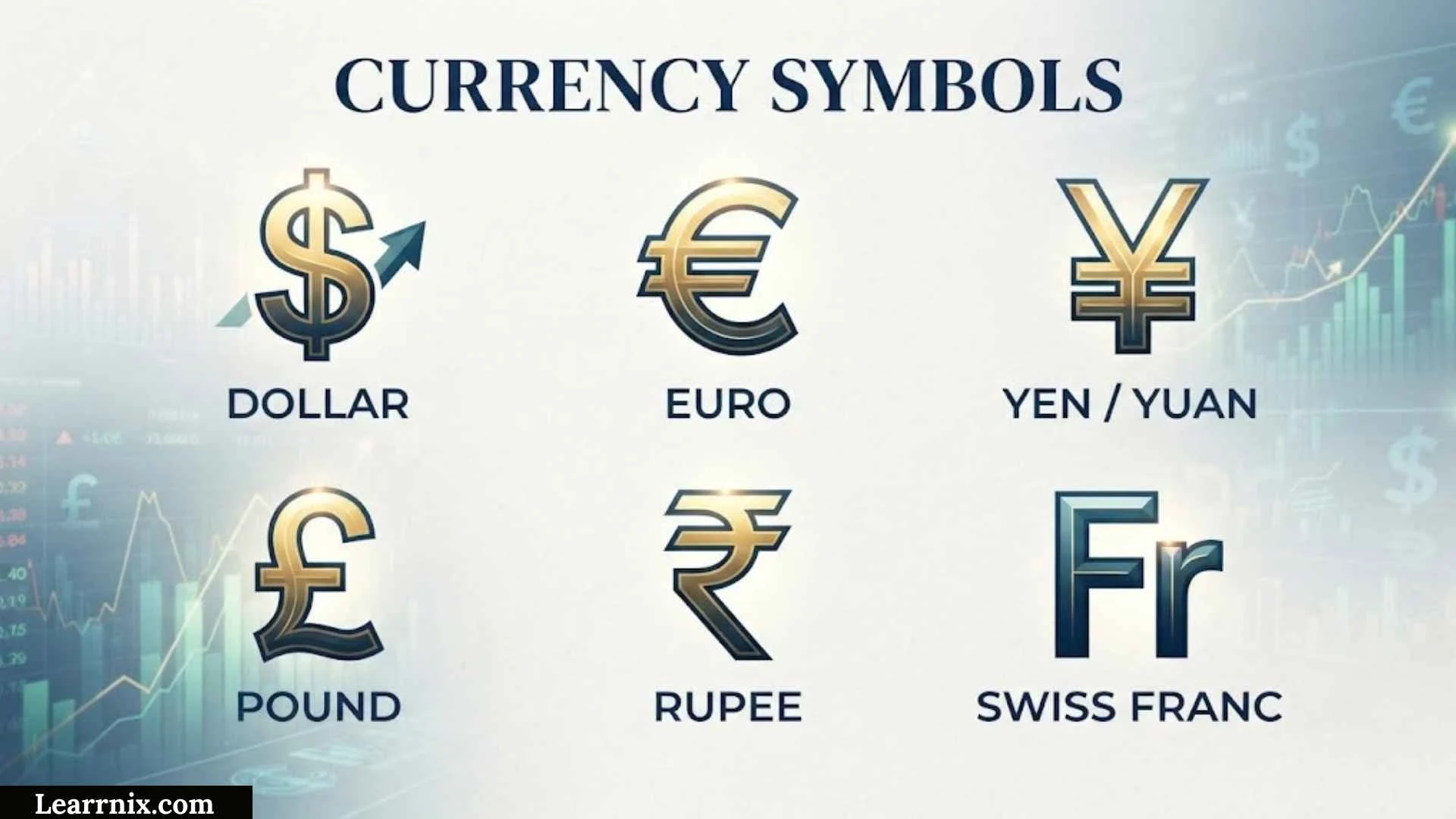
Currency symbols are short characters used to identify money and make prices easier to understand. Some are instantly recognizable, such as $, €, £, ¥, and ₹, while others are mainly familiar within particular countries or regions. A single symbol can also represent more than one currency, which makes context important.
People search for currency symbols for many reasons. You may need a symbol for a website, online store, spreadsheet, document, social media post, financial article, school project, or simple copy-and-paste use. Unicode also provides standardized characters that allow many currency signs to work digitally across different platforms.
This guide brings together common currency symbols from around the world, including their names, meanings, Unicode code points, regional categories, and copy-paste versions. It also explains shared symbols, international currency codes, historical signs, and practical ways to identify the correct currency.
Currency Symbol Means
A currency symbol is a character or sign used to represent a monetary unit. It is normally displayed alongside a numerical amount, allowing readers to identify the currency without spelling out its complete name.
For example:
- $25 — Dollar amount
- €25 — Euro amount
- £25 — Pound sterling amount
- ₹25 — Indian rupee amount
- ₩25 — South Korean won amount
- ₽25 — Russian ruble amount
Currency symbols are not always unique to one country. The $ sign can refer to US dollars, Canadian dollars, Australian dollars, New Zealand dollars, and several other dollar currencies. Similarly, ¥ is commonly associated with both the Japanese yen and Chinese yuan.
This is why a currency symbol and an international currency code serve different purposes. ISO 4217 provides three-letter codes such as USD, EUR, GBP, and JPY to identify currencies more precisely.
Currency Symbols Copy Paste
If you simply need a currency symbol to copy and paste, these are some of the most useful ones:
| Symbol | Currency |
| $ | Dollar |
| € | Euro |
| £ | Pound Sterling |
| ¥ | Yen / Yuan |
| ₹ | Indian Rupee |
| ₽ | Russian Ruble |
| ₩ | South Korean Won |
| ₺ | Turkish Lira |
| ₴ | Ukrainian Hryvnia |
| ₫ | Vietnamese Dong |
| ₦ | Nigerian Naira |
| ₱ | Philippine Peso |
| ฿ | Thai Baht |
| ₡ | Colon |
| ₲ | Paraguayan Guarani |
| ₵ | Ghanaian Cedi |
| ₭ | Lao Kip |
| ₮ | Mongolian Tugrik |
| ₾ | Georgian Lari |
| ₼ | Azerbaijani Manat |
| ₸ | Kazakhstani Tenge |
| ₪ | Israeli New Shekel |
| ֏ | Armenian Dram |
These characters can generally be selected, copied, and pasted wherever the relevant font and character encoding are supported.
For international content, it is useful to include the currency name or code alongside an ambiguous symbol. For example, US$100 is clearer than simply $100 when readers may be dealing with several dollar currencies.
Currency Symbols in English
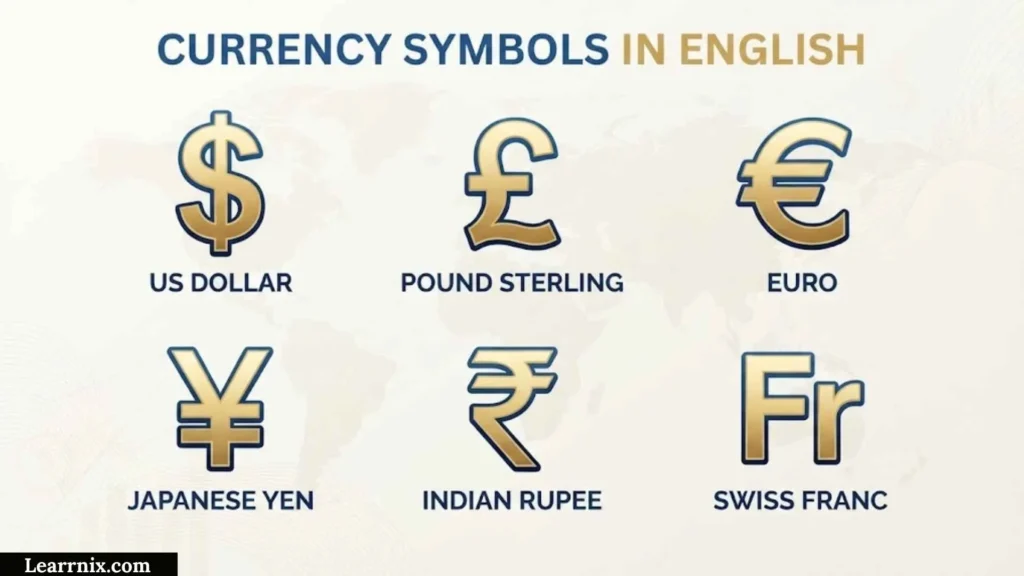
English-language content frequently places currency symbols directly before the numerical amount:
- $50
- €50
- £50
- ₹50
- ¥50
However, placement can differ according to local language and currency conventions. Some currencies are commonly displayed before the amount, while others may be written after it or represented using an abbreviation.
The dollar sign deserves particular attention because its meaning changes according to context. $100 might mean 100 US dollars, Canadian dollars, Australian dollars, or another dollar currency. In international writing, country prefixes or ISO codes can remove this ambiguity.
For example:
- US$100 — United States dollars
- CA$100 — Canadian dollars
- A$100 — Australian dollars
- NZ$100 — New Zealand dollars
- C$100 — Canadian dollars in some contexts
The exact display can vary by language, region, and software. Unicode’s CLDR data also distinguishes localized currency symbols and international codes when formatting monetary values.
All Currency Symbols Copy Paste
Here is a larger collection of currency-related characters that can be useful for copying:
$ ¢ £ ¤ ¥ ƒ ֏ ؋ ৲ ৳ ৹ ₠ ₡ ₢ ₣ ₤ ₥ ₦ ₧ ₨ ₩ ₪ ₫ € ₭ ₮ ₯ ₰ ₱ ₲ ₳ ₴ ₵ ₶ ₷ ₸ ₹ ₺ ₻ ₼ ₽ ₾ ₿ ฿
Not every character in this collection represents a current national currency. Unicode includes both contemporary and historical currency symbols, and some monetary signs are encoded outside the dedicated Currency Symbols block.
For everyday use, the most recognizable modern signs include $, €, £, ¥, ₹, ₽, ₩, ₺, ₴, ₦, ₱, and ₫.
A symbol such as ¤ has a different purpose. It is the general currency sign and can be used when a specific currency symbol is unavailable or not appropriate.
Currency Symbols D
The search phrase currency symbols d can relate to dollar and dong currency symbols, particularly because both are strongly associated with the letter D in their currency names.
Dollar Symbol
The $ symbol is known as the DOLLAR SIGN in Unicode. It is used for numerous dollar currencies and is also used in historical monetary contexts. Unicode identifies it as U+0024.
Dong Symbol
The Vietnamese dong uses ₫, known in Unicode as the DONG SIGN, with code point U+20AB. It should not be confused with an ordinary lowercase d.
So, for quick copying:
Dollar: $
Vietnamese Dong: ₫
If the intended search is for dollar symbols specifically, the country or currency code should be included when precision matters.
Currency Symbols Unicode
Unicode provides standardized character codes for many currency symbols. This is particularly useful for websites, software, databases, documents, and digital publishing because a character can be represented consistently rather than relying on an image.
Some important Unicode currency characters include:
| Symbol | Unicode Code Point | Unicode Name |
| $ | U+0024 | DOLLAR SIGN |
| ¢ | U+00A2 | CENT SIGN |
| £ | U+00A3 | POUND SIGN |
| ¤ | U+00A4 | CURRENCY SIGN |
| ¥ | U+00A5 | YEN SIGN |
| ₦ | U+20A6 | NAIRA SIGN |
| ₩ | U+20A9 | WON SIGN |
| ₪ | U+20AA | NEW SHEQEL SIGN |
| ₫ | U+20AB | DONG SIGN |
| € | U+20AC | EURO SIGN |
| ₭ | U+20AD | KIP SIGN |
| ₮ | U+20AE | TUGRIK SIGN |
| ₱ | U+20B1 | PESO SIGN |
| ₲ | U+20B2 | GUARANI SIGN |
| ₴ | U+20B4 | HRYVNIA SIGN |
| ₵ | U+20B5 | CEDI SIGN |
| ₸ | U+20B8 | TENGE SIGN |
| ₹ | U+20B9 | INDIAN RUPEE SIGN |
| ₺ | U+20BA | TURKISH LIRA SIGN |
| ₼ | U+20BC | MANAT SIGN |
| ₽ | U+20BD | RUBLE SIGN |
| ₾ | U+20BE | LARI SIGN |
| ₿ | U+20BF | BITCOIN SIGN |
Unicode specifically identifies € as U+20AC EURO SIGN and ₹ as U+20B9 INDIAN RUPEE SIGN. It also distinguishes the modern Indian rupee sign from the older generic rupee sign ₨.
The Unicode Standard also notes that currency symbols can occur outside the dedicated Currency Symbols block. For example, $, £, and ¥ are encoded in other Unicode blocks.
Currency Symbols List
The following currency symbols cover many of the characters most useful for everyday reference:
| Symbol | Currency Name | Common Association | ISO Code |
| $ | Dollar | United States and other countries | USD* |
| € | Euro | Euro area | EUR |
| £ | Pound Sterling | United Kingdom | GBP |
| ¥ | Yen | Japan | JPY |
| ¥ | Yuan | China | CNY |
| ₹ | Indian Rupee | India | INR |
| ₽ | Ruble | Russia | RUB |
| ₩ | Won | South Korea | KRW |
| ₺ | Turkish Lira | Türkiye | TRY |
| ₴ | Hryvnia | Ukraine | UAH |
| ₫ | Dong | Vietnam | VND |
| ₦ | Naira | Nigeria | NGN |
| ₱ | Philippine Peso | Philippines | PHP |
| ฿ | Baht | Thailand | THB |
| ₪ | New Shekel | Israel | ILS |
| ₾ | Lari | Georgia | GEL |
| ₼ | Manat | Azerbaijan | AZN |
| ₸ | Tenge | Kazakhstan | KZT |
| ₮ | Tugrik | Mongolia | MNT |
| ₭ | Kip | Laos | LAK |
| ₲ | Guarani | Paraguay | PYG |
| ₵ | Cedi | Ghana | GHS |
*The dollar sign is shared by multiple currencies, so USD is specifically the code for the United States dollar.
ISO 4217 is designed to provide internationally recognized three-letter and three-digit identifiers for currencies, making it particularly useful where a symbol alone could cause confusion.
Foreign Currency Symbols
Foreign currency symbols are signs used to represent monetary units outside the reader’s own country. They appear frequently in travel guides, international stores, currency converters, financial reports, and global e-commerce.
Some common examples are:
- € — Euro
- £ — Pound sterling
- ₹ — Indian rupee
- ¥ — Japanese yen or Chinese yuan
- ₩ — South Korean won
- ₽ — Russian ruble
- ₺ — Turkish lira
- ₫ — Vietnamese dong
- ฿ — Thai baht
- ₦ — Nigerian naira
When writing for an international audience, avoid assuming that everyone will recognize an unfamiliar sign. A combination such as ₹5,000 INR or ¥5,000 JPY provides much clearer information than a symbol by itself.
This is especially useful on websites where visitors may come from several countries.
European Currency Symbols
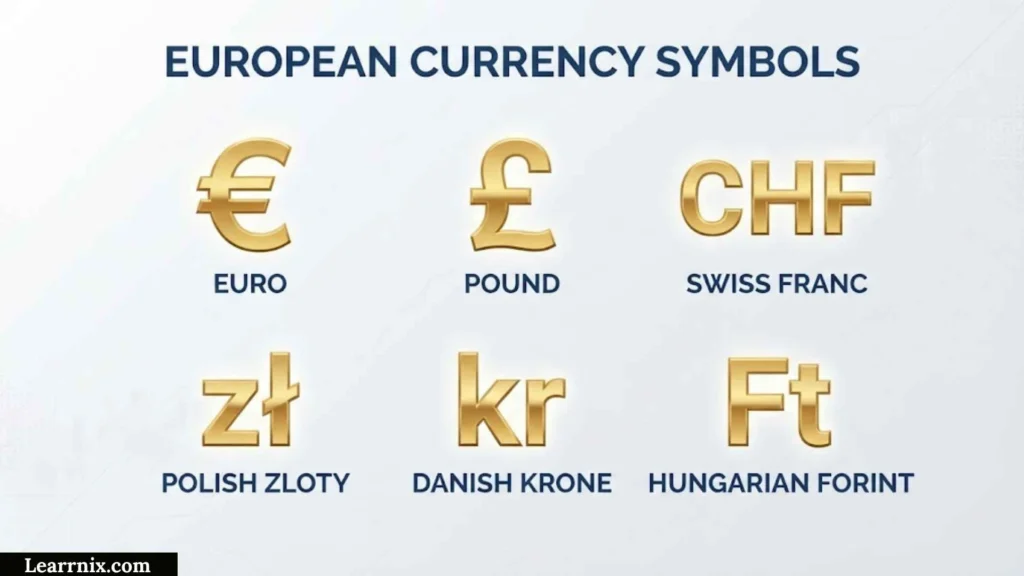
Europe has a mixture of currencies, with the euro being the primary currency across the euro area.
Common European currency symbols include:
- € — Euro
- £ — Pound sterling
- ₽ — Russian ruble
- ₴ — Ukrainian hryvnia
- ₺ — Turkish lira
- ₾ — Georgian lari
There are also historical European currency characters such as ₣ for the French franc and ₧ for the Spanish peseta. These can still appear in historical material even though those currencies are no longer the current national currencies of France and Spain.
Unicode specifically lists the French franc sign and peseta sign as historical currency characters, while € is the modern euro sign.
The euro sign should also not be confused with ₠, the euro-currency sign. Unicode notes that ₠ was intended for the former European Currency Unit and is not the euro symbol.
Currency Symbols Around the World
Currency symbols vary across continents, and some regions have particularly distinctive signs.
North And South America
Dollar and peso symbols are common throughout the Americas. Examples include:
- $ — Dollar
- ¢ — Cent
- ₡ — Colón
- ₱ — Philippine peso, although the Philippines is in Asia
- ₲ — Paraguayan guarani
The dollar sign is especially widespread and therefore often needs a country identifier.
Europe
Europe includes:
- € — Euro
- £ — Pound sterling
- ₽ — Russian ruble
- ₴ — Ukrainian hryvnia
- ₺ — Turkish lira
- ₾ — Georgian lari
Africa
Examples include:
- ₦ — Nigerian naira
- ₵ — Ghanaian cedi
- $ — Used by some African dollar currencies in various contexts
Asia
Asia has many distinctive currency signs:
- ₹ — Indian rupee
- ¥ — Yen or yuan
- ₩ — Won
- ₫ — Dong
- ฿ — Baht
- ₭ — Kip
- ₮ — Tugrik
- ₸ — Tenge
- ₺ — Turkish lira
This variety makes a worldwide currency symbol reference useful when reading international prices.
Asian Currency Symbols
Asian currency symbols include some of the most recognizable monetary characters.
| Symbol | Currency | Country |
| ¥ | Yen | Japan |
| ¥ | Yuan | China |
| ₹ | Rupee | India |
| ₩ | Won | South Korea |
| ₫ | Dong | Vietnam |
| ฿ | Baht | Thailand |
| ₭ | Kip | Laos |
| ₮ | Tugrik | Mongolia |
| ₸ | Tenge | Kazakhstan |
| ₺ | Lira | Türkiye |
| ₪ | New Shekel | Israel |
One of the most common points of confusion is ¥. The symbol is commonly used for both Japanese yen and Chinese yuan. The currency codes JPY and CNY make the distinction clear.
India provides another useful example. The modern Indian rupee sign is ₹, U+20B9, while ₨ is an older generic rupee sign. Unicode specifically distinguishes these characters.
Currency Symbols With Name And Meanings
A symbol tells you that an amount represents money, but its exact meaning depends on the currency and context.
| Symbol | Name | Meaning |
| $ | Dollar Sign | Used by multiple dollar currencies |
| € | Euro Sign | Represents the euro |
| £ | Pound Sign | Commonly represents pound sterling |
| ¥ | Yen Sign | Commonly represents Japanese yen and Chinese yuan |
| ₹ | Indian Rupee Sign | Represents India’s rupee |
| ₽ | Ruble Sign | Represents the Russian ruble |
| ₩ | Won Sign | Used for won currencies, especially South Korea |
| ₺ | Turkish Lira Sign | Represents Türkiye’s lira |
| ₴ | Hryvnia Sign | Represents Ukraine’s hryvnia |
| ₫ | Dong Sign | Represents Vietnam’s dong |
| ₦ | Naira Sign | Represents Nigeria’s naira |
| ₱ | Peso Sign | Used for the Philippine peso and associated peso currencies |
| ฿ | Baht Sign | Represents Thailand’s baht |
| ₪ | New Shekel Sign | Represents Israel’s new shekel |
| ₾ | Lari Sign | Represents Georgia’s lari |
Some symbols have meanings beyond a single current currency. Unicode’s character names describe the standardized character, while actual financial usage depends on local conventions.
For example, £ is officially the Unicode POUND SIGN, but it can also be associated with lira usage. Likewise, ¥ is officially named YEN SIGN even though it is also commonly used for yuan.
International Currency Symbols
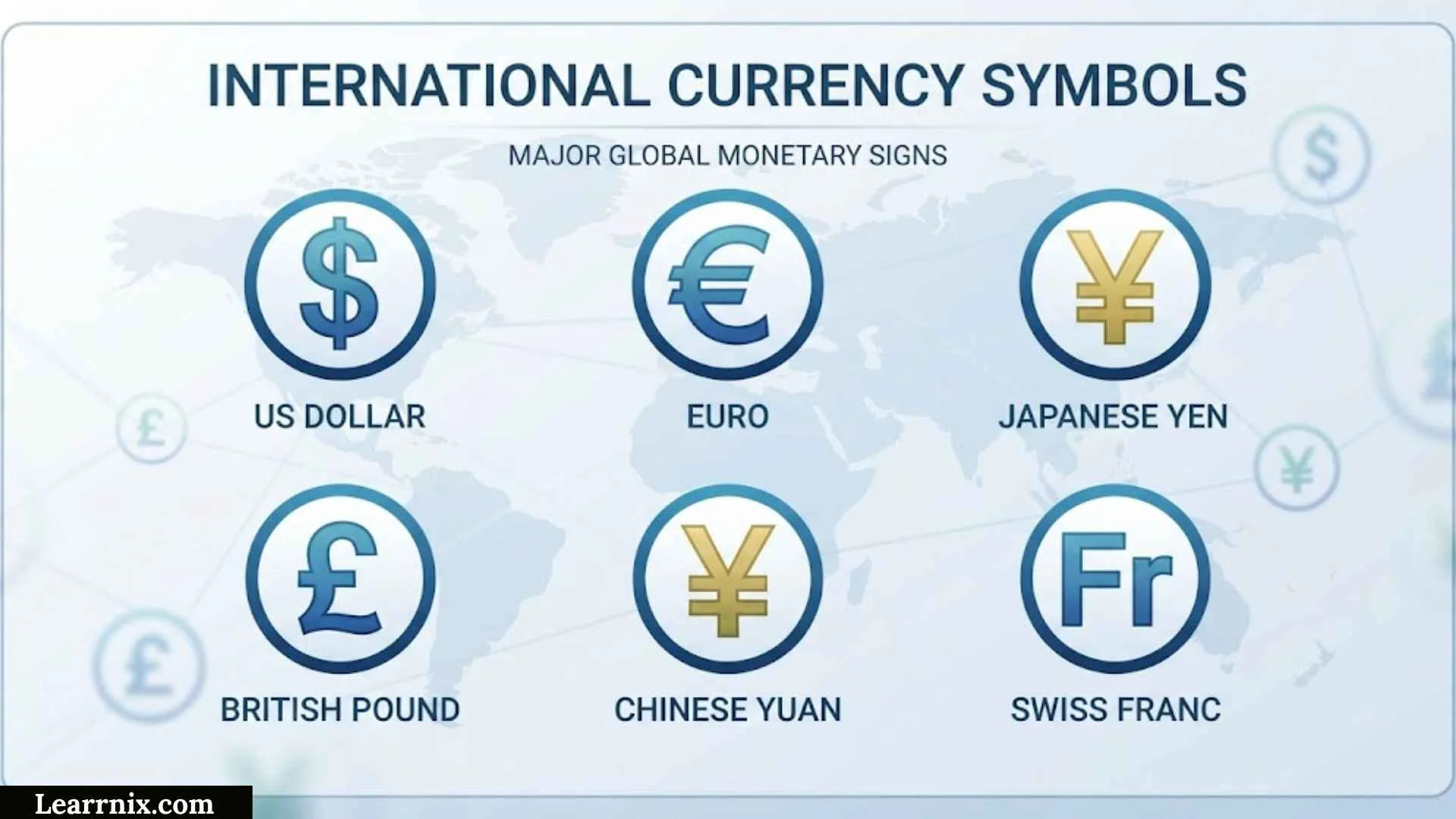
An international currency symbol is useful when readers need to recognize a currency quickly, but international financial systems usually depend on standardized currency codes for precision.
Common ISO 4217 codes include:
- USD — United States dollar
- EUR — Euro
- GBP — Pound sterling
- JPY — Japanese yen
- CNY — Chinese yuan
- INR — Indian rupee
- KRW — South Korean won
- CAD — Canadian dollar
- AUD — Australian dollar
- CHF — Swiss franc
- AED — United Arab Emirates dirham
- SAR — Saudi riyal
- PKR — Pakistani rupee
ISO explains that its currency standard uses three-letter alphabetic codes and equivalent three-digit numeric codes. These identifiers are designed for applications such as trade, commerce, and banking.
A symbol is therefore best for quick visual recognition, while an ISO code is often better when exact identification is required.
Different Currency Symbols of Different Countries
Countries can have completely different symbols, or several countries can share the same sign.
For example:
| Country | Currency | Symbol | ISO Code |
| United States | Dollar | $ | USD |
| United Kingdom | Pound Sterling | £ | GBP |
| India | Rupee | ₹ | INR |
| Japan | Yen | ¥ | JPY |
| China | Yuan | ¥ | CNY |
| South Korea | Won | ₩ | KRW |
| Russia | Ruble | ₽ | RUB |
| Ukraine | Hryvnia | ₴ | UAH |
| Vietnam | Dong | ₫ | VND |
| Nigeria | Naira | ₦ | NGN |
| Thailand | Baht | ฿ | THB |
| Philippines | Peso | ₱ | PHP |
| Türkiye | Lira | ₺ | TRY |
| Georgia | Lari | ₾ | GEL |
| Azerbaijan | Manat | ₼ | AZN |
The most important thing to remember is that a currency symbol is not necessarily a unique country identifier. $, for example, is used by numerous currencies.
If your content involves international customers, showing the country, currency name, or ISO code alongside the symbol is the safest approach.
Types of Currency Symbols
Currency symbols can be divided into several useful categories.
Common Modern Symbols
These are the signs people are most likely to encounter in everyday pricing:
$ € £ ¥ ₹ ₽ ₩ ₺ ₴ ₦ ₱ ฿ ₪ ₫
Shared Symbols
Some symbols represent multiple currencies.
The clearest examples are:
- $ — Various dollar currencies
- ¥ — Japanese yen and Chinese yuan
- ₱ — Peso currencies in different historical and modern contexts
For these symbols, a country abbreviation or ISO code can make the intended meaning clear.
Dedicated National Symbols
Some currency signs are strongly associated with a particular modern currency, such as:
- ₹ — Indian rupee
- ₦ — Nigerian naira
- ₴ — Ukrainian hryvnia
- ₺ — Turkish lira
- ₾ — Georgian lari
- ₼ — Azerbaijani manat
Historical Currency Symbols
Unicode also contains symbols for currencies that are no longer in current everyday circulation. Examples include:
- ₣ — French franc sign
- ₧ — Peseta sign
- ₯ — Drachma sign
- ₳ — Austral sign
- ₠ — Euro-currency sign
These can be useful for historical writing, archives, books, museums, and educational material. Unicode distinguishes historical characters from modern currency signs rather than treating every monetary symbol as a currently active currency.
Digital Currency Symbols
Unicode makes it possible to use currency characters directly as text. This is useful for copy-and-paste lists, websites, applications, documents, and databases.
One notable example is ₿, the Bitcoin sign. It is a Unicode currency-related character, but Bitcoin is a cryptocurrency rather than a national fiat currency.
When choosing a symbol for a website or application, also consider font support. Some newer or less familiar currency characters may display as a missing-glyph box when the selected font does not contain the character. Unicode’s CLDR documentation specifically notes this issue for some newer currency symbols.
FAQ
What is the most common currency symbol?
The $ symbol is one of the most widely recognized currency signs and is used by several different dollar currencies. The country or ISO code is needed when the exact currency is unclear.
What is the difference between a currency symbol and a currency code?
A currency symbol is a short character such as $, €, or ₹, while a currency code is a standardized identifier such as USD, EUR, or INR.
Why do some countries use the same currency symbol?
Currency symbols developed through historical and local usage, so different currencies can share similar or identical signs. The dollar and yen signs are common examples.
What is the Unicode code for the Indian rupee symbol?
The modern Indian rupee symbol ₹ is encoded as U+20B9 INDIAN RUPEE SIGN in Unicode. It is distinct from the older generic rupee sign ₨.
Can I copy and paste currency symbols?
Yes. Unicode currency characters such as $, €, £, ₹, ₽, and ₩ can be copied and pasted into many supported applications, websites, documents, and messages.
Conclusion
Currency symbols make monetary amounts quick to recognize and easier to scan. From the familiar $, €, and £ to regional signs such as ₹, ₦, ₴, and ₾, each character has its own history, usage, and context.
The biggest source of confusion is that some symbols are shared by multiple currencies. The $ symbol does not automatically mean US dollars, and ¥ can represent Japanese yen or Chinese yuan. In these situations, an ISO currency code such as USD, CAD, JPY, or CNY provides greater precision.
For everyday copy-and-paste needs, the symbol itself is usually all you need. For websites, financial applications, international pricing, and professional documents, combining the symbol with the currency name or ISO code is a better practice. Unicode provides the standardized characters that make many of these symbols practical for modern digital content.

I am Daniel Harper, an education enthusiast and writer who enjoys creating helpful content to make learning more accessible and engaging.
I focus on sharing knowledge about effective study methods, educational growth, and skills that help learners succeed in a changing world.
Through my writing, I aim to inspire students to explore new ideas and develop a passion for learning.
Books by Daniel Harper:
- The Path to Lifelong Learning
- Unlocking Your Learning Potential
 Michael Carter
 Charlotte Anderson