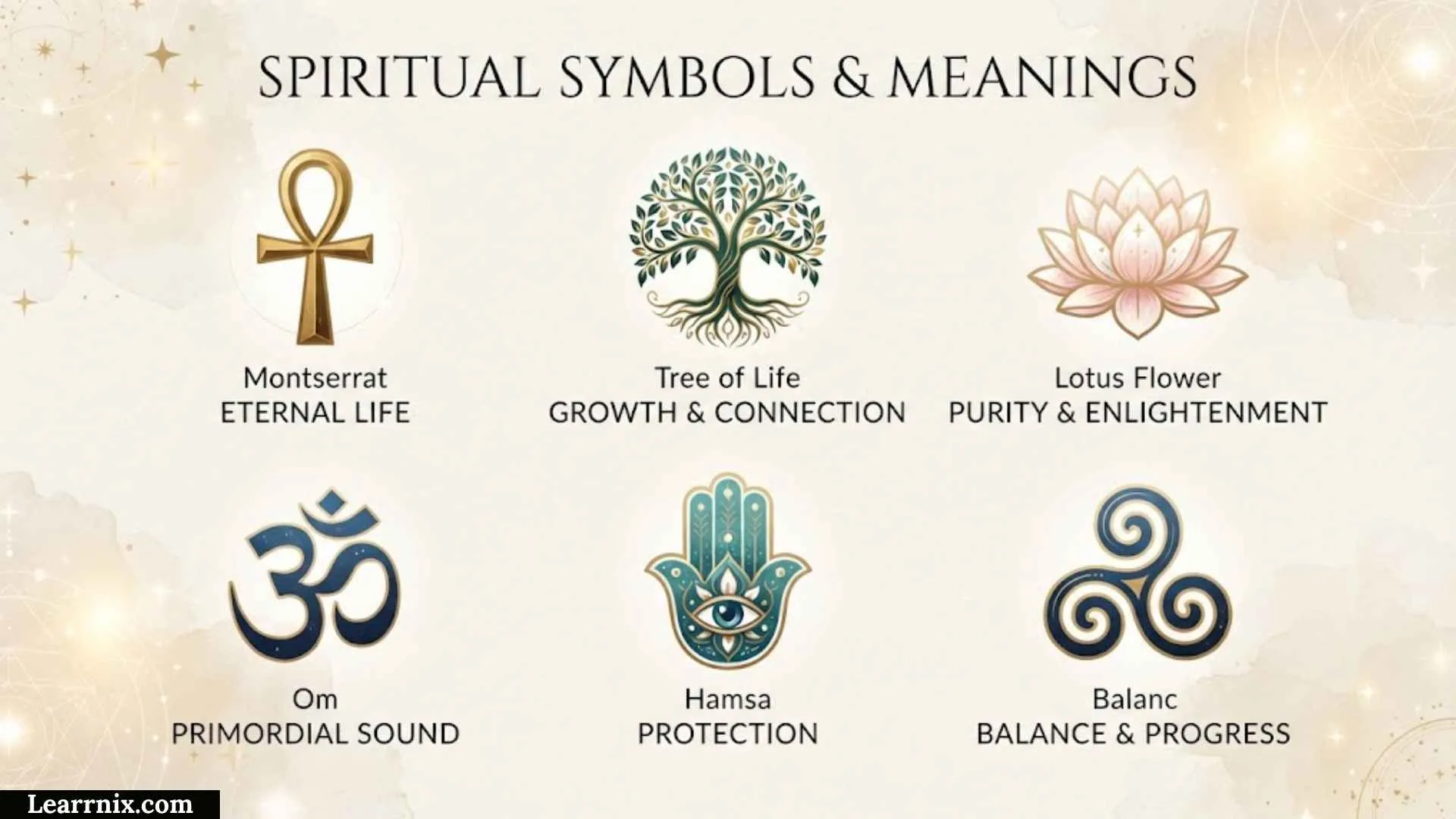
Spiritual symbols can communicate ideas that are difficult to express with words. A lotus may represent spiritual growth, an Om symbol may be connected with sacred sound and consciousness, while a tree can represent life, connection, and renewal. But the meaning of a spiritual symbol is rarely as simple as a one-word definition.
If you are searching for spiritual symbols and meanings, you may want to understand what a particular symbol represents, where it came from, how it has been used, and whether its modern interpretation matches its traditional meaning. This guide explores those questions in detail.
You will learn about major spiritual symbols from different cultural and religious traditions, the ideas commonly associated with them, how meanings change over time, common misconceptions, and how to research a symbol responsibly.
Quick Answer:
Spiritual symbols are images, shapes, objects, or designs used to represent spiritual, religious, philosophical, or cultural ideas. Their meanings depend on historical and cultural context. Common examples include the lotus for spiritual development, Yin Yang for complementary forces and balance, the Ankh for life in ancient Egyptian symbolism, the Hamsa for protection in several traditions, and the cross as a central Christian symbol.
What Are Spiritual Symbols?
A spiritual symbol is a visual representation that communicates an idea related to spirituality, religion, philosophy, nature, consciousness, or human existence.
Unlike ordinary signs, spiritual symbols often have several layers of meaning. Their significance may come from religious teachings, mythology, historical events, rituals, sacred texts, artistic traditions, or cultural practices.
For example, a tree can simply represent nature in an ordinary illustration. In a spiritual context, however, a tree may represent life, growth, ancestry, connection between different realms, or the continuing cycle of existence.
This is why looking up a symbol’s “meaning” should usually be the beginning of research rather than the end.
Spiritual Symbols vs. Religious Symbols
The terms spiritual and religious are related, but they are not identical.
A religious symbol is generally connected with an established religious tradition. Examples include the Christian cross, the Star of David in Judaism, and the Dharma wheel in Buddhism.
A spiritual symbol can have a broader meaning. It may be used within a religion, several traditions, a philosophical system, or an individual’s personal spiritual practice.
Some symbols therefore belong to both categories.
For example, the lotus has important meanings in Buddhist and Hindu traditions while also being used more broadly today as a symbol of personal growth and transformation.
Why Symbols Have Different Meanings
A symbol’s meaning can change because of:
- Culture
- Religion
- Historical period
- Geographic location
- Language
- Artistic tradition
- Ritual use
- Personal interpretation
- Modern popular culture
The same visual design may therefore mean something different in two different settings.
A responsible explanation should distinguish between a symbol’s traditional meaning and a modern or personal interpretation.
Why Spiritual Symbols Matter
Symbols have played an important role in human culture because they make abstract ideas easier to communicate.
Concepts such as eternity, consciousness, sacrifice, balance, protection, rebirth, and spiritual transformation can be difficult to explain visually. A symbol provides a compact representation that people can recognize and remember.
Symbols Make Abstract Ideas Easier To Understand
A circle, for example, has no obvious beginning or ending when viewed as a complete shape. Because of this visual quality, circular forms have often been associated with ideas such as wholeness, continuity, cycles, or eternity.
The shape itself does not prove that it has one universal spiritual meaning. Rather, cultures have developed symbolic interpretations around visual forms.
Symbols Can Connect People With Traditions
Religious and cultural symbols can connect individuals with a larger historical tradition.
A symbol used during a ceremony may remind people of beliefs, stories, values, ancestors, or sacred teachings. Its significance can therefore come from the community and tradition surrounding it.
Symbols Can Also Have Personal Meaning
People sometimes adopt symbols to represent personal experiences.
Someone who has overcome a difficult period may connect with the lotus because of its association with emerging from challenging conditions. Another person may choose a tree to represent family roots and personal growth.
Personal symbolism can be meaningful, but it should not automatically be presented as the historical meaning of the symbol.
Major Spiritual Symbols And Their Meanings
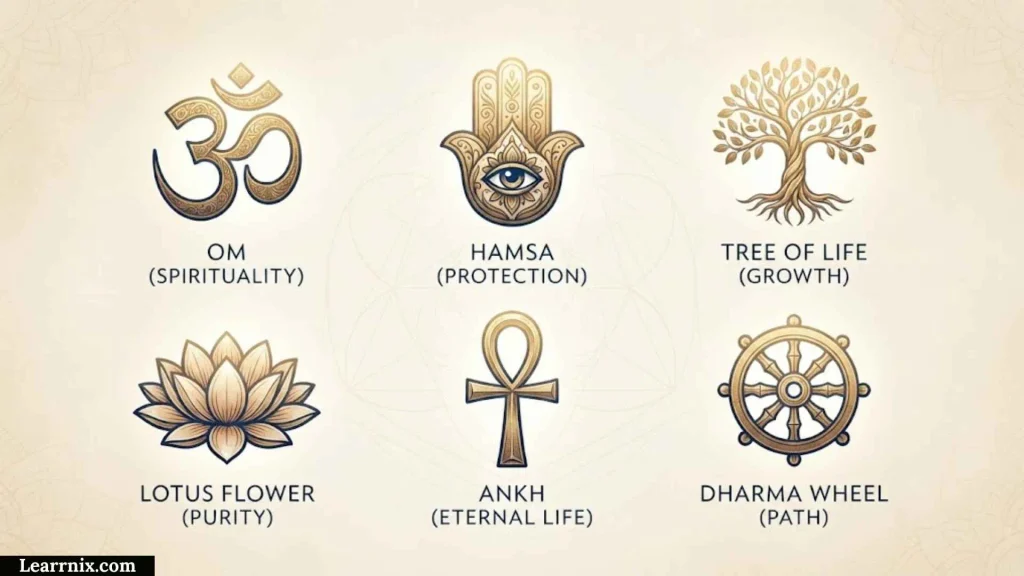
There are countless symbols associated with spiritual traditions around the world. The following examples are among the most recognizable and provide a useful starting point for understanding symbolic language.
Om Symbol
The Om, also written Aum, is an important sacred sound and symbol in Hindu traditions and related Indian philosophical traditions.
It is associated with sacred sound, consciousness, and ultimate reality. In Hindu philosophical thought, Om has been discussed in connection with different states of consciousness and meditation.
Its modern use extends beyond religious settings. You may see the symbol in yoga studios, meditation spaces, artwork, books, and jewelry.
Because Om has a specific cultural and religious history, it is more accurate to describe its traditional meanings than to reduce it to a generic symbol for “peace.”
Lotus Flower
The lotus is one of the most recognizable spiritual symbols in South Asian religious traditions.
Its growth from muddy water into a flower above the surface provides a powerful image for purity, spiritual development, and awakening. In Buddhism, the lotus is closely associated with teachings and imagery surrounding spiritual awakening. It also has important symbolic roles in Hindu traditions.
Different lotus colors and artistic representations can have different associations, so a simple online list should not be treated as a universal rule.
Yin Yang
The Yin Yang, commonly called the Taijitu, is associated with Chinese philosophy and particularly with Taoist thought.
The symbol illustrates complementary forces rather than a simple battle between good and evil. Each side contains a small portion of the other, visually expressing interdependence.
It is commonly discussed in relation to:
- Balance
- Complementarity
- Interdependence
- Change
- Harmony
- Dynamic relationships
A common mistake is to interpret Yin and Yang as “good versus bad.” That interpretation misses the more nuanced idea of complementary forces.
Cross
The cross is one of the central symbols of Christianity.
Its primary Christian significance is connected with the crucifixion of Jesus. Depending on Christian tradition and context, the cross can represent sacrifice, redemption, faith, salvation, and resurrection.
Different forms, including the Latin cross and other historical Christian crosses, can carry distinct cultural or denominational associations.
Star Of David
The Star of David, or Magen David, is widely associated with Judaism and Jewish identity.
The six-pointed design consists of two interlocking triangles. Its historical development is more complicated than some modern explanations suggest, and the symbol became strongly associated with Jewish identity particularly in more recent centuries.
Today it is used widely in Jewish religious, cultural, and communal contexts.
Hamsa
The Hamsa is a hand-shaped symbol found across parts of the Middle East and North Africa.
It has associations with multiple religious and cultural traditions, including Jewish and Islamic contexts. It is commonly connected with protection, blessing, and protection from the evil eye.
Because it exists across different traditions, its meaning should be explained according to the specific cultural context rather than assigned to only one religion.
Evil Eye
The evil eye refers to a widespread cultural belief that a harmful gaze, often connected with envy, can cause misfortune.
Protective objects associated with the evil eye appear across regions including the Mediterranean, Middle East, North Africa, and South Asia.
The familiar blue-and-white eye-shaped amulet is particularly associated with the Turkish nazar tradition. Similar protective beliefs and objects exist in many cultures, but they are not necessarily identical.
Tree Of Life
The Tree of Life is not a single symbol belonging to only one culture. Tree-of-life imagery appears in different religious, mythological, and cultural traditions.
Common themes include:
- Life
- Growth
- Roots and ancestry
- Connection
- Renewal
- Fertility
- Relationship between different realms
Its exact meaning depends heavily on the tradition in which it appears.
Ankh
The Ankh is a well-known ancient Egyptian symbol.
It is commonly interpreted as representing life and appears frequently in ancient Egyptian art, especially in the hands of deities. The symbol became strongly associated with concepts of life and vitality.
Modern culture sometimes gives the Ankh additional meanings, but its ancient Egyptian context is the foundation for understanding it.
Eye Of Horus
The Eye of Horus, also known as the Wedjat, is an ancient Egyptian symbol associated with Horus.
It has been connected with protection, healing, restoration, and well-being in ancient Egyptian religious symbolism.
The eye has a rich role in Egyptian mythology, making it more historically meaningful than the simplified modern description of it as merely a “protection symbol.”
Mandala
A mandala is generally a geometric design organized around a center.
Mandalas have important roles in Hindu and Buddhist traditions. In Tibetan Buddhism, elaborate mandalas can function as sacred visual representations used in religious practice and meditation.
Modern wellness culture often uses mandalas as general symbols of peace and mindfulness, but their traditional religious functions can be much more specific.
Dharma Wheel
The Dharma wheel, or Dharmachakra, is one of the important symbols of Buddhism.
The wheel is associated with the Buddha’s teachings and the path of Dharma. Its spokes are interpreted in different ways depending on Buddhist tradition and context.
Unlike generic decorative wheels, the Dharma wheel has a specific religious meaning rooted in Buddhist teachings.
Triquetra
The triquetra is a three-part interlaced design.
It is often described as a Celtic symbol, although its historical use and modern associations are more complicated. The design has appeared in Christian contexts as well, where threefold symbolism can be connected with the Trinity.
Modern interpretations commonly associate it with concepts such as eternity, interconnectedness, and threefold unity.
Spiritual Symbols By Meaning
Instead of searching for a symbol by its name, many people search according to the idea they want it to represent. This is where symbolic themes become especially useful.
Symbols Of Protection
Protection is a recurring theme in spiritual and religious symbolism.
Examples include the Hamsa, evil eye amulets, and the Eye of Horus.
However, these symbols should be understood as cultural or religious expressions of protective belief. There is no scientific basis for treating a symbolic object as a guaranteed physical protection device.
Symbols Of Love And Compassion
Love and compassion appear in many spiritual traditions.
The heart is the most familiar modern symbol of love, while the lotus can have associations with compassion and spiritual development in particular Buddhist and Hindu contexts.
When choosing a symbol for love, consider whether you want it to represent romantic love, family connection, compassion, devotion, or universal love. Different symbols may communicate different ideas.
Symbols Of Growth And Transformation
Growth is often represented through nature.
The lotus represents spiritual development in particular traditions. The Tree of Life can represent growth and connection. The butterfly is a common modern metaphor for transformation because of its biological life cycle.
The important distinction is that these meanings do not all have the same historical status. Some are deeply rooted in religious traditions, while others are modern symbolic interpretations.
Symbols Of Wisdom And Knowledge
Wisdom can be represented through eyes, books, light, sacred texts, trees, and animals such as owls.
The owl’s association with wisdom is especially strong in Western culture because of its connection with Athena in Greek mythology. It should therefore be understood as a mythological and cultural association rather than a universal spiritual rule.
Symbols Of Peace And Balance
Yin Yang is one of the clearest examples of a symbol associated with complementary forces and balance.
The dove is another widely recognized peace symbol, while certain religious and spiritual traditions use circles, flowers, or other sacred forms to communicate harmony.
Again, context matters. A symbol that represents balance in one tradition may have a different meaning in another.
Symbols Of Life And Renewal
The Ankh is strongly associated with life in ancient Egyptian symbolism.
The Tree of Life, lotus, sun, and seasonal imagery can also communicate life and renewal across different traditions.
These examples demonstrate why natural processes often become symbolic language. Growth, death, rebirth, sunrise, flowering, and seasonal change are experiences humans can observe directly and connect with broader philosophical ideas.
How Spiritual Symbolism Developed Throughout History
Humans have used symbolic imagery since ancient times. Religious art, burial objects, architecture, pottery, manuscripts, clothing, jewelry, and monuments have all carried symbolic meanings.
Ancient Egyptian Symbolism
Ancient Egyptian civilization developed a sophisticated visual language involving gods, animals, crowns, plants, eyes, and objects.
Symbols such as the Ankh and Eye of Horus were integrated into religious art and writing.
Their meanings cannot always be separated from Egyptian mythology, religious beliefs, and the social role of temples and rulers.
Indian Spiritual Traditions
Indian religious and philosophical traditions contain extensive symbolic systems.
Om, the lotus, chakras, mandalas, yantras, and various deities are examples of imagery that can carry layered philosophical and religious meanings.
These symbols should not be treated as interchangeable. Their meanings depend on the specific tradition, text, practice, and historical period.
Buddhist Symbolism
Buddhist traditions use a wide range of symbols, including the Dharma wheel, lotus, Bodhi tree, and various mudras and visual forms.
These symbols can help communicate teachings about suffering, liberation, compassion, wisdom, impermanence, and awakening.
Different Buddhist schools may use symbols in distinct ways.
Chinese Philosophical Symbolism
Chinese philosophy contains important symbolic concepts involving complementary forces, nature, cycles, and harmony.
The Yin Yang is one of the most recognizable examples. Understanding it requires more than interpreting the two colors as opposites; it is connected with a larger philosophical framework concerning relationships and change.
Celtic And European Symbolism
Celtic-inspired symbols are extremely popular in modern jewelry and artwork. Knots, spirals, crosses, and threefold patterns are often marketed with simple spiritual meanings.
However, modern “Celtic symbolism” can sometimes combine historical material with later artistic interpretations. Historical claims should therefore be checked against reliable sources.
How To Interpret A Spiritual Symbol Correctly
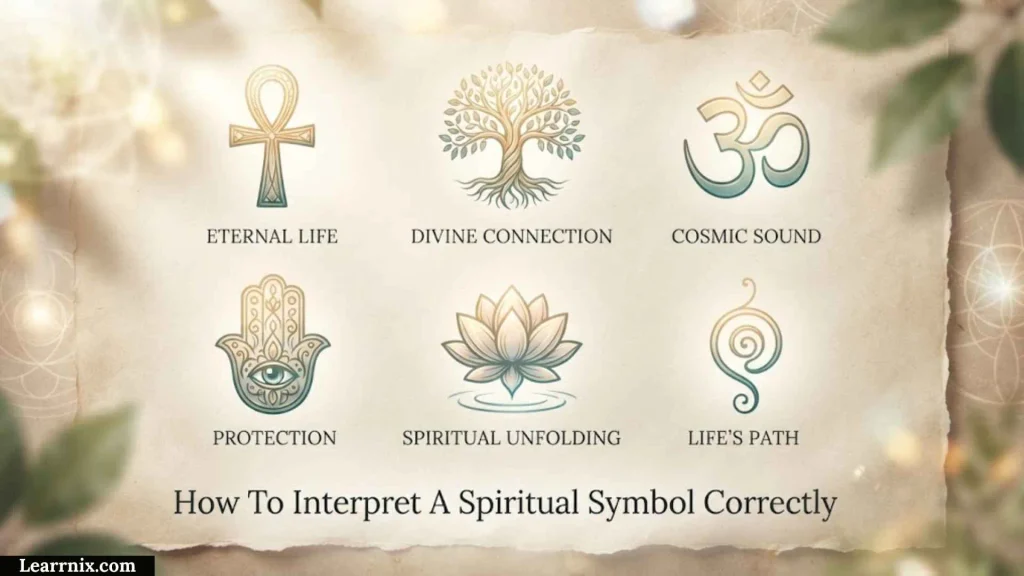
A symbol should be interpreted using context rather than a single online definition.
Step 1: Identify The Symbol
Start with the visual characteristics.
Is it a circle, hand, eye, flower, animal, cross, geometric pattern, or written character?
If you do not know the symbol’s name, describe its shape and surrounding elements when researching it.
Step 2: Find Its Cultural Origin
Ask where the symbol was historically used.
Was it associated with ancient Egypt, South Asia, East Asia, Europe, the Middle East, or another region?
This can immediately narrow down possible interpretations.
Step 3: Identify The Religious Or Philosophical Context
Determine whether it belongs to Hinduism, Buddhism, Christianity, Judaism, Islam, Taoism, ancient Egyptian religion, or another tradition.
Some symbols cross religious boundaries, so avoid assuming that one tradition owns every use of a particular design.
Step 4: Check Historical Sources
Look for museum collections, university resources, scholarly publications, religious institutions, and reputable reference works.
Be cautious with websites that provide highly specific meanings without explaining where those meanings came from.
Step 5: Separate Traditional And Modern Meanings
Ask whether a claimed interpretation is historically documented or primarily a modern spiritual interpretation.
This distinction is especially important for tattoos, jewelry, social-media posts, and commercial products.
A Simple Decision Guide For Choosing A Spiritual Symbol
If you are choosing a symbol for personal reflection, artwork, jewelry, or another purpose, use this process:
What idea do you want the symbol to represent?
↓
Protection → Research symbols such as the Hamsa or evil eye within their specific traditions.
Growth → Explore the lotus or Tree of Life and examine their historical meanings.
Balance → Research Yin Yang and the philosophical context behind it.
Life → Explore the Ankh and other life-related symbols from specific traditions.
Faith → Identify symbols belonging to the religious tradition you follow.
Wisdom → Research symbols associated with knowledge, insight, or particular deities and traditions.
Transformation → Consider symbols such as the lotus or modern butterfly symbolism, while distinguishing traditional meanings from contemporary ones.
Personal meaning → Choose a symbol whose historical context you understand and explain your personal interpretation separately.
This approach prevents you from selecting a symbol simply because a website assigns it an attractive one-word meaning.
Common Misconceptions About Spiritual Symbols
Online articles often simplify symbolism. Several misconceptions are worth avoiding.
Every Symbol Has One Universal Meaning
This is probably the most common mistake.
Symbols are products of culture and history. Their meanings can change across religions, countries, and time periods.
Modern Meaning Is Always Ancient Meaning
A symbol may become popular on social media, in fashion, or in modern spirituality long after its original use.
A contemporary interpretation should not automatically be presented as an ancient belief.
A Symbol Automatically Has Supernatural Power
A symbol can be spiritually important to a person without being scientifically proven to produce a supernatural effect.
Religious belief and scientific evidence are different categories of knowledge and should not be confused.
Similar Shapes Must Have The Same Origin
A spiral, circle, triangle, or cross can appear independently in different cultures.
Visual similarity does not necessarily prove historical connection.
One Religion Explains Every Use Of A Symbol
Some symbols are used across multiple traditions.
The Hamsa is an excellent example because it has appeared in different cultural and religious contexts.
Common Mistakes When Researching Spiritual Symbols
Understanding symbolism becomes easier when you know what to avoid.
Relying On One Website
A single website may repeat an interpretation that has been copied across many other websites.
Check multiple reliable sources, especially when making historical claims.
Ignoring Cultural Context
Calling every symbol “universal spirituality” can remove the cultural meaning that makes the symbol important.
Always ask where, when, and by whom it was used.
Confusing Mythology With History
Mythological stories are important sources of cultural meaning, but they should not automatically be presented as literal historical events.
Treating Modern Pinterest Or Social Media Meanings As Ancient Facts
Modern platforms frequently use simplified symbolic definitions. These can be useful for personal inspiration but may not accurately describe historical usage.
Using Sacred Symbols Without Understanding Them
Before using a religious or culturally important symbol in a tattoo, logo, product, or artwork, research its background.
This is particularly important when the symbol comes from a living religious tradition.
Practical Uses Of Spiritual Symbols Today
Spiritual symbols continue to appear in everyday life.
Jewelry
People may wear symbols because they identify with a faith, cultural tradition, personal value, or spiritual idea.
Before purchasing a symbol-based item, research what the design represents within its original tradition.
Tattoos
A tattoo can have deeply personal meaning. However, symbols associated with living religions or cultures should be approached respectfully.
A person may choose a lotus to represent personal growth, for example, while also recognizing its deeper significance in Buddhist and Hindu traditions.
Meditation And Reflection
Mandalas, sacred sounds, religious imagery, and other symbolic forms can be incorporated into contemplative practices depending on the tradition.
Home Decor
Symbols such as trees, flowers, geometric designs, and religious icons are commonly used as decorative elements.
When using sacred imagery as decoration, understanding its cultural significance helps avoid accidental misuse.
Art And Writing
Artists often use symbolic imagery to communicate themes that cannot be expressed directly.
A painting featuring a tree may explore ancestry, mortality, family, or renewal without explicitly explaining each idea.
How To Choose The Right Spiritual Symbol
There is no single “best” spiritual symbol because the appropriate choice depends on your purpose.
Ask yourself these questions:
- What do I want it to represent?
- Does the symbol have a documented connection with that idea?
- Where did the symbol originate?
- Is it connected with a living religion or culture?
- Am I using a traditional meaning or my own interpretation?
- Would I be comfortable explaining its history to someone who belongs to that tradition?
- Am I choosing it because I understand it or simply because it looks attractive?
These questions create a simple decision framework that is more reliable than choosing from a list of trendy symbolic meanings.
Spiritual Symbol Comparison Table
| Symbol | Common Meaning Or Association | Important Context |
| Om | Sacred sound, consciousness, ultimate reality | Hindu and related Indian traditions |
| Lotus | Purity, spiritual development, awakening | Hindu and Buddhist traditions |
| Yin Yang | Complementary forces, balance, change | Chinese philosophy and Taoist thought |
| Cross | Faith, sacrifice, redemption, salvation | Christianity |
| Star of David | Jewish identity and tradition | Judaism |
| Hamsa | Protection and blessing | Multiple Middle Eastern and North African traditions |
| Evil Eye | Protection from harmful gaze | Multiple cultures |
| Ankh | Life and vitality | Ancient Egypt |
| Eye of Horus | Protection, restoration, well-being | Ancient Egypt |
| Dharma Wheel | Buddha’s teachings and Dharma | Buddhism |
| Mandala | Sacred visual structure, contemplation | Hindu and Buddhist traditions |
| Tree of Life | Life, growth, connection, ancestry | Multiple traditions |
| Triquetra | Threefold unity, interconnectedness | Historical and modern Celtic/Christian contexts |
What Makes A Spiritual Symbol Meaningful?
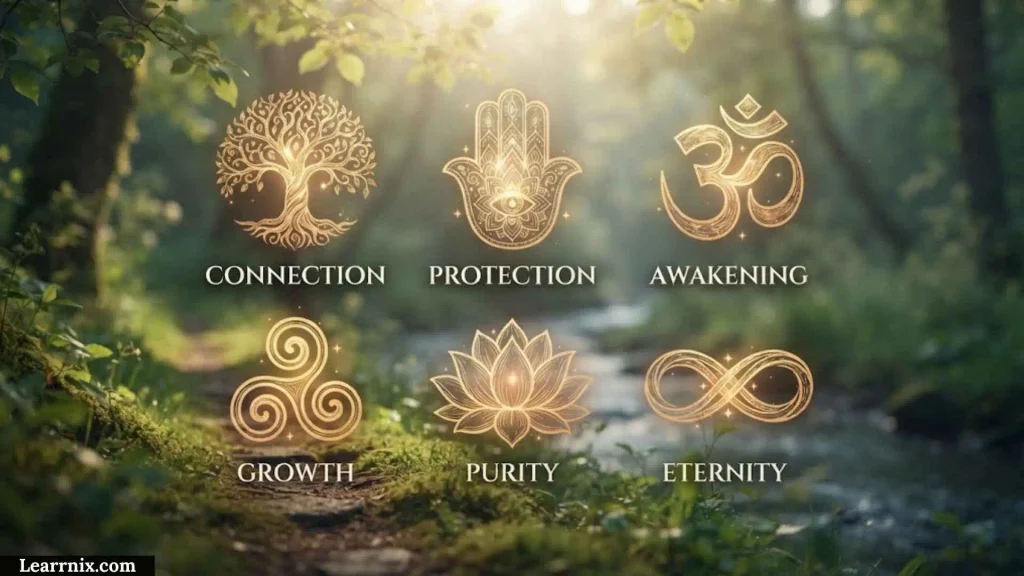
A symbol becomes meaningful through the relationship between the image and the ideas surrounding it.
Three factors are especially important.
Historical Meaning
This is what the symbol can be documented to represent in its historical context.
Cultural Meaning
This concerns how communities have understood and used the symbol.
Personal Meaning
This is the meaning an individual gives the symbol based on personal experiences or beliefs.
These three levels can coexist. Someone may use a lotus because it represents personal resilience while also appreciating its established role in Buddhist and Hindu traditions.
Editorial Note On Symbolic Meanings
Spiritual symbolism is a broad subject that includes religion, mythology, philosophy, anthropology, art history, and cultural studies. Because interpretations can differ, this article distinguishes documented traditional associations from modern and personal interpretations wherever possible.
A short definition such as “this symbol means protection” can be useful for a beginner, but it should not replace historical or cultural context.
For symbols connected with a living religious tradition, primary religious sources, museums, universities, and scholarly references are generally more useful than anonymous symbolism websites.
Frequently Asked Questions About Spiritual Symbols And Meanings
What Are The Most Common Spiritual Symbols?
Some widely recognized examples include Om, the lotus, Yin Yang, the cross, Star of David, Hamsa, evil eye, Ankh, Eye of Horus, Dharma wheel, mandala, and Tree of Life.
Their meanings differ by cultural and religious context.
What Symbol Represents Spiritual Awakening?
The lotus is strongly associated with spiritual development and awakening in Buddhist and Hindu traditions. Other symbols can represent awakening or enlightenment depending on the spiritual tradition being discussed.
What Symbol Represents Protection?
The Hamsa, evil eye amulet, and Eye of Horus are commonly associated with protection in particular cultural and historical traditions.
Their traditional associations should not be interpreted as scientific proof that the objects provide supernatural protection.
What Symbol Represents Growth?
The lotus and Tree of Life are commonly connected with growth and development. The butterfly is also widely used as a modern symbol of transformation.
The historical basis for these associations differs from symbol to symbol.
What Symbol Represents Balance?
The Yin Yang is strongly associated with complementary forces and balance in Chinese philosophical traditions.
Its meaning is more nuanced than simply representing good and evil.
What Symbol Represents Life?
The Ankh is strongly associated with life in ancient Egyptian symbolism. Other life-related symbols exist in many cultures, including tree and plant imagery.
What Is A Symbol Of Inner Peace?
There is no single universal symbol for inner peace. Lotus imagery, mandalas, certain Buddhist symbols, doves, and other designs may be associated with peace or contemplation depending on cultural context.
What Symbol Represents Transformation?
The lotus is associated with spiritual development in particular Asian traditions, while the butterfly is a common modern metaphor for transformation.
If historical accuracy matters, research the specific tradition behind the symbol.
Can Spiritual Symbols Have Different Meanings?
Yes. This is one of the most important principles of symbolism.
The same image can have different meanings depending on culture, religion, historical period, geographic region, and personal interpretation.
Are Spiritual Symbols Religious?
Some are explicitly religious, while others are broader cultural or philosophical symbols.
The distinction depends on the symbol and the context in which it is being used.
Can I Create My Own Spiritual Symbol?
Yes. People can create personal symbols to represent experiences, values, goals, or beliefs.
However, a personal symbol should not automatically be described as an ancient or traditional symbol unless there is historical evidence supporting that claim.
Should I Research A Symbol Before Getting It As A Tattoo?
Yes. This is especially important when the symbol comes from another religion or living culture.
Research its origin, traditional meaning, variations, and modern interpretations before permanently using it.
Key Takeaways About Spiritual Symbols
The most important lessons from this guide are:
- Spiritual symbols represent ideas that may include faith, life, protection, wisdom, balance, growth, and transformation.
- A symbol rarely has one universal meaning.
- Historical and cultural context matters.
- Religious symbols should be understood within their traditions.
- Modern interpretations are not always the same as historical meanings.
- Personal symbolism can be meaningful without being historically traditional.
- Similar-looking symbols do not necessarily have the same origin.
- Reliable sources are important when researching historical or religious symbolism.
- Sacred symbols should be used respectfully, particularly when they belong to a living religious or cultural tradition.
- A symbol’s meaning should be evaluated according to its purpose, origin, history, and context.
References
For further research into spiritual and religious symbolism, reputable institutional and academic resources are preferable to unsourced lists of symbolic meanings.
- The British Museum — collections and research covering ancient Egyptian, Asian, Middle Eastern, and other cultural traditions.
- The Metropolitan Museum of Art — educational material and collection resources on religious art, symbolism, and world cultures.
- Encyclopaedia Britannica — reference material covering religions, mythology, philosophy, and historical symbols.
- Smithsonian Institution — educational resources concerning world cultures, history, religion, and material culture.
- Oxford Reference — reference works covering religion, mythology, history, and cultural terminology.
- The Victoria and Albert Museum — collections and educational resources covering art, design, religion, and cultural symbolism.
These sources can help readers distinguish documented historical or religious interpretations from modern symbolic trends found online.

I am Daniel Harper, an education enthusiast and writer who enjoys creating helpful content to make learning more accessible and engaging.
I focus on sharing knowledge about effective study methods, educational growth, and skills that help learners succeed in a changing world.
Through my writing, I aim to inspire students to explore new ideas and develop a passion for learning.
Books by Daniel Harper:
- The Path to Lifelong Learning
- Unlocking Your Learning Potential
 Michael Carter