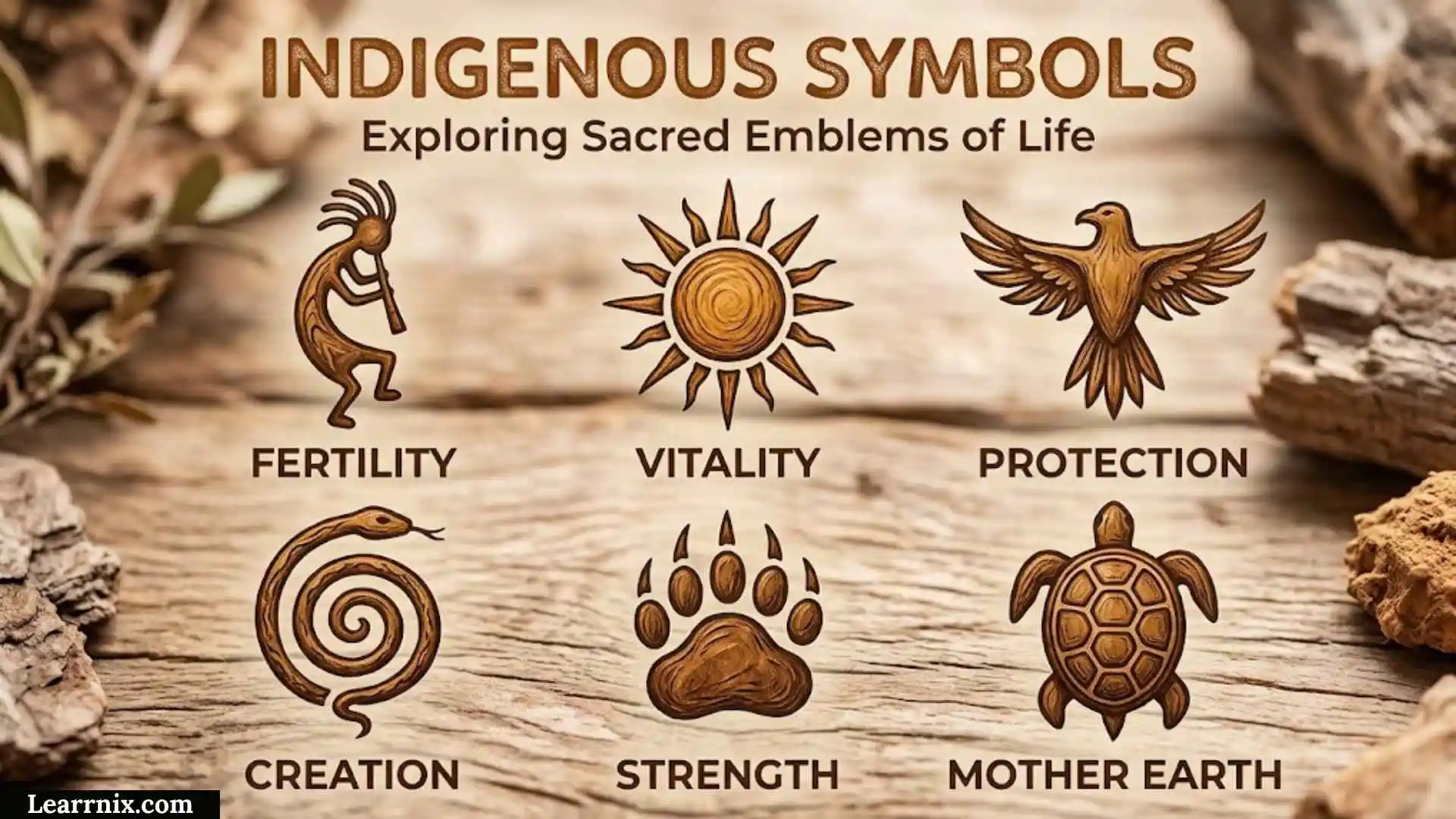
If you are searching for Indigenous symbols and their meanings, the most important thing to understand is that there is no single universal Indigenous symbol system. Indigenous peoples include thousands of distinct communities, nations, language groups, and cultural traditions. A symbol used by a Māori community in Aotearoa New Zealand may have a completely different meaning from a similar-looking design used by an Aboriginal Australian community or a First Nations nation in Canada.
Indigenous symbols can appear as animals, plants, geometric patterns, colors, carvings, tattoos, textiles, flags, ceremonial objects, architectural designs, and storytelling images. They can communicate identity, ancestry, family relationships, connection to Country or land, spirituality, history, social roles, and community knowledge.
This guide explains the major types of Indigenous symbolism, provides documented examples from different cultural traditions, explains why meanings vary, and shows how to research or interpret an Indigenous symbol without reducing a living culture to a simple dictionary of meanings.
Quick Answer: What Are Indigenous Symbols?
Indigenous symbols are visual or material forms used within particular Indigenous cultures to communicate identity, history, ancestry, relationships with land, spirituality, stories, community values, or cultural knowledge.
Examples include:
- Animals such as eagle, raven, bear, salmon, turtle, or Thunderbird
- Natural elements such as sun, moon, water, mountains, and earth
- Geometric patterns and circles
- Clan or family crests
- Māori tā moko motifs
- Aboriginal Australian art symbols
- Indigenous flags
- Carved figures on Northwest Coast monumental poles
- Woven patterns and textile motifs
- Culturally significant objects such as pounamu
The key point is that a symbol does not have one meaning simply because it appears in Indigenous art. AIATSIS specifically explains that Aboriginal and Torres Strait Islander art symbols can be regional or personal, dynamic, and capable of multiple meanings.
Why Indigenous Symbols Are Different From A Universal Symbol Dictionary
Many websites publish lists claiming that a particular Indigenous symbol always means something such as strength, protection, wisdom, or family. This approach can be misleading.
Indigenous cultures are not one culture. The term includes different peoples with their own languages, histories, territories, artistic systems, ceremonies, and relationships with land.
For example, the Government of Canada recognizes First Nations, Inuit, and Métis peoples as distinct Indigenous peoples with unique histories, languages, cultural practices, and spiritual beliefs.
This diversity means that context comes before interpretation.
Why Context Changes Symbolic Meaning
The same visual subject can have different meanings depending on:
- Indigenous nation
- Community
- Geographic region
- Artist
- Family or clan
- Ceremony
- Historical period
- Type of object
- Position within a design
- Color
- Relationship to other symbols
A circle, for example, may communicate cycles or relationships in one context while functioning as part of a particular artistic convention in another.
A bird may represent a clan crest in one tradition, a mythological being in another, and simply an animal subject in a contemporary artwork.
The Best Rule For Understanding Indigenous Symbols
Before asking “What does this symbol mean?”, ask:
“Which Indigenous community does this symbol come from, and how does that community explain it?”
That question immediately produces a more accurate interpretation.
Major Types Of Indigenous Symbols
Indigenous symbolism appears in many forms rather than one fixed visual language.
| Type | Examples | What It Can Communicate |
| Animal imagery | Eagle, raven, bear, salmon | Identity, stories, relationships, ancestry |
| Plants | Trees, flowers, medicinal plants | Land, food, healing, cultural knowledge |
| Celestial imagery | Sun, moon, stars | Time, seasons, spirituality, navigation |
| Geometric designs | Circles, lines, spirals | Identity, relationships, cycles, artistic language |
| Clan or family crests | Animals and supernatural beings | Lineage, history, social identity |
| Body designs | Tā moko and other Indigenous tattoo traditions | Identity, genealogy, role, status |
| Textiles | Woven patterns and motifs | Community, history, place, identity |
| Flags | Aboriginal Flag and other Indigenous flags | Collective identity and political or cultural history |
| Carvings | Poles, sculptures, objects | Stories, ancestors, events, relationships |
| Ceremonial objects | Masks, drums, clothing, tools | Cultural, spiritual, social, or ceremonial roles |
This broad range is why “Indigenous symbols” is best understood as a category of cultural expression, not as one standardized symbol system.
Animal Symbols In Indigenous Cultures
Animals are among the most recognizable subjects in Indigenous art and storytelling.
However, animal symbolism should not be reduced to a modern list such as “eagle equals freedom” or “bear equals strength.” In many traditions, animals have relationships with creation stories, family histories, clan identities, food systems, landscapes, ceremonies, or supernatural narratives.
Eagle Symbols
Eagle imagery has important cultural and spiritual significance in a number of Indigenous North American traditions.
Depending on the community, eagle imagery may relate to spiritual relationships, prayer, strength, vision, leadership, or other teachings.
The important point is that there is no single Indigenous definition of the eagle.
When researching an eagle symbol, identify the nation, artist, object, and cultural context before assigning a meaning.
Raven Symbols
Raven is particularly important in several Indigenous cultures of the Pacific Northwest.
In Northwest Coast traditions, raven can appear as a crest figure and in stories involving transformation, ancestry, and supernatural events.
The Smithsonian has documented Northwest Coast crest figures such as raven, bear, eagle, killer whale, and Thunderbird as elements associated with family and lineage.
This makes raven imagery an excellent example of why a symbol may communicate identity and ancestry, rather than simply a personality trait.
Bear Symbols
Bear imagery also occurs across numerous Indigenous traditions.
In some cultural contexts, bears may be associated with strength, healing, protection, family, or other qualities. But the exact meaning depends on the community and artwork.
A bear figure should therefore be interpreted through its specific cultural source rather than automatically labeled with a universal meaning.
Salmon Symbols
Salmon is especially significant in several Indigenous communities of the Pacific Northwest.
Its importance can relate to:
- Food
- Rivers
- Seasonal cycles
- Community
- Renewal
- Cultural relationships with waterways
A salmon image can therefore communicate a relationship between people and their environment rather than merely representing an animal.
Thunderbird Symbols
The Thunderbird is a powerful supernatural figure in several Indigenous traditions of the Pacific Northwest.
A Canadian Heritage description of a Kwakwaka’wakw totem pole identifies a Thunderbird at the top of the pole and explains its role within the cultural mythology represented by the carving. The same pole includes other figures such as salmon and the sisiutl, demonstrating how multiple beings can form part of a larger cultural narrative.
This is an important distinction: Thunderbird imagery should not simply be described as a generic “Native American bird symbol.” It belongs to particular Indigenous traditions and stories.
Turtle Symbols
Turtle imagery appears in multiple Indigenous traditions.
In some North American contexts, turtles are associated with creation stories, earth, longevity, or relationships with land. But because turtle symbolism occurs among different nations, the specific tradition must be identified before assigning a precise meaning.
Nature Symbols And Their Cultural Meaning
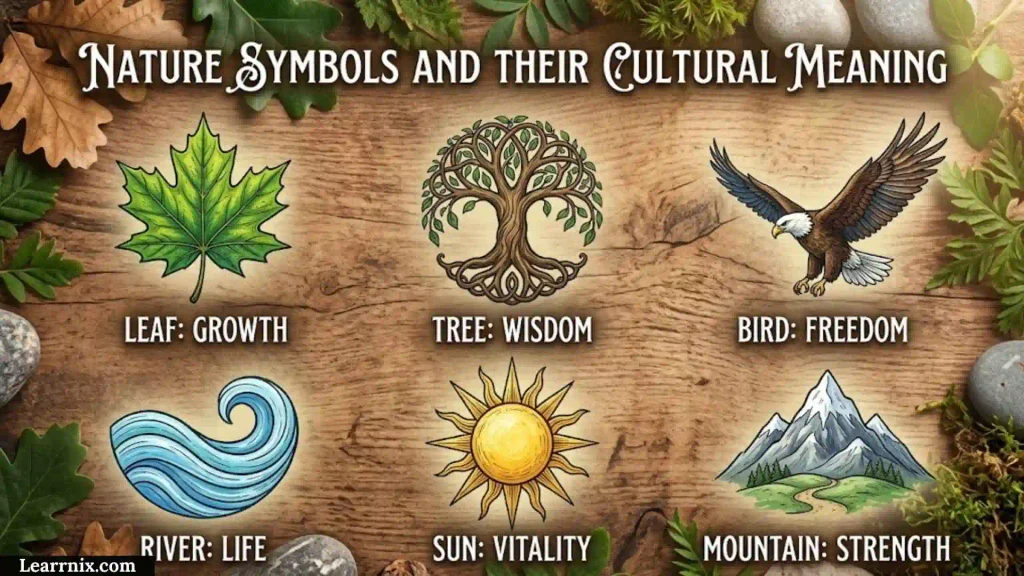
Nature is an important subject in many Indigenous artistic traditions, but this does not mean all Indigenous cultures use nature symbols in the same way.
Common subjects include:
- Sun
- Moon
- Stars
- Water
- Rivers
- Mountains
- Trees
- Plants
- Fire
- Earth
- Wind
- Animals
These images can communicate relationships with place, seasonal cycles, food, spirituality, ancestry, or ecological knowledge.
Sun Symbols
The sun is a powerful image across many cultures, including Indigenous cultures.
It may be associated with:
- Light
- Life
- Time
- Seasons
- Creation
- Spiritual relationships
But the meaning depends on the cultural tradition.
A particularly well-documented modern example is the Aboriginal Flag of Australia. AIATSIS explains that the yellow circle represents the sun, while black represents Aboriginal people and red represents the earth and ochre.
This example is useful because the meaning comes from a specific documented flag rather than from a generic claim about all Indigenous cultures.
Moon And Star Symbols
Moon and star imagery can be connected with:
- Seasonal cycles
- Time
- Navigation
- Ancestral stories
- Spiritual knowledge
- The sky
The interpretation depends heavily on the cultural tradition and the artwork in which the celestial imagery appears.
Water Symbols
Water may be represented through waves, rivers, fish, flowing lines, or other designs.
It can relate to:
- Life
- Food
- Travel
- Rivers
- Oceans
- Creation
- Community
- Place
For communities whose histories and livelihoods are strongly connected with rivers, lakes, or oceans, water imagery may communicate an entire relationship with Country rather than one simple abstract idea.
The Circle In Indigenous Symbolism
The circle is a common visual form in many Indigenous artistic traditions.
It can sometimes be connected with:
- Cycles
- Community
- Continuity
- Relationships
- Seasons
- Wholeness
However, it is inaccurate to claim that the circle always means one particular thing in Indigenous cultures.
A documented example comes from Indigenous memorial design in Canada. The National Native American Veterans Memorial at the Smithsonian incorporates circular forms and the four directions within a larger symbolic design. Its meaning comes from the complete architectural and cultural context rather than from the circle alone.
The lesson is important: shape alone rarely provides enough evidence to determine meaning.
Four Directions And Four-Part Designs
Four-direction symbolism appears in a number of Indigenous traditions.
A four-part design can refer to:
- North
- South
- East
- West
- Seasons
- Stages of life
- Elements
- Spiritual teachings
- Relationships between different parts of a community
But the associations differ among nations.
A four-part design should therefore be interpreted using the explanation provided by the specific community, artist, or cultural institution.
Aboriginal Australian Symbols
Aboriginal and Torres Strait Islander art contains some of the world’s best-known Indigenous visual traditions.
Yet it is also one of the areas where generic online symbol dictionaries can create serious misunderstandings.
AIATSIS explains that Aboriginal and Torres Strait Islander art symbols may be regional, personal, dynamic, and capable of multiple meanings. It specifically warns against the idea that every symbol has one fixed definition.
Why Aboriginal Art Symbols Can Have Multiple Meanings
An image may communicate different information depending on:
- Location
- Story
- Artist
- Community
- Country
- Arrangement
- Color
- Audience
- Cultural knowledge
For example, a circular design might represent a place, person, gathering, or another concept depending on the artwork.
This makes interpretation more like reading a visual language than translating individual icons.
Contemporary Aboriginal Symbolism
Indigenous symbolism is not limited to ancient or historical art.
AIATSIS has documented contemporary Aboriginal artists who use symbols to communicate family relationships and generations. In one documented example, artist Maree Clarke described symbols representing men and women and other forms representing different generations of her family.
This demonstrates that Indigenous symbolism continues to develop and communicate contemporary experiences.
The Aboriginal Flag As A Modern Indigenous Symbol
The Aboriginal Flag is one of the clearest examples of a documented modern Indigenous symbol.
AIATSIS identifies Harold Thomas, a Luritja man, as the designer of the flag. The design uses:
- Black for Aboriginal people
- Red for the earth and ochre
- Yellow for the sun
The flag was first raised publicly in 1971.
Why The Aboriginal Flag Is Different From Traditional Art Symbols
Unlike an ancient motif whose meaning may be reconstructed through multiple sources, the Aboriginal Flag has a documented creator and stated symbolism.
That makes it possible to discuss its meaning with considerably more confidence.
It also demonstrates that Indigenous symbolism includes modern political, cultural, and identity symbols, not only traditional artwork.
Māori Symbols And Cultural Motifs
Māori visual culture provides another distinct Indigenous symbolic tradition from Aotearoa New Zealand.
Important forms include:
- Tā moko
- Whakairo
- Tāniko
- Pounamu
- Waka imagery
- Meeting-house designs
- Textile patterns
Te Papa describes Māori cultural treasures, or taonga, as including carvings, ornaments, garments, tools, weapons, and other objects that carry cultural meaning and connections with Māori heritage.
Tā Moko And Its Symbolism
Tā moko is the traditional Māori practice of marking the body with culturally significant designs.
Te Papa explains that the motifs form a visual language connected with artistic expression, identity, role, and potentially genealogy and social status. It also emphasizes that the meanings and significance of moko are complex.
This is why tā moko should not be treated simply as a decorative tattoo style.
Pounamu As A Cultural Symbol
Pounamu, often called New Zealand greenstone, is an important material in Māori culture.
It has historically been used for tools, weapons, ornaments, and other objects. A pounamu object can therefore communicate relationships involving craftsmanship, ancestry, gifting, status, and cultural identity depending on the object and context.
The material itself and the finished object should not automatically be assigned one universal symbolic meaning.
First Nations Symbols In Canada
Canada is home to many distinct Indigenous peoples, including First Nations, Inuit, and Métis communities.
Canadian official sources document Indigenous emblems and motifs in public art, coats of arms, monuments, flags, and cultural objects.
For example, Canada’s official symbols information notes Indigenous emblems incorporated into provincial and territorial heraldry, including the Mi’kmaq eight-pointed star, Wolastoqiyik wampum, and Inuit inukshuk and qulliq.
Totem Pole Symbols
Totem poles are especially associated with Indigenous peoples of the Pacific Northwest.
They can contain figures representing:
- Family histories
- Ancestors
- Clan or lineage relationships
- Supernatural beings
- Animals
- Important events
- Cultural stories
A Canadian Heritage example of a Kwakwaka’wakw pole includes Thunderbird, salmon, a man holding salmon, and sisiutl imagery.
Another important example is the Gwaii Haanas Legacy Pole, which was designed around the theme “Land, Sea, People.” Parks Canada explains that the pole represents the relationship between the Haida Nation and the protection of Gwaii Haanas, with figures representing people and events connected to that history.
This shows how a monumental pole can function as a historical narrative, not simply a collection of animal symbols.
Why Totem Poles Should Not Be Treated As Simple Symbol Charts
A common misconception is that every figure carved on a pole has a fixed universal meaning.
In reality, the significance can depend on the nation, family, artist, history, and purpose of the pole.
Research on the Ni’isjoohl pole, for example, describes monumental poles as connected with oral histories, ancestors, places, relationships with the spiritual world, and important events.
Indigenous Symbols In Andean Textiles
Indigenous symbolism is also expressed through textiles in the Andes.
The Library of Congress documents Andean textile traditions containing motifs such as the sun, stars, flowers, and llamas. It also notes that color and placement can influence interpretation.
This provides another useful example of why a symbol should not be separated from the object on which it appears.
A motif may have one meaning in isolation but acquire additional meaning from:
- Color
- Position
- Repetition
- Neighboring motifs
- Textile type
- Community
- Historical period
Textiles can therefore operate as visual records of community knowledge and identity.
Indigenous Symbols And Identity
One of the most important functions of Indigenous symbolism is the communication of identity.
A symbol can identify:
- A nation
- A family
- A clan
- An ancestor
- A place
- A community
- A person’s role
- A cultural tradition
Māori tā moko provides a strong example because Te Papa explains that moko can communicate identity, role, and aspects of genealogy and status.
Northwest Coast crest imagery provides another example, where animal and supernatural figures can communicate family and lineage.
Why Identity Matters
A symbol that communicates identity is not necessarily equivalent to a modern logo.
It may carry obligations, ancestral relationships, community history, or cultural authority.
This is why copying an Indigenous design without understanding its context can be more complicated than simply borrowing a decorative pattern.
Indigenous Symbols And Connection To Land
Many Indigenous cultural traditions place strong importance on relationships with land, water, animals, plants, and specific places.
Symbols may communicate:
- Country
- Territory
- Rivers
- Mountains
- Coastal areas
- Traditional food sources
- Sacred places
- Seasonal movement
- Ancestral relationships
The Gwaii Haanas Legacy Pole is a particularly clear modern example. Its “Land, Sea, People” theme connects the visual design with Haida relationships to place and with a specific history of protecting Gwaii Haanas.
This illustrates a broader principle: Indigenous symbolism can describe relationships with place rather than simply representing an object.
Indigenous Symbols And Storytelling
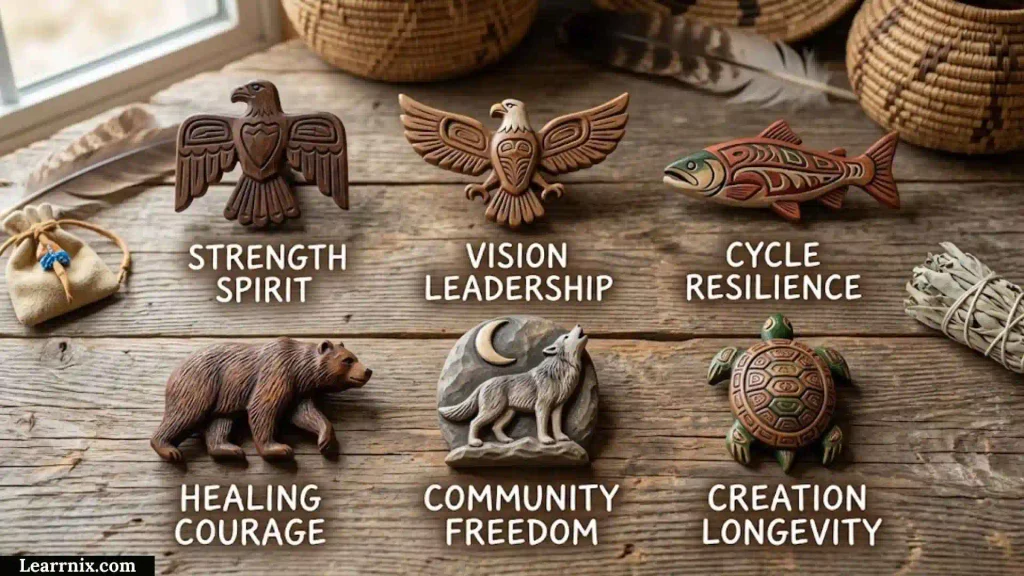
Symbols can preserve and communicate stories.
A carved figure may represent an ancestor. An animal may refer to a family history. A landscape may refer to a place connected with an important event.
Northwest Coast crest figures can relate to ancestral histories, transformations, journeys, marriages, and other stories.
Similarly, Aboriginal Australian artworks can use visual forms to communicate stories and knowledge connected with Country.
The artwork is therefore often best understood as a story system, not a collection of isolated icons.
Indigenous Symbols And Ceremonial Objects
Some Indigenous symbols appear on objects used in ceremonial or culturally significant settings.
These can include:
- Masks
- Drums
- Clothing
- Jewelry
- Carvings
- Body designs
- Woven objects
- Ceremonial structures
- Musical instruments
An important distinction is that an object may have a function as well as symbolic meaning.
For example, a carved object may be both a physical item and a carrier of ancestral or community knowledge.
This is why museum descriptions often provide more useful information than simple “symbol meaning” websites.
Why Some Indigenous Symbols Are Culturally Sensitive
Not every Indigenous design should be treated as freely reusable decoration.
Some cultural knowledge, imagery, ceremonies, objects, or designs may be restricted, sacred, family-specific, community-specific, or connected with particular roles.
The National Museum of the Indigenous peoples of America explains that some collection information and images are withheld or restricted because Indigenous communities have identified cultural sensitivities around them.
This is a strong reminder that availability online does not automatically mean unrestricted cultural use.
How To Research An Indigenous Symbol Correctly
If you find an Indigenous symbol on a website, artwork, tattoo, textile, monument, or object, use a structured research process.
Step 1: Identify The Cultural Origin
Start by asking:
Which Indigenous nation, people, or community created or uses this symbol?
Do not stop at a broad label such as “Native American” or “Aboriginal.”
Step 2: Identify The Artist Or Source
Look for:
- Artist name
- Community
- Museum collection
- Cultural institution
- Historical record
- Indigenous organization
- Government cultural source
A named source is much stronger than an anonymous symbol chart.
Step 3: Determine The Symbol’s Function
Ask whether it is:
- A family crest
- A clan emblem
- A tattoo motif
- A ceremonial design
- A flag
- A storytelling image
- A contemporary artwork
- A historical object
- A decorative pattern
The function can dramatically change the interpretation.
Step 4: Check Historical Context
Determine whether the design is:
- Traditional
- Historical
- Contemporary
- Revived
- Adapted
- Created for a modern political movement
The Aboriginal Flag, for example, is a modern Indigenous identity symbol with a documented creator and history.
Step 5: Look For The Community’s Own Explanation
Whenever possible, prioritize explanations from:
- Indigenous communities or artists
- Indigenous cultural institutions
- Museums with specialist collections
- Government cultural institutions
- Academic research
This approach is more reliable than repeating unsourced internet claims.
A Practical Decision Tree For Identifying Indigenous Symbols
Use this quick decision guide:
Do you know where the symbol comes from?
→ No: Do not assign a specific meaning yet. Identify the cultural source first.
→ Yes: Continue.
Is the meaning documented by the community, artist, museum, or reliable cultural institution?
→ No: Treat online interpretations as uncertain.
→ Yes: Continue.
Is the design connected with genealogy, ceremony, status, or restricted cultural knowledge?
→ Yes: Research cultural protocols before reproducing it.
→ No: Continue researching its historical and artistic context.
Is it a contemporary artwork?
→ Yes: Use the artist’s own explanation where available.
Is it being used commercially?
→ Yes: Check permissions, attribution, cultural protocols, and applicable intellectual-property rules.
This decision tree helps prevent the most common error: taking a design out of its original context and giving it a new meaning.
Common Mistakes When Interpreting Indigenous Symbols
Treating Indigenous Peoples As One Culture
This is the biggest mistake.
“Indigenous” is a broad category, not a single cultural identity.
Assuming Every Symbol Has One Meaning
AIATSIS specifically warns that Aboriginal and Torres Strait Islander art symbols can have regional or personal meanings and may be dynamic rather than fixed.
Using Generic Native American Symbol Lists
A list that combines symbols from dozens of unrelated nations may make the information look comprehensive while actually removing cultural context.
Confusing A Symbol With An Object
A drum, carving, textile, tattoo, or mask may have a practical, ceremonial, artistic, historical, and symbolic role at the same time.
Assuming Ancient Means Unchanging
Indigenous cultures are living cultures. Contemporary Indigenous artists continue to develop visual languages and use traditional knowledge in new ways. AIATSIS’s documentation of contemporary Aboriginal artists provides clear evidence of this continuity and innovation.
Copying A Design Without Research
A design may look decorative to an outsider while carrying information about identity, ancestry, ceremony, or status.
Research should come before reproduction.
Indigenous Symbols Vs. Universal Symbols
The difference between cultural and universal symbolism can be useful when researching a design.
| Indigenous Cultural Symbolism | Broad Universal Symbolism |
| Connected to a particular community or tradition | Often shared across many cultures |
| Meaning may depend on ancestry or identity | Meaning is often more general |
| Can be tied to land or Country | May have little geographic connection |
| May communicate family or clan history | Usually communicates a broad idea |
| Can have ceremonial protocols | Often freely used in everyday communication |
| Interpretation depends heavily on cultural context | Interpretation may be relatively standardized |
This does not mean every Indigenous symbol is sacred or restricted. It means that the possibility of cultural specificity should be investigated rather than assumed away.
Can Indigenous Symbols Be Used In Tattoos?
This is one of the most common practical questions.
The answer depends entirely on the symbol.
Māori tā moko, for example, is not simply a collection of attractive geometric tattoo designs. Te Papa describes moko as a visual language associated with identity, role, artistic expression, and potentially genealogy and status.
Before using an Indigenous motif as a tattoo, ask:
- Which culture does it belong to?
- Is it traditional or contemporary?
- Does it communicate genealogy?
- Does it indicate social role or status?
- Is it connected with ceremony?
- Has the artist or community provided guidance?
- Are there cultural protocols around reproduction?
When the answer is unclear, choosing a generic non-Indigenous design is safer than assigning your own meaning to an Indigenous motif.
Can Indigenous Symbols Be Used In Logos And Business Designs?
Commercial use requires even more care.
A business owner may find an Indigenous-looking pattern attractive, but visual similarity does not establish permission or cultural appropriateness.
Before using a design commercially, check:
- Cultural origin
- Artist attribution
- Copyright
- Trademark considerations
- Community protocols
- Cultural restrictions
- Whether the design communicates identity or status
- Whether an Indigenous artist created the work
Canadian Heritage specifically discusses Indigenous traditional knowledge, cultural expressions, and protocols in relation to creative industries.
The safest approach is to work directly with an Indigenous artist or cultural organization when a project genuinely needs Indigenous visual representation.
Why Indigenous Symbols Still Matter Today
Indigenous symbols are not simply historical artifacts.
They continue to appear in:
- Contemporary art
- Public monuments
- Museums
- Flags
- Fashion
- Architecture
- Tattoos
- Jewelry
- Community events
- Cultural education
- Political and social movements
The Gwaii Haanas Legacy Pole, for example, is a contemporary monumental work that communicates a specific relationship between the Haida Nation, Canada, land, sea, and conservation history.
Similarly, contemporary Aboriginal artists continue to use visual symbols to communicate family, generations, Country, and identity.
This demonstrates that Indigenous symbolism is a living practice rather than a subject confined to the distant past.
A Useful Checklist For Respectful Symbol Research
Before publishing, drawing, tattooing, selling, or teaching an Indigenous symbol, check the following:
- Have I identified the specific Indigenous culture?
- Do I know the community or nation?
- Do I know who created the artwork?
- Is the source authoritative?
- Is the symbol traditional or contemporary?
- Does it have multiple meanings?
- Is it connected with genealogy or status?
- Is it ceremonial or culturally sensitive?
- Am I confusing an object with a symbol?
- Am I using a generic online definition without evidence?
- If commercial, have I checked cultural and legal considerations?
- Have I preserved the original cultural context?
This checklist is especially useful for writers, designers, students, educators, tattoo clients, marketers, and content creators.
Frequently Asked Questions About Indigenous Symbols
What Are The Most Common Indigenous Symbols?
There is no universal list. Commonly encountered examples include animals, celestial bodies, natural elements, geometric patterns, clan crests, flags, tattoo motifs, and culturally significant objects. Their meanings depend on the specific Indigenous tradition.
What Is A Symbol Of Indigenous Identity?
There is no single worldwide symbol of Indigenous identity. Individual Indigenous peoples and nations may have their own flags, emblems, animals, patterns, artwork, or other identity markers.
What Does The Eagle Symbolize In Indigenous Culture?
The eagle has important meanings in several Indigenous North American traditions, but those meanings are not identical everywhere. It may have spiritual, ceremonial, or community-specific significance depending on the nation.
What Does The Turtle Symbolize In Indigenous Cultures?
Turtle symbolism varies among Indigenous nations. In some North American traditions it can be associated with creation, earth, longevity, or cultural teachings. The specific community should be identified before giving a definitive interpretation.
What Does The Thunderbird Symbolize?
The Thunderbird is a powerful supernatural figure in several Indigenous traditions, especially in parts of the Pacific Northwest. Its stories and significance differ among communities. A Canadian Heritage example identifies Thunderbird as part of Kwakwaka’wakw visual heritage.
What Does The Aboriginal Flag Mean?
According to AIATSIS, the Aboriginal Flag uses black to represent Aboriginal people, red for the earth and ochre, and yellow for the sun. It was designed by Harold Thomas and first raised publicly in 1971.
What Do Indigenous Circles Mean?
There is no single universal meaning. Depending on the culture and artwork, circular forms can relate to cycles, community, relationships, places, gatherings, or other ideas.
Are Indigenous Symbols Sacred?
Some Indigenous symbols, designs, objects, stories, and forms of knowledge can be sacred or culturally restricted, while many others are not. The status of a symbol must be determined within its specific cultural context.
Can I Use An Indigenous Symbol As A Tattoo?
Not automatically. Some designs may communicate identity, genealogy, status, or cultural belonging. Māori tā moko is one example where the meaning goes far beyond ordinary decorative tattooing.
Can I Use Indigenous Symbols For A Business Logo?
You should research the specific design, cultural protocols, artist rights, and applicable intellectual-property rules before using it commercially. Working directly with an Indigenous artist or community is preferable when authentic cultural representation is intended.
Are Indigenous Symbols Still Used Today?
Yes. Indigenous artists and communities continue to use traditional and contemporary visual languages in art, monuments, textiles, tattoos, flags, architecture, and other cultural expressions.
Key Takeaways About Indigenous Symbols
- Indigenous symbolism is not one universal system.
- Different Indigenous peoples have distinct visual traditions.
- Symbols can communicate identity, ancestry, land, spirituality, history, family, and community.
- Animal imagery can have different meanings in different nations.
- Aboriginal Australian symbols may have regional, personal, and multiple meanings.
- Māori tā moko uses a complex visual language connected with identity and role.
- Northwest Coast monumental poles can communicate family histories, ancestors, places, and important events.
- The Aboriginal Flag is a documented modern Indigenous identity symbol with specific meanings assigned to its colors.
- Contemporary Indigenous artists continue to develop and use symbolic visual languages.
- A symbol’s meaning should be researched through its specific cultural context, not a generic internet dictionary.
- Some cultural designs may involve protocols or restrictions around reproduction.
- Indigenous symbolism should be approached as a living cultural practice rather than simply as decoration.
Conclusion
Indigenous symbols are powerful forms of visual communication, but their meaning cannot be reduced to one universal list. Across Aboriginal Australian, Māori, First Nations, Inuit, Native American, Andean, and other Indigenous traditions, symbols can communicate relationships with land, ancestry, family, spirituality, identity, history, and community.
Animals such as eagle, raven, bear, salmon, turtle, and Thunderbird can carry important meanings, while the sun, moon, water, earth, geometric forms, textiles, tattoos, flags, and carvings provide other ways of expressing cultural knowledge. Yet each example must be understood through its own cultural setting.
The most reliable way to interpret an Indigenous symbol is to identify who created or uses it, which community it belongs to, what purpose it serves, and how that community explains its meaning. This approach avoids the common mistake of turning complex living traditions into fixed symbol charts.
For students, researchers, writers, designers, and anyone interested in Indigenous art, that context-first approach provides a more accurate and respectful understanding of what these symbols communicate.

I am Michael Carter, an educational content creator who believes that knowledge has the power to transform lives.
I create resources focused on modern education, digital learning, and building essential skills for the future.
I love helping readers discover simple and effective ways to improve their learning journey.
Books by Michael Carter:
- Modern Education for Tomorrow’s World
- Learning Skills for Future Success
 Daniel Harper