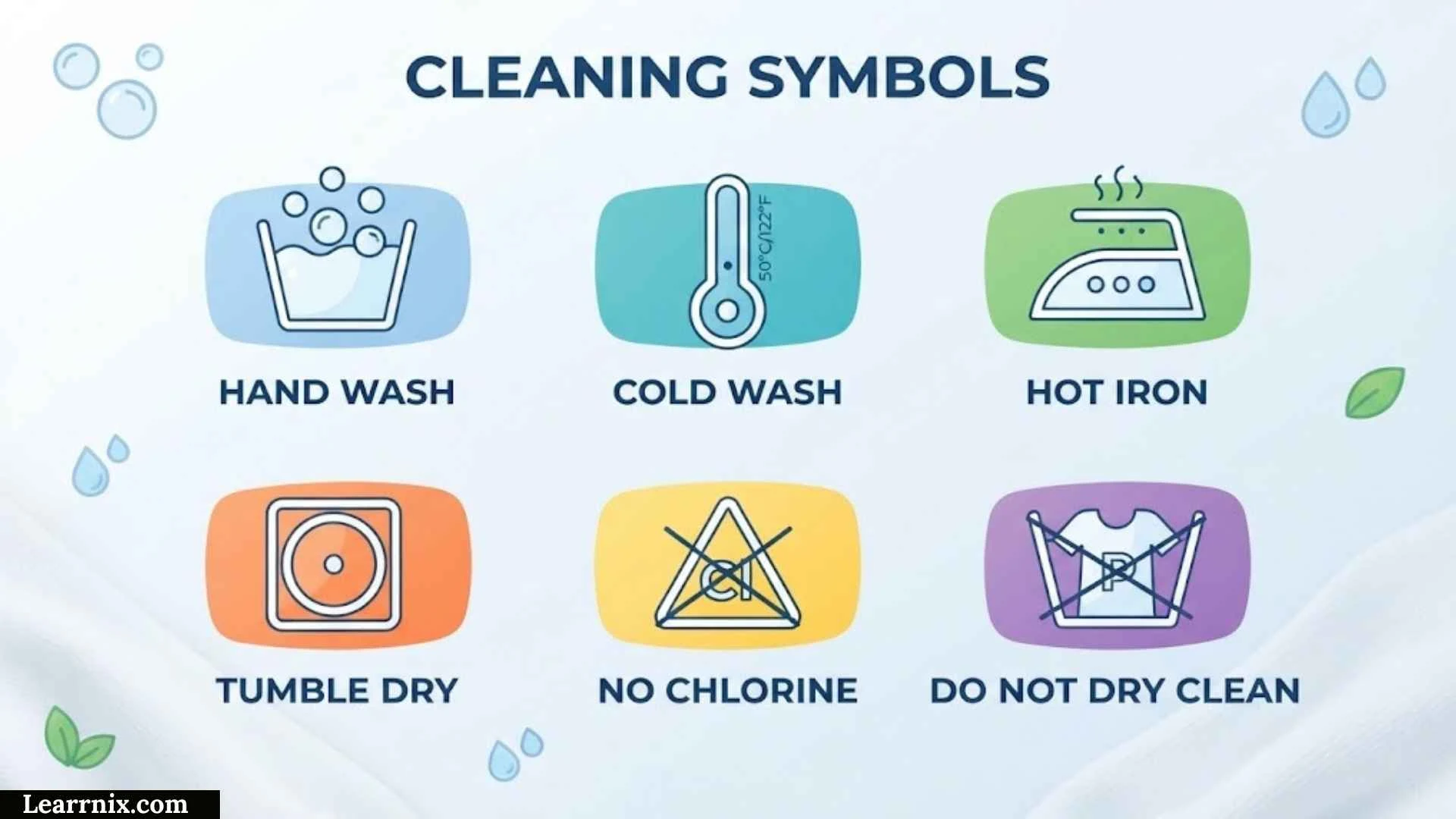
If you have ever looked at a clothing label and wondered what the tiny tub, triangle, square, iron, or circle means, you are looking at cleaning symbols. These symbols provide care instructions for washing, bleaching, drying, ironing, and professional textile cleaning.
The main challenge is that one small detail can change the entire instruction. A crossed-out symbol can mean “do not use this process,” dots can indicate heat levels, and lines can signal gentler treatment. Understanding the complete label can help prevent shrinking, fading, stretching, heat damage, and other avoidable problems.
The international system is covered by ISO 3758:2023, which establishes graphical symbols for textile care labeling. It covers domestic washing, bleaching, drying, and ironing, as well as professional dry and wet cleaning.
This guide explains the most common cleaning symbols, how to read the details inside them, how U.S. and international labeling can differ, common mistakes, and what to do when a symbol is unfamiliar.
Quick Answer: What Do Cleaning Symbols Mean?
Cleaning symbols are standardized visual instructions that tell you how a textile should be washed, bleached, dried, ironed, or professionally cleaned.
The five basic care-symbol categories are:
| Symbol | Main Meaning | Common Instructions |
| Washtub | Washing | Machine wash, hand wash, temperature, gentle cycles |
| Triangle | Bleaching | Bleach allowed, restricted bleach, or no bleach |
| Square | Drying | Tumble dry, line dry, drip dry, dry flat |
| Iron | Ironing | Heat level, ironing restrictions, no ironing |
| Circle | Professional cleaning | Dry cleaning or other professional textile-care instructions |
A symbol should always be read as a complete graphic, because additional marks can change its meaning.
ISO 3758:2023 explains that the symbols are intended to communicate the most severe care treatment that will not cause irreversible damage to the textile article under the standard’s care-labeling system.
Why Cleaning Symbols Matter
Cleaning symbols are designed to reduce guesswork. A garment may look like an ordinary shirt or sweater, but its fabric, dye, construction, lining, trim, printing, or other components can respond differently to heat, water, agitation, chemicals, or solvents.
They Help Prevent Fabric Damage
Incorrect cleaning can cause problems such as:
- Shrinkage
- Color bleeding
- Fabric distortion
- Stretching
- Surface damage
- Loss of shape
- Damage to printed designs
- Heat damage
- Damage to coatings or decorative elements
A care label gives you information about the cleaning methods the manufacturer considers appropriate for the finished product.
In the United States, the FTC’s Care Labeling Rule requires covered manufacturers and importers to provide care instructions for covered textile apparel and certain piece goods. The instructions must have a reasonable basis, supported by reliable evidence.
They Make Instructions Easier to Understand
Symbols are useful because clothing is sold across different languages and markets.
Instead of printing a long paragraph, a label can communicate a washing, drying, or ironing instruction through a familiar graphical system.
This is particularly useful when a garment is manufactured in one country, sold in another, and cared for by someone who does not speak the manufacturer’s language.
The Five Main Cleaning Symbols Explained
Learning the five basic shapes is the easiest way to start reading care labels.
Washtub Symbol: Washing
The washtub represents washing.
Depending on the details, it can communicate:
- Machine washing
- Hand washing
- Water-temperature limits
- Gentler washing processes
- A prohibition against washing
A hand inside the tub indicates hand washing. A crossed-out tub indicates that the garment should not be washed using that process.
In the U.S., the FTC requires covered washing instructions to communicate whether a product should be washed by hand or machine and, when necessary, the water temperature.
Triangle Symbol: Bleaching
The triangle represents bleaching.
Different versions can indicate whether:
- Bleaching is permitted
- Only certain bleach types should be used
- Bleaching should not be used
A crossed-out triangle means do not bleach.
This distinction matters because bleach can affect both dyes and fibers.
The FTC specifically recognizes instructions for situations where chlorine bleach could cause harm but non-chlorine bleach can be used when needed.
Square Symbol: Drying
The square represents drying.
It can be modified to indicate methods such as:
- Tumble drying
- Line drying
- Drip drying
- Drying flat
- Drying in the shade
- Specific heat levels
Drying deserves as much attention as washing because a garment can tolerate water but still be damaged by excessive heat or mechanical action.
Iron Symbol: Ironing
The iron symbol indicates whether ironing is appropriate and, where applicable, the permitted heat level.
Additional marks can communicate:
- Low heat
- Medium heat
- High heat
- No steam
- Do not iron
A crossed-out iron means do not iron.
The FTC’s care guidance includes temperature-related ironing instructions and warnings such as “Do not iron” when ironing could damage the garment.
Circle Symbol: Professional Cleaning
The circle is used for professional textile cleaning.
Letters and other marks inside or around the circle can provide additional information about the cleaning process.
A crossed-out circle means the item should not undergo the indicated professional cleaning process.
Professional-cleaning instructions are especially important for garments that should not be treated with ordinary household washing methods.
How Dots, Lines, Crosses, and Other Marks Change Meaning
Recognizing the five shapes is only the beginning. The smaller details often contain the most important information.
What Do Dots Mean?
Dots commonly indicate heat or temperature levels in care-symbol systems.
A simple way to remember the general concept is:
More dots usually indicate more heat.
However, do not rely on the dots alone. Always consider the complete symbol and the care-label system being used.
What Do Lines Under a Symbol Mean?
Lines beneath certain symbols modify the treatment.
They can indicate a gentler or reduced process.
This matters because two garments may both be washable but require different levels of mechanical treatment.
What Does a Crossed-Out Symbol Mean?
A crossed-out symbol generally means the process represented by that symbol should not be used.
Examples include:
- Crossed-out tub → do not wash
- Crossed-out triangle → do not bleach
- Crossed-out iron → do not iron
- Crossed-out circle → do not use the indicated professional cleaning process
Never treat a crossed-out symbol as an optional recommendation.
Why the Complete Symbol Matters
Consider a drying symbol.
Seeing a square tells you that the instruction concerns drying. But the additional marks determine whether the garment can be tumble dried, dried flat, line dried, or treated with a particular heat level.
That is why identifying only the main shape is not enough.
Washing Symbols and What They Tell You
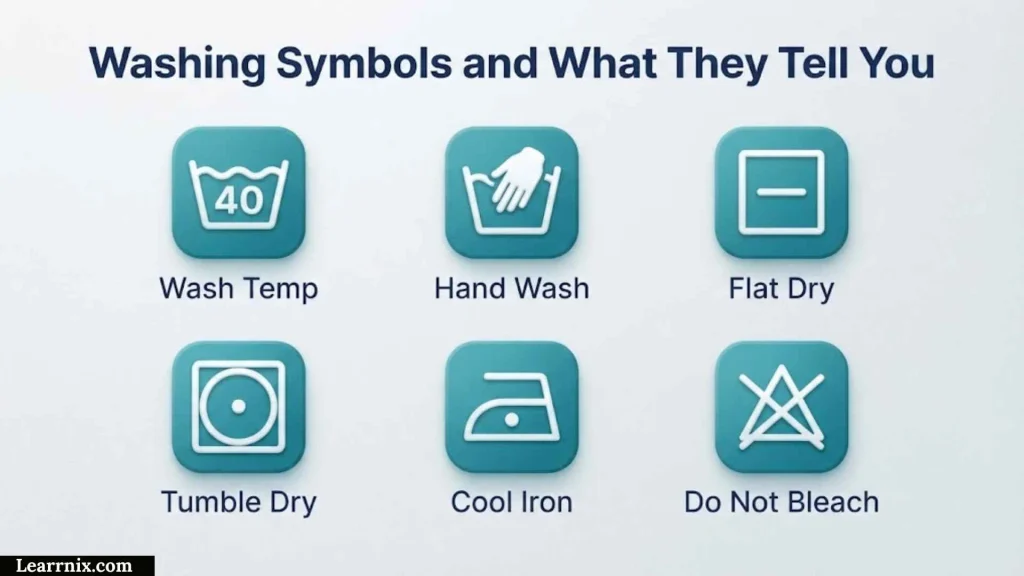
Washing instructions are among the most useful cleaning symbols because washing is a routine part of clothing care.
Machine Washing
A wash tub without a hand symbol generally indicates a machine-washing instruction when interpreted according to the complete symbol.
The rest of the symbol may indicate temperature or a gentler treatment.
Do not automatically put every machine-washable garment on the same cycle.
Hand Washing
A hand inside the tub means hand washing.
Hand washing still requires care. It does not mean that aggressive rubbing, twisting, or wringing is automatically safe.
The FTC defines hand washing as using water, detergent or soap, and gentle squeezing action.
Gentle or Delicate Washing
Some garments require reduced mechanical action.
This is important for items that may be vulnerable to:
- Stretching
- Excessive agitation
- Shape distortion
- Surface damage
A delicate cycle is not simply a marketing term. In U.S. care-label terminology, “delicate cycle” or “gentle cycle” refers to slower agitation and reduced time.
Do Not Wash
A crossed-out wash tub means the garment should not be washed through the prohibited washing process.
If another cleaning method is provided, follow that instruction instead.
Water Temperature Symbols Explained
Temperature is a major part of textile care.
Why Temperature Matters
Heat can affect:
- Natural fibers
- Synthetic fibers
- Dyes
- Elastic components
- Fabric finishes
- Printed decorations
- Garment shape
A garment can be washable while still requiring a low-temperature process.
Is Hot Water Always Better?
No.
A hotter setting is not automatically the correct choice simply because you want stronger cleaning.
If the label specifies a lower temperature, that limit is part of the garment’s care instruction.
The FTC’s rules require water-temperature information when regular hot-water use could harm the product.
Bleaching Symbols Explained
Bleaching is one of the easiest areas to misunderstand.
Bleach Allowed
If the symbol permits bleaching, follow the complete care instruction rather than assuming every bleach product should be used in unlimited amounts.
Non-Chlorine Bleach
Some garments may allow non-chlorine bleach while restricting chlorine bleach.
This distinction is important because “bleach” is not always a single chemical treatment.
The FTC specifically provides for the instruction “Only non-chlorine bleach, when needed” when chlorine bleach could harm the product but non-chlorine bleach would not.
Do Not Bleach
A crossed-out triangle means bleaching should not be used.
This instruction is important even when a stain looks difficult to remove.
A strong stain does not override a care label.
Drying Symbols Explained
Drying is often where clothing damage occurs because heat and mechanical movement can be harder on some textiles than ordinary washing.
Tumble Dry
A tumble-drying symbol indicates that machine drying is permitted under the conditions shown.
Additional marks may indicate heat restrictions.
Low, Medium, and High Heat
When heat levels are specified, choose the corresponding dryer setting.
Do not assume that a garment suitable for tumble drying can automatically tolerate the highest temperature.
Line Dry
Line drying means hanging the damp item from a line or bar as specified by the care instruction.
Drip Dry
Drip drying means allowing the garment to dry while excess water drains away.
Dry Flat
Dry-flat instructions are important for garments whose shape could change if they are hung while wet.
Instead of placing the garment on a hanger, lay it horizontally as directed.
Dry in the Shade
Some care systems specify shade drying.
This instruction is especially useful when the label indicates that drying away from direct sunlight is required.
Ironing Symbols Explained
Ironing instructions communicate whether heat and pressure can safely be applied to the fabric.
Low-Temperature Ironing
Use a low setting when the care label indicates low heat.
Medium-Temperature Ironing
Medium heat should only be used when permitted.
High-Temperature Ironing
High heat can be appropriate for some textiles but damaging to others.
Never assume that a fabric’s appearance tells you its maximum ironing temperature.
Do Not Iron
A crossed-out iron means the item should not be ironed.
Some garments contain heat-sensitive coatings, prints, synthetic fibers, or decorative elements that can be damaged by direct heat.
Steam Restrictions
Some labels also restrict steam.
If the label says no steam, do not assume that ordinary ironing is still safe with the steam function turned on.
Dry-Cleaning and Professional-Cleaning Symbols
Professional-cleaning symbols can look more complicated than household laundry symbols because they may contain letters.
What Does the Circle Mean?
The circle identifies professional cleaning information.
Additional letters or markings provide further instructions for the professional cleaner.
Do not interpret every circle as simply “take this to the dry cleaner.” The complete symbol can provide more specific information.
What Does a Crossed-Out Circle Mean?
A crossed-out circle means the indicated professional-cleaning process should not be used.
If another care method is provided, follow the permitted method.
Why Professional-Cleaning Instructions Matter
Professional cleaning can involve solvents, moisture, heat, mechanical action, and finishing processes.
The FTC explains that U.S. dry-cleaning instructions may need to identify a suitable solvent when some solvents could harm the garment.
Cleaning Symbols vs. Laundry Symbols vs. Care Symbols
These terms are often used interchangeably, but they can have slightly different meanings.
Cleaning Symbols
“Cleaning symbols” is a broad phrase people use when searching for information about clothing-care marks.
Laundry Symbols
“Laundry symbols” often refers to household washing, bleaching, drying, and ironing instructions.
Care Symbols
“Care symbols” is the more formal industry term associated with textile care-labeling standards.
ISO 3758:2023 specifically uses the term care labelling code using symbols and covers washing, bleaching, drying, ironing, and professional textile care.
For search purposes, these phrases belong to the same semantic topic, but users may use them differently.
Cleaning Symbols on Clothes vs. Cleaning Product Symbols
There is another important search-intent distinction.
Someone searching for cleaning symbols may be asking about clothing labels. Another person may mean symbols printed on bottles of cleaning chemicals.
These are not the same system.
Clothing Care Symbols
Textile-care symbols appear on items such as:
- Shirts
- Trousers
- Dresses
- Jackets
- Sweaters
- Towels
- Bedding
- Other textile products
They explain how to care for the material.
Chemical Hazard Symbols
Cleaning products can carry hazard pictograms that communicate chemical risks.
These symbols should not be interpreted using clothing-care rules.
For example, a hazard pictogram on a bottle of household cleaner is not a washing instruction for clothing.
Why This Difference Matters
If you are trying to understand a symbol on a shirt tag, look for the textile-care system.
If you are trying to understand a symbol on a chemical container, use the product’s safety and hazard information.
Mixing the two systems can lead to unsafe decisions.
Cleaning Symbols for Different Fabrics
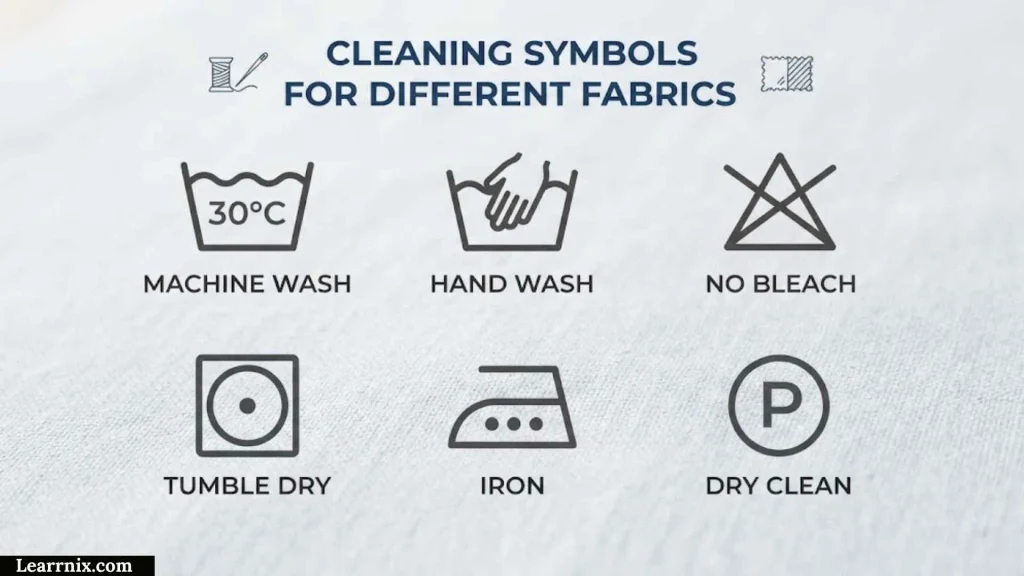
The fiber name alone does not always tell you exactly how a finished garment should be cleaned.
Cotton
Cotton garments are often washable, but the correct temperature and drying method can vary.
Do not assume every cotton shirt has the same care requirements.
Wool
Wool can be sensitive to heat, agitation, and incorrect drying.
If the label calls for hand washing or another special process, follow the garment-specific instruction.
Silk
Silk can be sensitive to heat, chemicals, agitation, and water.
Because garments differ in construction and finishing, the care label should take priority over a generic rule about silk.
Synthetic Fabrics
Synthetic materials vary widely.
Some tolerate routine machine washing, while others may be sensitive to high temperatures or particular finishing processes.
Blended Fabrics
Blended garments can contain fibers with different characteristics.
The finished garment’s care instruction should therefore be followed rather than choosing a method based on only one fiber in the blend.
How to Read a Complete Cleaning Label
When you see a care label, use this five-step process.
Step 1: Identify the Washing Instruction
Find the washtub and check:
- Machine or hand washing
- Temperature
- Gentle-treatment indicators
- Any prohibition
Step 2: Check the Bleach Instruction
Look for the triangle.
Determine whether:
- Bleaching is permitted
- A specific type of bleach is required
- Bleaching is prohibited
Step 3: Check Drying
Find the square.
Look for:
- Tumble drying
- Heat level
- Line drying
- Drip drying
- Drying flat
- Shade or other drying instructions
Step 4: Check Ironing
Find the iron symbol.
Check the permitted heat level and whether ironing or steam is prohibited.
Step 5: Check Professional Cleaning
Look for the circle.
If it contains letters or other markings, do not ignore them. They may provide important instructions for the professional cleaner.
Cleaning Symbols Decision Guide
Use this quick decision tree when you are unsure what to do:
Can the garment be washed?
→ Yes → Follow the tub symbol, temperature, and cycle instructions.
→ No → Look for the permitted professional-cleaning instruction.
Is bleaching allowed?
→ Yes → Follow the exact bleaching instruction.
→ No → Do not use bleach.
Can it go in the dryer?
→ Yes → Follow the specified heat level.
→ No → Use the permitted alternative, such as line drying or drying flat.
Can it be ironed?
→ Yes → Follow the indicated temperature.
→ No → Keep the iron away from the garment.
Does the professional-cleaning symbol contain special instructions?
→ Yes → Show the complete label to the cleaner.
→ Unsure → Ask a professional instead of guessing.
Common Cleaning-Symbol Mistakes
Knowing the symbols is useful, but incorrect interpretation can still cause problems.
Washing Everything on the Same Cycle
A mixed laundry load may contain delicate garments and durable everyday clothing.
Treating them all identically can expose sensitive items to unnecessary agitation or heat.
Ignoring the Drying Instruction
Many people check the wash symbol and immediately put the garment into a hot dryer.
That can be a mistake.
Washing and drying are separate stages, and each has its own care instruction.
Assuming All Bleach Is the Same
Chlorine and non-chlorine bleaching instructions should not be treated as interchangeable.
Read the triangle carefully.
Using Maximum Heat
Higher heat is not automatically better.
Use the temperature permitted by the label.
Ironing Because the Garment Looks Wrinkled
Wrinkles do not override a “do not iron” instruction.
If ironing is prohibited, use another permitted finishing method.
Guessing an Unfamiliar Symbol
If you cannot confidently identify a symbol, avoid experimenting on an expensive or delicate item.
A wrong cleaning method can cause permanent damage.
Real-World Examples of Reading Care Labels
Example 1: Everyday Cotton Shirt
Imagine a shirt with:
- A machine-wash symbol
- A moderate temperature instruction
- A bleach restriction
- A tumble-dry instruction
- A low-heat ironing instruction
The correct approach is not simply “wash and dry.”
You would follow each part of the label separately: wash at the indicated temperature, follow the bleach restriction, use the permitted dryer setting, and iron only at the specified heat.
Example 2: Delicate Sweater
Suppose a sweater has a hand-wash instruction and a dry-flat instruction.
Putting it into a normal washing machine and hanging it wet would ignore two important parts of the care label.
The safer approach is to hand wash it according to the label and dry it flat.
Example 3: Printed Fashion Garment
A garment may be washable but have an ironing restriction because direct heat could damage a printed design.
This demonstrates why the care label must be read as a complete set of instructions.
Example 4: Garment Requiring Professional Cleaning
A jacket may carry a professional-cleaning symbol rather than a normal washing instruction.
Instead of testing it in a home washing machine, follow the professional-care instruction and show the complete label to the cleaner.
Why Care Labels Are More Than Suggestions
It is easy to think of care labels as general advice, but they can represent tested care requirements.
The FTC states that manufacturers and importers covered by the U.S. Care Labeling Rule must have a reasonable basis for care information. This can include reliable testing, technical literature, prior experience, or industry expertise.
This is especially important for garments containing several components.
For example, a garment may contain a main fabric, lining, buttons, trim, elastic, printed decoration, or other components. The finished product needs to be considered as a whole when determining appropriate care.
ISO Care Symbols and U.S. Care Labels
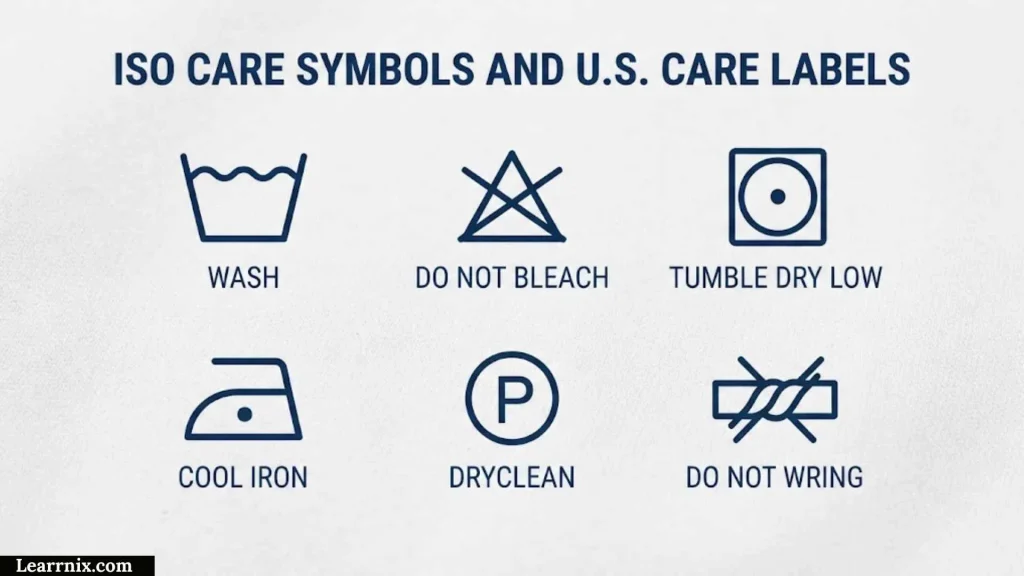
Care symbols can differ by market, which is one reason online symbol charts do not always look identical.
ISO 3758:2023
ISO 3758:2023 is the current international standard for textile care labeling by symbols. It covers:
- Washing
- Bleaching
- Drying
- Ironing
- Professional dry cleaning
- Professional wet cleaning
The standard is the fourth edition and was published in December 2023.
U.S. FTC Care Labeling
In the United States, the FTC administers the Care Labeling Rule for covered textile apparel and certain piece goods.
The FTC explains that U.S. care-symbol requirements and international ISO symbols are similar but not identical.
This distinction is important when interpreting a label from another country.
Do Cleaning Symbols Apply Only to Clothing?
No.
Textile care labeling can apply to many textile articles, not just everyday clothing.
Examples can include:
- Bedding
- Towels
- Household textiles
- Decorative textile products
- Other textile articles
ISO 3758:2023 applies broadly to textile articles, while excluding certain products such as some non-removable furniture and mattress covers and carpets or rugs requiring professional carpet cleaning.
What If the Cleaning Label Is Missing or Damaged?
If the label is unreadable, do not automatically use the strongest cleaning method.
For Everyday Clothing
Check whether the brand provides care instructions elsewhere, such as an official product page or accompanying documentation.
For Expensive or Delicate Items
Professional advice is safer than trial and error.
This is especially true for:
- Vintage garments
- Formalwear
- Luxury clothing
- Delicate knitwear
- Items with complex decoration
- Garments that cannot easily be replaced
For an Unclear Symbol
Look at the entire label rather than one cropped mark.
Dots, lines, letters, and crosses can completely change the meaning.
How to Choose the Right Cleaning Method
A useful rule is to make the decision from the label outward, not from the fabric name inward.
If the Label Permits Machine Washing
Use the indicated temperature and cycle.
If It Requires Hand Washing
Use gentle handling and avoid aggressive twisting unless specifically permitted.
If It Prohibits Bleach
Do not use bleach simply because another stain-removal method failed.
If It Prohibits Tumble Drying
Choose the drying method shown on the label.
If It Prohibits Ironing
Do not use an iron, even for a quick touch-up.
If It Requires Professional Cleaning
Give the complete care information to the cleaner.
This approach reduces guesswork and respects the limits communicated by the manufacturer.
Expert Tips for Using Cleaning Symbols
Read Every Symbol Before Starting Laundry
Do not begin with the wash symbol and assume the rest will take care of itself.
Read the full label first.
Separate Similar Garments When Their Labels Differ
Two shirts that look almost identical may have different care requirements because of differences in fabric construction, dyes, trims, or finishing.
Pay Special Attention to Heat
Check washing, drying, and ironing temperatures separately.
Treat “Do Not” Instructions Seriously
A crossed-out symbol is not a mild suggestion.
It is a restriction on the represented process.
Keep the Label Information Available
The FTC explains that covered care instructions are intended to remain available during the useful life of the product.
If a removable tag contains important information, keep it somewhere accessible.
Do Not Confuse a Fabric Rule With a Garment Rule
Generic advice such as “cotton can be washed” or “wool should be hand washed” is not enough.
The finished garment’s own label should guide the final decision.
Frequently Asked Questions About Cleaning Symbols
What Are the Five Main Cleaning Symbols?
The five main textile care-symbol categories are washing, bleaching, drying, ironing, and professional cleaning. They are represented by the washtub, triangle, square, iron, and circle respectively.
What Does a Triangle Mean on a Cleaning Label?
A triangle relates to bleaching. Depending on its markings, it can indicate that bleaching is allowed, restricted, or prohibited.
What Does a Square Mean on Clothing?
A square represents drying. Additional marks can indicate tumble drying, line drying, drip drying, drying flat, heat limitations, or other drying conditions.
What Does a Circle Mean on a Clothing Label?
A circle represents professional textile cleaning. Additional markings can provide more detailed instructions for the cleaning process.
What Does a Crossed-Out Washing Symbol Mean?
A crossed-out washing symbol means the represented washing process should not be used.
What Do Dots Mean on Laundry Symbols?
Dots commonly communicate temperature or heat levels. The exact interpretation depends on the particular symbol and care-label system.
What Do Lines Under Laundry Symbols Mean?
Lines can indicate a gentler or reduced treatment. They should always be interpreted together with the main symbol.
Are Cleaning Symbols the Same in Every Country?
No. Different markets can use different care-label systems. ISO 3758:2023 provides an international system, while U.S. requirements are administered under the FTC’s Care Labeling Rule. The FTC notes that U.S. and ISO symbol systems are similar but not identical.
Can I Machine Wash Something That Says Dry Clean?
Do not assume so. Follow the complete care label. If the garment provides only professional-cleaning instructions, using a home washing machine could damage it.
What Does “Do Not Bleach” Mean?
It means bleach should not be used as part of the garment’s permitted care process. In a symbol system, this is commonly represented by a crossed-out triangle.
What Does “Dry Flat” Mean?
It means the garment should be laid horizontally while drying rather than hung, when that method is specified by the care instruction.
Why Are Cleaning Symbols Important?
They communicate textile-care instructions in a compact visual form and help consumers avoid cleaning treatments that could damage the product. ISO 3758:2023 is specifically designed to communicate care treatments that will not cause irreversible damage under the standard’s system.
What Should I Do If I Cannot Identify a Symbol?
Read the entire label and check for dots, lines, letters, and crosses. If the item is valuable or delicate and the symbol remains unclear, ask a professional cleaner rather than testing an uncertain method.
Key Takeaways About Cleaning Symbols
- Cleaning symbols provide visual instructions for textile care.
- A washtub represents washing.
- A triangle represents bleaching.
- A square represents drying.
- An iron represents ironing.
- A circle represents professional textile cleaning.
- A crossed-out symbol indicates that the represented process should not be used.
- Dots can communicate temperature or heat levels.
- Lines can indicate gentler treatment.
- Always interpret the complete symbol, not just its main shape.
- Clothing-care symbols are different from chemical hazard pictograms.
- ISO 3758:2023 is the current international standard for textile care labeling by symbols.
- U.S. textile care labeling is governed by the FTC’s Care Labeling Rule for covered products.
- When a label is unclear, avoid experimenting on valuable or delicate textiles.
Conclusion
Cleaning symbols turn complicated textile-care instructions into a compact visual system. Once you recognize the washtub, triangle, square, iron, and circle, you can understand the basic purpose of most clothing care labels.
The important part is learning to read the details. Temperature marks, dots, lines, crosses, letters, and other modifications can change what a symbol permits. Washing instructions also do not tell you everything about drying, bleaching, or ironing, so the entire label should be considered before cleaning the garment.
The safest approach is simple: read the complete care label, follow the most specific instruction, avoid prohibited treatments, and ask a professional when an expensive or delicate item is unclear.
With that habit, cleaning symbols become much easier to understand and can help you avoid common laundry mistakes while keeping textiles in better condition.

I am Michael Carter, an educational content creator who believes that knowledge has the power to transform lives.
I create resources focused on modern education, digital learning, and building essential skills for the future.
I love helping readers discover simple and effective ways to improve their learning journey.
Books by Michael Carter:
- Modern Education for Tomorrow’s World
- Learning Skills for Future Success
 Charlotte Anderson