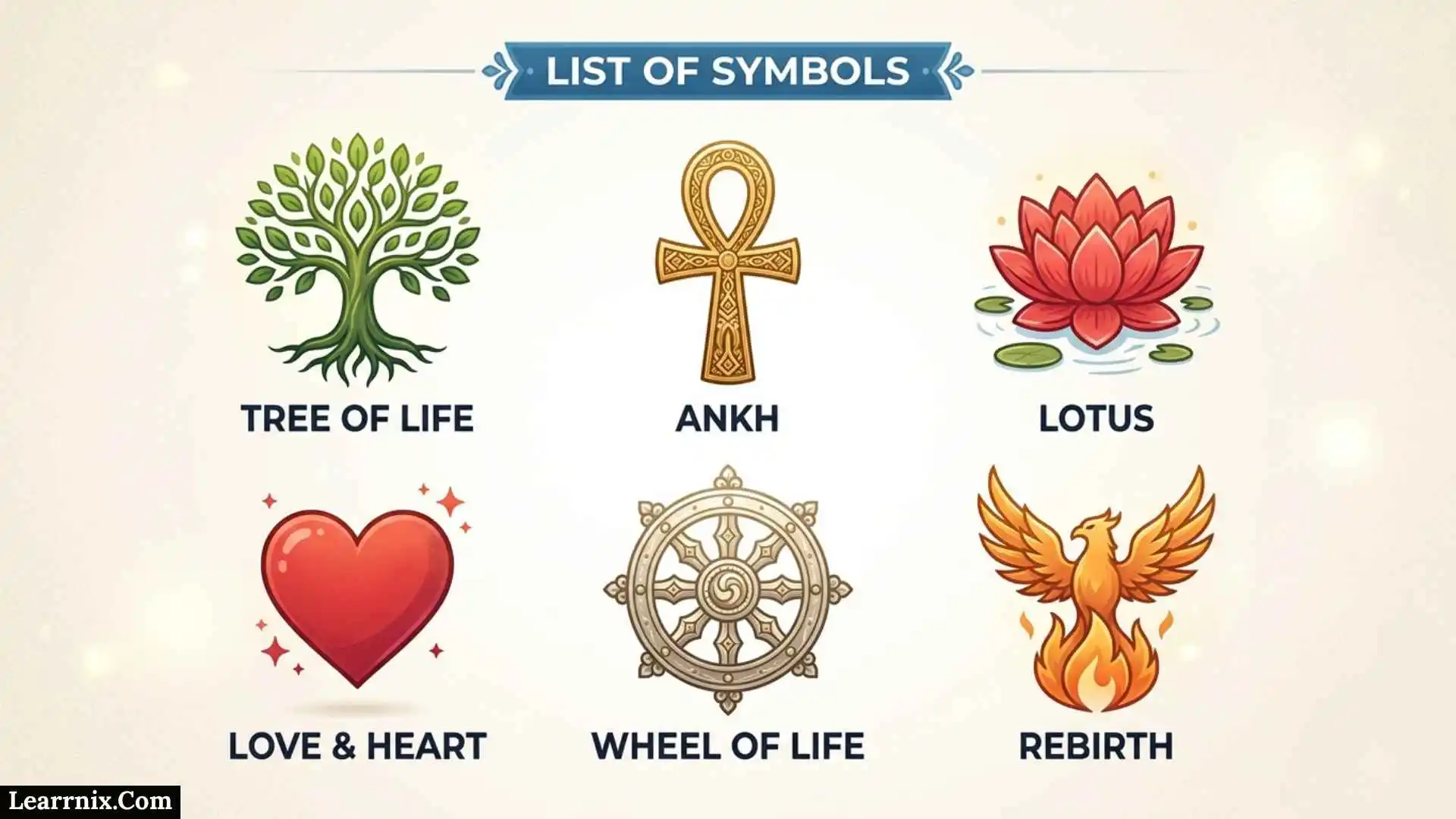
Symbols are everywhere. A heart can express love, an arrow can show direction, a warning triangle can signal danger, and a mathematical sign can communicate an exact relationship without using a sentence. But the meaning of a symbol is not always universal. It can change according to culture, religion, history, industry, design, and context.
This list of symbols brings the most useful symbols together in one place. It covers common symbols and their meanings, visual and cultural symbols, religious symbols, nature and animal symbolism, mathematical and keyboard symbols, currency signs, safety symbols, technology icons, and symbols commonly used in everyday communication.
If you need a symbol for a logo, tattoo, school project, website, social media post, document, design, or simple reference, the tables below can help you identify the right one and understand what it commonly represents.
Quick Answer: What Are Symbols?
A symbol is a mark, image, character, object, or sign that communicates an idea, meaning, identity, action, or concept beyond its physical appearance.
For example:
- ❤️ commonly represents love or affection.
- ☮ commonly represents peace or anti-war ideas.
- ⚠️ communicates warning or caution.
- ∞ represents infinity or something without an end.
- $ identifies a currency unit in several monetary systems.
- @ is widely used in email addresses and digital communication.
- → commonly indicates direction, movement, or a logical relationship.
Not every symbol has one fixed meaning. A snake, for example, can represent danger in one setting and healing or transformation in another. Context is essential.
Common Symbols and Their Meanings
The following table provides a quick reference to widely recognized visual symbols.
| Symbol | Name | Common Meaning |
| ❤️ | Heart | Love, affection, compassion |
| ☮ | Peace symbol | Peace, harmony, anti-war |
| 🕊️ | Dove | Peace, hope, purity |
| ⭐ | Star | Excellence, achievement, guidance |
| ☀️ | Sun | Life, energy, warmth, optimism |
| 🌙 | Moon | Night, cycles, mystery |
| 🌳 | Tree | Growth, life, stability |
| 🦋 | Butterfly | Transformation, change, renewal |
| 🦉 | Owl | Wisdom, knowledge |
| 🦁 | Lion | Courage, strength, leadership |
| 🐍 | Snake | Danger, transformation, healing, depending on context |
| 🔥 | Flame | Fire, passion, energy, danger |
| ⚓ | Anchor | Stability, security, hope |
| ∞ | Infinity | Eternity, endlessness |
| ⚖️ | Scales | Justice, balance, law |
| ✝️ | Cross | Christianity and Christian faith |
| ☯️ | Yin-yang | Balance and complementary opposites |
| 🪷 | Lotus | Purity, spiritual growth, enlightenment in relevant traditions |
| 🏳️ | Flag | Identity, nation, group, cause |
| ➡️ | Arrow | Direction, movement, progression |
| ⚠️ | Warning | Caution, danger, hazard |
| ♻️ | Recycling | Recycling and environmental action |
| ⓘ | Information | Information or assistance |
| 🔒 | Lock | Security, privacy, protection |
| 🔑 | Key | Access, opportunity, solution |
| 💡 | Light bulb | Idea, innovation, understanding |
| 🏠 | House | Home, family, shelter |
| 🌈 | Rainbow | Hope, renewal, diversity, or community-specific meanings |
These meanings should be treated as common associations, not universal definitions. A symbol can carry different meanings in different communities.
What Is the Difference Between a Symbol, Sign, and Icon?
The words symbol, sign, and icon are sometimes used as if they mean the same thing, but they can describe different kinds of communication.
Symbol
A symbol usually represents an idea or concept through an accepted or learned association.
For example, a heart can represent love even though a drawn heart is not a literal human heart.
Sign
A sign usually provides information, direction, instruction, or a warning.
Examples include:
- Stop signs
- Exit signs
- Road signs
- No-entry signs
- Warning signs
- Direction arrows
Icon
An icon often visually resembles the thing or action it represents.
Examples include:
- A trash-bin icon for deleting something
- A printer icon for printing
- A house icon for a homepage
- A magnifying glass for search
In real-world design, these categories can overlap. What matters most is whether the audience can understand the intended message quickly and accurately.
Symbols of Love and Relationships
Some symbols are strongly associated with affection, romance, family, friendship, and emotional connection.
Heart
❤️ The heart is one of the most recognizable symbols associated with love and affection.
It can be used in:
- Romantic messages
- Wedding designs
- Greeting cards
- Social media
- Jewelry
- Logos
- Charity campaigns
Its meaning can range from romantic love to friendship, compassion, and emotional care.
Interlocking Rings
Two interlocking rings commonly represent marriage, partnership, commitment, or a lasting relationship.
Cupid and the Bow
Cupid, the bow, and arrows are associated with romantic attraction in Western cultural traditions.
Infinity Symbol
∞ can represent an endless bond, eternal love, or a relationship intended to last indefinitely.
When used in jewelry or tattoos, its meaning is often personal rather than strictly traditional.
Symbols of Peace and Harmony
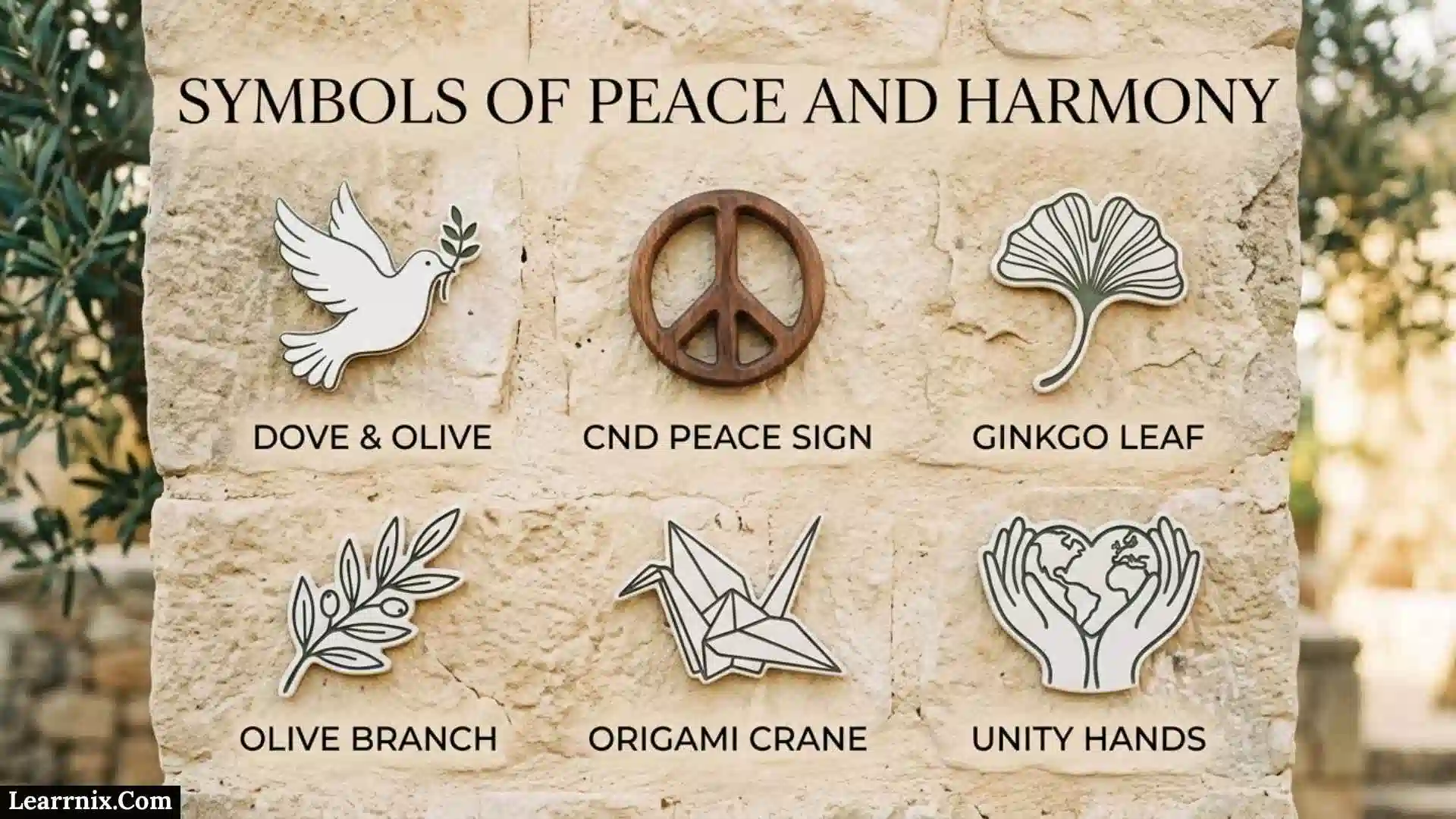
Peace symbols appear in religious traditions, political movements, art, memorials, and everyday communication.
Peace Symbol
☮ The peace symbol became strongly associated with peace and anti-war movements during the 20th century.
Dove
🕊️ The dove has a long history of association with peace and reconciliation, especially within Western religious and cultural traditions.
Olive Branch
The olive branch is an ancient symbol associated with peace, reconciliation, and agreement.
White Flag
A white flag can communicate surrender, truce, or a desire to stop fighting. Its exact interpretation depends on the situation.
Important: Symbols of peace do not always have identical histories. Their meanings developed through different religious, political, historical, and cultural traditions.
Symbols of Strength, Courage, and Leadership
Symbols of strength are popular in branding, tattoos, sports, military imagery, motivational designs, and personal artwork.
Lion
🦁 The lion is often associated with:
- Courage
- Power
- Leadership
- Authority
- Pride
- Strength
Eagle
The eagle is frequently associated with power, freedom, vision, and authority. National meanings vary from country to country.
Mountain
⛰️ A mountain can symbolize endurance, achievement, challenge, stability, and overcoming obstacles.
Oak Tree
An oak can represent strength, endurance, stability, and longevity in traditions where it carries those associations.
Sword
A sword can symbolize strength, defense, justice, authority, or conflict. Its meaning changes significantly depending on historical and cultural context.
Symbols of Wisdom and Knowledge
Symbols related to knowledge often appear in education, universities, books, libraries, and intellectual branding.
Owl
🦉 The owl is widely associated with wisdom, especially through classical Western traditions.
Open Book
📖 An open book commonly represents:
- Education
- Learning
- Knowledge
- Reading
- Research
Light Bulb
💡 The light bulb is commonly used to represent an idea, discovery, creativity, or understanding.
Eye
👁️ An eye can represent observation, awareness, perception, protection, or spiritual ideas depending on the cultural context.
Symbols of Growth, Change, and Transformation
Some symbols communicate development rather than a fixed state.
Butterfly
🦋 A butterfly is commonly used as a metaphor for transformation because of its life cycle.
It may represent:
- Change
- Personal growth
- Renewal
- New beginnings
- Transformation
Tree
🌳 Trees can symbolize life, growth, roots, family, stability, and continuity.
A family tree, for example, uses branching structure to show relationships between generations.
Phoenix
The phoenix is traditionally associated with renewal and rising again after destruction in traditions where the myth appears.
Spiral
A spiral can represent growth, movement, cycles, development, or continuity. Its meaning depends heavily on the design and cultural setting.
Animal Symbols and What They Represent
Animals are among the most common sources of symbolism. Their meanings are often based on mythology, religion, literature, folklore, natural behavior, or cultural tradition.
| Animal | Common Associations |
| 🦁 Lion | Courage, strength, leadership |
| 🦉 Owl | Wisdom, knowledge |
| 🦋 Butterfly | Transformation, renewal |
| 🦅 Eagle | Freedom, power, vision |
| 🐍 Snake | Danger, healing, transformation |
| 🐺 Wolf | Loyalty, independence, instinct |
| 🦊 Fox | Cleverness, adaptability |
| 🐘 Elephant | Strength, memory, wisdom |
| 🐢 Turtle | Patience, longevity, protection |
| 🐬 Dolphin | Intelligence, playfulness, harmony |
| 🐦 Dove | Peace, hope |
| 🦌 Deer | Gentleness, nature, grace |
| 🐝 Bee | Community, cooperation, productivity |
| 🐦 Raven | Mystery, intelligence, transformation in some traditions |
These are symbolic associations, not scientific definitions of animal behavior.
Flower and Plant Symbols
Plants have been used in art, religion, ceremonies, heraldry, literature, and design for centuries.
Rose
🌹 Roses can represent love, beauty, affection, remembrance, or other meanings depending on color and cultural context.
Lotus
🪷 The lotus has important symbolic roles in several Asian religious and cultural traditions. Meanings can include purity, spiritual development, renewal, and enlightenment, but the interpretation is tradition-specific.
Olive Branch
🫒 The olive branch is widely associated with peace and reconciliation.
Laurel
A laurel wreath has long been associated with achievement, honor, victory, and distinction in traditions influenced by classical antiquity.
Oak
Oak imagery can communicate strength, endurance, stability, or dignity.
Four-Leaf Clover
☘️ The four-leaf clover is commonly associated with good luck.
Shape Symbols and Their Common Meanings
Simple geometric shapes can influence how people interpret a design.
| Shape | Common Design Association |
| ○ Circle | Unity, completeness, continuity |
| □ Square | Stability, order, structure |
| △ Triangle | Direction, strength, change |
| ☆ Star | Achievement, excellence, guidance |
| → Arrow | Direction, movement |
| ∞ Infinity | Eternity, endlessness |
| Spiral | Growth, cycles, movement |
| Cross | Intersection, faith in some contexts |
| Diamond | Value, clarity, distinction |
| Hexagon | Structure, balance, organization |
These associations are useful in design, but they should not be treated as universal rules. Color, typography, surrounding imagery, and cultural context can change the message.
Religious and Spiritual Symbols
Religious symbols can carry deep historical and spiritual meanings. They should be used carefully because their interpretation may differ among denominations, cultures, and traditions.
Cross
✝️ The cross is one of the central symbols of Christianity and can represent Christian faith, the crucifixion of Jesus, salvation, or religious identity.
Crescent and Star
☪️ The crescent and star are strongly associated with Islam in modern popular culture, although the symbols themselves have a complex historical development and are not a universal symbol of Islam in the same way a single official emblem would be.
Star of David
✡️ The six-pointed Star of David is strongly associated with Judaism and Jewish identity.
Om
ॐ Om is an important sacred symbol in Hindu traditions and also has significance in related Indian religions.
Yin-Yang
☯️ The yin-yang symbol comes from Chinese philosophical traditions and is commonly used to express complementary forces and balance.
Dharma Wheel
☸️ The Dharma wheel is an important Buddhist symbol associated with the Buddha’s teachings and the path of Dharma.
Khanda
☬ The Khanda is an important symbol associated with Sikhism.
Lotus
🪷 The lotus has important spiritual meanings across several Asian religious traditions, although the specific interpretation varies.
Because religious symbolism is sensitive to context, a design should be checked against the tradition it claims to represent rather than relying on a generic “symbol meanings” list.
Symbols of Freedom and Independence
Freedom-related symbols are common in political art, national identity, memorials, literature, and social movements.
Broken Chains
Broken chains can represent liberation, freedom, or the end of oppression.
Open Bird or Flying Bird
A flying bird can represent freedom, independence, movement, or release.
Torch
A torch can symbolize enlightenment, freedom, guidance, or remembrance depending on its context.
Statue or Monument Imagery
Monuments may use symbolic objects to communicate national values such as liberty, unity, sacrifice, or independence.
Symbols of Protection and Safety
Safety symbols need special attention because their purpose is often practical rather than decorative.
| Symbol | Common Purpose |
| ⚠️ | Warning or caution |
| ⛔ | Prohibited or restricted action |
| 🚫 | Do not / prohibition |
| 🔒 | Security or privacy |
| 🛡️ | Protection or defense |
| 🆘 | Emergency assistance |
| ☣️ | Biological hazard |
| ☢️ | Radiation hazard |
| 🔥 | Fire or fire-related danger |
| 🧯 | Fire extinguisher |
| 🚭 | No smoking |
| ♿ | Accessibility |
| ⚡ | Electrical hazard or electricity |
For workplace and public safety, use standardized signs and applicable regulations instead of relying only on artistic interpretations.
Symbols of Death, Mourning, and Remembrance
Death-related symbolism varies greatly between cultures and religions.
Skull
💀 A skull can represent death, mortality, danger, piracy, rebellion, or a warning.
Black Color
Black is often associated with mourning in many Western contexts, but mourning colors differ across cultures.
Candle
🕯️ A candle may represent remembrance, prayer, hope, mourning, or spiritual light.
Tombstone
A tombstone is a direct visual representation of burial and remembrance.
White Flowers
White flowers are sometimes used for mourning, remembrance, purity, or peace. Their meaning can vary by culture and ceremony.
There is no single worldwide “symbol of death.” Context matters.
Symbols of Time and Eternity
Time-related symbols often use circular forms, repetition, or objects associated with measurement.
Clock
🕐 A clock represents time, schedules, deadlines, or the passage of time.
Hourglass
⌛ An hourglass commonly represents limited time, waiting, or the passing of time.
Infinity
∞ represents an idea of endlessness or infinity.
Circle
A circle can represent cycles and continuity in some symbolic systems.
Ouroboros
The ouroboros—a serpent depicted in a circle biting or holding its own tail—is associated in various historical traditions with cycles, renewal, eternity, and self-containment.
Symbols of Success and Achievement
Success symbols are common in business, sports, education, awards, and personal development.
Trophy
🏆 A trophy represents victory, achievement, competition, or recognition.
Medal
🏅 A medal commonly represents accomplishment, ranking, honor, or recognition.
Star
⭐ A star can communicate excellence, quality, achievement, or distinction.
Crown
👑 A crown can symbolize authority, royalty, status, leadership, or winning.
Upward Arrow
⬆️ An upward arrow can suggest growth, improvement, progress, or increasing performance.
Symbols of Family and Home
Family symbolism often uses houses, trees, people, linked shapes, and hearts.
House
🏠 A house can represent home, family, shelter, belonging, or security.
Family Figures
👨👩👧👦 Groups of people can represent family, community, or relationships.
Family Tree
A branching tree is commonly used to represent ancestry and relationships between generations.
Heart
❤️ In family designs, the heart can represent affection, care, and emotional connection rather than romantic love alone.
Symbols of Hope and Positivity
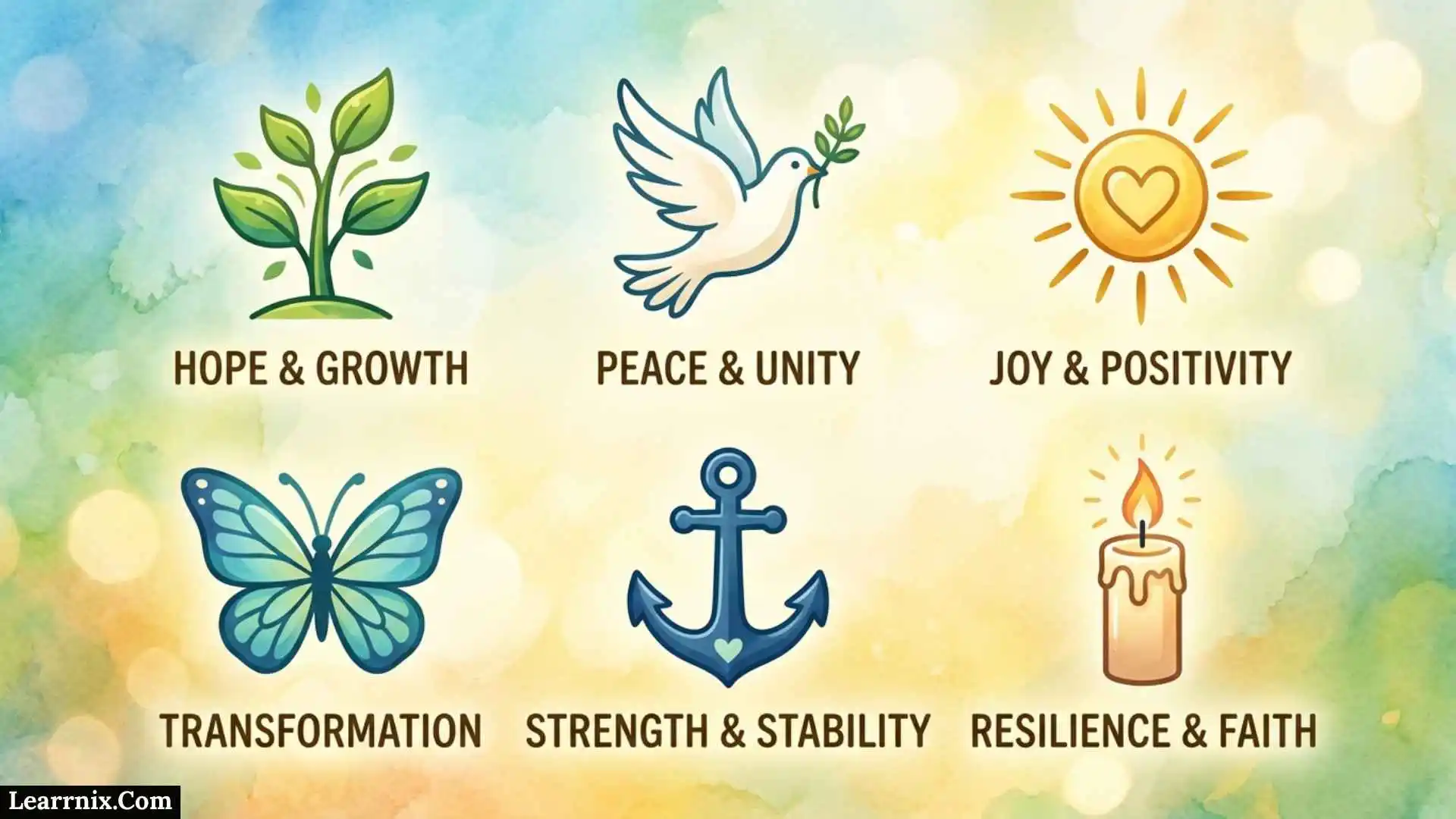
Hope symbols are often used in campaigns, memorials, personal artwork, and motivational messages.
Sunrise
🌅 A sunrise can represent a new beginning, hope, renewal, or a fresh start.
Rainbow
🌈 A rainbow can symbolize hope, renewal, diversity, or a specific community or movement depending on context.
Star
⭐ A star can represent guidance, aspiration, or a positive goal.
Dove
🕊️ A dove can represent peace and hope.
Candle
🕯️ A candle can represent hope, remembrance, guidance, or spiritual light.
Nature Symbols
Nature imagery can communicate ideas about life, balance, growth, environment, and natural cycles.
| Symbol | Common Association |
| 🌳 Tree | Life, growth, stability |
| 🌊 Water/Waves | Change, movement, emotion |
| ☀️ Sun | Energy, life, warmth |
| 🌙 Moon | Cycles, night, mystery |
| 🌿 Leaf | Nature, growth, environment |
| 🌱 Seedling | New growth, beginning |
| ⛰️ Mountain | Strength, challenge, achievement |
| 🌊 Ocean | Vastness, freedom, mystery |
| 🔥 Fire | Energy, transformation, danger |
| 🌈 Rainbow | Hope, renewal |
Nature symbolism is especially useful in environmental branding, wellness design, education, and storytelling.
Common Mathematical Symbols
A different search intent appears when someone searches for a “list of symbols” because they want mathematical characters.
| Symbol | Name | Common Meaning |
| + | Plus | Addition |
| − | Minus | Subtraction |
| × | Multiplication | Multiplication |
| ÷ | Division | Division |
| = | Equals | Equality |
| ≠ | Not equal | Inequality |
| < | Less than | Comparison |
| > | Greater than | Comparison |
| ≤ | Less than or equal to | Comparison |
| ≥ | Greater than or equal to | Comparison |
| ≈ | Approximately equal | Approximation |
| % | Percent | Percentage |
| √ | Square root | Root operation |
| ∞ | Infinity | Unbounded quantity |
| π | Pi | Mathematical constant |
| ∑ | Summation | Sum |
| ∫ | Integral | Calculus |
| Δ | Delta | Change or difference in many contexts |
| ∴ | Therefore | Logical conclusion |
| ∝ | Proportional to | Proportional relationship |
Mathematical notation can be highly specialized, so a symbol may have different meanings in different branches of mathematics.
Keyboard and Text Symbols
Many people searching for symbols simply want characters they can copy and paste into messages, documents, profiles, or websites.
Common Keyboard Symbols
| Symbol | Name | Common Use |
| @ | At sign | Email addresses, mentions |
| # | Number sign / hash | Numbers, hashtags |
| & | Ampersand | “And” |
| * | Asterisk | Notes, multiplication, wildcards |
| _ | Underscore | File names, usernames |
| – | Hyphen / minus | Words, ranges, subtraction |
| + | Plus sign | Addition, positive values |
| = | Equals sign | Equality |
| / | Slash | Separating or dividing |
| Backslash | Computing and file paths | |
| | | Vertical bar | Computing, logic, separators |
| ~ | Tilde | Approximation or computing |
| ^ | Caret | Exponents or insertion |
| ` | Backtick | Computing and code |
| < | Less-than sign | Mathematics and markup |
| > | Greater-than sign | Mathematics and markup |
The exact name and use can vary by technical field.
Punctuation Symbols
Punctuation marks help structure written language.
| Symbol | Name | Main Function |
| . | Period / full stop | Ends a statement |
| , | Comma | Separates elements |
| ? | Question mark | Marks a question |
| ! | Exclamation mark | Strong emotion or emphasis |
| : | Colon | Introduces information |
| ; | Semicolon | Connects related clauses |
| ‘ | Apostrophe | Possession or contractions |
| ” “ | Quotation marks | Direct quotation or special usage |
| ( ) | Parentheses | Additional information |
| [ ] | Brackets | Inserted or grouped material |
| — | Em dash | Break or emphasis |
| – | En dash | Ranges or relationships |
| … | Ellipsis | Omission or trailing thought |
Correct punctuation depends on the language and style guide being used.
Currency Symbols
Currency symbols identify or abbreviate monetary units.
| Symbol | Common Association |
| $ | Dollar currencies |
| € | Euro |
| £ | Pound sterling and some other pound-denominated currencies |
| ¥ | Japanese yen and Chinese yuan in common usage |
| ₹ | Indian rupee |
| ₩ | South Korean won |
| ₽ | Russian ruble |
| ₺ | Turkish lira |
| ₴ | Ukrainian hryvnia |
| ₫ | Vietnamese đồng |
| ₦ | Nigerian naira |
| ₱ | Philippine peso |
| ฿ | Thai baht |
A currency symbol does not always uniquely identify a currency. For example, $ is used by multiple currencies, so a country code or currency code such as USD, CAD, AUD, or another appropriate code may be needed for clarity.
Technology and Digital Symbols
Modern technology has created a large vocabulary of icons and symbols.
| Symbol/Icon | Common Meaning |
| 🔍 | Search |
| ⚙️ | Settings |
| 🔒 | Security or locked status |
| 🔓 | Unlocked status |
| 🏠 | Home |
| ⏻ | Power |
| ▶️ | Play |
| ⏸️ | Pause |
| ⏹️ | Stop |
| 🔊 | Volume/sound |
| 🔇 | Muted |
| 📁 | Folder |
| 🗑️ | Delete/trash |
| ☁️ | Cloud/cloud service |
| 📶 | Wireless/network signal |
| 🔗 | Link |
| 📎 | Attachment |
| ✉️ | Email/message |
Digital icons are most effective when their meaning is familiar, consistent, and supported by accessible labels where needed.
Social Media and Communication Symbols
Digital communication uses symbols to save space and express emotion quickly.
Hashtag
is commonly used to identify topics or keywords on social platforms.
At Sign
@ is used in email addresses and, on many platforms, to identify or mention another account.
Heart
❤️ is widely used to express affection, approval, appreciation, or support.
Check Mark
✓ or ✔ can indicate completion, approval, correctness, or selection.
Cross Mark
✕ or ❌ can indicate an error, rejection, cancellation, or something unavailable.
Sparkles
✨ are often used in informal digital communication to suggest excitement, emphasis, celebration, or a polished/new quality.
Environmental Symbols
Environmental symbols help communicate ideas about sustainability, conservation, and ecological responsibility.
Recycling Symbol
♻️ The recycling symbol is strongly associated with recycling.
Leaf
🌿 A leaf can suggest nature, plants, sustainability, freshness, or organic products.
Earth
🌍 The Earth symbol can represent the planet, global issues, geography, or environmental awareness.
Water Drop
💧 A water drop can represent water, hydration, conservation, cleanliness, or environmental concerns.
Be careful with environmental claims in branding. A green leaf or recycling-like image does not automatically prove that a product is environmentally sustainable.
National and Cultural Symbols
National symbols can include flags, coats of arms, monuments, animals, plants, historical objects, songs, and buildings.
Examples include:
- National flags
- National emblems
- National animals
- National flowers
- National birds
- National monuments
- National anthems
- Traditional clothing
- Historic architecture
- Cultural foods
A symbol may be legally official, culturally important, historically significant, or simply popular. These categories should not be confused.
For example, a food can be culturally associated with a country without being its legally designated national food.
Why Do Symbols Have Different Meanings?
A symbol’s meaning can change because of culture, history, religion, location, industry, audience, and context.
Consider the snake.
In one setting, a snake may communicate:
- Danger
- Poison
- Fear
In another, it may represent:
- Healing
- Renewal
- Transformation
In mythology or religious art, it may carry yet another meaning.
This is why copying a symbol from a generic list without checking its context can create unintended messages.
How to Find the Correct Meaning of a Symbol
If you find a symbol you do not recognize, use a context-first approach.
Step 1: Identify the Type
Ask whether it is:
- A visual symbol
- A religious symbol
- A mathematical symbol
- A keyboard character
- A safety sign
- A national symbol
- A technical icon
- An emoji
Step 2: Examine Its Surroundings
Look at the words, colors, objects, or other symbols around it.
A triangle on a road sign is not interpreted in the same way as a triangle in a mathematical equation.
Step 3: Check the Culture or Tradition
If the symbol is religious, historical, or cultural, determine which tradition it comes from.
Step 4: Look for a Standard Definition
For technical, safety, mathematical, or Unicode characters, use the appropriate official standard or reference rather than relying on an informal symbolism website.
Unicode maintains official emoji charts containing character names, keywords, categories, code points, and other information for emoji characters and sequences.
Step 5: Consider the Intended Audience
A symbol that is obvious to a designer may be unclear to someone from another culture or age group.
How to Choose the Right Symbol for a Design
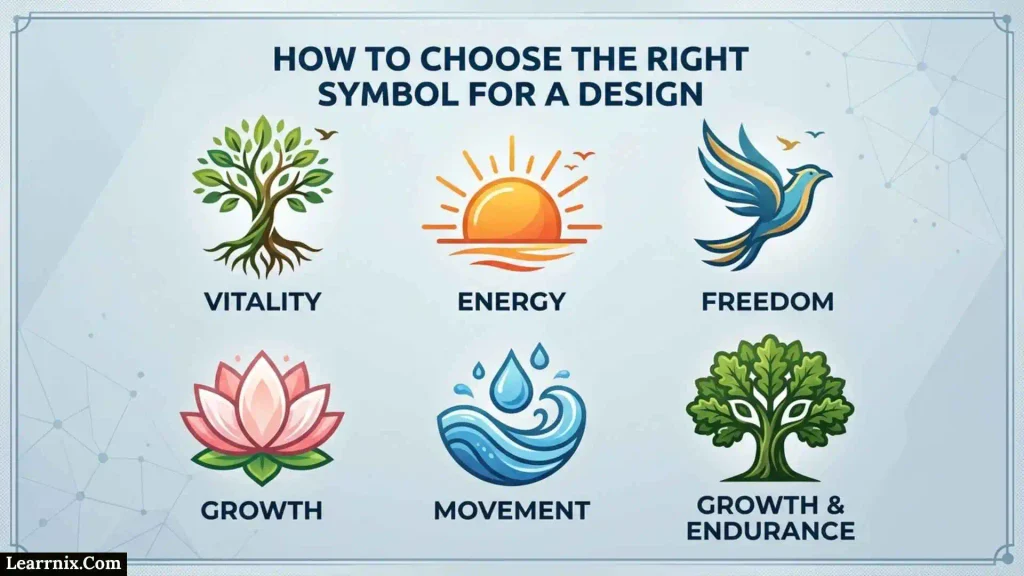
Choosing a symbol is not simply about finding an attractive picture. The symbol must support the message.
Use This Simple Decision Guide
What are you trying to communicate?
↓
Love or affection?
→ Consider a heart or another culturally appropriate relationship symbol.
Peace or reconciliation?
→ Consider a dove, olive branch, or peace symbol depending on the context.
Strength or leadership?
→ Consider a lion, eagle, mountain, or oak imagery.
Growth or transformation?
→ Consider a tree, seedling, butterfly, or other appropriate growth imagery.
Security or protection?
→ Consider a lock or shield.
Direction or movement?
→ Use an arrow.
Technical information?
→ Prefer the recognized standard icon or notation.
Religious identity?
→ Research the specific tradition before selecting the symbol.
This approach reduces the risk of using a symbol simply because it “looks right.”
Common Mistakes When Using Symbols
Assuming Every Symbol Has One Universal Meaning
This is one of the biggest mistakes. Meaning depends on context.
Choosing a Symbol Only Because It Looks Attractive
A beautiful symbol can still communicate the wrong idea.
Ignoring Cultural Context
A symbol that seems harmless in one culture can have a very different meaning elsewhere.
Confusing Cultural and Official Symbols
A popular cultural symbol is not necessarily an officially designated national or religious emblem.
Using Safety Symbols as Decoration
Safety signs should remain clear and recognizable. Decorative modifications can reduce their effectiveness.
Treating Emoji and Unicode Characters as Identical to Traditional Symbols
Emoji are encoded characters and sequences within the Unicode system. Their visual appearance can vary between platforms. Unicode’s documentation distinguishes characters and sequences and provides standardized names and annotations.
Overloading One Design With Too Many Symbols
Using ten symbols in a small logo can make the message difficult to understand. One strong symbol is often more effective than several competing ones.
Symbol Meaning Checklist
Before using a symbol, ask:
- What does this symbol normally represent?
- Is that meaning universal or culture-specific?
- Does its historical meaning differ from its modern use?
- Is it religious or politically sensitive?
- Does the target audience understand it?
- Is there an official standard for this symbol?
- Could another interpretation create confusion?
- Does it fit the purpose of the design?
- Does the surrounding color or text change its meaning?
- Is there a simpler symbol that communicates the message better?
This checklist is especially useful for logos, tattoos, websites, school projects, signs, packaging, and public communication.
Frequently Asked Questions
What is the most common symbol for love?
The heart is one of the most widely recognized visual symbols associated with love and affection. Its meaning can also include friendship, compassion, and emotional care depending on context.
What symbol represents peace?
Common peace-related symbols include the peace symbol ☮, dove 🕊️, olive branch, and white flag. Their histories and exact meanings differ.
What symbol represents strength?
Common symbolic choices include the lion, eagle, mountain, oak tree, shield, and sometimes the sword. The best choice depends on the cultural or design context.
What symbol represents wisdom?
The owl is a common symbol of wisdom in Western cultural traditions. Books, lamps, and other knowledge-related imagery can also represent learning and understanding.
What symbol represents transformation?
The butterfly is a popular symbol of transformation and change. The phoenix and spiral can also communicate renewal or cycles in appropriate contexts.
What symbol represents family?
Common choices include a family group, house, heart, family tree, or linked circles. The best option depends on whether the design focuses on home, relationships, ancestry, or emotional connection.
What symbol represents infinity?
The symbol ∞ is the standard mathematical symbol for infinity and is also widely used in art, jewelry, tattoos, and popular culture to represent endlessness or eternity.
What symbol means warning?
⚠️ is commonly used to indicate warning or caution. Other warning symbols are used for specific hazards, and standardized safety signage should be used when safety communication is involved.
What are the main types of symbols?
Common categories include visual symbols, cultural symbols, religious symbols, mathematical symbols, punctuation marks, currency symbols, keyboard characters, safety symbols, technical icons, national symbols, and digital symbols.
Are symbols universal?
No. Some symbols have broadly recognized meanings, while others are strongly tied to a particular culture, religion, historical period, profession, or technical standard.
Where can I find official information about Unicode symbols and emoji?
The Unicode Consortium provides official emoji charts and technical information about Unicode emoji characters and sequences. Its charts include names, keywords, categories, code points, and other details.
Key Takeaways
- A symbol communicates an idea, meaning, action, identity, or concept.
- Symbol meanings are often influenced by culture and context.
- Visual symbols include hearts, arrows, stars, animals, plants, and geometric shapes.
- Religious symbols require context because meanings differ between traditions.
- Mathematical and keyboard symbols have more standardized technical meanings.
- Safety symbols should follow recognized standards rather than artistic interpretation.
- Currency signs do not always identify one currency uniquely.
- Unicode provides authoritative information for digital characters and emoji.
- The best symbol is not necessarily the most attractive one; it is the one that communicates the intended message clearly.
- When a symbol has cultural, religious, historical, or technical importance, verify its meaning from an authoritative source.
Conclusion
A good list of symbols should do more than provide a collection of characters. It should explain what symbols mean, where they are used, why their meanings can change, and how to select the right symbol for a particular situation.
For everyday communication, symbols such as ❤️, ⭐, ➡️, ⚠️, 🔒, and 💡 are easy starting points. For mathematical, technical, safety, religious, national, or culturally important symbols, however, context matters much more.
The safest approach is simple: identify the type of symbol, understand its context, check its cultural or technical background, and then use it for the message you actually want to communicate.

I am Daniel Harper, an education enthusiast and writer who enjoys creating helpful content to make learning more accessible and engaging.
I focus on sharing knowledge about effective study methods, educational growth, and skills that help learners succeed in a changing world.
Through my writing, I aim to inspire students to explore new ideas and develop a passion for learning.
Books by Daniel Harper:
- The Path to Lifelong Learning
- Unlocking Your Learning Potential
 Michael Carter