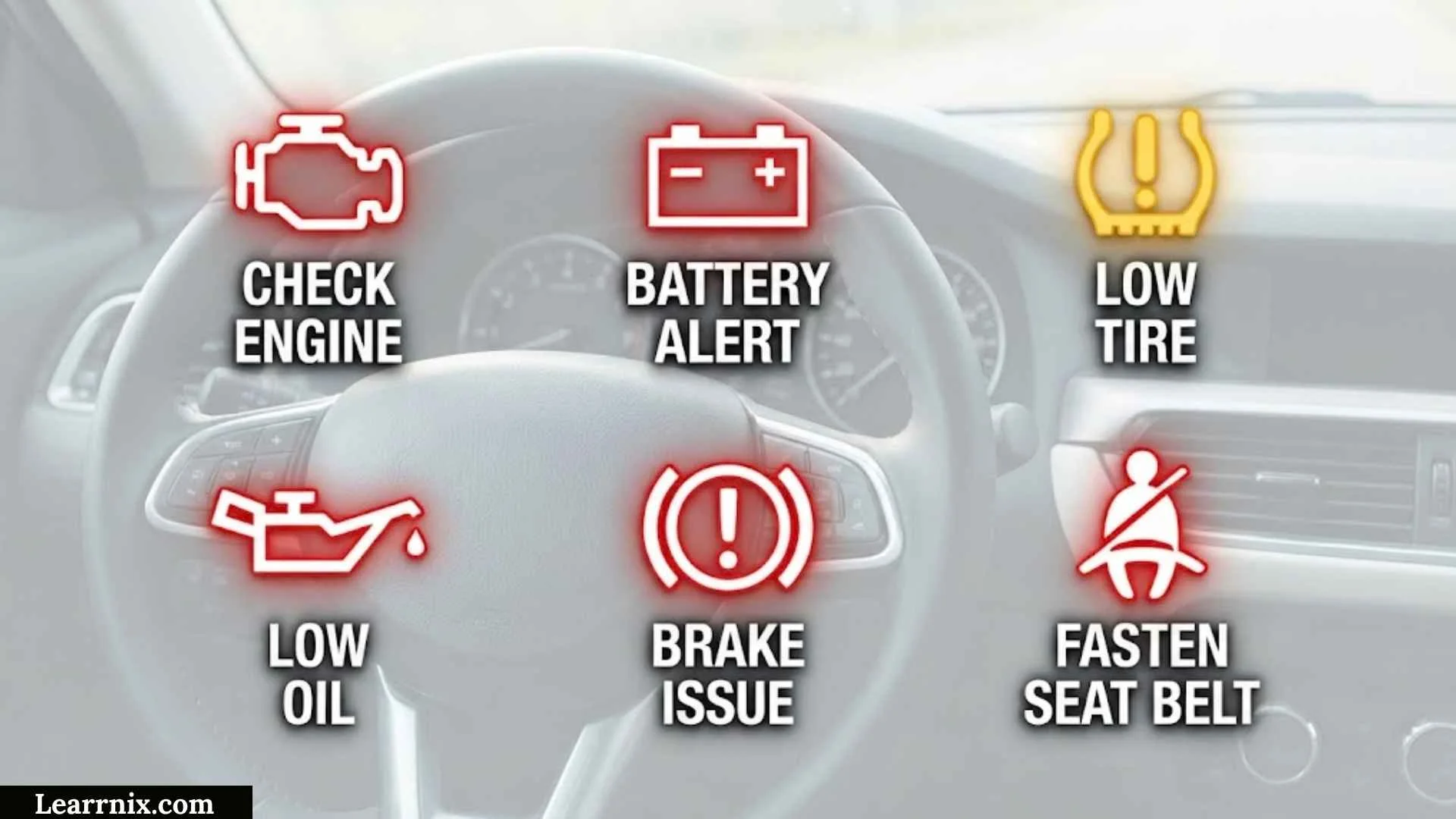
Car symbols are a simple visual language used to communicate information about a vehicle. Some symbols appear on the dashboard to show warnings, active features, or vehicle status, while others appear on the outside of a car as brand logos and badges.
If you are trying to identify an unfamiliar dashboard light, understand car symbols and meanings, or recognize a luxury car logo, this guide covers the most useful categories in one place. You will find common symbols with names, explanations, examples, and practical differences between dashboard indicators and manufacturer logos.
Dashboard symbols can vary by vehicle make, model, year, and equipment. Official owner manuals should therefore be treated as the final reference for a particular vehicle. Manufacturer manuals also show that some indicators are only available on certain models or equipment packages.
Car Symbols And Meanings
Car symbols can communicate everything from a low fuel level to a potential problem with the braking or charging system. A symbol’s color, whether it is steady or flashing, and the message displayed beside it can all provide additional information.
Here are some of the most common car symbols and their general meanings:
| Symbol Or Indicator | Common Name | General Meaning |
| ⚠ | Warning Triangle | General warning or caution |
| 🛢 | Oil Pressure Symbol | Low engine oil pressure or lubrication warning |
| 🔋 | Battery Symbol | Charging-system or electrical-system warning |
| 🌡 | Coolant Temperature Symbol | Engine coolant temperature warning |
| ⛽ | Fuel Pump | Fuel level or refueling information |
| ABS | ABS Warning | Anti-lock braking system warning |
| ! | Brake Warning | Brake system or parking-brake-related warning |
| 👤 | Seat Belt Reminder | Seat belt needs to be fastened |
| 🚗 | Vehicle Indicator | Vehicle-related warning or driver-assistance status |
| 🔧 | Wrench/Service Symbol | Maintenance or service reminder |
The actual graphics may look different from these text representations. Dashboard symbols are graphical indicators, so an emoji or Unicode character should not be treated as an exact replacement for an official dashboard icon.
Red, Yellow, Green, And Blue Car Symbols
Color can provide a useful first clue, but it should not be used by itself to diagnose a vehicle problem.
Red indicators commonly draw attention to conditions that may require immediate attention. Brake-system warnings, certain temperature warnings, and some safety-system warnings can use red.
Yellow or amber indicators commonly signal a warning, malfunction, or condition that should be checked. Examples include some engine, ABS, tire-pressure, and electronic-system warnings.
Green indicators commonly show that a feature is operating or active, such as certain lighting or driving functions.
Blue indicators are often informational, such as a high-beam indicator.
Exact meanings vary by vehicle. Official vehicle manuals explicitly explain that warning and indicator lights can differ by model and equipment.
Car Symbols On Dashboard
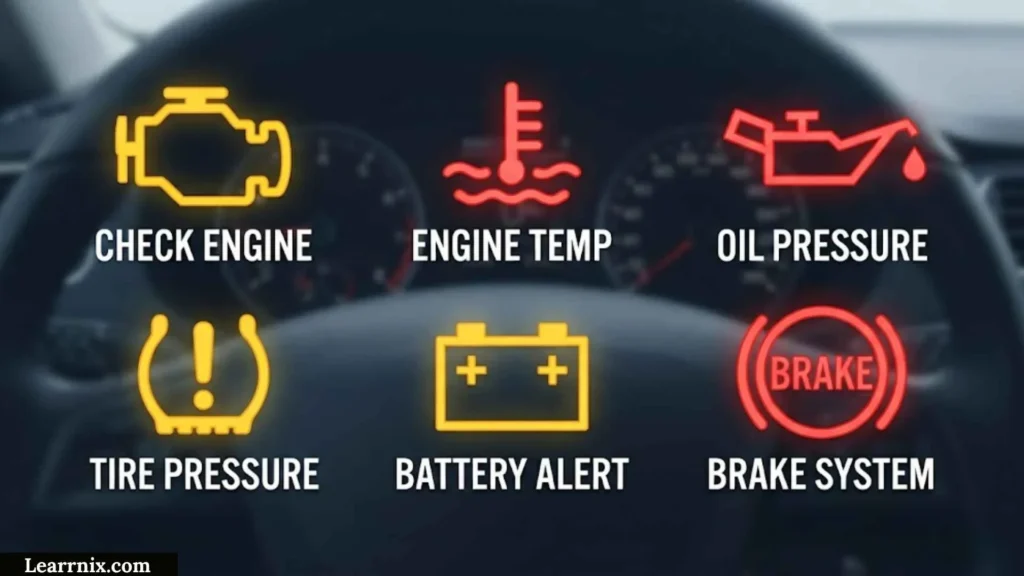
Car symbols on the dashboard are designed to give drivers quick information without requiring long messages. They may appear in the instrument cluster behind the steering wheel, on a digital display, or in other areas of the vehicle.
Common dashboard indicators include:
- Engine-shaped check-engine indicator
- Oil-pressure symbol
- Battery or charging-system symbol
- Brake warning symbol
- ABS symbol
- Airbag or SRS symbol
- Tire-pressure symbol
- Seat-belt reminder
- Fuel indicator
- High-beam indicator
- Turn-signal arrows
- Traction-control indicator
- Steering-system warning
- Door-open indicator
A dashboard symbol may appear briefly when the ignition is switched on because the vehicle is performing a system check. Some indicators should disappear after the vehicle starts, while others remain illuminated when a condition requires attention. Vehicle manuals explain these startup checks differently depending on the model.
Dashboard Symbols That Need Particular Attention
A persistent warning involving the brakes, engine temperature, oil pressure, steering, or another critical system should not be ignored. The correct response depends on the specific vehicle and warning.
For example, a brake warning may relate to the parking brake, brake fluid, or another brake-system condition. A battery-shaped light can indicate a charging-system problem rather than simply meaning that the battery needs replacement. Toyota’s current owner information, for example, separately lists charging-system, coolant-temperature, oil-pressure, ABS, SRS, and malfunction indicators.
When a warning appears, look for any accompanying text message and consult the owner’s manual before deciding what action to take.
Dashboard Car Symbols
Dashboard car symbols can be grouped into several useful categories. Understanding these categories makes it easier to identify what an unfamiliar indicator is trying to tell you.
Safety And Restraint Symbols
Safety-related indicators include the seat-belt reminder and airbag/SRS warning. A seat-belt indicator generally reminds the driver or passenger to fasten a seat belt. An airbag warning can indicate a fault in the supplemental restraint system.
These symbols are not merely decorative indicators. They relate to safety equipment and should be treated according to the manufacturer’s instructions.
Mechanical And Vehicle-System Symbols
Mechanical indicators can relate to:
- Engine oil pressure
- Coolant temperature
- Battery charging
- Brakes
- Engine management
- Transmission temperature
- Steering assistance
For example, an oil-pressure symbol commonly uses an oil-can shape, while a charging-system warning commonly uses a battery shape. Manufacturer service documentation also identifies these familiar symbols among vehicle warning and indicator lights.
Driver Assistance Symbols
Newer vehicles can display symbols for advanced driver-assistance systems. These can include:
- Forward collision warning
- Lane departure warning
- Blind-spot warning
- Rear cross-traffic warning
- Automatic emergency braking
- Adaptive cruise control
- Parking assistance
- Traction or stability control
These systems do not all work in the same way. NHTSA explains that some technologies provide warnings while others can take action, such as applying the brakes in certain emergency situations.
Car Symbols And What They Mean
The easiest way to understand a car symbol is to identify its shape, color, location, and accompanying message together.
For example, a tire-shaped symbol with an exclamation mark commonly indicates the tire-pressure monitoring system. A steering-wheel symbol may relate to the steering system. A car positioned between lane markings can represent a lane-related driver-assistance function.
Common Symbols Explained
Check Engine Symbol: Usually indicates that the vehicle’s diagnostic system has detected a fault. The symbol alone does not identify the exact problem.
Oil Can Symbol: Commonly associated with engine oil pressure. It should not automatically be interpreted as simply meaning that the engine needs an oil change.
Battery Symbol: Usually relates to the vehicle’s charging system.
Thermometer Symbol: Commonly indicates engine coolant temperature.
Brake Symbol: Can be associated with the parking brake, brake fluid, or another brake-system condition, depending on the vehicle.
ABS Symbol: Indicates the anti-lock braking system and can illuminate when the system detects a fault.
Airbag Symbol: Usually identifies the supplemental restraint system.
Tire-Pressure Symbol: Indicates that the tire-pressure monitoring system has detected a pressure-related condition.
Seat-Belt Symbol: Reminds an occupant to fasten a seat belt.
High-Beam Symbol: Indicates that the high-beam headlights are operating.
The important point is that a symbol provides a starting point, not always a complete diagnosis. Vehicle documentation should be used for the exact interpretation.
Car Symbols With Names
If you want a quick car symbols names list, the following reference covers many symbols drivers encounter.
| Symbol | Name | Use Or Meaning |
| 🛢 | Oil Can | Oil pressure or lubrication warning |
| 🔋 | Battery | Charging-system warning |
| 🌡 | Temperature | Engine coolant temperature |
| ⛽ | Fuel Pump | Fuel level |
| ABS | Anti-Lock Braking System | ABS warning |
| ! | Brake Warning | Brake-related warning |
| ⚠ | General Warning | General vehicle warning |
| 👤 | Seat Belt | Seat-belt reminder |
| 🚘 | Vehicle Symbol | Vehicle or assistance-related status |
| 🔧 | Service/Wrench | Maintenance or service |
| ⇆ | Turn Signal | Direction indicator |
| 🔒 | Lock | Locking/security-related function |
| 💡 | Light | Lighting-related function |
The last few Unicode characters are simplified text representations and should not be confused with the exact official graphics displayed by a vehicle.
Copy And Paste Car-Themed Symbols
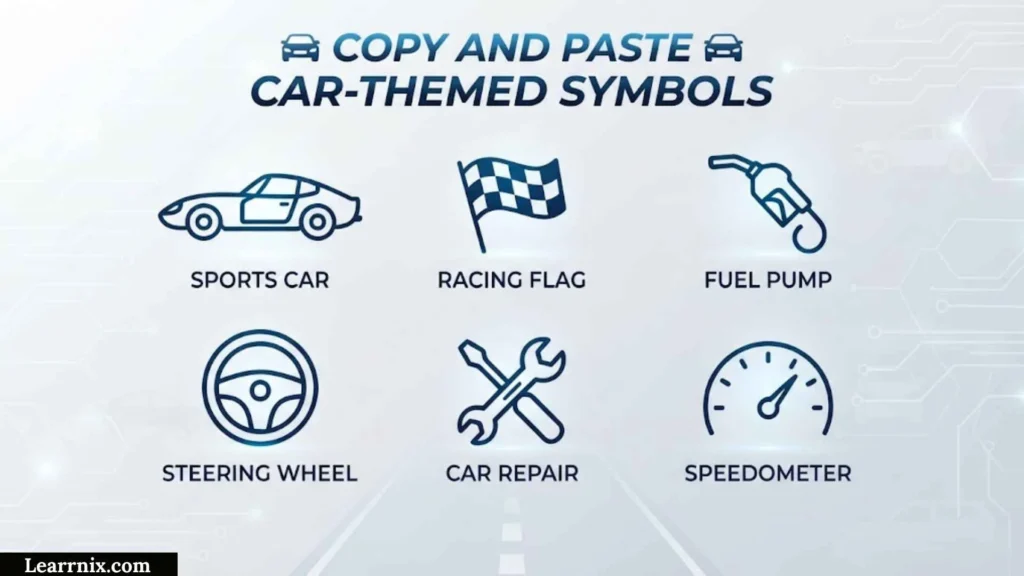
For websites, social media posts, usernames, messages, and decorative text, you can copy these general Unicode symbols:
Car And Transport: 🚗 🚘 🚙 🏎️ 🚕 🚓 🚑 🚐 🛻 🚌
Warning And Information: ⚠️ ❗ ❕ ℹ️ ⓘ
Direction And Status: → ← ↑ ↓ ✓ ✔ ✕ ✖
Decorative Symbols: ★ ☆ ✦ ✧ ◆ ◇ ● ○
These characters are useful for text-based automotive content, but they are not official dashboard icons.
Luxury Car Logos And Names List
Luxury car logos are visual identifiers used by automobile manufacturers and marques. Unlike dashboard warning symbols, their primary purpose is brand recognition.
Some recognizable luxury automotive brands include:
| Luxury Brand | Common Logo Or Emblem Description |
| Mercedes-Benz | Three-pointed star |
| BMW | Circular roundel |
| Audi | Four interlocking rings |
| Lexus | Stylized L inside an oval |
| Porsche | Shield-shaped crest |
| Bentley | Winged B |
| Rolls-Royce | Double-R monogram and winged emblem |
| Jaguar | Jaguar-themed emblem |
| Lamborghini | Bull inside a shield |
| Maserati | Trident |
| Aston Martin | Winged emblem |
| Ferrari | Prancing horse emblem |
A brand’s logo may have different versions for vehicles, advertisements, digital platforms, merchandise, and special editions. Some manufacturers have also updated their visual identities over time.
Why Car Logos Are Different From Dashboard Symbols
A car logo identifies a manufacturer or automotive brand.
A dashboard symbol communicates information about the vehicle.
For example, the four-ring emblem associated with Audi identifies the brand, while an ABS indicator tells the driver about the anti-lock braking system. Confusing these two categories can make it harder to understand what a vehicle display is communicating.
Foreign Car Symbols
Foreign car symbols generally refers to the logos and identifying marks of automobile brands headquartered outside the country where the term is being used.
For example, drivers in the United States may casually describe Japanese, German, Italian, Korean, Swedish, or French automobile brands as foreign car brands.
Japanese Car Symbols
Common Japanese automotive brands include:
- Toyota
- Honda
- Nissan
- Mazda
- Subaru
- Mitsubishi
- Suzuki
- Lexus
- Infiniti
- Acura
German Car Symbols
Well-known German automotive brands include:
- BMW
- Mercedes-Benz
- Audi
- Volkswagen
- Porsche
- Opel
Italian Car Symbols
Italian automotive brands include:
- Ferrari
- Lamborghini
- Maserati
- Fiat
- Alfa Romeo
- Lancia
Korean Car Symbols
Common South Korean automotive brands include:
- Hyundai
- Kia
- Genesis
The country associated with a brand does not necessarily tell you where every vehicle or component is manufactured. Automotive companies operate global production and supply networks, so the brand’s headquarters, design location, and manufacturing location can be different.
Car Symbols Logo
A car symbols logo can mean different things depending on the context. It may refer to a manufacturer’s emblem, a vehicle badge, or a decorative Unicode character representing a car or automotive theme.
Common Car Logo Styles
Automotive logos often use recognizable visual concepts such as:
- Animals
- Wings
- Shields
- Rings
- Stars
- Letters
- Geometric shapes
- Crests
- Abstract forms
A logo is normally associated with the identity of a brand rather than the operating condition of the vehicle.
Car Logo Symbols For Text
If you are creating a social media post, username, website heading, or message, Unicode symbols can provide an automotive feel without reproducing an official trademark.
Useful examples include:
- 🚗 — Automobile
- 🏎️ — Racing car
- 🚘 — Oncoming automobile
- 🛞 — Wheel
- 🏁 — Chequered flag
- ⚙️ — Gear
- ⛽ — Fuel pump
- 🔧 — Wrench
- 🛠️ — Tools
These are Unicode emoji or symbols, not official manufacturer logos. Their appearance can also change between operating systems and applications because different platforms may render emoji differently.
Car Logos And Trademarks
Official automotive logos can be protected trademarks. If you are publishing commercial content or creating branding material, use the appropriate official assets and follow the applicable brand guidelines rather than recreating a manufacturer’s logo with random Unicode symbols.
FAQ
What are the most common car symbols on a dashboard?
Common dashboard symbols include the check-engine, oil-pressure, battery, brake, ABS, airbag, tire-pressure, seat-belt, temperature, fuel, and high-beam indicators. Exact designs vary by vehicle.
What does a red car symbol usually mean?
A red indicator commonly signals a condition that needs prompt attention, but its exact meaning depends on the symbol and vehicle. Check the owner’s manual for the correct response.
What does a yellow car symbol mean?
A yellow or amber indicator commonly identifies a warning, malfunction, or condition that should be checked. The specific symbol and accompanying message provide more useful information than color alone.
Are car logos the same as dashboard symbols?
No. A car logo identifies a manufacturer or brand, while a dashboard symbol communicates information about a vehicle system, warning, or active feature.
Where can I find the exact meaning of my car symbols?
The owner’s manual is the most reliable source for a specific vehicle. Manufacturer manuals explain the symbols installed on that model and may identify differences caused by optional equipment or regional specifications.
Conclusion
Car symbols cover a wide range of information, from simple indicators such as turn signals and high beams to important warnings involving brakes, oil pressure, temperature, airbags, and electronic systems. Learning the common shapes and categories makes dashboard information easier to recognize.
Car logos serve a different purpose by identifying manufacturers and luxury automotive brands. Japanese, German, Italian, Korean, and other international brands use distinctive emblems, while Unicode car and transport symbols can be useful for online content, messages, and decorative text.
The most useful approach is to use general car-symbol guides for identification and then confirm unfamiliar warnings in the owner’s manual for your exact vehicle. Dashboard symbols can differ by model and equipment, so the manufacturer’s information should take priority when a warning appears.

I am Charlotte Anderson, an education writer who is passionate about creating meaningful learning resources for students and lifelong learners.
I enjoy researching new educational approaches and sharing ideas that make studying easier and more effective.
Through my work, I aim to inspire curiosity, confidence, and a love for learning.
Books:
- The Complete Guide to Better Learning
- Building Skills for Academic Success
 Michael Carter