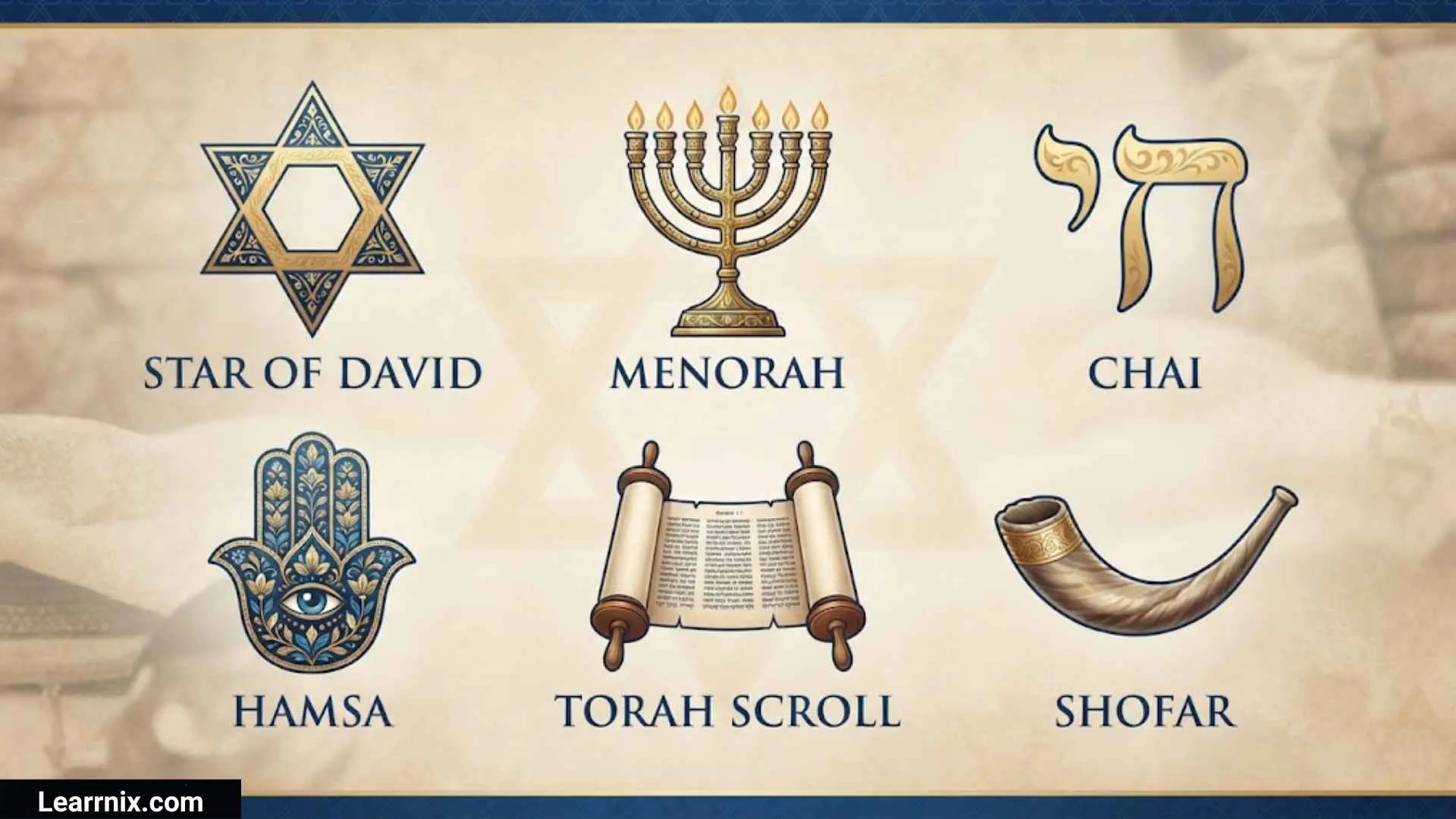
Jewish symbols are visual expressions of faith, identity, history, culture, and tradition. Some, such as the menorah, have roots in ancient Jewish worship, while others, such as the Star of David, became widely recognized as Jewish symbols much later. Symbols such as chai, the hamsa, mezuzah, Torah imagery, and the shofar also carry important meanings in different Jewish contexts.
People search for Jewish symbols for many reasons. Some want to understand the meaning behind a necklace or tattoo, others want to identify a symbol on food packaging, and many simply want to copy-and-paste Jewish characters for social media or messages. The meaning of a symbol can depend on its historical period, Jewish community, and religious context, so it is useful to look beyond a simple one-line definition.
This guide covers the major Jewish symbols, their meanings, history, variations, jewelry uses, protective associations, kosher food marks, Ashkenazi traditions, and Messianic Jewish imagery. It also includes copyable characters and practical explanations so you can recognize these symbols and understand how they are commonly used.
Jewish Symbols And Meanings
Jewish symbolism includes both ancient religious objects and symbols that became popular in later Jewish culture. There is no single official list containing every Jewish symbol. Some symbols are directly connected with biblical commandments or Jewish ritual, while others developed through art, community customs, or folk traditions.
Here are some of the most recognizable examples:
| Symbol | Name | Common Meaning Or Association |
| ✡ | Star of David / Magen David | Jewish identity and community |
| 🕎 | Menorah | Temple, light, and Jewish heritage |
| חי | Chai | Life and vitality |
| Hamsa | Hamsa Hand | Protection in some Jewish traditions |
| ש | Shin | Hebrew letter with several religious associations |
| 🕍 | Synagogue imagery | Jewish worship and community |
| Shofar | Ram’s horn | Repentance, awakening, and holy days |
| Torah scroll | Torah | Jewish teaching, law, and learning |
| Lulav and etrog | Four Species | Sukkot and Jewish ritual |
| Mezuzah | Doorpost scroll | Torah, covenant, and Jewish home |
The menorah is among the oldest and most important Jewish symbols. The seven-branched menorah was associated with the Tabernacle and the Temple in Jerusalem. The Star of David, although now perhaps the most recognizable Jewish emblem, has a much more recent history as a widespread Jewish symbol.
The Hebrew word חי, pronounced chai, means “life.” Because the letters have a combined numerical value of 18, the number 18 has a special place in Jewish culture, particularly in gifts and charitable giving.
What Are The Five Symbols Of Judaism
Judaism does not have an official rule limiting its symbolism to exactly five symbols. However, if someone asks for five widely recognized Jewish symbols, these are strong examples:
- ✡ Star of David — Magen David: A modern symbol of Jewish identity and community.
- 🕎 Menorah: Represents the ancient Temple tradition and Jewish heritage.
- חי Chai: The Hebrew word for life, strongly associated with Jewish culture and jewelry.
- Hamsa: A hand-shaped symbol associated with protection in some Jewish communities.
- Mezuzah: A religious object containing Torah passages that is traditionally placed on a Jewish home’s doorpost.
The distinction between these objects is important. A Star of David is primarily an emblem, while a mezuzah is a ritual object with specific religious requirements. The menorah is deeply rooted in ancient Temple tradition, while the hamsa has a broader Middle Eastern history and is not exclusively Jewish.
Other symbols could also be included in a list of five, such as the Torah scroll, shofar, lulav, etrog, or the tablets representing the commandments.
Pictures Of Jewish Symbols And Meanings
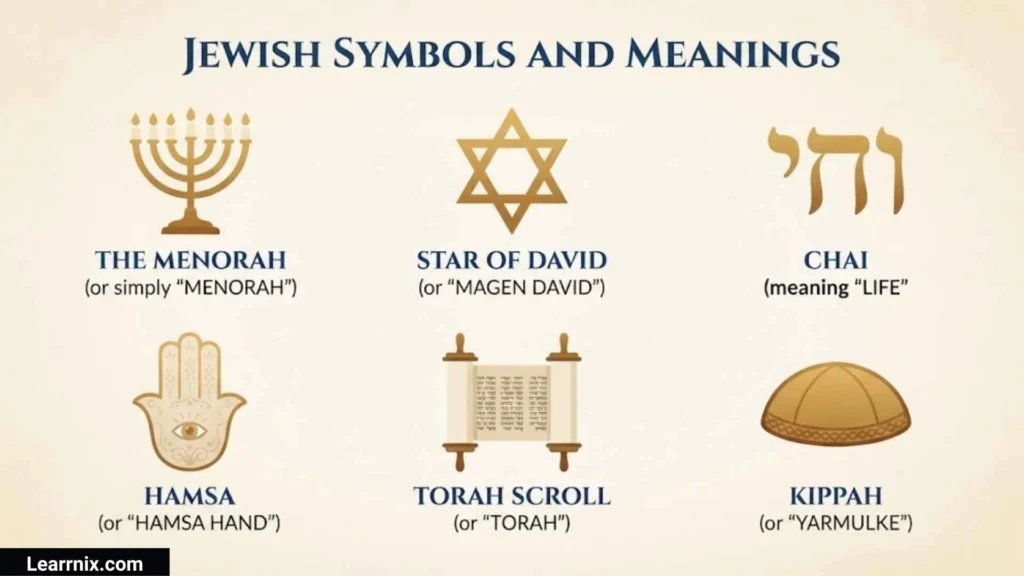
Pictures are particularly useful when learning Jewish symbols because many have recognizable shapes. The same symbol may also appear in simplified, decorative, or modern designs.
Star Of David
✡ is the familiar six-pointed star formed by two overlapping triangles. Its Hebrew name is Magen David, meaning “Shield of David.” Today it is strongly associated with Jewish identity, Judaism, and Israel. Its specific association with Judaism developed over time rather than beginning as a universally recognized biblical symbol.
Menorah
The traditional seven-branched menorah represents the ancient Temple menorah. It should be distinguished from the hanukkiah, which has eight branches plus a shamash for Hanukkah.
Chai
חי is formed from the Hebrew letters chet and yud and means “life.” It is especially common in pendants, necklaces, artwork, and Jewish gifts.
Hamsa
The hamsa is an open hand, often shown with an eye in its center. It is widely used among Sephardic and Mizrahi Jewish communities and is associated with protection from the Evil Eye in some traditions. It is also used in Muslim and other Middle Eastern cultures, so it should not be described as exclusively Jewish.
Priestly Hands
Two raised hands forming the traditional priestly blessing gesture can be found in Jewish art, including some gravestones and religious objects. The image is associated with the Kohanim, the Jewish priestly class.
Important Jewish Symbols
Several symbols stand out because of their historical or religious importance.
Menorah: The seven-branched menorah is one of the oldest widely recognized Jewish symbols and is connected with the Tabernacle and Temple.
Star of David: The Magen David became a major public symbol of Jewish identity, especially in modern times. Although the hexagram itself is an ancient geometric form, its role as a universal Jewish emblem developed much later.
Torah Scroll: A Torah scroll represents Jewish scripture, learning, law, and religious tradition. It is central to synagogue worship and Jewish study.
Shofar: The shofar is a ram’s horn traditionally sounded during important Jewish religious occasions, particularly Rosh Hashanah. Its sound is associated with reflection and spiritual awakening.
Mezuzah: A mezuzah contains specific Torah passages written on parchment and is traditionally affixed to a Jewish home’s doorpost. It is more than a decorative symbol because it has a defined religious function.
Lulav And Etrog: These are part of the Four Species used during Sukkot. The lulav combines palm, myrtle, and willow branches, while the etrog is a citron.
Tablets: Images of the two tablets associated with the commandments are common in Jewish visual art and synagogue decoration.
What Are Some Jewish Symbols
Jewish symbols can be understood more easily by grouping them according to their purpose or association.
Symbols Of Jewish Identity
- ✡ — Magen David / Star of David
- Hebrew lettering
- Menorah imagery
- Israeli and Jewish cultural imagery
Symbols Of Life And Blessing
- חי — Chai
- Tree and fruit imagery
- Pomegranate imagery
- Olive branches
Symbols Of Ritual
- Menorah
- Shofar
- Mezuzah
- Lulav
- Etrog
- Torah scroll
- Tallit and tzitzit
Symbols Associated With Protection
- Hamsa
- Certain amuletic designs
- Some Hebrew-letter combinations used in Jewish folk traditions
The important point is that these categories overlap. A symbol can represent religious practice, cultural identity, history, or personal meaning at the same time. Jewish symbolism also varies between communities and historical periods.
Common Jewish Symbols
If you are trying to identify Jewish imagery quickly, these are among the symbols you are most likely to encounter:
- ✡ Star of David — Jewish identity and community.
- 🕎 Menorah — Temple tradition and Jewish heritage.
- חי Chai — Life.
- Hamsa — Protection in some Jewish traditions.
- Mezuzah — Torah passages and the Jewish home.
- Shofar — Rosh Hashanah and spiritual awakening.
- Torah scroll — Jewish scripture and learning.
- Lulav and etrog — Sukkot.
- Dreidel — Hanukkah.
- Two tablets — The commandments.
- Priestly hands — The Kohanic blessing.
- Pomegranate — Biblical and Jewish artistic symbolism.
The dreidel is particularly connected with Hanukkah. Its four Hebrew letters traditionally form the phrase nes gadol haya sham, meaning “a great miracle happened there”; Israeli dreidels commonly use פ instead of ש to represent “a great miracle happened here.”
Jewish Symbols Copy And Paste
If you need Jewish-related symbols for social media, messages, usernames, headings, artwork, or decorative text, these characters can be copied directly.
Star And Decorative Symbols
- ✡ — Six-pointed star
- ★ — Black star
- ☆ — White star
- ✦ — Four-pointed star
- ✧ — Four-pointed outline star
Hebrew Symbols And Words
- חי — Chai, “life”
- ש — Shin
- ח — Chet
- י — Yud
- א — Alef
- ב — Bet
- שלום — Shalom, “peace”
- תורה — Torah
- שבת — Shabbat
- מזוזה — Mezuzah
You can also create simple decorative combinations:
✡ חי ✡
★ חי ★
✡ שלום ✡
חי • 18 • חי
The character ✡ is useful for digital copy-and-paste because it is a Unicode character. Hebrew words, however, are made from Hebrew script characters rather than from one special “Jewish Unicode” symbol. Their appearance can vary depending on the font and device.
Jewish Symbols Necklace
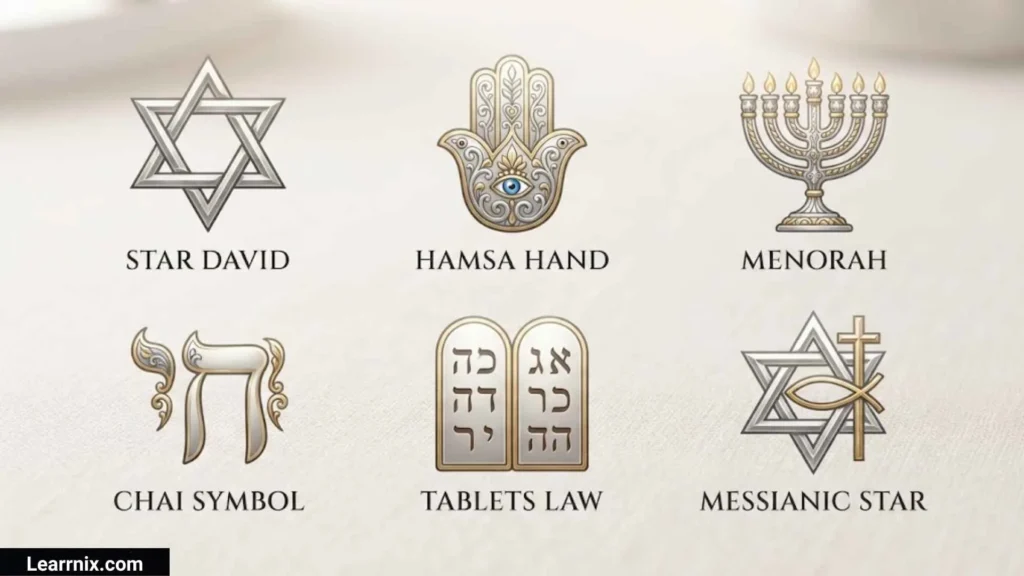
Jewish symbols are commonly worn as necklaces because they allow people to express identity, heritage, faith, family connection, or a meaningful Jewish concept.
Star Of David Necklace
A Star of David pendant is perhaps the most recognizable Jewish necklace design. It can be worn as a visible expression of Jewish identity or as a connection to family and heritage.
Chai Necklace
A חי pendant represents life and is one of the most popular Jewish jewelry designs. Its connection with the number 18 gives it an additional layer of meaning, especially when given as a gift.
Hamsa Necklace
Hamsa necklaces are particularly common in Sephardic and Mizrahi Jewish cultural contexts. Depending on the wearer and community, the hand may represent protection or a wish to avoid the Evil Eye.
Menorah Necklace
A menorah pendant connects the wearer with Jewish history and Temple symbolism. It is especially meaningful for people who want a design with an ancient Jewish association.
Jewish Symbols Jewelry
Jewish jewelry includes much more than Star of David necklaces. Rings, bracelets, pendants, earrings, charms, and personalized pieces may feature Hebrew words, religious objects, or historical imagery.
| Jewelry Design | Meaning Or Association |
| Star of David | Jewish identity |
| Chai | Life and vitality |
| Hamsa | Protection in some traditions |
| Menorah | Temple and Jewish heritage |
| Hebrew name | Personal or family identity |
| Shalom | Peace |
| Pomegranate | Biblical and Jewish cultural imagery |
| Tree of Life | Life, growth, and Jewish artistic tradition |
A useful distinction is that Jewish jewelry can be cultural or decorative, while some Jewish ritual objects have specific religious requirements. A decorative Star of David pendant, for example, is not the same type of religious object as tefillin or a Torah scroll.
Jewish Symbols Of Protection
Protection is a recurring theme in Jewish folk traditions, but it needs to be discussed carefully because Jewish communities have different views about amulets, the Evil Eye, and protective practices.
Hamsa
The hamsa is the most recognizable Jewish-associated protective hand. Its name comes from the Arabic word for five and refers to the five fingers. Many versions contain an eye in the center, representing protection from the Evil Eye.
Its Jewish status is not completely straightforward. The hamsa is shared across Jewish, Muslim, and other Middle Eastern cultures, and some Jewish authorities have questioned or discouraged its use. Other Sephardic traditions accepted protective hand imagery.
Mezuzah
A mezuzah is sometimes described online as a Jewish “protection symbol,” but that description is incomplete. Its primary purpose is to contain Torah passages and serve as a religious reminder at the entrance to a home.
Chai
Chai represents life rather than protection specifically. However, its association with life and well-being explains why it is frequently selected for meaningful jewelry and gifts.
Hebrew Letters
Hebrew letters can appear in Jewish amuletic traditions, particularly in historical mystical practices. Their interpretation can be complex, and not every decorative Hebrew letter combination should automatically be treated as a traditional protective formula.
Ancient Jewish Symbols
Some Jewish symbols have ancient roots, while others only became strongly associated with Judaism in relatively recent centuries.
The seven-branched menorah is one of the clearest ancient Jewish symbols. It is described in the Torah in connection with the Tabernacle and later became associated with the Temple in Jerusalem. Archaeological and artistic evidence also shows the menorah’s long-standing importance in Jewish visual culture.
Other ancient Jewish imagery includes:
- Menorah — Temple worship and Jewish heritage.
- Shofar — Ritual sound and sacred occasions.
- Lulav and etrog — Sukkot.
- Pomegranate — Biblical imagery and Jewish art.
- Olive branch — Biblical and cultural associations.
- Dove — Biblical imagery and Jewish symbolism.
- Priestly hands — The blessing of the Kohanim.
- Tablets — The commandments.
- Torah scroll — Jewish scripture and learning.
The Star of David should not simply be labeled an ancient biblical symbol. The hexagram is an old geometric design, but its widespread adoption as a Jewish communal emblem occurred much later. Historical evidence shows Jewish use of the hexagram in different periods, with its modern prominence developing over time.
Jewish Symbols On Food
When Jewish symbols appear on food packaging, they are often kosher certification marks, also called a hechsher. These marks indicate that a recognized kosher certification organization has certified the product according to its standards.
Common certification organizations include:
- OU — Orthodox Union
- OK — OK Kosher
- Star-K — Star-K Kosher Certification
- Kof-K — Kof-K Kosher Supervision
Additional letters or words can communicate categories such as dairy, meat, or Passover status. However, these markings are not completely standardized across every certification agency, so shoppers should check the certifier’s own explanation rather than assuming that every letter has the same meaning.
For example, a D attached to a certification symbol commonly indicates dairy, while Pareve/Parve identifies a neutral kosher category under the certifier’s system. Passover certification can also have its own designation.
A kosher certification symbol is different from a Star of David or menorah. It is primarily practical information for consumers rather than a general emblem of Jewish identity.
Ashkenazi Jewish Symbols
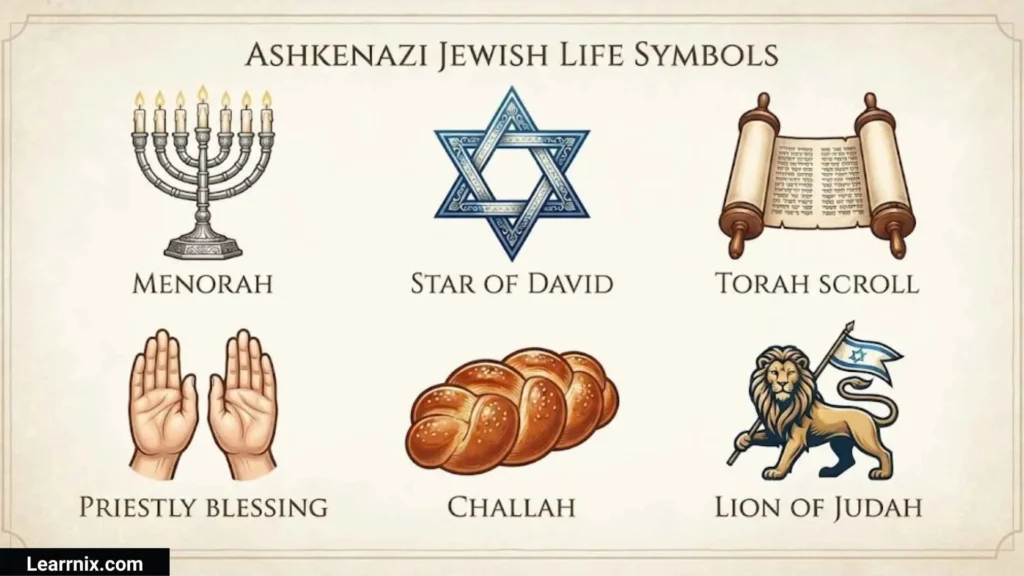
Ashkenazi Jewish communities developed rich visual traditions across Central and Eastern Europe. However, there is no single symbol that can accurately be called the exclusive “Ashkenazi Jewish symbol.”
Ashkenazi Jewish art and material culture may feature:
- Star of David
- Menorah
- Hebrew inscriptions
- Torah imagery
- Shabbat objects
- Challah and challah covers
- Hanukkah menorahs
- Dreidels
- Matzah and Passover imagery
- Jewish papercut designs
Jewish papercutting is especially interesting because historical Jewish papercuts could combine Hebrew inscriptions with menorahs, animals, plants, ritual objects, and other imagery. These designs became part of Jewish artistic culture in several communities.
Ashkenazi and Sephardic Jewish traditions are not identical. Their languages, pronunciation, food customs, liturgy, art, and regional histories developed differently. Therefore, a symbol commonly found in one community should not automatically be presented as universal to all Jews.
Jewish Symbols Chai
חי is one of the most recognizable Hebrew symbols used in Jewish jewelry and decorative art. It consists of two Hebrew letters:
- ח — Chet
- י — Yud
Together they spell chai, meaning “life” or “living.”
The numerical value of ח is 8 and י is 10, producing 18. This is why 18 has become culturally significant in Jewish giving and celebrations. People may give gifts or charitable donations in multiples of 18, such as 18, 36, 54, or 180.
Copy it here:
חי
Related expressions include:
- לחיים — L’chaim, “to life”
- 18 — The numerical value associated with chai
- חי — Life
Because of its short form and strong meaning, chai works especially well on pendants, rings, bracelets, wall art, greeting cards, and digital designs.
Jewish Symbols Hand
The Jewish hand symbol usually refers to one of two very different forms: the hamsa or the priestly blessing hands.
The hamsa is an open hand, frequently with an eye in the center. It is especially familiar in Jewish communities with Sephardic and Mizrahi heritage and is often associated with protection from the Evil Eye.
The priestly blessing gesture is made with both hands and is associated with the Kohanim. Its appearance in Jewish art can identify a connection with priestly heritage or the Priestly Blessing.
These two hand symbols should not be confused. The hamsa is generally a single stylized hand, often with an eye, while the priestly gesture depicts two hands arranged in a specific blessing position.
Messianic Jewish Symbols
Messianic Jewish communities use some traditional Jewish symbols while also incorporating imagery connected with belief in Jesus as the Messiah. Their symbolism therefore differs from the symbols traditionally used throughout mainstream Jewish communities.
One symbol associated with the modern Messianic Jewish movement is the Messianic Seal, often represented using a combination of a menorah, Star of David, and fish imagery.
Other designs associated with Messianic Jewish groups may include:
- Menorah
- Star of David
- Fish or ichthys
- Hebrew lettering
- Cross combined with Jewish imagery
- Messianic Seal
Context matters when identifying these designs. A Star of David by itself is broadly recognized as Jewish, while a Star of David combined with a cross or explicitly Christian imagery may indicate a Messianic context.
It is therefore better to describe Messianic Jewish symbols separately rather than treating every symbol used by Messianic groups as a universally accepted symbol of Judaism.
FAQ
What is the most recognized Jewish symbol?
The Star of David, also called the Magen David, is probably the most recognizable modern Jewish symbol. It is widely associated with Jewish identity, communities, synagogues, jewelry, and Jewish cultural expression.
What does the Jewish symbol chai mean?
The Hebrew word חי means “life” or “living.” Its letters have a combined numerical value of 18, which explains the special cultural significance of the number 18 in Jewish giving and celebrations.
Is the hamsa an official Jewish symbol?
The hamsa is used as a Jewish cultural and protective symbol, particularly in some Sephardic traditions, but it is not exclusively Jewish and its use has been debated among Jewish authorities.
What is the oldest Jewish symbol?
The seven-branched menorah is generally regarded as one of the oldest major Jewish symbols. Its connection with the Tabernacle and Temple makes it much older in Jewish tradition than the modern widespread use of the Star of David.
What do Jewish symbols on food packaging mean?
They are usually kosher certification marks, or hechshers. They identify an organization that has certified the product according to its kosher standards, while additional markings may provide information about dairy, meat, or Passover status.
Conclusion
Jewish symbols represent a wide range of ideas, from identity and heritage to religious practice, life, learning, ritual, and protection. The menorah and other ancient imagery connect modern Jewish communities with earlier periods, while the Star of David has become a powerful modern emblem of Jewish identity.
Symbols such as חי, the hamsa, mezuzah, shofar, Torah, lulav, etrog, and priestly hands show how diverse Jewish visual culture can be. They can appear in religious settings, jewelry, artwork, homes, holiday traditions, gravestones, and everyday cultural objects.
For digital use, ✡ and חי are simple copy-and-paste choices, while Hebrew words such as שלום and תורה can add meaningful text to designs. The most important point is to understand the context behind each symbol rather than assuming that every Jewish-looking design has the same history or religious status.

I am Daniel Harper, an education enthusiast and writer who enjoys creating helpful content to make learning more accessible and engaging.
I focus on sharing knowledge about effective study methods, educational growth, and skills that help learners succeed in a changing world.
Through my writing, I aim to inspire students to explore new ideas and develop a passion for learning.
Books by Daniel Harper:
- The Path to Lifelong Learning
- Unlocking Your Learning Potential
 Michael Carter
 Charlotte Anderson