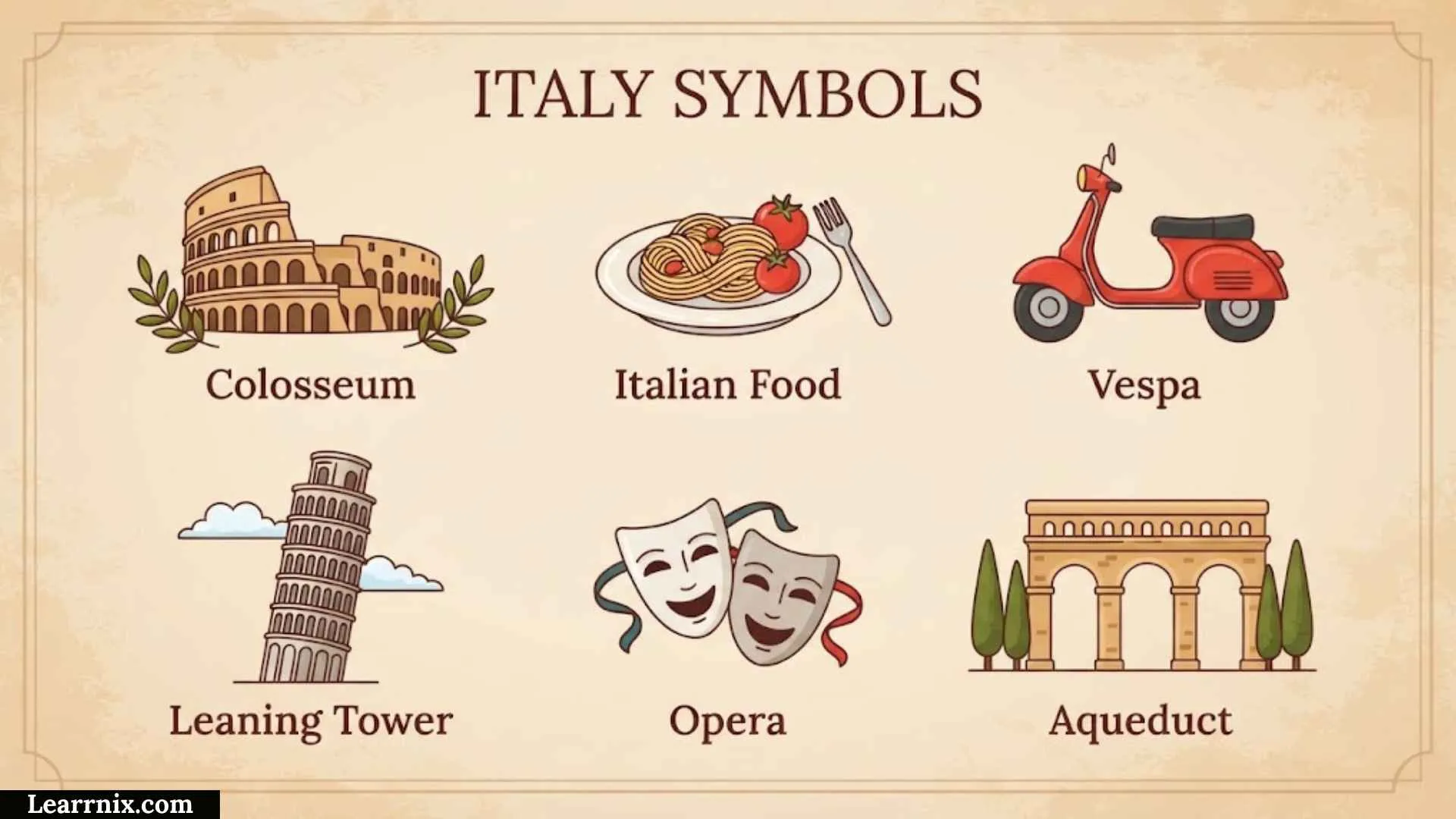
When people search for Italy symbols, they may be looking for the Italian flag, national emblem, anthem, famous landmarks, historical icons, or cultural objects that represent Italian identity. The most important distinction is that not every famous Italian image is an official national symbol.
The official symbols of the Italian Republic include the Tricolore flag, national anthem, emblem, and Presidential Standard. The Italian Republic’s emblem contains a five-pointed star, steel cogwheel, olive branch, and oak branch, each with a specific symbolic role.
Italy also has many widely recognized cultural and historical symbols. The Colosseum, Roman wolf, Renaissance art, Italian architecture, pasta, pizza, olive trees, and laurel wreaths are commonly associated with Italy, but they do not all have official state status.
This guide explains the major symbols of Italy, what they mean, where they came from, and how to tell an official national symbol from a cultural or historical representation.
Quick Answer: What Are the Main Symbols of Italy?
The main official symbols of the Italian Republic are:
- Italian Tricolore — the green, white, and red national flag.
- National Anthem — Il Canto degli Italiani, commonly known as Fratelli d’Italia.
- Emblem of the Italian Republic — featuring the star, cogwheel, olive branch, and oak branch.
- Presidential Standard — the distinctive symbol of the presence of the President of the Republic.
Other famous symbols associated with Italy include:
- Colosseum
- Roman wolf
- Italian star
- Olive branch
- Oak branch
- Laurel wreath
- Renaissance art
- Roman architecture
- Opera
- Pasta
- Pizza
- Italian fashion
- Green, white, and red
The key difference is official status. The first four belong to the formal symbolism of the Italian Republic, while many of the others are historical or cultural symbols.
Italy Symbols at a Glance
| Symbol | Type | Main Meaning or Association |
| Tricolore | Official | Italian national identity |
| Green, white, and red | Official flag colors | National flag |
| Fratelli d’Italia | Official | National identity and Italian unification |
| Republic emblem | Official | Civic and constitutional values |
| Presidential Standard | Official | Presence and office of the President |
| Star | Emblem element | Italy and historical national identity |
| Steel cogwheel | Emblem element | Work |
| Olive branch | Emblem element | Peace |
| Oak branch | Emblem element | Strength and dignity |
| Colosseum | Historical/cultural | Ancient Rome |
| Roman wolf | Historical/cultural | Rome and its legendary origins |
| Laurel wreath | Historical/cultural | Victory and classical heritage |
| Renaissance art | Cultural | Italian artistic heritage |
| Pasta and pizza | Cultural | Italian culinary traditions |
| Italian architecture | Cultural/historical | Roman, Renaissance, Baroque, and regional heritage |
This classification is useful because it prevents a common mistake: treating every well-known Italian image as an official national emblem.
Official Symbols vs. Cultural Symbols of Italy
Before looking at individual symbols, it helps to understand the two main categories.
Official Symbols of the Italian Republic
Official state symbols have a formal connection with the Italian Republic. The Quirinal’s overview identifies the Tricolore, national anthem, emblem, and Presidential Standard among the Republic’s symbols.
These symbols are used in official ceremonies, government settings, diplomatic contexts, military protocol, and other formal situations.
Cultural and Historical Symbols
Cultural symbols are different. They may represent Italy because of history, art, architecture, food, literature, sport, or international recognition.
For example, the Colosseum strongly represents Rome and ancient Roman civilization, but it is not the official emblem of the Italian Republic.
Likewise, pizza is strongly associated with Italian culture but is not a constitutional or governmental symbol.
This distinction gives readers a simple rule:
If it belongs to the formal symbolism of the Republic, it is an official symbol. If it represents Italy through history or culture, it is a cultural symbol.
The Italian Tricolore Flag
The Italian Tricolore is perhaps the most recognizable national symbol of Italy.
It consists of three vertical bands of equal size:
Green | White | Red
Article 12 of the Italian Constitution establishes the Italian flag as the Tricolore with green, white, and red vertical bands of equal dimensions.
The flag is used on public buildings, during national ceremonies, at diplomatic locations, in military contexts, and at sporting events.
When Did the Italian Flag Begin?
The history of the Tricolore reaches back to January 7, 1797, when the Parliament of the Cispadane Republic adopted a green, white, and red tricolor at Reggio Emilia. The Quirinal identifies this event as the birth of the Italian national flag.
The colors were already appearing in political and military contexts in northern Italy during the period of the French Revolutionary and Napoleonic campaigns.
Over time, the Tricolore developed from a regional and political symbol into a broader representation of Italian national identity.
The Tricolore and the Risorgimento
The flag became particularly important during the Risorgimento, the nineteenth-century movement associated with Italian unification.
During this period, the green, white, and red colors increasingly expressed ideas of national unity and independence. The flag appeared in uprisings and political movements before becoming associated with the emerging Italian nation.
When the Kingdom of Italy was proclaimed in 1861, the Tricolore continued as the national flag, although the design and official regulations changed over time.
After the creation of the Republic, the modern form was confirmed and incorporated into Article 12 of the Constitution.
What Do the Green, White, and Red Colors Mean?
Many popular explanations assign individual meanings to the three colors. You may hear interpretations connecting:
- Green with hope or the Italian landscape
- White with faith or the Alps
- Red with sacrifice or blood
These interpretations are common in popular culture, but they should not be confused with an official constitutional explanation.
The Constitution defines the flag’s colors, order, orientation, and proportions, while the historical record explains how the colors developed through political and military traditions.
That is the more precise way to explain the Italian flag.
Italy’s National Anthem: Fratelli d’Italia
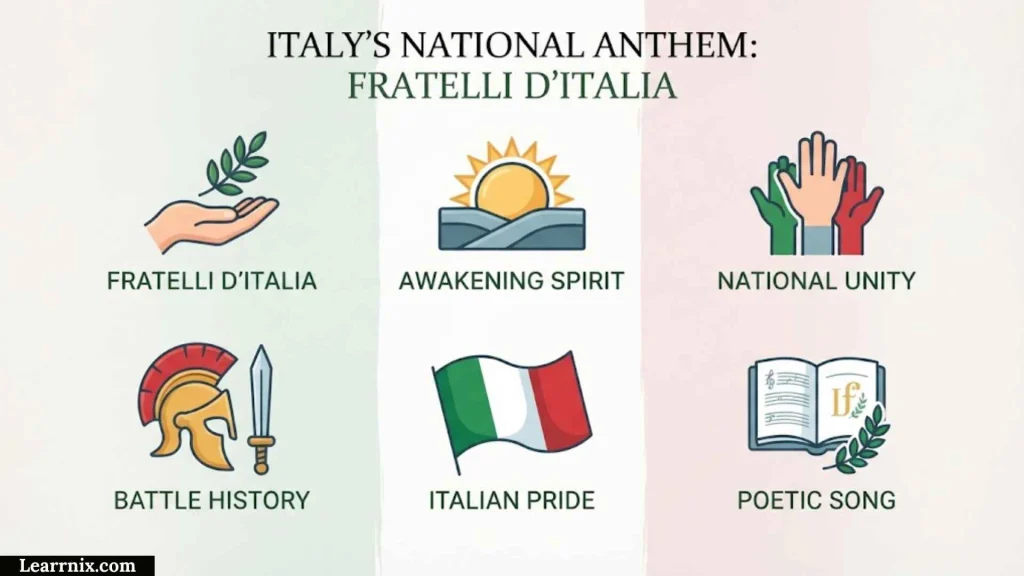
Italy’s national anthem is “Il Canto degli Italiani,” widely known as “Fratelli d’Italia” or the Anthem of Mameli.
The lyrics were written by Goffredo Mameli in 1847, and the music was composed by Michele Novaro. The song emerged during the patriotic atmosphere of the Risorgimento.
Why Is Fratelli d’Italia an Italian Symbol?
The anthem is strongly connected with Italian national identity and the movement toward national unity.
Its historical context includes themes associated with:
- National unity
- Independence
- Italian identity
- Historical memory
- The struggle for a unified country
The song became the national anthem of the Italian Republic on October 12, 1946.
This makes the anthem an important link between modern Italy and the nineteenth-century movement that helped shape the Italian state.
Who Wrote Italy’s National Anthem?
Goffredo Mameli wrote the lyrics, while Michele Novaro composed the music.
Both figures are closely associated with Genoa and the patriotic culture of the Risorgimento. The Quirinal’s historical account explains that the song quickly became one of the best-known musical expressions of Italian unification.
The Emblem of the Italian Republic
The Emblem of the Italian Republic is one of the most important official symbols of modern Italy.
It was officially adopted on May 5, 1948, after a design process lasting 24 months. The process included two public competitions and approximately 800 submitted sketches from around 500 citizens, artists, and amateurs.
The emblem contains several elements that work together:
- Five-pointed star
- Steel cogwheel
- Olive branch
- Oak branch
The Italian Star
The star is one of the oldest elements of Italian national iconography.
The Quirinal explains that the star has historically been associated with the personification of Italy and appeared in imagery connected with the Risorgimento and the former Kingdom of Italy.
In the Republic’s emblem, the star is positioned above the steel cogwheel and forms the central upper element of the design.
The Steel Cogwheel
The steel cogwheel represents work.
Its meaning is directly connected to Article 1 of the Italian Constitution, which describes Italy as a democratic republic founded on work.
This is an important example of how an Italian national symbol connects visual design with a constitutional principle.
The cogwheel is not simply an industrial decoration. It was deliberately selected to communicate the importance of work within the Republic.
The Olive Branch
The olive branch represents peace.
The Quirinal explains that it expresses Italy’s desire for peace both through internal harmony and international brotherhood.
The olive branch also fits Italy’s wider Mediterranean cultural landscape, where olive trees have long been important in agriculture, food, history, and symbolism.
The Oak Branch
The oak branch represents the strength and dignity of the Italian people. It also reflects the importance of native woodland species in Italy’s natural heritage.
Together, the olive and oak branches create a useful symbolic contrast:
Olive branch → peace
Oak branch → strength and dignity
This combination gives the emblem a broader message about the character and values associated with the Republic.
The Presidential Standard of Italy
The Presidential Standard is different from the national flag.
It is the distinctive symbol of the presence of the President of the Italian Republic and is used according to military and ceremonial protocol. The Quirinal explains that it can accompany the President on official journeys and appear in locations where the President is making an official visit.
Why Does Italy Have a Presidential Standard?
The Presidential Standard provides a visual way to identify the presence of the head of state.
Its design also connects the presidency with Italian history and the Tricolore.
The modern standard has a square shape with a blue border and the Republic’s emblem at its center. The Quirinal explains that the blue border is connected with the Armed Forces, of which the President is Commander-in-Chief.
This makes the Presidential Standard an official symbol of an office, rather than a replacement for the national flag.
The Colosseum as a Symbol of Italy
The Colosseum is not an official national symbol, but it is one of the world’s most recognizable cultural symbols associated with Italy.
Located in Rome, the ancient amphitheater represents:
- Ancient Rome
- Roman architecture
- Archaeological heritage
- Classical civilization
- Rome’s historical importance
For a tourist, a textbook, or an international advertisement, an image of the Colosseum can immediately communicate Rome or Italy.
Its symbolic power comes from history and cultural recognition rather than constitutional status.
The Roman Wolf and the Story of Rome
The Roman wolf, traditionally shown with Romulus and Remus, is another famous historical symbol associated with Italy.
The image refers to the traditional Roman foundation story in which the twins Romulus and Remus are connected with the origins of Rome.
It therefore represents:
- Rome
- Ancient Roman mythology
- The legendary foundation of the city
- Italy’s classical heritage
It is more accurate to call the Roman wolf a Roman or historical symbol than an official national symbol of the modern Italian Republic.
The Laurel Wreath and Classical Heritage
The laurel wreath has strong associations with ancient Greek and Roman culture.
It traditionally represents ideas such as:
- Victory
- Honor
- Achievement
- Excellence
- Classical learning
Because Italy contains many important Roman sites and has played a major role in European intellectual and artistic history, the laurel wreath can function as a broader cultural representation of Italian heritage.
It is especially appropriate in historical, artistic, academic, and ceremonial contexts.
Renaissance Art as an Italian Cultural Symbol
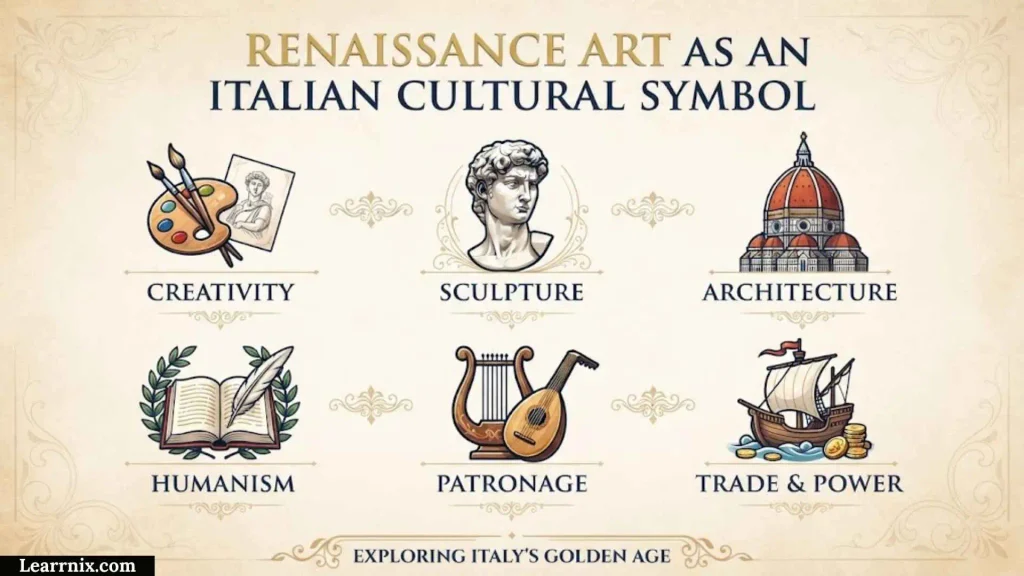
Italy’s identity is also strongly connected with the Renaissance, one of the most influential periods in European art and intellectual history.
Artists associated with Italy include:
- Leonardo da Vinci
- Michelangelo
- Raphael
- Sandro Botticelli
Their work is often used to represent Italian artistic heritage.
However, an important distinction remains: Renaissance art is a cultural symbol of Italy, not an official state symbol.
This distinction makes the article more accurate than simply creating a list of famous Italian objects.
Italian Architecture as a National Identity Symbol
Architecture provides another major layer of Italian symbolism.
Italy is associated with:
- Roman architecture
- Renaissance buildings
- Baroque churches
- Medieval city centers
- Venetian architecture
- Historic piazzas
- Italian villas
- Classical monuments
Different regions contribute different architectural traditions.
Rome connects Italy with ancient civilization, Florence with Renaissance heritage, Venice with its distinctive historic urban environment, and many other cities with regional architectural traditions.
Therefore, Italian architecture is best understood as a collection of cultural symbols, rather than one single national symbol.
Food as a Symbol of Italian Culture
Food is among the strongest everyday representations of Italy around the world.
Common examples include:
- Pizza
- Pasta
- Gelato
- Espresso
- Olive oil
- Risotto
- Regional cheeses
- Italian breads
- Regional sauces
These foods can communicate Italian cultural identity in restaurants, advertising, travel media, and everyday conversation.
Is Pizza an Official Symbol of Italy?
No. Pizza is a cultural symbol, not an official state symbol.
The same applies to pasta, gelato, espresso, and most other foods associated with Italy.
Their importance comes from culinary history and international recognition rather than from the constitutional symbolism of the Republic.
Italian Symbols in Sports
Italy’s national identity is also visible in sport.
The Tricolore is used by Italian national teams and athletes in international competitions.
Another important term is Azzurri, traditionally associated with Italian national sports teams.
The blue color used in Italian sports has a different historical origin from the green, white, and red national flag. It is associated with the House of Savoy and became established as a traditional Italian sporting color.
This creates an interesting distinction:
| Symbolic Element | Common Context |
| Green, white, red | National flag |
| Tricolore | National identity |
| Blue/Azzurro | Traditional national sports identity |
| Republic emblem | Official state identity |
Knowing this difference helps avoid assuming that every color used to represent Italy has the same origin.
Italy Symbols and the Risorgimento
To understand many Italian symbols, it is important to understand the Risorgimento.
The Risorgimento refers to the nineteenth-century movement through which the Italian states moved toward political unification.
The Tricolore and Il Canto degli Italiani became closely associated with this period.
Why the Risorgimento Matters
Before unification, the Italian peninsula consisted of multiple states and political territories.
The national symbols that developed during the nineteenth century therefore carried ideas of:
- Unity
- Independence
- Shared identity
- Political change
- National belonging
The Tricolore’s later role as the national flag makes more sense when viewed against this history. The Quirinal’s historical account specifically traces the flag through the Napoleonic period, the Risorgimento, Italian unification, and the republican era.
A Simple Decision Guide to Italy Symbols
If you are unsure whether something is an official symbol or a cultural symbol, use this guide:
Is it formally connected with the Italian Republic?
↓ Yes
Look at the Tricolore, national anthem, Republic emblem, or Presidential Standard.
↓ No
Is it strongly connected with Italian history or culture?
↓ Yes
It may be a cultural or historical symbol, such as the Colosseum, Roman wolf, Renaissance art, food, or architecture.
↓ No
It may simply be an Italian-themed image rather than a recognized national symbol.
This distinction is especially useful for students, writers, designers, and anyone researching Italian symbolism.
Official vs. Cultural Italy Symbols
| Question | Official Symbol | Cultural Symbol |
| Part of Republic’s formal symbolism? | Yes | Usually no |
| Used by government? | Frequently | Sometimes |
| Has constitutional/state significance? | Yes | Usually no |
| Example | Tricolore | Colosseum |
| Example | Republic emblem | Roman wolf |
| Example | National anthem | Pizza |
| Example | Presidential Standard | Renaissance art |
The difference is not about importance. A cultural symbol can be extremely famous without being an official state symbol.
Common Misconceptions About Italy Symbols
The Colosseum Is Italy’s Official Emblem
The Colosseum is a famous symbol of Rome and Italy, but it is not the official emblem of the Italian Republic.
The official Republic emblem features the star, steel cogwheel, olive branch, and oak branch.
Each Flag Color Has an Official Constitutional Meaning
Popular explanations assign meanings to green, white, and red, but Article 12 primarily establishes the flag’s composition.
It is more accurate to discuss the historical development of the colors rather than claim that each individual color has a constitutionally defined meaning.
The Roman Wolf Represents the Modern Italian Government
The Roman wolf is historically connected with Rome and its legendary origins. It should not be confused with the emblem of the modern Italian Republic.
Pizza Is an Official National Symbol
Pizza is an important cultural representation of Italy, but it has no status comparable to the Tricolore or Republic emblem.
The Italian Flag and Presidential Standard Are the Same
They are not.
The Tricolore represents the Italian nation, while the Presidential Standard identifies the presence of the President under official protocol.
How Italy Symbols Are Used in Real Life
Italian symbols appear in many different settings.
Government and Public Institutions
The Tricolore and Republic emblem may appear in official government contexts, public institutions, ceremonies, and state communications.
International Diplomacy
Italian diplomatic missions use national symbols to identify the Italian state abroad.
Sporting Events
The Tricolore is highly visible when Italian athletes and national teams compete internationally. The flag is also part of medal ceremonies and national celebrations.
Education
Students often study the flag, anthem, emblem, Risorgimento, and Italian unification when learning about Italy’s history and government.
Tourism and Branding
Cultural symbols such as the Colosseum, Roman architecture, Italian food, and Renaissance imagery are widely used to communicate an Italian theme.
The important practical lesson is that context determines which symbol works best.
Italy Symbols for Students and School Projects
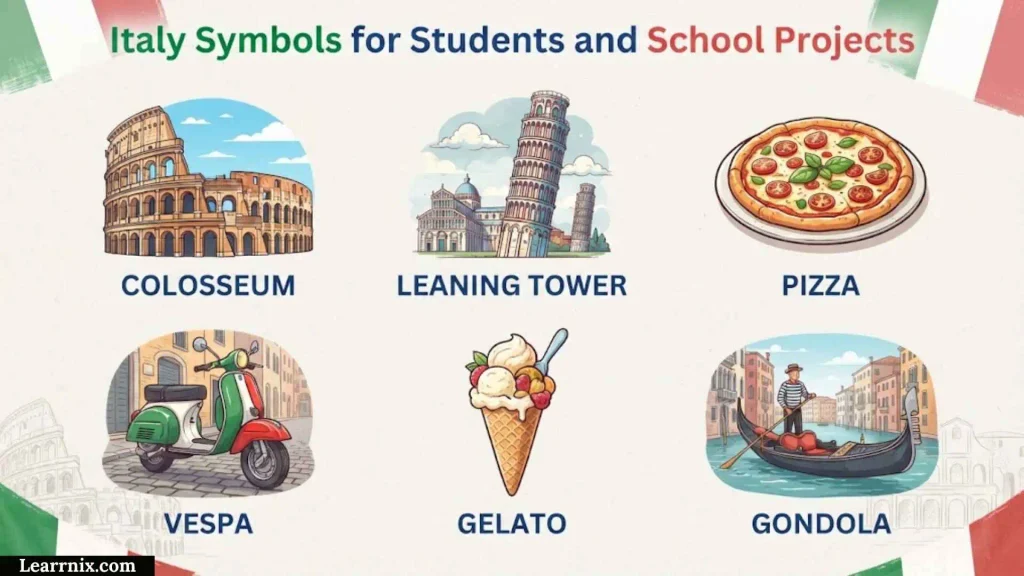
If you are creating a school project about Italy symbols, organize the information into four sections.
Government Symbols
Include:
- Tricolore
- National anthem
- Republic emblem
- Presidential Standard
Historical Symbols
Include:
- Roman wolf
- Colosseum
- Laurel wreath
- Roman architecture
- Risorgimento imagery
Cultural Symbols
Include:
- Renaissance art
- Italian architecture
- Opera
- Fashion
- Food
Natural and Emblem Elements
Include:
- Olive branch
- Oak branch
- Italian star
This organization makes the project easier to understand and prevents official and cultural symbols from being mixed together.
Key Takeaways About Italy Symbols
The most important points are:
- The Italian Tricolore is the national flag.
- The Tricolore contains green, white, and red vertical bands of equal size.
- Its history as an Italian national flag begins in 1797 at Reggio Emilia.
- Italy’s national anthem is Il Canto degli Italiani, commonly called Fratelli d’Italia.
- Goffredo Mameli wrote the lyrics and Michele Novaro composed the music.
- The Republic’s emblem was adopted on May 5, 1948.
- The emblem contains a star, steel cogwheel, olive branch, and oak branch.
- The cogwheel represents work.
- The olive branch represents peace.
- The oak branch represents strength and dignity.
- The Presidential Standard represents the presence of the President of the Republic.
- The Colosseum, Roman wolf, Renaissance art, pizza, and pasta are cultural or historical symbols rather than official republican symbols.
- The Risorgimento is essential for understanding the historical development of Italian national identity and symbolism.
Frequently Asked Questions About Italy Symbols
What Is the Most Important Symbol of Italy?
The Italian Tricolore is one of the country’s principal national symbols. It is the national flag defined by Article 12 of the Italian Constitution.
What Are the Four Official Symbols of Italy?
The main official symbols of the Italian Republic are the Tricolore, national anthem, Republic emblem, and Presidential Standard.
What Does the Italian Flag Represent?
The Italian flag represents the Italian nation and has become strongly associated with national unity and identity. Its historical development is closely connected with the Risorgimento and Italian unification.
What Are the Colors of the Italian Flag?
The Italian flag uses green, white, and red, arranged vertically in three equal bands.
When Was the Italian Tricolore First Adopted?
The Italian Tricolore originated at Reggio Emilia on January 7, 1797, when the Cispadane Republic adopted the green, white, and red colors.
What Is Italy’s National Anthem?
Italy’s national anthem is Il Canto degli Italiani, better known as Fratelli d’Italia or the Anthem of Mameli.
Who Wrote Fratelli d’Italia?
Goffredo Mameli wrote the lyrics, and Michele Novaro composed the music.
What Does the Italian Republic Emblem Mean?
The emblem combines several symbols. The star has a long association with the personification of Italy, the steel cogwheel represents work, the olive branch represents peace, and the oak branch represents strength and dignity.
Why Is There a Cogwheel on Italy’s Emblem?
The steel cogwheel represents work and connects visually with Article 1 of the Italian Constitution, which describes Italy as a democratic republic founded on work.
What Does the Olive Branch Mean on Italy’s Emblem?
The olive branch represents the nation’s will for peace, including internal concord and international brotherhood.
What Does the Oak Branch Represent?
The oak branch symbolizes the strength and dignity of the Italian people.
Is the Colosseum an Official Symbol of Italy?
No. The Colosseum is an extremely important historical and cultural symbol of Rome and Italy, but it is not the official emblem of the Italian Republic.
Is the Roman Wolf an Official Italian Symbol?
The Roman wolf is a famous historical symbol associated with Rome and the story of Romulus and Remus. It is not the official emblem of the modern Italian Republic.
Is Pizza a Symbol of Italy?
Pizza is one of the world’s best-known cultural symbols of Italy, but it is not an official state symbol.
Why Is Italy Associated With Green, White, and Red?
The three colors developed as a political and national symbol beginning in the late eighteenth century and became increasingly associated with Italian unity during the Risorgimento. The Tricolore was later retained as the national flag.
What Is the Presidential Standard of Italy?
The Presidential Standard is a distinctive official symbol identifying the presence of the President of the Italian Republic during official activities and travel.
References
- Quirinal Palace — Symbols of the Republic: Official information on the Tricolore, national anthem, Republic emblem, and Presidential Standard.
- Quirinal Palace — The Italian Tricolore: Official history of the Italian flag from its origin in 1797 through the Risorgimento, unification, and republican period.
- Quirinal Palace — The Emblem: Official explanation of the star, cogwheel, olive branch, and oak branch.
- Quirinal Palace — National Anthem: Official history of Il Canto degli Italiani and its adoption as the national anthem.
- Quirinal Palace — Presidential Standard: Official explanation of the Standard’s purpose, design, and history.
- Italian Presidency — National Flag Statement: Recent official statement describing the Tricolore’s historical development and continuing national significance.
Conclusion
Italy’s symbols tell a story that extends from ancient Rome and Renaissance culture to the Risorgimento and the modern Italian Republic.
The most important official symbols are the Tricolore, national anthem, Republic emblem, and Presidential Standard. The Tricolore connects modern Italy with a history that began in 1797 and continued through the Risorgimento and Italian unification. The national anthem preserves the patriotic spirit of the nineteenth century, while the Republic emblem uses the star, cogwheel, olive branch, and oak branch to express ideas connected with Italy, work, peace, strength, and dignity.
At the same time, Italy’s identity cannot be understood through official symbols alone. The Colosseum, Roman wolf, Renaissance art, architecture, cuisine, fashion, and classical imagery remain powerful cultural representations of the country.
The most accurate way to understand Italy symbols is therefore to separate official national symbols from historical and cultural symbols. That distinction makes the subject clearer, more trustworthy, and much more useful for students, travelers, researchers, and anyone interested in Italian history and culture.

I am Daniel Harper, an education enthusiast and writer who enjoys creating helpful content to make learning more accessible and engaging.
I focus on sharing knowledge about effective study methods, educational growth, and skills that help learners succeed in a changing world.
Through my writing, I aim to inspire students to explore new ideas and develop a passion for learning.
Books by Daniel Harper:
- The Path to Lifelong Learning
- Unlocking Your Learning Potential
 Michael Carter
 Charlotte Anderson