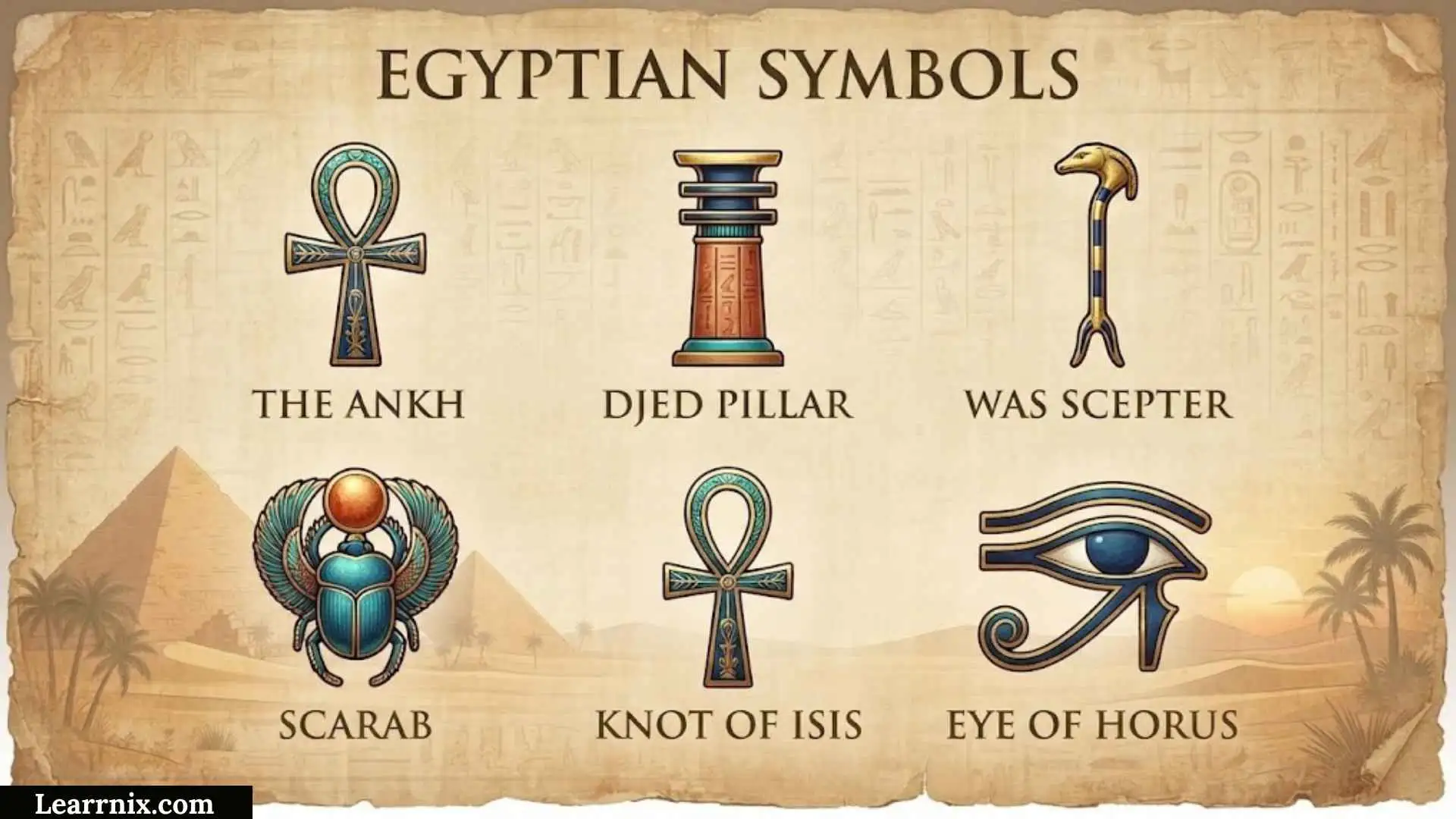
Egyptian symbols have remained popular for thousands of years because they combine striking designs with ideas about life, protection, renewal, power, stability, and the gods. From the ankh and Eye of Horus to scarabs, djed pillars, and hieroglyphs, each symbol has a particular historical context and meaning.
People search for Egyptian symbols for many reasons. Some want to understand ancient Egyptian culture, while others need symbols for tattoos, artwork, usernames, social media, jewelry, or copy-and-paste text. This guide covers the most important symbols, their meanings, names, historical uses, and modern text versions.
You will also find a practical reference for Egyptian symbols of life and protection, famous hieroglyphic signs, tattoo ideas, and Unicode characters that can be copied. Because ancient Egyptian signs could have different functions in writing and religious art, the explanations below distinguish historical meanings from modern interpretations.
Egyptian Symbols And Meanings
Ancient Egyptian symbols were used in writing, religious scenes, jewelry, amulets, monuments, coffins, statues, and everyday objects. Some were hieroglyphic signs used to represent sounds or words, while others communicated broader religious or symbolic ideas.
Here are some of the best-known Egyptian symbols:
| Symbol | Name | Common Meaning |
| ☥ | Ankh | Life and living |
| 𓂀 | Wedjat / Eye of Horus | Health, healing, regeneration |
| 𓆣 | Scarab | Rebirth, renewal, transformation |
| 𓊽 | Djed | Stability and endurance |
| 𓇳 | Sun disk | Sun and solar associations |
| Uraeus | Cobra | Protection and kingship |
| Tyet | Isis knot | Protection |
| Shen | Rope ring | Eternity and protection |
| Cartouche | Oval enclosure | Royal name |
The ankh is one of the clearest examples of a symbol with a documented meaning. The British Museum describes it as the hieroglyphic word for life and as a symbol of life. The same source connects the scarab with rebirth and the uraeus with protection and kingship.
The djed is associated with stability and endurance, while the Eye of Horus, also called the wedjat, is strongly connected with health, healing, and regeneration.
Egyptian Symbols And Meanings With Pictures
Pictures are especially useful when learning Egyptian symbols because many have distinctive shapes. The ankh has a loop above a cross-like form, the Eye of Horus resembles a stylized human or falcon eye, and the scarab is represented by a beetle.
Ankh
☥ — Ankh
The ankh is the famous Egyptian symbol of life. It appears frequently in ancient Egyptian religious and royal artwork, sometimes being held by gods or offered to a ruler.
Eye Of Horus
𓂀 — Wedjat
The Eye of Horus represents the healed eye of Horus and is associated with health, healing, and regeneration. Ancient amulets featuring the wedjat were used in protective contexts.
Scarab
𓆣 — Scarab
The scarab became associated with renewal and rebirth. Egyptian scarab amulets were also decorated with other favorable signs, including the ankh, wedjat, djed, and nefer.
Djed
𓊽 — Djed
The djed is commonly associated with stability and endurance. It was especially connected with Osiris and could appear alongside other positive signs on amulets.
Egyptian Symbols Copy Paste
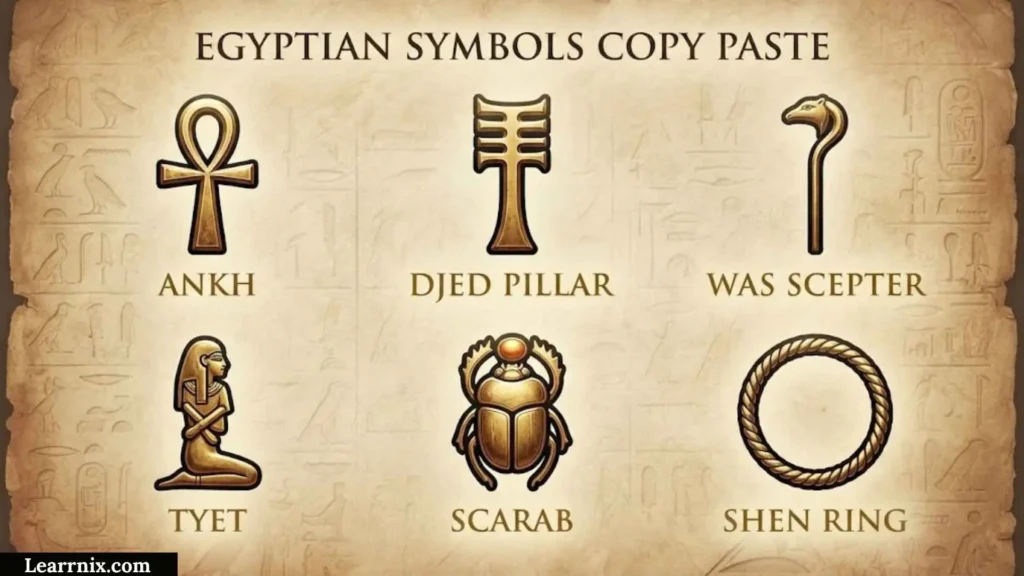
If you need Egyptian symbols for a username, caption, profile, design, or decorative text, several characters can be copied directly.
Copy these symbols:
- ☥ — Ankh
- 𓂀 — Eye of Horus / Wedjat
- 𓆣 — Scarab
- 𓊽 — Djed
- 𓇳 — Sun-related hieroglyphic sign
- ☥ 𓂀 𓆣 — Decorative Egyptian combination
- 𓂀☥𓆣 — Egyptian-inspired text combination
You can select the symbol, copy it, and paste it into a compatible app or website. However, not every Egyptian image found online is a Unicode character. Some are custom graphics, font glyphs, or images.
This distinction matters if you need a symbol that works as actual text. Unicode supports many Egyptian hieroglyphic characters, but a historical inscription may contain arrangements and signs that are better represented as an image rather than ordinary typed text.
Egyptian Symbols Text
Egyptian symbols can make ordinary text visually distinctive. For example:
☥ Ancient Egypt ☥
𓂀 Protection 𓂀
𓆣 Renewal 𓆣
𓂀 ☥ 𓆣
These combinations can work in social media bios, usernames, captions, digital artwork, headings, and decorative messages.
Keep in mind that symbol rendering depends on the font and operating system. If a character appears as a square or missing-glyph box, the device may not have a font that supports that particular hieroglyph.
For historical or educational use, avoid treating every decorative Egyptian-looking character as an authentic hieroglyph. A visually attractive symbol and a historically documented sign are not necessarily the same thing.
Egyptian Symbols Name
Learning the names of Egyptian symbols makes it easier to research their history and use them accurately.
- Ankh — Symbol and hieroglyph associated with life.
- Wedjat — The healed Eye of Horus, associated with health and regeneration.
- Scarab — Beetle associated with becoming, renewal, and rebirth.
- Djed — Symbol associated with stability and endurance.
- Was Scepter — Associated with power and dominion.
- Uraeus — Upright cobra associated with protection and kingship.
- Tyet — Isis knot associated with protection.
- Shen — Ring-shaped sign associated with eternity and protection.
- Cartouche — Oval enclosure used around royal names.
- Lotus — Associated with rebirth and renewal.
The Met notes that the scarab hieroglyph kheper can mean “to become” or “to evolve” and was used as an amulet in life and death, symbolizing rebirth. It also describes the shen sign as a protective ring or rope motif.
Ancient Egyptian Symbols And Meanings
Ancient Egyptian symbolism developed over a very long period, so meanings should not be treated as a simple modern dictionary. A sign could function as a sound, word, determinative, religious symbol, or part of a larger composition.
The ankh represented life, while the djed represented stability and endurance. The wedjat was connected with healing and regeneration. The scarab became associated with transformation and rebirth, partly because ancient Egyptians connected the beetle’s behavior with the movement of the sun and new life.
Ancient objects also show that symbols were frequently combined. A Middle Kingdom scarab at The Metropolitan Museum of Art contains the ankh, wedjat eyes, nefer sign, and djed together. These signs were selected for positive and protective meanings rather than simply being arranged as a sentence.
This is an important detail when researching Egyptian symbols. A modern website may assign one English word to a symbol, but its ancient use could be more complex.
Egyptian Symbols Text
Egyptian text symbols are useful when you want the appearance of ancient Egypt without creating a complete image. The most recognizable options include:
☥
Ankh — life
𓂀
Wedjat — health, healing, regeneration
𓆣
Scarab — becoming, renewal, rebirth
𓊽
Djed — stability and endurance
You can also combine them:
☥ 𓂀 𓆣
𓊽 ☥ 𓂀
𓆣 ☥ 𓊽
These combinations are suitable for decorative digital text, although they should not be presented as genuine ancient Egyptian sentences unless they have been properly translated and arranged.
Egyptian Symbols Of Life
The ankh is the most direct Egyptian symbol of life. Its association with life is well documented, and it appears in religious and royal scenes where divine figures present or hold it.
Other Egyptian symbols can also relate to life, renewal, or continued existence:
- ☥ Ankh — Life and living.
- 𓆣 Scarab — Rebirth and renewal.
- 𓂀 Wedjat — Healing and regeneration.
- Lotus — Rebirth and renewal.
- Djed — Stability and endurance.
The lotus is particularly interesting because its daily opening and closing were connected with ideas of rebirth and renewal. The British Museum also describes the blue lotus as connected with rebirth and renewed life.
For a modern design representing life, the ankh is generally the clearest choice because its historical association is direct and widely recognized.
Ankh Egyptian Symbols
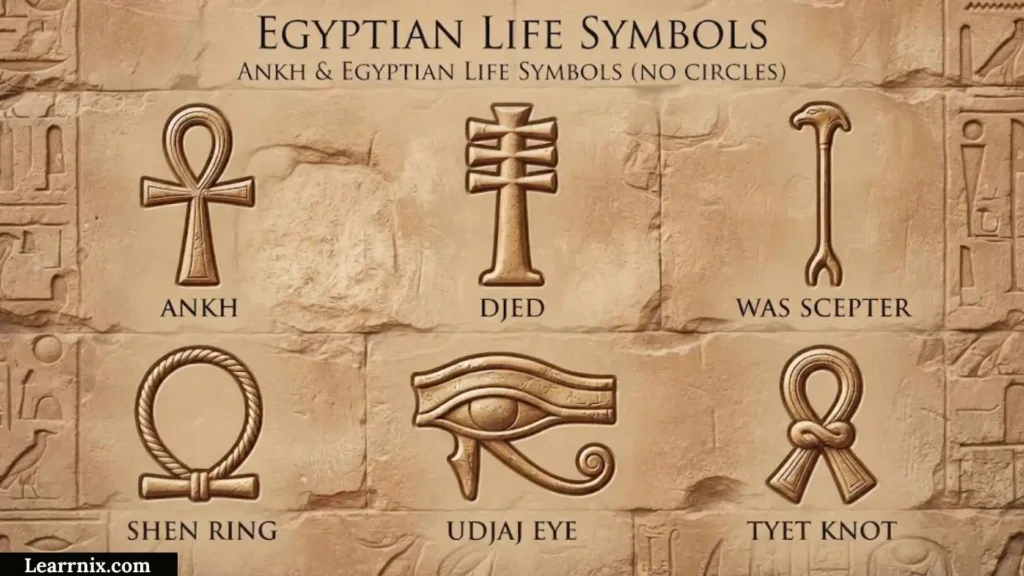
The ankh (☥) is probably the most recognizable Egyptian symbol worldwide. It has a loop at the top and a vertical and horizontal structure underneath it.
Its primary historical meaning is life. In ancient Egyptian art, gods are often shown carrying the ankh, and the sign could symbolize the giving or sustaining of life. The British Museum specifically identifies the ankh as both the hieroglyphic word for life and a symbol of life.
Today, people use the ankh in jewelry, tattoos, artwork, clothing, logos, usernames, and digital text. The character ☥ is convenient for copy-and-paste use.
The ankh is sometimes called the “key of life” in modern popular culture. However, when writing historically accurate content, it is better to emphasize its documented association with life rather than presenting every modern nickname as an ancient Egyptian term.
Protection Egyptian Symbols And Meanings
Protection was an important part of ancient Egyptian religious practice. Amulets were created and worn for different protective and beneficial purposes, and several symbols became closely associated with safeguarding people.
Eye Of Horus
The wedjat or Eye of Horus is one of the strongest protection-related Egyptian symbols. Because the eye was restored after being damaged in the Horus myth, it became associated with health, healing, and regeneration.
Sa
The sa is a hieroglyphic sign associated with protection. The Met records the sa as one of the protective signs found on Egyptian scarabs.
Tyet
The Tyet, often known as the Isis knot, is another protective symbol connected with Isis. It appears in amulets and religious objects.
Uraeus
The uraeus is the raised cobra associated with protection and royal authority. The British Museum describes it as a protective symbol worn on the pharaoh’s forehead.
Scarab
Scarab amulets often combined several favorable symbols. Examples from the Met include combinations involving the ankh, protection sign, wedjat, and djed.
Hieroglyphics Egyptian Symbols
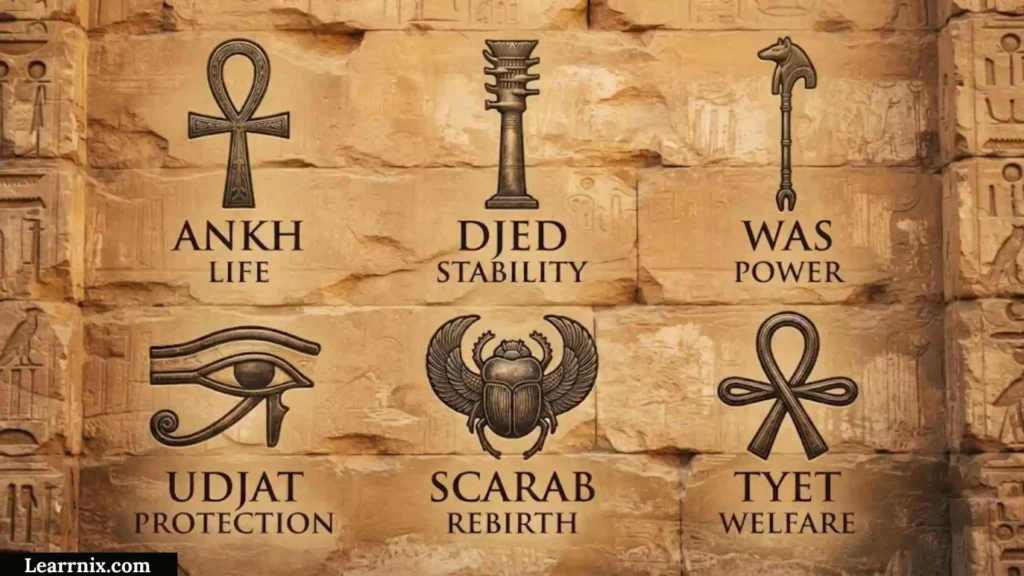
Egyptian hieroglyphs were a writing system rather than simply a collection of magical symbols. Individual signs could represent sounds, words, or grammatical information.
Some hieroglyphic signs are also famous as symbols because they became associated with broader religious ideas.
Examples include:
- Ankh — Life.
- Wedjat — Eye of Horus; health and regeneration.
- Scarab — Becoming and renewal.
- Djed — Stability and endurance.
- Shen — A ring associated with eternity and protection.
- Uraeus — Cobra associated with protection and kingship.
The Met’s educational material explains that hieroglyphs could be arranged in balanced groups rather than simply written in a modern left-to-right line. It also notes that the ankh can mean “life” or “to live.”
This is why automatically converting an English name into a series of Egyptian pictures can be misleading. A proper hieroglyphic rendering considers the sounds and conventions of the ancient Egyptian writing system.
Egyptian Symbols Of Protection
Several symbols stand out when the search intent is specifically protection.
| Symbol | Protective Association |
| 𓂀 Wedjat | Health, healing, regeneration |
| Uraeus | Protection and royal power |
| Sa | Protection |
| Tyet | Protection connected with Isis |
| Scarab | Protective and positive amuletic symbolism |
| Shen | Protective ring and eternity |
Ancient scarabs demonstrate how these ideas could be combined. One Middle Kingdom scarab contains the ankh and the sign for protection, while other examples include wedjat eyes and additional positive signs.
For a tattoo or modern graphic, the Eye of Horus is usually the easiest protection symbol for people to recognize. For a historically focused design, however, the exact period and context should be considered.
What Does Each Egyptian Symbols Mean?
Egyptian symbols do not all have one universal meaning. Some are words, some are sounds, and some are religious or artistic symbols. The following table provides a practical overview of the most frequently searched examples.
| Symbol | Name | Main Meaning Or Association |
| ☥ | Ankh | Life |
| 𓂀 | Wedjat | Health, healing, regeneration |
| 𓆣 | Scarab | Becoming, renewal, rebirth |
| 𓊽 | Djed | Stability, endurance |
| Uraeus | Cobra | Protection, kingship |
| Sa | Protection sign | Protection |
| Tyet | Isis knot | Protection |
| Shen | Ring | Eternity, protection |
| Was | Was scepter | Power, dominion |
| Cartouche | Royal enclosure | Royal names |
| Lotus | Lotus flower | Rebirth, renewal |
| Maat feather | Feather | Maat, truth and order |
The meanings above are historical associations, not universal modern definitions. For example, the Met identifies the djed with endurance and the ankh with life, while its scarab examples show multiple signs being deliberately combined to create positive and protective meanings.
Famous Egyptian Symbols
Some Egyptian symbols have become especially recognizable outside Egypt.
Ankh: The classic symbol of life and one of the most recognizable Egyptian signs.
Eye Of Horus: A distinctive eye associated with health, healing, regeneration, and protection.
Scarab: A beetle motif associated with becoming, renewal, and rebirth.
Djed: A pillar-like symbol associated with stability and endurance.
Uraeus: A raised cobra representing protection and royal authority.
Cartouche: An oval enclosure traditionally used around the names of kings.
Lotus: A flower associated with rebirth and renewal.
Was Scepter: A staff associated with power and dominion.
These symbols could also appear together. Museum examples show Egyptian craftsmen combining signs such as the ankh, djed, wedjat, nefer, and protection sign on scarabs and amulets.
Egyptian Symbols Tattoos
Egyptian symbols make popular tattoo designs because they are visually recognizable and can carry meaningful associations. The best choice depends on the idea you want the tattoo to communicate.
Ankh Tattoo
☥ represents life and is a strong choice for someone who wants a simple, historically grounded Egyptian design.
Eye Of Horus Tattoo
𓂀 can represent healing, protection, health, or resilience. Its distinctive shape also works well as a standalone design.
Scarab Tattoo
A scarab can represent renewal, transformation, becoming, or rebirth. It can also be combined with hieroglyphic signs for a more elaborate design.
Djed Tattoo
The djed works well for themes of stability, endurance, and strength.
Combined Egyptian Tattoo
An artistic design can combine an ankh, Eye of Horus, scarab, or djed. Before using multiple signs, research their individual meanings so the final composition has a clear purpose.
For historically inspired tattoos, it is also worth checking the exact reference image and orientation. Modern tattoo artists often stylize Egyptian signs, meaning the final artwork may be visually inspired by ancient Egypt without being an exact reproduction of an ancient inscription.
What is the most famous Egyptian symbol?
The ankh is one of the most famous Egyptian symbols. It is strongly associated with life and has a distinctive looped design that remains recognizable today.
What Egyptian symbol means protection?
The Eye of Horus is strongly associated with protection, health, healing, and regeneration. The sa sign and uraeus are also important protective symbols in ancient Egyptian contexts.
What does the Egyptian ankh symbol mean?
The ankh means life and was used as both a hieroglyphic sign and a symbol associated with life in ancient Egyptian art.
Is the Eye of Horus the same as the Eye of Ra?
No. The Eye of Horus and Eye of Ra are connected with different Egyptian religious traditions and should not automatically be treated as identical. The wedjat specifically refers to the restored eye of Horus.
Can Egyptian hieroglyphs be copied and pasted?
Yes, many Egyptian hieroglyphic characters are available in Unicode and can be copied as text. However, some historical inscriptions, decorative combinations, or specialized signs are better represented with images or dedicated hieroglyphic fonts.
Egyptian symbols combine writing, religion, art, and ancient ideas in a way that still makes them useful and interesting today. The ankh, Eye of Horus, scarab, djed, uraeus, and other signs each have their own history, so understanding their original context makes their modern use more meaningful.
For quick copy-and-paste purposes, ☥, 𓂀, and other supported Unicode characters are convenient choices. For tattoos, educational work, artwork, or historical designs, it is better to verify the exact sign instead of relying on a generic Egyptian-style graphic.
The simplest way to choose an Egyptian symbol is to start with the meaning you want. Choose the ankh for life, the wedjat for healing and protection, the scarab for renewal, the djed for stability, or the uraeus for protection and kingship. This approach gives your chosen symbol a clearer connection to its ancient Egyptian background.

I am Charlotte Anderson, an education writer who is passionate about creating meaningful learning resources for students and lifelong learners.
I enjoy researching new educational approaches and sharing ideas that make studying easier and more effective.
Through my work, I aim to inspire curiosity, confidence, and a love for learning.
Books:
- The Complete Guide to Better Learning
- Building Skills for Academic Success
 Michael Carter