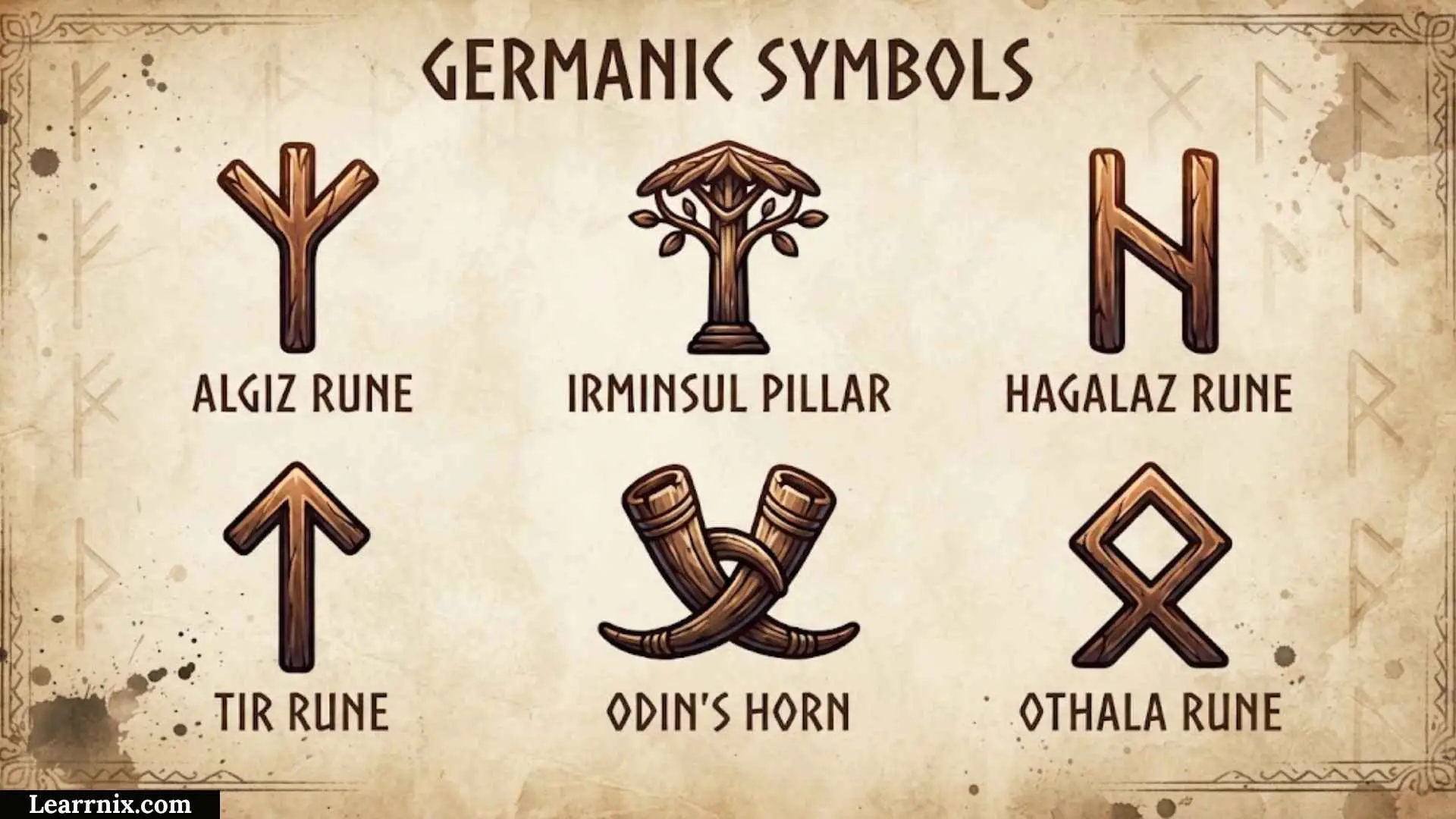
Germanic symbols cover a wide range of historical signs, runes, motifs, and later interpretations connected with Germanic-speaking peoples and their cultures. Many symbols seen today come from runic writing, archaeological finds, literature, folklore, and modern artistic traditions.
Runes are especially important when exploring Germanic symbols. The earliest widely recognized runic system, the Elder Futhark, contained 24 characters, while later Germanic and Scandinavian traditions developed different rune forms and alphabets. Unicode also encodes the Runic script, making many rune characters available for digital text.
However, it is useful to separate historical evidence from modern symbolism. A rune originally functioned primarily as a writing character, and its exact meaning can depend on the inscription, period, language, and cultural setting. This guide explains the major categories people search for, including ancient and medieval symbols, pagan associations, tattoos, family and protection themes, and copy-and-paste runes.
Germanic Symbols and Their Meanings
Germanic symbols do not have one universal dictionary of meanings. Some are historical writing characters, while others are motifs known from archaeology, mythology, literature, or modern interpretations. Runes are the clearest example because their primary historical role was writing.
The Elder Futhark contains 24 runes. Unicode identifies the Runic script as historically used across German, Scandinavian, and Anglo-Saxon areas, with evidence extending from the first century into the nineteenth century.
Some commonly discussed runes include:
| Symbol | Name | Common Historical Association |
| ᚠ | Fehu | The sound f; commonly associated with wealth or cattle in modern rune explanations |
| ᚢ | Uruz | The sound u; often associated with the aurochs in modern interpretations |
| ᚦ | Thurisaz | The sound th; connected by name with a giant or thorn-related concept |
| ᚨ | Ansuz | The sound a; associated by name with a god or divine being |
| ᚱ | Raidō | The sound r; often connected with riding or journeys |
| ᛏ | Tīwaz | The sound t; associated with the god Týr in traditional rune-name discussions |
| ᛒ | Berkanan | The sound b; traditionally associated with birch |
| ᛟ | Ōthalan | The sound o; associated with inheritance or ancestral property in later interpretations |
These associations should not be treated as universal symbolic definitions. Rune shapes and values changed between different runic systems, and the historical record is incomplete. Unicode specifically notes that rune forms and their meanings can vary across periods and societies.
Ancient Germanic Symbols
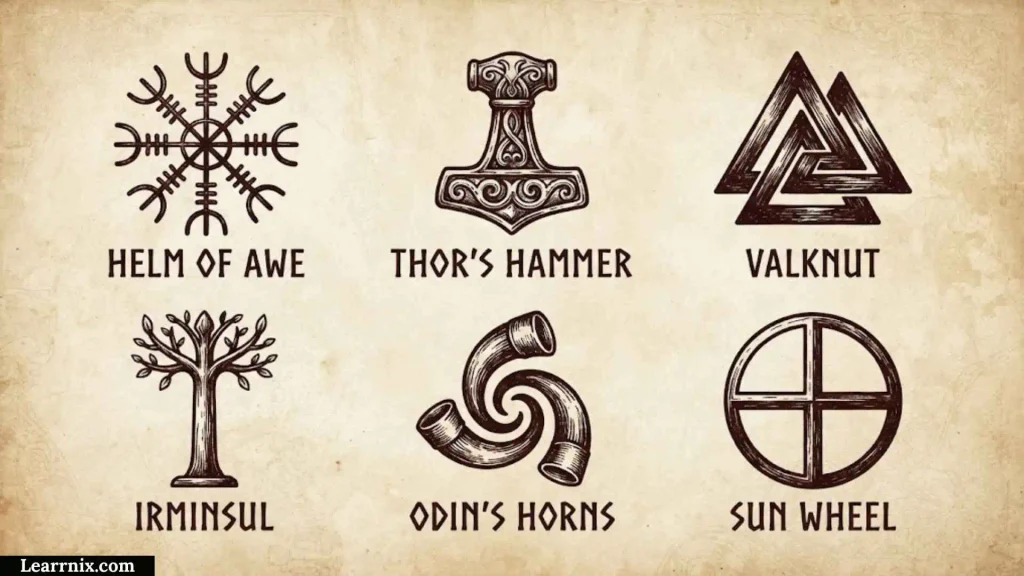
Ancient Germanic symbols are most strongly represented by runic inscriptions and archaeological motifs. Runes were used by several Germanic-speaking communities, but they were not one fixed alphabet throughout history.
The Elder Futhark is particularly important because it contains 24 characters and represents an early stage of the runic tradition. Later systems developed different numbers of characters and different shapes. For example, Younger Futhark eventually reduced the Scandinavian rune inventory to 16 characters.
Other ancient motifs can appear in archaeological objects, weapons, jewelry, stones, and ornaments. Their interpretation requires caution because an image surviving on an artifact does not automatically reveal its intended symbolic meaning.
Germanic Pagan Symbols and Meanings
Germanic pagan symbols are often discussed in connection with pre-Christian Germanic religions and mythology. Common modern examples include runes, symbols associated with particular deities, and motifs inspired by legendary objects.
Some frequently encountered examples are:
- ᛏ Tīwaz — commonly connected with Týr in modern historical and religious discussions.
- ᚨ Ansuz — traditionally linked by name with the ansuz, a divine being or god.
- ᛟ Ōthalan — associated in rune-name traditions with inherited property or ancestral land.
- Mjölnir imagery — the hammer of Thor, although it belongs specifically to Norse mythology rather than representing all Germanic cultures.
- Sun and solar motifs — recurring imagery that can appear in prehistoric and later northern European contexts.
It is important to avoid treating Norse, continental Germanic, Anglo-Saxon, and other traditions as completely identical. They were related but developed in different places and periods.
Traditional Germanic Symbols
Traditional Germanic symbols can refer to historical runes, mythological imagery, decorative motifs, and symbols preserved in manuscripts or archaeological material.
Runic writing is one of the most recognizable traditions. The word futhark comes from the first six rune names in the traditional sequence. Unicode records Elder Futhark as a 24-rune system and also distinguishes later Anglo-Saxon, Scandinavian, and medieval developments.
When researching a symbol as “traditional,” check its historical period first. A design used by a Viking Age Scandinavian community should not automatically be described as a symbol used by every ancient Germanic team.
Old Germanic Symbols
Old Germanic symbols generally refers to symbols associated with early Germanic peoples, especially runes and archaeological motifs. Among these, the Elder Futhark is one of the most important subjects.
The original Elder Futhark contains these 24 rune characters:
ᚠ ᚢ ᚦ ᚨ ᚱ ᚲ ᚷ ᚹ ᚺ ᚾ ᛁ ᛃ ᛇ ᛈ ᛉ ᛊ ᛏ ᛒ ᛖ ᛗ ᛚ ᛜ ᛞ ᛟ
These characters correspond to the traditional sequence of the early runic alphabet. Unicode provides standardized character encoding for the Runic script, but historical rune shapes can differ considerably depending on the system and period.
Medieval Germanic Symbols
Medieval Germanic symbols developed during a period when runic writing continued alongside the Latin alphabet. In Scandinavia, runes continued to be used during the Middle Ages, and new forms were created to correspond more closely with sounds represented by Latin letters.
Medieval runic traditions therefore should not be confused with the earlier Elder Futhark. Some characters look similar, but their forms, values, and uses can differ.
Medieval manuscripts, inscriptions, calendar staffs, monuments, and everyday objects can all provide evidence for later runic use. Unicode also records medieval developments within the broader Runic block.
Germanic Tribe Ancient Germanic Symbols
Ancient Germanic tribes did not all use exactly the same symbols or writing systems. Germanic-speaking peoples lived across a large geographical area, and their traditions changed over centuries.
Runic inscriptions provide important evidence about these communities. Unicode notes that thousands of runic inscriptions are known and that they are an important source for understanding the development of Germanic languages.
When connecting a symbol to a specific tribe, it is better to identify the archaeological object, inscription, location, and historical period rather than simply calling every rune a “tribal symbol.”
Norse Germanic Symbols
Norse symbols form one part of the wider Germanic symbolic tradition. Norse culture developed in Scandinavia, particularly during the Viking Age and medieval period, and used its own forms of runic writing and mythology.
Younger Futhark is especially important in this context. Unicode describes it as a Scandinavian development that appeared in the eighth century and contained 16 runes.
Popular Norse-inspired symbols include:
- ᚦ — a rune used in several runic systems and associated with the th sound.
- ᛏ — the T-rune, traditionally connected with Týr in rune-name traditions.
- Mjölnir — Thor’s hammer and a distinctly Norse mythological symbol.
- Runic inscriptions — historical writing rather than a single symbolic system.
- Valknut imagery — a modern label for a distinctive interlaced motif found in some Scandinavian archaeological contexts.
Not every symbol popularly marketed as “Viking” can be confidently assigned one fixed meaning. Historical context matters.
Germanic Symbols for Family
People searching for Germanic symbols for family are often looking for a design representing ancestry, heritage, home, inheritance, or connection between generations.
The rune ᛟ, traditionally called Ōthalan or Odal in rune-name traditions, is frequently associated with inheritance, ancestral property, or inherited land. This makes it one of the runes commonly selected for modern family or ancestry-themed designs.
Other choices can be based on the concept rather than a single historically fixed symbol:
- ᛟ — inheritance, ancestral property, heritage associations.
- ᛒ — birch-related associations and modern interpretations involving growth or family.
- ᛗ — the m-rune, historically representing a sound rather than universally meaning “family.”
- Runic inscriptions — useful for creating personalized names or family phrases.
For a historically responsible tattoo or emblem, it is better to explain what the rune actually represented as a written character and then describe any modern family interpretation separately.
Germanic Symbols of Protection
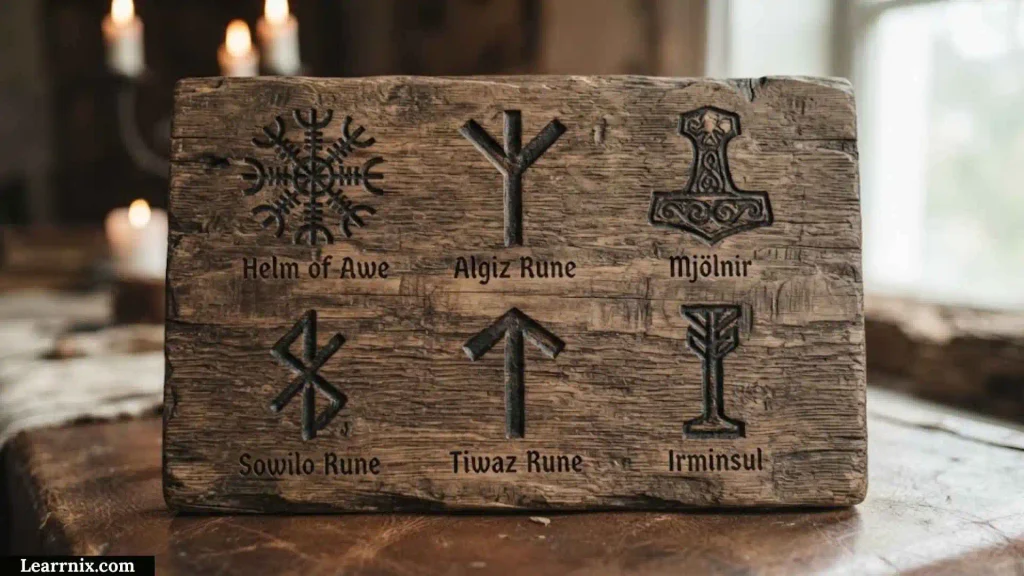
Protection is one of the most common reasons people search for Germanic symbols. Modern designs may use runes, mythological imagery, shields, weapons, or protective motifs.
The important distinction is that a historical rune was not necessarily a universal magical protection sign. Some runes later acquired magical or symbolic interpretations, but their primary historical function was often writing.
For a modern protection-themed design, people commonly encounter:
- ᛉ Algiz — often described in modern sources as protection or defense.
- ᛏ Tīwaz — sometimes used today in designs representing courage, justice, or strength.
- Mjölnir imagery — associated with Thor and therefore used in modern Norse-inspired protective designs.
- Shield motifs — commonly used as a general visual representation of defense.
These meanings should be presented as interpretations rather than universal historical facts.
Germanic Symbols of Strength
Germanic symbols of strength are often inspired by powerful animals, weapons, warriors, gods, and particular runes.
ᛏ Tīwaz is frequently used in modern designs representing courage, determination, honor, or strength. ᚢ Uruz is also commonly connected with physical power because its traditional name is associated with the aurochs, an extinct wild cattle species.
Other strength-themed designs may use:
- Bear imagery — representing physical power in modern artistic interpretations.
- Wolf imagery — often connected with warriors, mythology, and wildness.
- Hammer imagery — particularly when the intended reference is Thor.
- Runic inscriptions — useful for personal mottos or names rather than relying on a single symbol.
The meaning depends heavily on whether the design is historical, reconstructed, or modern.
Germanic Symbols and Meanings Tattoos
Germanic symbols are popular tattoo subjects because their angular shapes work well in small, simple, and geometric designs. Runes can be arranged individually, as words, or as part of larger decorative compositions.
Before getting a rune tattoo, verify the exact rune, historical system, and intended spelling. A character from Elder Futhark is not automatically interchangeable with a rune from Younger Futhark or another runic tradition.
Common tattoo themes include:
| Tattoo Theme | Symbolic Direction |
| Family | Heritage, ancestry, inheritance |
| Strength | Courage, power, endurance |
| Protection | Defense, guardianship, safety |
| Journey | Travel, movement, personal development |
| Heritage | Ancestry and cultural interest |
| Courage | Warrior or deity-related imagery |
A tattoo should also be checked for unintended modern associations. Some runic symbols have been appropriated by modern extremist groups, so historical context and design choices matter.
Germanic Symbols Tattoos
Germanic symbols tattoos can range from a single rune to larger compositions inspired by Norse mythology, historical inscriptions, or Germanic folklore.
For a simple tattoo, one authentic rune may be more historically defensible than a complicated modern design that combines unrelated symbols. If the goal is a meaningful inscription, the language and spelling should be verified before converting words into runes.
A few practical tattoo ideas include:
- A single rune representing a carefully researched concept.
- A historically documented runic word.
- A name written using an appropriate historical runic system.
- A Norse mythological motif combined with a relevant inscription.
- A minimalist geometric design inspired by historical rune shapes.
Remember that runes were writing characters, so translating a modern English word directly into an ancient rune alphabet requires attention to pronunciation and historical language.
Germanic Symbols Copy and Paste
If you need Germanic or runic characters for social media, usernames, decorative text, study notes, or designs, the following Elder Futhark characters can be copied directly:
ᚠ ᚢ ᚦ ᚨ ᚱ ᚲ ᚷ ᚹ ᚺ ᚾ ᛁ ᛃ ᛇ ᛈ ᛉ ᛊ ᛏ ᛒ ᛖ ᛗ ᛚ ᛜ ᛞ ᛟ
Individual Copy-And-Paste Runes
- ᚠ — Fehu
- ᚢ — Uruz
- ᚦ — Thurisaz
- ᚨ — Ansuz
- ᚱ — Raidō
- ᚲ — Kaunan
- ᚷ — Gebō
- ᚹ — Wunjō
- ᚺ — Hagalaz
- ᚾ — Naudiz
- ᛁ — Isaz
- ᛃ — Jēra
- ᛇ — Eihwaz
- ᛈ — Perþ
- ᛉ — Algiz
- ᛊ — Sōwilō
- ᛏ — Tīwaz
- ᛒ — Berkanan
- ᛖ — Ehwaz
- ᛗ — Mannaz
- ᛚ — Laguz
- ᛜ — Ingwaz
- ᛞ — Dagaz
- ᛟ — Ōthalan
Unicode identifies the Runic block as U+16A0–U+16FF and documents the Elder Futhark characters within that broader encoding system.
The appearance of a rune can vary by font. Unicode also warns that historical runic forms can differ substantially, so the exact visual shape seen on one inscription may not look identical to a modern digital character.
German Folklore German Germanic Symbols
German folklore and Germanic symbolism overlap historically, but they should not be treated as identical categories. “Germanic” is a much broader historical term covering different Germanic-speaking societies, while “German” usually refers more specifically to German regions, people, language, or culture.
Folklore from German-speaking areas includes stories, supernatural beings, seasonal traditions, protective customs, animals, plants, and legendary objects. Some modern artwork combines these elements with runic designs, although that does not mean every folklore motif is an ancient Germanic rune or symbol.
For accurate research, consider three separate categories:
- Historical Germanic symbols — symbols supported by archaeological, linguistic, or historical evidence.
- German folklore motifs — imagery from German-speaking folk traditions.
- Modern Germanic-inspired designs — contemporary artwork influenced by historical themes.
This distinction prevents modern decorative interpretations from being presented as ancient facts.
German Germanic Symbols
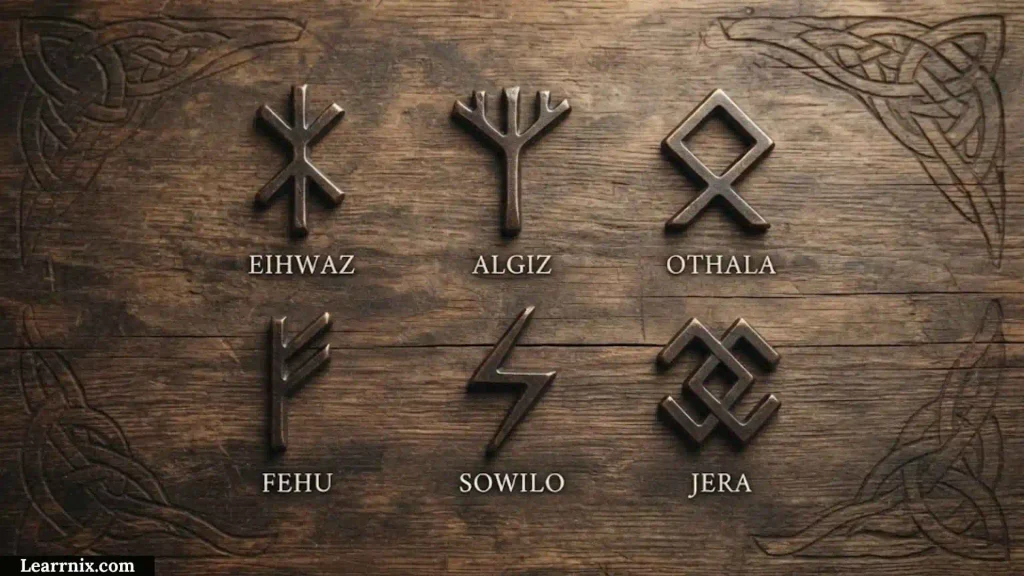
The phrase “German Germanic symbols” can refer to symbols connected with Germanic heritage, German history, German folklore, or the broader Germanic cultural family.
There is no single official collection of “Germanic symbols” representing Germany. Instead, different symbols belong to different historical contexts. Runes are part of the wider Germanic runic tradition, while later German heraldry, folklore, Christian imagery, and national symbols belong to different historical periods.
When researching a particular symbol, ask:
- What period does it come from?
- Where was it found or documented?
- Which language or culture used it?
- Was it a writing character or an emblem?
- Is its modern meaning different from its historical use?
These questions make it easier to distinguish historical evidence from modern interpretations.
FAQ
What Are Germanic Symbols?
Germanic symbols are historical or modern signs associated with Germanic-speaking peoples, traditions, mythology, folklore, and writing systems. Runes are among the most recognizable examples.
Are Runes Germanic Symbols?
Yes, runes are part of the historical Germanic writing tradition. However, different runic systems were used in different regions and periods, so not every rune belongs to exactly the same historical context.
What Is the Most Famous Germanic Symbol?
There is no single universally recognized “most famous” Germanic symbol. Runes, Thor’s hammer, and several Norse motifs are widely recognized today, but their historical contexts differ.
Can I Use Germanic Runes for a Tattoo?
Yes, but research the specific rune and runic system before using it. A rune can represent a sound rather than the modern concept people sometimes assign to it, and some symbols have acquired additional modern associations.
Can Germanic Runes Be Copied and Pasted?
Many runic characters can be copied and pasted because Unicode includes the Runic script. The standard covers characters from multiple historical runic systems, so choosing the correct character for your intended historical context is important.
Conclusion
Germanic symbols cover a broad historical field that includes runes, mythology, folklore, archaeological motifs, and later artistic interpretations. The Elder Futhark is especially useful for understanding the early runic tradition, while Younger Futhark and medieval runes show how the system changed over time.
For tattoos, usernames, decorative text, or research, the most useful approach is to identify the exact symbol and its historical context first. A rune should not automatically be given a single modern meaning simply because that interpretation is popular online.
The copy-and-paste runes in this guide can also make it easier to explore the characters digitally. Just remember that modern Unicode characters represent standardized digital forms, while historical inscriptions can contain different shapes and regional variations.

I am Daniel Harper, an education enthusiast and writer who enjoys creating helpful content to make learning more accessible and engaging.
I focus on sharing knowledge about effective study methods, educational growth, and skills that help learners succeed in a changing world.
Through my writing, I aim to inspire students to explore new ideas and develop a passion for learning.
Books by Daniel Harper:
- The Path to Lifelong Learning
- Unlocking Your Learning Potential
 Michael Carter
 Charlotte Anderson