
Money symbols are small characters that make currency easy to recognize. Signs such as $, €, £, ¥, and ₹ appear in prices, websites, financial documents, shopping pages, messages, and everyday writing. Some symbols identify one currency clearly, while others can represent more than one currency depending on the country and context.
This guide covers money symbols from around the world, including their names, meanings, Unicode characters, country associations, international uses, and copy-and-paste versions. You will also find useful information about Asian, foreign, English, global, and worldwide currency symbols, along with practical examples.
Money-related symbols can also be used outside financial writing. Coins, currency signs, and wealth imagery may appear in drawings, logos, spiritual practices, witchcraft, tattoos, and decorative designs. These symbolic meanings can vary by culture, so the guide separates official currency usage from broader personal and cultural interpretations.
Currency Symbol Means
A currency symbol is a character or sign used to identify a monetary unit when an amount is written. It provides a short visual alternative to spelling out the complete currency name.
For example:
- $50 — dollar
- €50 — euro
- £50 — pound sterling
- ¥50 — yen or yuan
- ₹50 — Indian rupee
- ₩50 — South Korean won
- ₽50 — Russian ruble
A currency symbol does not necessarily belong to only one currency. The dollar sign $ is used for several dollar and peso currencies, while ¥ is used for both Japanese yen and Chinese yuan. Unicode identifies $ as U+0024 DOLLAR SIGN and ¥ as U+00A5 YEN SIGN.
This is why financial websites often add a country abbreviation or ISO currency code when an amount could be misunderstood. ISO 4217 provides internationally recognized three-letter and three-digit currency codes for clearer identification.
Currency Symbols With Name
The following table covers some of the most commonly encountered currency symbols and their associated currencies.
| Symbol | Currency Name | ISO Code |
| $ | Dollar | USD, CAD, AUD, and others |
| ¢ | Cent | — |
| £ | Pound sterling | GBP |
| € | Euro | EUR |
| ¥ | Yen / yuan | JPY / CNY |
| ₹ | Indian rupee | INR |
| ₩ | Won | KRW |
| ₽ | Russian ruble | RUB |
| ₺ | Turkish lira | TRY |
| ₴ | Ukrainian hryvnia | UAH |
| ₦ | Nigerian naira | NGN |
| ₱ | Philippine peso | PHP |
| ₫ | Vietnamese dong | VND |
| ฿ | Thai baht | THB |
| ₭ | Lao kip | LAK |
| ₮ | Mongolian tögrög | MNT |
| ₲ | Paraguayan guaraní | PYG |
| ₸ | Kazakhstani tenge | KZT |
| ₾ | Georgian lari | GEL |
| ₼ | Azerbaijani manat | AZN |
| ₿ | Bitcoin | BTC |
Unicode lists many of these as dedicated currency characters, including the euro sign, naira sign, won sign, dong sign, kip sign, tugrik sign, rupee sign, lari sign, manat sign, ruble sign, and Bitcoin sign.
The ISO code is useful when the symbol is ambiguous. For example, $ by itself does not always tell a reader whether the amount is in USD, CAD, AUD, or another dollar currency.
Money Symbols Copy & Paste
If you need currency signs for a website, social media post, document, message, spreadsheet, design, or username, you can copy them directly from this list.
Common Money Symbols
- $ — Dollar sign
- ¢ — Cent sign
- £ — Pound sign
- € — Euro sign
- ¥ — Yen sign
- ₹ — Indian rupee sign
- ₩ — Won sign
- ₽ — Ruble sign
- ₺ — Turkish lira sign
- ₴ — Hryvnia sign
- ₦ — Naira sign
- ₱ — Peso sign
- ₫ — Dong sign
- ฿ — Thai currency symbol baht
- ₭ — Kip sign
- ₮ — Tugrik sign
- ₲ — Guarani sign
- ₸ — Tenge sign
- ₾ — Lari sign
- ₼ — Manat sign
- ₿ — Bitcoin sign
You can copy a symbol and paste it into a price, such as $25, €25, £25, or ₹25. Unicode also includes the generic ¤ CURRENCY SIGN, which can be used when a specific currency is unknown or intentionally unspecified.
Symbol appearance can depend on the font and device. If a less common currency character appears as a square or missing glyph, using the currency’s ISO code is often a practical alternative.
Money Symbols And Meanings
Money symbols have both practical and symbolic meanings. Their official meaning comes from their use as currency signs, while broader meanings may develop through culture, advertising, art, or personal interpretation.
For example, $ commonly indicates a dollar or certain peso currencies. € identifies the euro, £ is associated with pound sterling, and ₹ identifies the Indian rupee. Unicode specifically identifies ₹ as the INDIAN RUPEE SIGN and distinguishes it from the older generic rupee sign ₨.
Money imagery can also suggest:
- Wealth
- Prosperity
- Financial success
- Business
- Trade
- Savings
- Abundance
- Material value
- Economic activity
These broader associations are not universal definitions. A $ used in a financial table has a precise practical function, while the same sign in artwork might simply represent wealth or money in a general sense.
List Of Money Symbols
Here is a convenient list of widely recognized and less common monetary characters:
| Symbol | Common Name | Unicode |
| $ | Dollar sign | U+0024 |
| ¢ | Cent sign | U+00A2 |
| £ | Pound sign | U+00A3 |
| ¤ | Currency sign | U+00A4 |
| ¥ | Yen sign | U+00A5 |
| ₠ | Euro-currency sign | U+20A0 |
| ₡ | Colon sign | U+20A1 |
| ₣ | French franc sign | U+20A3 |
| ₦ | Naira sign | U+20A6 |
| ₩ | Won sign | U+20A9 |
| ₪ | New sheqel sign | U+20AA |
| ₫ | Dong sign | U+20AB |
| € | Euro sign | U+20AC |
| ₭ | Kip sign | U+20AD |
| ₮ | Tugrik sign | U+20AE |
| ₱ | Peso sign | U+20B1 |
| ₲ | Guarani sign | U+20B2 |
| ₴ | Hryvnia sign | U+20B4 |
| ₵ | Cedi sign | U+20B5 |
| ₸ | Tenge sign | U+20B8 |
| ₹ | Indian rupee sign | U+20B9 |
| ₺ | Turkish lira sign | U+20BA |
| ₼ | Manat sign | U+20BC |
| ₽ | Ruble sign | U+20BD |
| ₾ | Lari sign | U+20BE |
| ₿ | Bitcoin sign | U+20BF |
These Unicode names and code points are based on the current Unicode currency-symbol charts.
Types Of Money Symbols
Money symbols can be divided into several useful categories.
Major Currency Symbols
These are the signs most people recognize immediately:
- $ — dollar sign
- € — euro sign
- £ — pound sign
- ¥ — yen sign
- ₹ — Indian rupee sign
Regional Currency Symbols
Some symbols are strongly associated with particular countries or regions, such as ₩ for the Korean won, ₺ for the Turkish lira, and ₴ for the Ukrainian hryvnia.
Generic Currency Symbols
The ¤ character is officially named CURRENCY SIGN and represents a generic or unspecified currency rather than a particular national currency.
Cryptocurrency Symbols
The Bitcoin sign ₿ is a Unicode currency character associated with Bitcoin. It is different from traditional national currency symbols because Bitcoin is a cryptocurrency rather than a government-issued national currency.
Historical Currency Symbols
Unicode also contains symbols associated with former currencies, including the French franc sign, peseta sign, drachma sign, German penny sign, and other historical monetary characters. These can be useful for historical documents and educational content.
Money Symbols Around The World
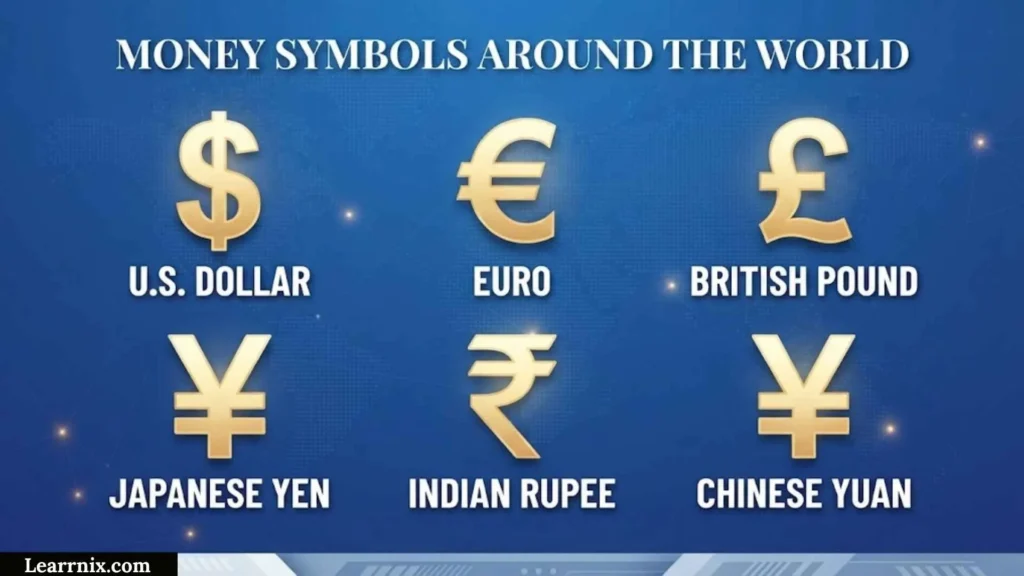
Currency symbols vary across continents, countries, languages, and financial systems. Some are unique to a particular currency, while others are shared.
North American currencies frequently use the dollar sign, while Europe commonly uses the euro sign and pound sign. Asia contains a wide range of symbols, including ₹, ¥, ₩, ฿, and ₫.
Africa also has recognizable currency characters, such as ₦ for the Nigerian naira and ₵ for the Ghanaian cedi. Eastern Europe and nearby regions include symbols such as ₽, ₴, ₾, and ₸.
The important point is that a worldwide currency list should not assume that every symbol maps to exactly one currency. Unicode notes that $ is used for multiple currencies and that ¥ has been used for both yen and yuan.
Money Symbols By Country
Country-based lists make currency signs easier to understand because they connect a symbol with a specific national currency.
| Country | Currency | Symbol | Code |
| United States | U.S. dollar | $ | USD |
| Canada | Canadian dollar | $ / C$ | CAD |
| United Kingdom | Pound sterling | £ | GBP |
| Japan | Japanese yen | ¥ | JPY |
| China | Renminbi/yuan | ¥ / 元 | CNY |
| India | Indian rupee | ₹ | INR |
| South Korea | South Korean won | ₩ | KRW |
| Thailand | Thai baht | ฿ | THB |
| Vietnam | Vietnamese dong | ₫ | VND |
| Philippines | Philippine peso | ₱ | PHP |
| Turkey | Turkish lira | ₺ | TRY |
| Ukraine | Ukrainian hryvnia | ₴ | UAH |
| Russia | Russian ruble | ₽ | RUB |
| Nigeria | Nigerian naira | ₦ | NGN |
| Kazakhstan | Kazakhstani tenge | ₸ | KZT |
| Georgia | Georgian lari | ₾ | GEL |
| Azerbaijan | Azerbaijani manat | ₼ | AZN |
Currency symbols can differ by locale even when the underlying currency is the same. Unicode CLDR notes that localized forms such as CA$ can be used to distinguish Canadian dollars from other dollar currencies.
Asian Money Symbols
Asia has a particularly diverse collection of currency signs and local currency notation.
Some commonly encountered Asian money symbols include:
- ¥ — Japanese yen and commonly used for Chinese yuan
- ₹ — Indian rupee
- ₩ — Korean won
- ฿ — Thai baht
- ₫ — Vietnamese dong
- ₱ — Philippine peso
- ₭ — Lao kip
- ₮ — Mongolian tögrög
- ₸ — Kazakhstani tenge
- ₺ — Turkish lira
The ¥ symbol is particularly interesting because Unicode defines U+00A5 YEN SIGN as the currency sign for both Japanese yen and Chinese yuan, even though local writing systems also use characters such as 元, 円, and 圓.
For international content, JPY and CNY are clearer than relying on ¥ alone.
Foreign Money Symbols
Foreign money symbols are currency signs used to represent currencies outside the reader’s own country or normal financial system.
For example, someone accustomed to U.S. dollars may consider €, £, ₹, ₩, and ₽ foreign money symbols. A traveler may encounter several of these signs on hotel prices, restaurant menus, transportation websites, and shopping pages.
Foreign currency symbols are useful for:
- Travel planning
- International shopping
- Currency comparison
- Financial education
- E-commerce
- Translation
- Business communication
- Exchange-rate content
When a currency sign is unfamiliar, look for the country name or three-letter code nearby. ISO 4217 is designed specifically to provide internationally recognized currency identifiers and reduce ambiguity in trade, commerce, and banking.
Global Money Symbols
Global money symbols are the currency signs that appear across international commerce, travel, websites, financial applications, and digital communication.
Some of the most recognizable include:
$ € £ ¥ ₹ ₩ ₽ ₺ ₴ ₦ ₱ ฿ ₫ ₭ ₮ ₸ ₾ ₼ ₿
A symbol is convenient because it takes very little space, but it is not always enough to identify a currency precisely. For example, $ can be used by several currencies, while € is strongly associated with the euro. Unicode CLDR also emphasizes that currency symbols are localized and that context can determine which form is most appropriate.
International Money Symbols
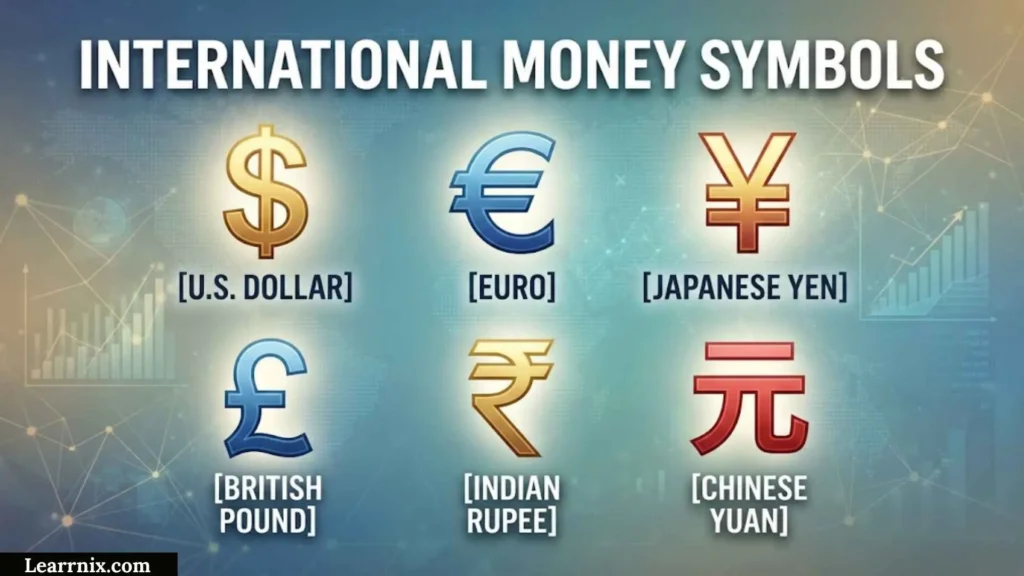
International money symbols are especially useful when a price may be viewed by people from different countries.
Compare these examples:
- $100
- $100 USD
- US$100
The first version is short but may be ambiguous. The second and third provide additional information.
The same applies to other currencies:
- €100 — EUR
- £100 — GBP
- ₹100 — INR
- ¥100 — JPY or CNY depending on context
- ₩100 — KRW
ISO 4217 uses three-letter alphabetic codes and three-digit numeric codes to identify currencies internationally. The alphabetic system includes familiar codes such as USD and EUR.
For an international website, adding the code can be especially useful when products are sold to customers in several countries.
Currency Money Symbols
Currency money symbols are used alongside numerical amounts to show which monetary unit applies. In many English-language contexts, the sign comes before the number:
- $20
- £20
- €20
- ₹20
However, placement is not universal. Currency formatting depends on language, country, and localization rules. Unicode CLDR distinguishes between symbols, narrow symbols, international codes, and currency names when formatting monetary amounts.
This matters for websites and applications. A professional price display should use the formatting convention expected by its target audience instead of assuming that every currency follows the same pattern.
English Money Symbols
English-language content frequently uses several currency symbols because English is common in international business and online commerce.
The most familiar include:
- $ — dollar
- £ — pound sterling
- € — euro
- ¥ — yen or yuan
- ¢ — cent
- ₹ — Indian rupee
In English writing, the symbol often appears before the amount, but localized formatting may vary. For example, an international audience may understand US$25 more clearly than $25.
The pound sign £ also illustrates why names matter. Unicode identifies U+00A3 as POUND SIGN and notes that the character has also been used historically for currencies such as the lira.
Worldwide Money Symbols
Worldwide money symbols cover a much larger range than the handful of signs most people see every day. Unicode’s currency collections include contemporary and historical characters from different regions and writing systems.
A useful worldwide collection includes:
- $ — Dollar sign
- ¢ — Cent sign
- £ — Pound sign
- € — Euro sign
- ¥ — Yen sign
- ₹ — Indian rupee sign
- ₩ — Won sign
- ₽ — Ruble sign
- ₺ — Turkish lira sign
- ₴ — Hryvnia sign
- ₦ — Naira sign
- ₱ — Peso sign
- ฿ — Baht sign
- ₫ — Dong sign
- ₭ — Kip sign
- ₮ — Tugrik sign
- ₸ — Tenge sign
- ₾ — Lari sign
- ₼ — Manat sign
- ₿ — Bitcoin sign
For historical research, Unicode also contains characters that are no longer used as modern national currency signs. This makes Unicode useful not only for current prices but also for historical and linguistic research.
Money Symbols Spiritual
Money symbols can take on broader meanings in spiritual or symbolic contexts. People may use coins, gold imagery, currency signs, or abundance-related designs to represent prosperity, financial goals, generosity, or material well-being.
Common symbolic associations include:
- Coins — wealth, exchange, opportunity, or value
- Gold imagery — prosperity and material value
- Currency signs — financial goals or abundance
- Green money imagery — wealth or financial success in popular culture
- Circular coins — continuity, exchange, or accumulation
These meanings are interpretive rather than official definitions. A currency character such as $ has a documented linguistic and financial function, but a person may give that same symbol an additional personal or spiritual meaning.
Money Symbols Witchcraft
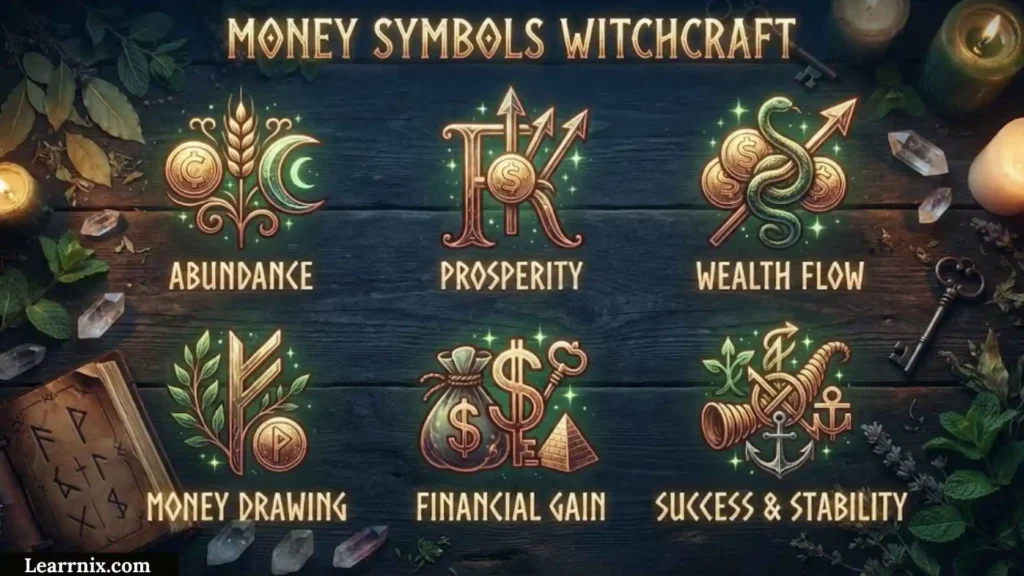
Money symbols may also appear in modern witchcraft and other spiritual practices as representations of prosperity, abundance, luck, or financial intentions.
A practitioner might use coins, written currency signs, candles, herbs, colors, or other objects as part of a personal ritual. The exact meaning depends on the tradition and the individual’s beliefs.
It is useful to separate this symbolic use from Unicode and financial terminology. There is no universal supernatural meaning assigned to $, €, £, or other currency characters. Their official definitions relate to currency notation, while spiritual interpretations are belief-based and can vary considerably.
Money Symbols Drawing
Money symbols are easy subjects for simple drawings, worksheets, illustrations, icons, and finance-themed artwork.
Simple Symbols To Draw
- $ — Draw an S-like shape with a vertical stroke.
- € — Create a curved E-like form with horizontal strokes.
- £ — Use the familiar pound shape with its horizontal bars.
- ¥ — Combine a Y-shaped form with horizontal strokes.
- ₹ — Reproduce the distinctive upper horizontal structure and vertical form.
- ¢ — Draw a C-shaped character with a vertical stroke.
For digital content, copying the original Unicode character is usually easier and more consistent than recreating it manually. For custom illustrations, an artist can modify the shape while keeping the recognizable currency concept.
FAQ
What is the most common money symbol?
The dollar sign $ is one of the most widely recognized currency symbols, but it is used by multiple currencies, so context is needed to identify the exact currency.
What is the universal symbol for money?
There is no single universal symbol for all currencies. Common signs include $, €, £, ¥, and ₹, while ¤ is the Unicode character for a generic or unspecified currency.
How do I copy and paste money symbols?
You can copy characters such as $, €, £, ₹, ₩, or ₽ directly from a symbol list and paste them into compatible documents, websites, messages, or social media posts.
Why can one money symbol represent different currencies?
Some currency signs were adopted or historically used by more than one currency. The dollar sign and yen sign are examples, so a country name or ISO code may be needed for clarity.
What is the difference between a money symbol and a currency code?
A money symbol is a character such as $ or €, while a currency code is a standardized identifier such as USD or EUR. Codes are especially useful for international financial communication.
Conclusion
Money symbols make prices and financial information easier to recognize at a glance. Familiar characters such as $, €, £, ¥, and ₹ are used across websites, documents, shopping platforms, financial applications, and everyday communication, while many additional symbols represent currencies in specific countries and regions.
For copy-and-paste purposes, Unicode provides a large collection of currency characters, including modern, regional, historical, and cryptocurrency-related symbols. Pairing an unfamiliar symbol with its currency name or ISO code can make the information much clearer, especially for an international audience.
Money signs can also be used creatively in drawings, designs, spiritual practices, and symbolic artwork. The key is to distinguish documented currency usage from personal or cultural interpretations, while choosing the symbol and formatting that best match the context.

I am Daniel Harper, an education enthusiast and writer who enjoys creating helpful content to make learning more accessible and engaging.
I focus on sharing knowledge about effective study methods, educational growth, and skills that help learners succeed in a changing world.
Through my writing, I aim to inspire students to explore new ideas and develop a passion for learning.
Books by Daniel Harper:
- The Path to Lifelong Learning
- Unlocking Your Learning Potential
 Michael Carter
 Charlotte Anderson