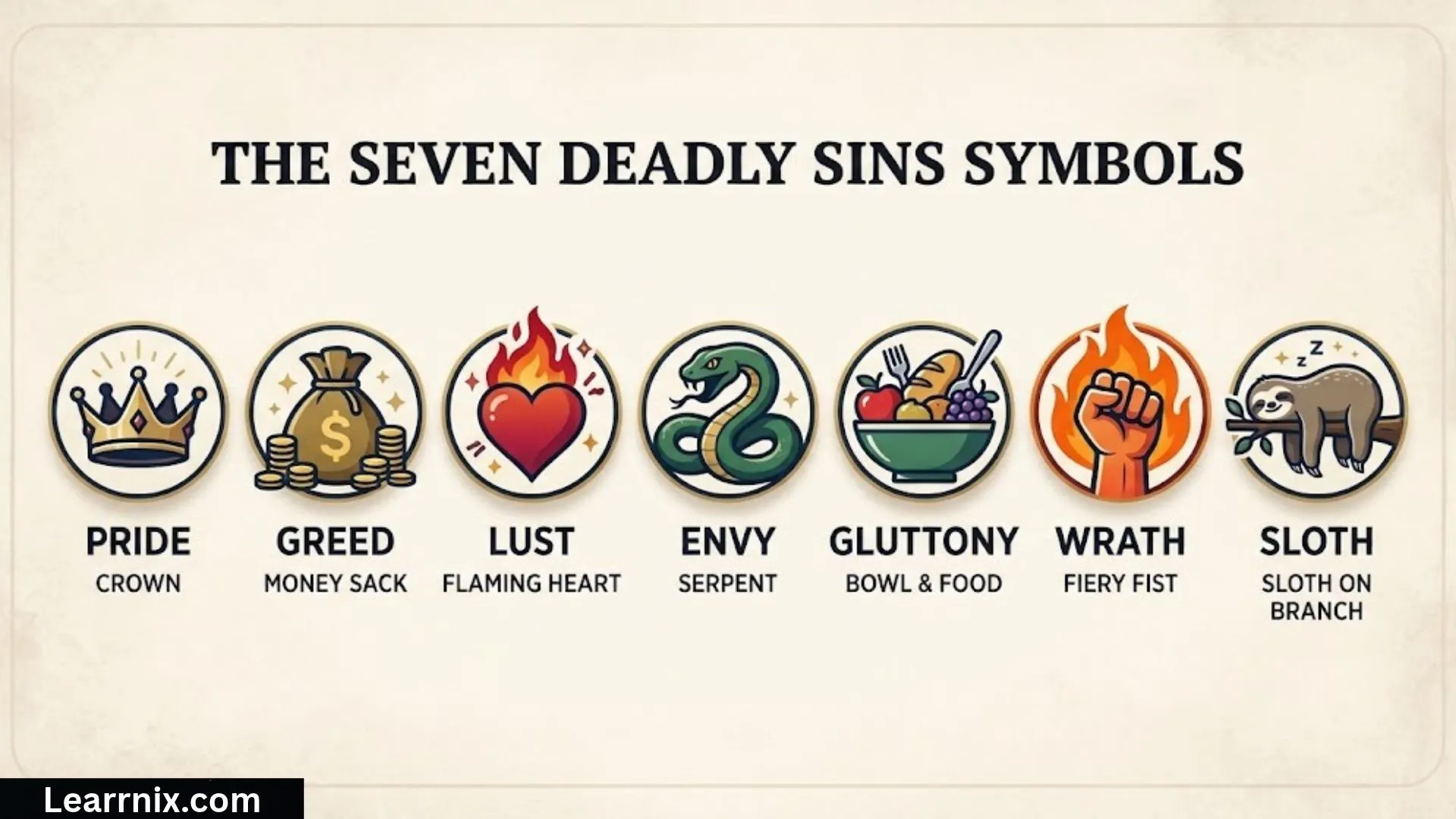
The seven deadly sins symbols represent seven human weaknesses that have been discussed in Christian teachings, literature, art, and popular culture for centuries. Pride, greed, lust, envy, gluttony, wrath, and sloth each describe a different behavior or desire that can negatively influence a person’s choices. Today, these concepts also appear in anime, tattoos, character designs, and decorative text.
If you are searching for seven deadly sins symbols to copy and paste, learning what each symbol means, or finding inspiration for a tattoo, this guide covers the main interpretations. It also explains how these symbols relate to the Bible, the anime The Seven Deadly Sins, and Helluva Boss, while distinguishing traditional religious ideas from modern fictional designs.
There is no single universal set of official symbols for all seven sins. Different historical traditions and modern adaptations use different animals, objects, colors, and character emblems. Below, you will find a practical symbol chart, individual meanings, text-friendly alternatives, drawing tips, and examples to help you choose a representation that fits your purpose.
What are the Seven Deadly Sins Symbols
The seven deadly sins are pride, greed, lust, envy, gluttony, wrath, and sloth. Their symbols are visual representations of these behaviors, making abstract ideas easier to recognize in religious art, stories, illustrations, and contemporary designs.
Traditional and modern representations vary. For example, a mirror can represent pride because it suggests vanity and excessive self-admiration, while a snake may symbolize envy, temptation, or deception depending on the artwork. These associations are interpretations rather than a universally standardized collection.
The seven sins and some commonly used visual representations include:
- Pride: Mirror, peacock, crown, or ornate face.
- Greed: Gold coins, treasure chest, or grasping hands.
- Lust: Rose, heart, flame, or seductive figure.
- Envy: Green eyes, snake, or two contrasting figures.
- Gluttony: Feast, overflowing plate, or goblet.
- Wrath: Flames, clenched fist, or broken weapon.
- Sloth: Sleeping figure, drooping flower, or hourglass.
These visual ideas are useful for illustrations, character concepts, jewelry, usernames, and tattoos. Their meanings depend on the context, so a rose, snake, or flame can communicate several different ideas outside the seven deadly sins.
Seven Deadly Sins Symbols Meaning
Each sin describes a different kind of excessive desire, harmful attitude, or failure of self-control. Understanding the meaning behind each symbol helps you select a design that communicates the intended message.
Pride Symbol
Pride, traditionally understood as excessive self-importance, is often represented by a mirror, peacock, or crown. A mirror can suggest vanity, while a crown may represent a desire for superiority, status, or admiration.
Pride does not mean that every form of confidence is wrong. The traditional moral concern is arrogance that places personal importance above humility, truth, or consideration for others.
Greed Symbol
Greed is commonly represented by gold, coins, treasure chests, and hands holding possessions tightly. These images suggest an excessive desire for wealth, power, or material things.
A pile of coins may communicate financial ambition, but a locked treasure chest or a hand refusing to release money can more clearly suggest possessiveness.
Lust Symbol
Lust is often represented by a heart, rose, flame, or sensual figure. In traditional Christian morality, lust refers to disordered sexual desire rather than love or attraction in general.
For a symbolic design, a rose with thorns can suggest temptation and consequences, while a flame may represent desire that becomes difficult to control.
Envy Symbol
Envy describes resentment toward another person’s success, possessions, beauty, or happiness. Snakes, green eyes, and contrasting figures are common artistic choices for expressing jealousy.
Green is a familiar cultural association with envy, but it is not a mandatory religious color. A design showing one figure looking toward another person’s prize may communicate the meaning more clearly than color alone.
Gluttony Symbol
Gluttony represents excessive consumption, traditionally associated with food and drink. An overflowing plate, overflowing goblet, or lavish feast can symbolize appetite without restraint.
The concept is broader than enjoying a meal. Its moral meaning concerns excess and a lack of moderation.
Wrath Symbol
Wrath represents uncontrolled anger, hostility, or a desire for revenge. Flames, clenched fists, swords, and storm imagery often communicate its intensity.
A broken sword can suggest the consequences of anger, while a burning emblem may represent rage that threatens to consume the person experiencing it.
Sloth Symbol
Sloth is associated with laziness, neglect, and spiritual or moral indifference. A sleeping figure, wilting flower, or stopped clock can represent inactivity and wasted opportunities.
Historically, sloth has also referred to a deeper failure to engage with meaningful responsibilities, rather than simply needing rest after a tiring day.
Seven Deadly Sins Symbols Chart
A chart makes it easier to compare the seven sins, their common visual representations, and the ideas they communicate. Use this table as a starting point for choosing symbols for artwork, study notes, character concepts, or personal designs.
| Sin | Common Symbol | Main Meaning | Suggested Color |
| Pride | Mirror or crown | Vanity and arrogance | Purple or gold |
| Greed | Gold coins | Excessive desire for wealth | Gold or green |
| Lust | Rose or flame | Unrestrained desire | Red or pink |
| Envy | Snake or green eyes | Jealousy and resentment | Green |
| Gluttony | Overflowing plate | Excessive consumption | Orange or brown |
| Wrath | Flames or clenched fist | Anger and revenge | Red or black |
| Sloth | Sleeping figure | Inactivity and neglect | Blue or gray |
The colors in this chart are creative suggestions, not fixed historical or biblical rules. Artists often change them to suit the mood of a scene or the personality of a character.
For a simple design, choose one recognizable object for each sin. For a more detailed illustration, combine two elements, such as a crown surrounded by mirrors for pride or a treasure chest overflowing with coins for greed.
Seven Deadly Sins Symbols Bible
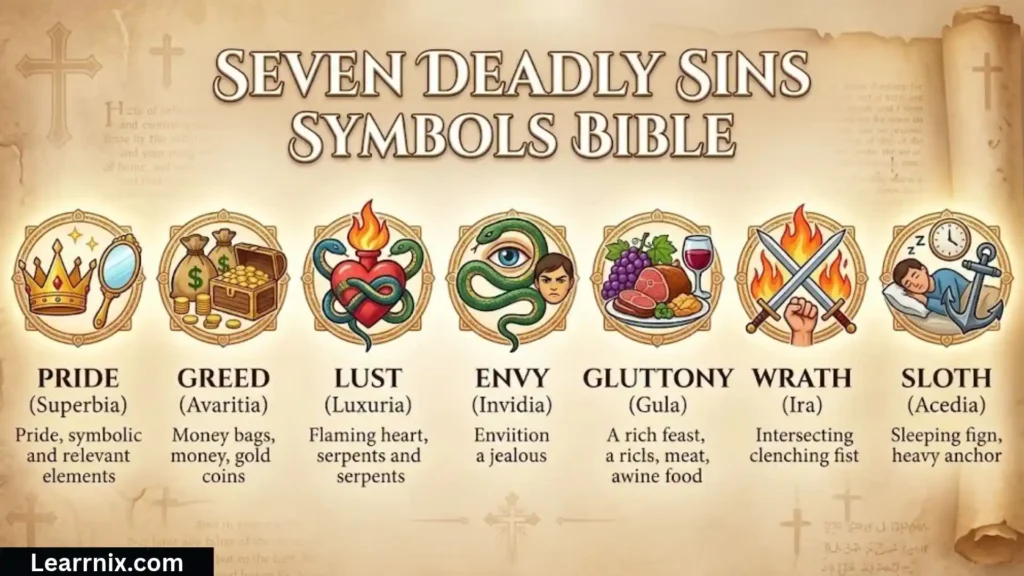
The seven deadly sins are rooted in Christian moral tradition, but the Bible does not present one official collection of seven icons representing them. The familiar list developed through centuries of Christian teaching, including the work of early Christian thinkers and later theologians.
Proverbs 6:16–19 describes seven things that the Lord hates, including pride, lying, violence, and sowing discord. This passage is related to discussions of sinful behavior, but its seven items are not identical to the traditional seven deadly sins.
The New Testament also discusses behaviors associated with these sins. For example, Galatians 5:19–21 lists various works of the flesh, while James 3:16 connects envy and selfish ambition with disorder.
Here is how the traditional sins relate to biblical themes:
- Pride: Proverbs 16:18 warns about pride preceding destruction.
- Greed: Luke 12:15 warns against greed and the belief that life consists of possessions.
- Lust: Matthew 5:28 discusses lustful intent in the context of adultery.
- Envy: James 3:16 connects envy and selfish ambition with disorder.
- Gluttony: Proverbs 23:20–21 warns against excessive indulgence.
- Wrath: James 1:19–20 teaches that human anger does not produce God’s righteousness.
- Sloth: Proverbs 6:6–11 uses the example of an ant to teach diligence.
These passages address the underlying behaviors rather than prescribing specific icons. Therefore, a crown, snake, or flame should be understood as an artistic representation, not an official biblical symbol. This distinction is useful when creating religious artwork or researching the history of the seven sins.
Seven Deadly Sins Symbols Copy And Paste
If you want seven deadly sins symbols to copy and paste into messages, bios, captions, or notes, the following Unicode characters offer convenient decorative options.
♛
Pride
Crown — superiority and status
Copy
$
Greed
Fullwidth dollar sign — wealth and possessions
Copy
♡
Lust
Outline heart — desire and attraction
Copy
♟
Envy
Chess piece — rivalry and comparison
Copy
🍽
Gluttony
Fork and knife with plate — excessive consumption
Copy
⚡
Wrath
High voltage — anger and intensity
Copy
☾
Sloth
Crescent moon — sleep and inactivity
Copy
These are suggested decorative substitutes, not official symbols assigned to the sins. Some are standard Unicode characters, while emoji-style characters may look different depending on the device, operating system, and font.
You can also combine them with ordinary text to create personalized captions:
- ♛ Pride — Confidence Without Humility
- $ Greed — The Endless Desire For More
- ♡ Lust — Desire And Temptation
- ♟ Envy — The Pain Of Comparison
- 🍽 Gluttony — Appetite Without Limits
- ⚡ Wrath — The Fire Of Anger
- ☾ Sloth — Dreams Without Action
For a consistent look, use simple monochrome characters together. If you prefer colorful symbols, use emoji sparingly so the meaning stays easy to recognize. These characters are convenient for social media and messaging, but they do not replace the distinctive emblems found in particular anime or game franchises.
Seven Deadly Sins Symbols Tattoo
Seven deadly sins tattoos appeal to people who want artwork with a personal, moral, philosophical, or fictional meaning. Some designs represent a struggle with a particular weakness, while others explore temptation, human imperfection, self-awareness, or personal growth.
A tattoo does not have to celebrate the sin it depicts. For some people, wrath represents a struggle to manage anger; for others, a phoenix-like flame can suggest transformation after difficult experiences.
Popular design directions include:
- Minimalist tattoos: A small crown for pride, a coin for greed, or a flame for wrath.
- Animal tattoos: A peacock for pride or a snake for envy, depending on the intended symbolism.
- Dark illustrative tattoos: Skulls, thorny roses, broken weapons, and dramatic shadows.
- Full seven-sin compositions: Seven small emblems arranged in a circle, vertical line, or symmetrical pattern.
- Personalized tattoos: An object, date, word, or color added to represent an individual experience.
Before choosing a tattoo, decide whether you want a traditional moral interpretation or a recognizable design from a fictional series. These can look very different, even when they represent the same sin.
Placement also affects the design. A wrist or finger often suits a small emblem, while the forearm, shoulder, back, or thigh offers more space for a detailed composition. Ask a professional tattoo artist to create an original stencil and check that fine lines will remain readable at the intended size.
Seven Deadly Sins Symbols Anime
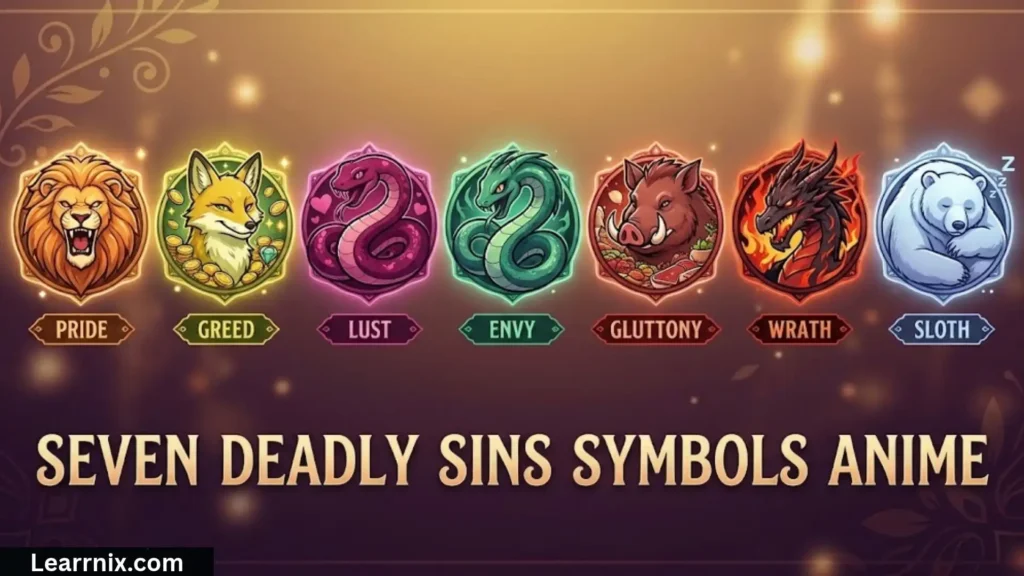
Anime frequently uses the seven deadly sins as a framework for characters, powers, personalities, and dramatic conflicts. The symbols may appear as tattoos, weapons, uniforms, jewelry, magical marks, or other distinctive emblems.
The most recognizable example is The Seven Deadly Sins, a fantasy anime based on the manga by Nakaba Suzuki. Its main characters are associated with individual sins, and their insignias form part of the series’ identity.
Anime symbolism is not always identical to traditional Christian symbolism. A character representing wrath may be compassionate in some situations, while a character associated with greed may also demonstrate loyalty. This contrast allows stories to explore the difference between a person’s defining flaw and their complete personality.
When looking for anime-inspired symbols, consider three details:
- Character association: Which sin is assigned to the character?
- Visual design: What emblem, weapon, or mark identifies the character?
- Story meaning: How does the character’s behavior relate to the sin?
If you want an accurate fan-art reference, distinguish official character insignias from generic designs created by fans. A crown or flame may represent a sin in an original illustration without being an official emblem from a specific anime.
Seven Deadly Sins Symbols Meliodas
Meliodas is the captain of the Seven Deadly Sins in the anime and manga The Seven Deadly Sins. He represents the Dragon’s Sin of Wrath, making the dragon emblem the central visual association for his character.
His symbol is commonly depicted as a dragon-shaped mark. The series connects the emblem to his identity, while his story explores anger, responsibility, loyalty, and the consequences of immense power.
For fans who want a Meliodas-inspired design, there are several options:
- A dragon emblem inspired by his official insignia.
- A small black dragon tattoo for a minimalist look.
- A larger illustration combining the dragon mark with a sword.
- Fan-art compositions using dark shading and fantasy-inspired details.
The dragon emblem associated with Meliodas is different from a generic wrath symbol such as a flame or clenched fist. If you want a design that other fans immediately recognize, the character-specific mark is a better starting point than a general symbol of anger.
For original artwork, you can also combine the dragon motif with abstract fire or storm elements. Keep in mind that these additions are creative interpretations rather than necessarily being part of the official insignia.
Seven Deadly Sins Symbols Helluva Boss
Helluva Boss is an adult animated series created by Vivienne Medrano. Its fictional setting draws on demons, Hell, and elements of demonology, giving it a different approach to sin-related imagery from traditional Christian art.
The series is associated with a fictional hierarchy of Hell that includes the Seven Deadly Sins. Characters and designs use recognizable colors, shapes, clothing, and supernatural features to establish their identities.
For example, Asmodeus is associated with lust, while Beelzebub is associated with gluttony. Their visual designs are specific to the show’s fictional world, and should not be confused with universal religious symbols.
When researching these designs, separate three categories:
- Traditional sin symbols: General images such as flames, mirrors, coins, and overflowing plates.
- Series characters: Official character appearances and recognizable design elements.
- Fan-made symbols: Unofficial logos, edits, and illustrations inspired by the show.
This distinction matters if you are planning a tattoo, cosplay accessory, fan-art illustration, or profile decoration. A generic heart may suggest lust, but it is not automatically an official Helluva Boss emblem. Similarly, a bee-inspired design may evoke gluttony, but it should not be treated as a universal symbol for the sin.
Human Form Biblical Seven Deadly Sins Symbols
The idea of giving each deadly sin a human form is popular in literature, illustration, games, and fantasy storytelling. However, the Bible does not provide an official set of seven human characters, each assigned to one of the deadly sins.
Artists can personify the sins by creating characters whose clothing, expressions, and actions communicate a particular weakness. This approach makes the concepts easier to understand and can work well for original character designs.
| Sin | Human Character Concept | Visual Details |
| Pride | The arrogant ruler | Crown, upright posture, ornate clothing |
| Greed | The possessive merchant | Coins, rings, tightly held treasure |
| Lust | The tempting charmer | Rose, flowing fabric, expressive eyes |
| Envy | The jealous observer | Green accents, sideward gaze, tense expression |
| Gluttony | The excessive feaster | Goblet, elaborate feast, overflowing table |
| Wrath | The furious warrior | Clenched fists, intense gaze, fire motifs |
| Sloth | The indifferent dreamer | Relaxed posture, drooping clothing, closed eyes |
These are original artistic concepts rather than biblical descriptions. The characters can be portrayed as adults of different genders, ages, backgrounds, and personalities.
To make each figure more meaningful, show the sin through behavior rather than relying entirely on clothing. A proud character might ignore advice, while an envious character may continually compare their achievements with someone else’s. A wrathful character might struggle to control an impulsive reaction.
This method creates a clearer visual narrative and avoids making the seven figures look like ordinary people wearing different costumes.
How To Draw The Seven Deadly Sins Symbols
Drawing the seven deadly sins symbols is easier when you begin with simple shapes. You do not need advanced artistic skills to create recognizable emblems for a sketchbook, school project, digital illustration, or tattoo concept.
Step 1: Choose A Symbol For Each Sin
Decide what each emblem should communicate before drawing. A mirror works well for pride, coins for greed, a rose for lust, and flames for wrath. Choose imagery that is clear and easy to recognize.
Step 2: Sketch The Basic Shapes
Use circles, triangles, and simple lines to establish the structure.
- Draw a circle or oval as the base of a mirror.
- Use overlapping circles for coins.
- Start a rose with a small spiral and add petals.
- Build a snake from curved lines.
- Sketch a plate as an oval with a rim.
- Create flames using curved, pointed shapes.
- Draw a sleeping figure with a rounded head and curved body.
Step 3: Add Details
Add borders, shading, textures, or small decorative elements. For example, a crown can include three points, while a treasure chest can have a lock and metal bands.
Avoid adding too many details to a small symbol. A simple silhouette is often more recognizable than a complicated drawing.
Step 4: Keep The Designs Consistent
If you are drawing all seven emblems, use the same line thickness, overall size, and level of detail. This makes the collection look like a unified set rather than seven unrelated pictures.
You could place the symbols inside circles, arrange them around a central motif, or create seven individual badges.
Step 5: Add Color And Meaning
Use color to support the idea behind each symbol. Red can emphasize wrath, green can suggest envy, and gold can suggest greed. These are artistic choices rather than fixed requirements.
Finally, test the designs in black and white. If the symbols remain recognizable without color, they are more versatile for printing, small tattoos, and monochrome digital artwork.
Wrath Seven Deadly Sins Symbols
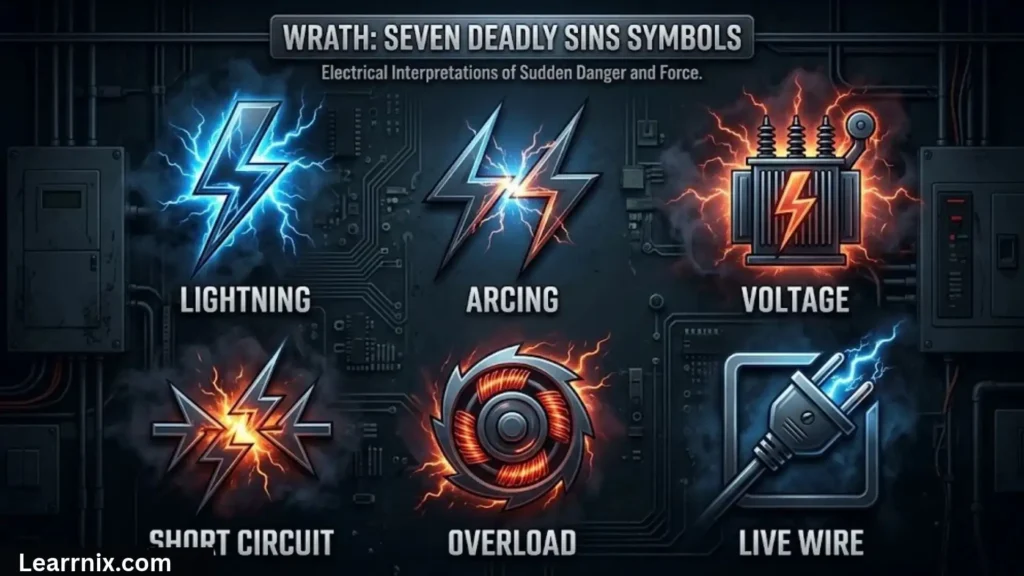
Wrath is commonly understood as intense anger that becomes destructive through hostility, revenge, or uncontrolled reactions. Its symbols often communicate heat, aggression, conflict, and the potential consequences of losing control.
Here are several visual representations that work well for wrath:
- 🔥 Fire: Suggests burning anger, destruction, and intense emotion.
- ⚡ Lightning: Represents sudden intensity, explosive reactions, or power.
- ⚔ Crossed swords: Suggests conflict, confrontation, or revenge.
- ✊ Clenched fist: Communicates aggression, resistance, or determination.
- A broken sword: Can represent the consequences of violence or a decision to end conflict.
These are general visual interpretations, not a standardized set of seven deadly sins Unicode symbols. Fire and lightning can also represent energy, courage, passion, or natural power in other contexts.
For a tattoo, flames surrounding a broken weapon can suggest anger and its consequences. For a minimalist design, a single flame or sharp angular mark may be enough.
In anime, wrath can be represented by an official character emblem rather than a generic flame. Meliodas, for example, is associated with the Dragon’s Sin of Wrath. His dragon mark belongs to the series’ character design, while flames and fists are broader artistic symbols.
The most effective wrath symbol depends on the message you want to convey: uncontrolled anger, inner conflict, power, revenge, or the struggle to master strong emotions.
Seven Deadly Sins Symbols Tattoo
If you are comparing tattoo styles, consider how a design will look on the body rather than focusing only on its meaning. A detailed illustration may work beautifully on the back or upper arm, while a small symbol is often better suited to the wrist or ankle.
Here are three approaches to consider when choosing a design.
Minimalist Symbol Tattoos
Minimalist designs use clean outlines and limited detail. A tiny crown, coin, rose, snake, or flame can represent one sin without requiring a large tattoo.
This style works well for people who prefer discreet artwork or want to combine several small symbols into a matching collection.
Dark And Gothic Designs
Gothic designs may use skulls, thorny vines, black shading, sharp lines, and dramatic contrast. These elements can create a darker interpretation of temptation, pride, violence, or moral conflict.
The style is a modern artistic choice, not a requirement for representing the sins.
Seven-Symbol Tattoo Sets
A seven-symbol set can represent all the sins together. You might arrange the emblems in a circular pattern, place them along the forearm, or use a separate symbol for each finger-sized design.
Before committing, ask your tattoo artist to check the spacing, line thickness, and readability at the intended size. Small details can blur over time, so simple designs are often more practical for very small placements.
Also consider whether you want generic symbols or the official insignias of an anime series. The former allows more personal interpretation, while the latter may be more recognizable to fans.
Frequently asked questions
What are the seven deadly sins and their symbols?
The seven deadly sins are pride, greed, lust, envy, gluttony, wrath, and sloth. Common artistic symbols include a mirror, coins, a rose, a snake, a feast, flames, and a sleeping figure. These associations vary across traditions and creative works.
Are the seven deadly sins symbols mentioned in the Bible?
The Bible discusses behaviors associated with all seven sins, but it does not provide an official set of seven corresponding icons. The familiar list developed through Christian tradition, and the symbols commonly used today are largely artistic interpretations.
What is Meliodas’s seven deadly sins symbol?
Meliodas represents the Dragon’s Sin of Wrath in The Seven Deadly Sins. His character is associated with a dragon-shaped emblem, which differs from generic wrath imagery such as flames or clenched fists.
Can I use seven deadly sins symbols for a tattoo?
Yes. You can choose minimalist emblems, detailed illustrations, or character-specific insignias inspired by anime. Consider the meaning, size, placement, and long-term readability before choosing a final design.
Are there official Unicode symbols for the seven deadly sins?
No single official Unicode character represents each of the seven sins as a complete set. You can use existing characters, such as ♛, ♡, and ⚡, as decorative alternatives, but their meanings depend on context.
Conclusion
The seven deadly sins symbols provide a visual way to explore pride, greed, lust, envy, gluttony, wrath, and sloth. From traditional religious interpretations to modern anime characters, each representation offers a different way to communicate human weaknesses, desires, and moral struggles.
For copy-and-paste use, ordinary Unicode characters can decorate social media bios, captions, and messages. For artwork and tattoos, objects such as crowns, coins, roses, snakes, and flames offer flexible starting points. Anime-inspired designs, including Meliodas’s dragon emblem, have their own meanings and should be distinguished from general symbolism.
Choose symbols based on the message you want to express, and remember that no single chart defines every tradition or fictional universe. Understanding the meaning behind each design will help you create more thoughtful tattoos, illustrations, character concepts, and decorative text.

I am Charlotte Anderson, an education writer who is passionate about creating meaningful learning resources for students and lifelong learners.
I enjoy researching new educational approaches and sharing ideas that make studying easier and more effective.
Through my work, I aim to inspire curiosity, confidence, and a love for learning.
Books:
- The Complete Guide to Better Learning
- Building Skills for Academic Success
 Daniel Harper
 Michael Carter