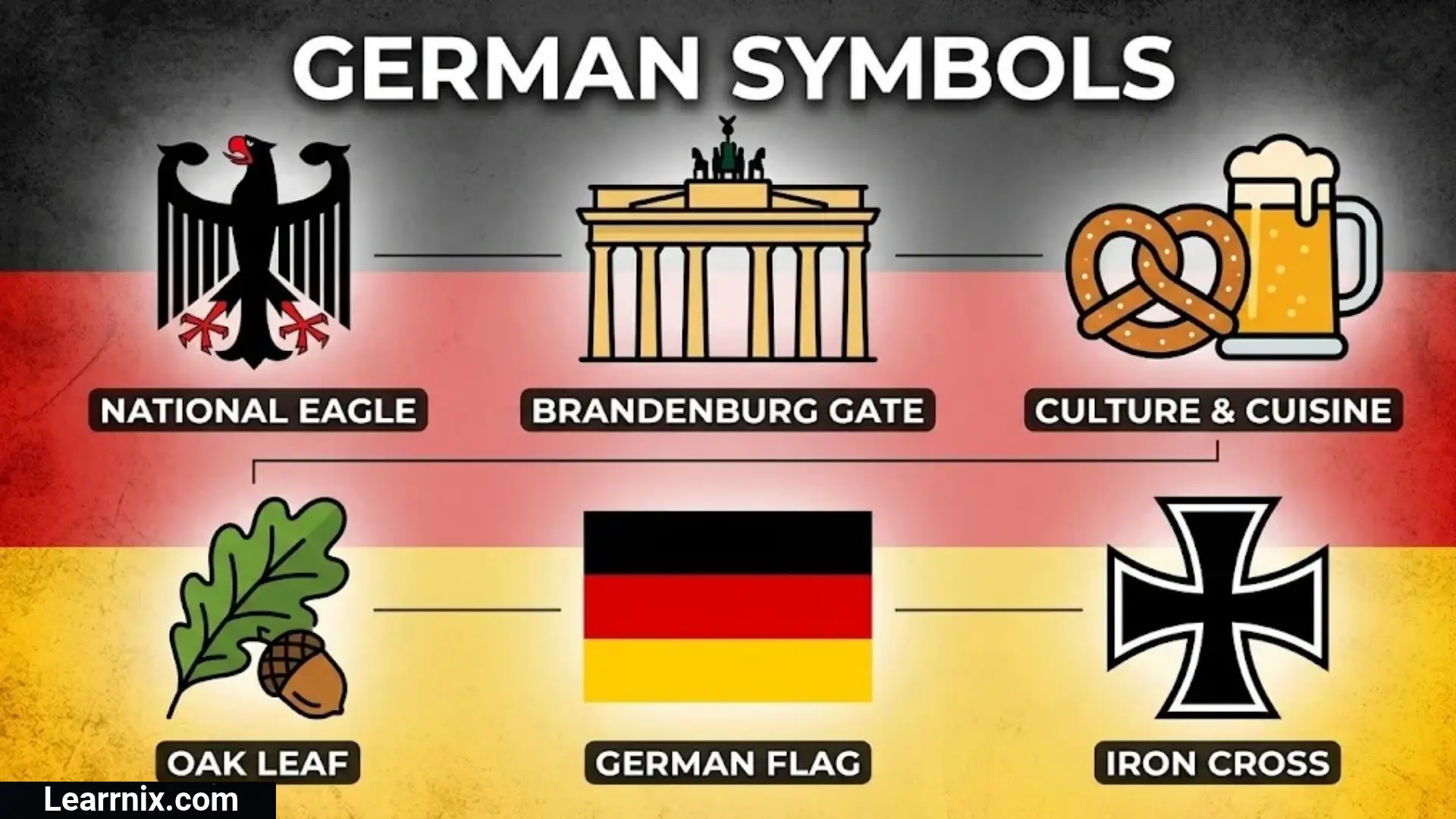
German symbols have a fascinating history that stretches from ancient Germanic cultures to medieval kingdoms, modern national identity, and important events of the 20th century. They include national emblems, traditional signs, historical runes, military decorations, and meaningful designs used in German art and culture.
Many people search for German symbols to understand their meanings, find traditional designs, create tattoos, explore family heritage, or copy special German characters into messages and social media posts. Each symbol has its own background, and some have changed meaning over time.
In this guide, you will discover German symbols and meanings, traditional and ancient signs, German letters, historical symbols from World War I and World War II, and East German emblems. You will also find copy-and-paste characters and useful information to help you understand the difference between cultural, national, and historical symbols.
German Symbols and Meanings
German symbols represent the country’s history, culture, national identity, traditions, and historical experiences. Some are connected with freedom and unity, while others represent strength, craftsmanship, religion, or particular historical periods.
Here are some important German symbols and their common meanings.
| Symbol | Name | Meaning |
| 🇩🇪 | German Flag | National identity and unity |
| 🦅 | Eagle | Power, authority, and sovereignty |
| ⚔ | Crossed Swords | Military history and conflict |
| ✠ | Cross | Christian heritage and faith |
| 🌳 | Oak Tree | Strength, endurance, and heritage |
| ✿ | Floral Motifs | Nature and traditional decoration |
| ᚠ | Fehu Rune | Wealth and cattle in historical runic traditions |
| ᛏ | Tiwaz Rune | Associated with the god Týr and justice |
| ⚒ | Hammer and Tools | Craftsmanship and labor |
| 🛡 | Shield | Protection and heraldic identity |
The black, red, and gold colors of the German flag are particularly important. They are associated with the historical movements for German unity, freedom, and democratic government.
The eagle is another recognizable national emblem. It has a long history in German imperial and state heraldry and remains part of the modern federal coat of arms.
Remember that not every historical symbol represents all German people. Some belong to particular kingdoms, political movements, religious traditions, or periods.
German Symbols Text
German symbols text includes special characters, decorative signs, letters, and Unicode symbols that can be used in digital communication.
Some characters are connected with the German language, while others represent German culture or historical designs.
Here are useful German-related text characters:
| Symbol | Name or Use |
| ä | Lowercase A with Umlaut |
| ö | Lowercase O with Umlaut |
| ü | Lowercase U with Umlaut |
| Ä | Uppercase A with Umlaut |
| Ö | Uppercase O with Umlaut |
| Ü | Uppercase U with Umlaut |
| ß | German Eszett |
| 🇩🇪 | German Flag Emoji |
| 🖤 | Black Heart |
| ❤️ | Red Heart |
| 💛 | Yellow Heart |
| 🦅 | Eagle Emoji |
| ⚔ | Crossed Swords |
| 🛡 | Shield |
These characters can help make usernames, captions, messages, and decorative text more interesting.
For example:
- Deutschland 🇩🇪
- Deutsche Kultur 🖤❤️💛
- German Heritage 🦅
- Familie und Tradition ♡
Keep in mind that decorative Unicode symbols are not necessarily official German cultural emblems. Their meanings depend on how they are used.
German Symbols Letters
German letters are an important part of the country’s written language. German uses the standard 26-letter Latin alphabet, along with three additional umlaut letters and one special character called Eszett.
The four additional characters are:
| Letter | Name | Example |
| ä | A Umlaut | Mädchen |
| ö | O Umlaut | schön |
| ü | U Umlaut | über |
| ß | Eszett or Sharp S | Straße |
The umlaut changes the pronunciation of a vowel. For example, the letter ä has a different sound from a, while ö and ü also have their own distinct pronunciations.
The ß character represents a particular type of s sound. It is used in words such as Straße (street) and groß (large).
German Letters to Copy
You can copy these uppercase and lowercase characters directly:
Uppercase German Letters:
Ä Ö Ü
Lowercase German Letters:
ä ö ü ß
These characters are useful when writing German names, translating words, creating usernames, or adding accurate German text to social media posts.
German Symbols Tattoos
German symbols tattoos are popular among people interested in German heritage, family history, traditional artwork, and historical designs.
A tattoo can represent personal values, cultural connections, or an important part of someone’s background. However, it is essential to understand the original meaning of a design before permanently using it.
Here are some ideas associated with German cultural and historical imagery.
| Symbol or Design | Common Association |
| German Eagle | Strength and national heritage |
| Oak Leaves | Endurance and courage |
| German Flag | National identity |
| Medieval Shield | Family heritage and protection |
| Iron Cross | Military history |
| Traditional German Lettering | Cultural and personal identity |
| Celtic Knotwork | Interconnectedness and continuity |
Popular German Tattoo Ideas
German Eagle Tattoo: The eagle is a long-standing emblem of German statehood and can represent authority, strength, and independence.
Oak Leaf Tattoo: Oak leaves have historical associations with endurance, honor, and strength.
German Flag Tattoo: The black, red, and gold flag can express national pride and connection to Germany.
Family Crest Tattoo: A historical family coat of arms can represent ancestry, family history, and heritage. It should be researched carefully because similar designs may belong to different families.
German Lettering Tattoo: German words such as Stärke (strength), Freiheit (freedom), and Familie (family) can be meaningful choices.
One important consideration is that some symbols associated with German history were later appropriated by Nazi organizations. Research their historical context before choosing a tattoo. Nazi insignia should not be confused with ordinary German cultural heritage.
German Symbols WW2
German symbols from World War II require special historical context because Nazi Germany used flags, insignia, military badges, and propaganda designs to promote its dictatorship and racist ideology.
The Nazi regime ruled Germany from 1933 until 1945. Its symbols became closely associated with persecution, aggressive war, the Holocaust, and other atrocities.
Some important historical examples include:
Nazi Swastika: The Nazi Party adopted a modified swastika as its central emblem. It appeared on flags, uniforms, propaganda posters, and official insignia. Although the swastika existed in many cultures thousands of years before Nazism, its use by the Nazi regime gave this particular design a lasting association with hatred and genocide.
Nazi Eagle: The regime used a specially designed eagle emblem, often shown holding a wreath containing a swastika. It represented the authority of the Nazi state.
Iron Cross: This older German military decoration existed before the Nazi period. It was also used during World War II, sometimes alongside Nazi insignia.
Nazi Party Badge: The party used a distinctive emblem combining its swastika design with a circular arrangement and other identifying details.
Military Insignia: German military organizations used different shoulder patches, rank marks, badges, and unit identifiers.
These symbols should be understood as historical evidence of a dictatorship rather than ordinary expressions of German culture. The United States Holocaust Memorial Museum documents their use in Nazi propaganda and explains how the swastika was appropriated by the regime.
Germany also restricts the public use of many Nazi symbols and propaganda materials, subject to legal exceptions such as historical, educational, artistic, and research contexts.
German Symbols to Copy
If you are looking for German-related symbols that you can copy and paste, the following collection provides useful characters for digital communication.
German Flag and Cultural Symbols
| Symbol | Name |
| 🇩🇪 | Germany Flag |
| 🦅 | Eagle |
| 🌳 | Tree |
| 🍂 | Fallen Leaves |
| 🛡 | Shield |
| ⚔ | Crossed Swords |
| ⚒ | Hammer and Pick |
| ✠ | Maltese Cross |
| ✚ | Cross |
| ♛ | Crown |
German Decorative Symbols
| Symbol | Name |
| ★ | Star |
| ☆ | Outline Star |
| ✦ | Four-Pointed Star |
| ✧ | Sparkle |
| ❖ | Decorative Diamond |
| ❀ | Flower |
| ❁ | Floral Symbol |
| ♡ | Outline Heart |
| ♥ | Heart |
| ✿ | Flower |
German Letters and Runes
| Character | Name |
| Ä | Capital A Umlaut |
| Ö | Capital O Umlaut |
| Ü | Capital U Umlaut |
| ä | Small A Umlaut |
| ö | Small O Umlaut |
| ü | Small U Umlaut |
| ß | Eszett |
| ᚠ | Fehu Rune |
| ᚢ | Uruz Rune |
| ᚦ | Thurisaz Rune |
| ᚨ | Ansuz Rune |
| ᚱ | Raidho Rune |
| ᛏ | Tiwaz Rune |
How to use these symbols: Select the character you need, copy it, and paste it into your preferred application. You can use suitable characters in captions, messages, usernames, profiles, and decorative designs.
Some older runic characters may display differently depending on the font and device being used.
Ancient German Symbols
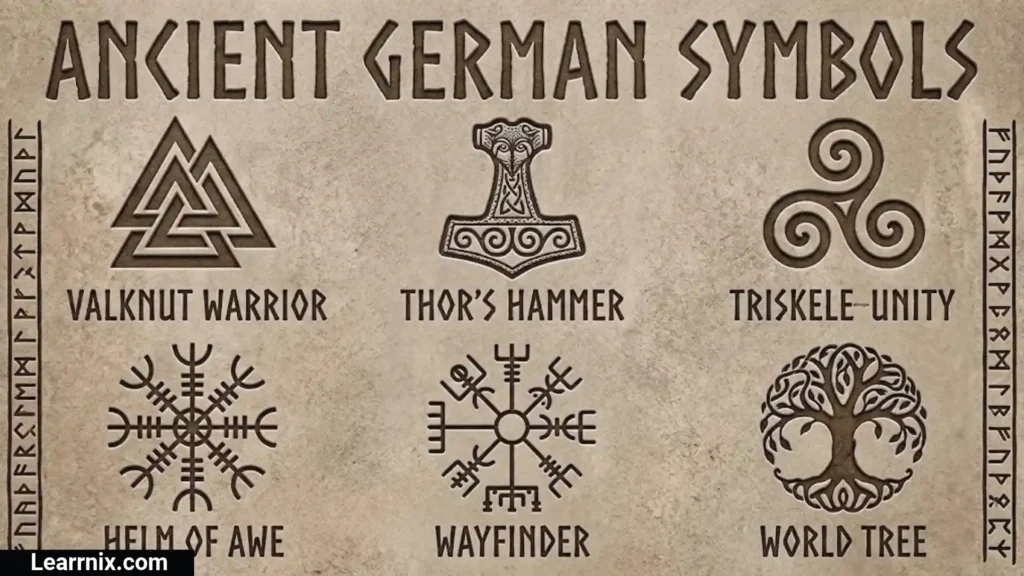
Ancient German symbols are closely connected with the early Germanic peoples who lived across parts of northern and central Europe.
These communities used different signs, ornaments, inscriptions, and runic writing systems. Their symbols appeared on stones, weapons, jewelry, tools, and other objects.
One important distinction is that ancient Germanic culture was not the same as the modern German nation. These historical communities existed long before Germany became a unified country.
Important Ancient Germanic Symbols
Runes: Runes were characters used in early Germanic writing systems. The Elder Futhark originally contained 24 characters.
Sun Wheel: Circular designs and rotating wheel motifs appeared in different ancient European cultures. Their meanings varied according to the object and community.
Oak Tree: The oak was an important tree in several ancient European traditions and became associated with strength and endurance.
Animal Motifs: Wolves, ravens, horses, and other animals appeared in Germanic stories, artwork, and decorative objects.
Serpent Designs: Snake-like patterns appeared in different European artistic traditions and could represent different ideas depending on their context.
Runes were primarily a writing system, not a universal collection of magical symbols. Their historical meanings must be considered carefully rather than relying entirely on modern interpretations.
Iconic German Symbols
Some German symbols are recognized internationally because of their connection with the country’s government, history, architecture, and cultural identity.
Here are several iconic examples.
- German Federal Eagle: The black eagle is a major national emblem representing the German state.
- Black, Red, and Gold Flag: The three horizontal colors represent Germany’s national identity and democratic traditions.
- Brandenburg Gate: This famous Berlin landmark is widely associated with German unity and the country’s history.
- Iron Cross: A historic military decoration with origins before the First World War.
- German Oak: An important cultural and historical motif associated with strength and endurance.
- German National Anthem: The third stanza of Deutschlandlied is the official national anthem.
- Reichstag Building: A significant political and historical landmark in Berlin.
The eagle and national flag are official state symbols, while buildings and cultural motifs represent broader historical and national associations.
Traditional German Symbols
Traditional German symbols come from regional customs, religious traditions, folklore, architecture, craftsmanship, and celebrations.
Many of these designs are still visible in German festivals, traditional clothing, decorative artwork, and regional products.
| Symbol | Traditional Association |
| Edelweiss | Alpine culture and mountain traditions |
| Oak Leaves | Strength and endurance |
| Pretzel | Traditional German baking |
| Beer Stein | Traditional brewing and beer culture |
| Christmas Tree | German Christmas traditions |
| Maypole | Seasonal celebrations |
| Black Forest Cuckoo Clock | Regional craftsmanship |
| German Eagle | Historical state identity |
The Edelweiss flower is strongly associated with Alpine regions. Traditional Bavarian clothing, such as Lederhosen and Dirndl, is another recognizable part of regional German culture.
The pretzel and Christmas tree are also familiar cultural references, although their history and use extend beyond Germany.
Old German Symbols
Old German symbols refer to signs and emblems used throughout different periods of German history.
Their meanings changed as kingdoms, empires, religious institutions, and political systems developed.
Some important historical examples include:
- Imperial Eagle: An emblem associated with the Holy Roman Empire and later German political traditions.
- Black, White, and Red: The colors of the German Empire from 1871 to 1918.
- Black, Red, and Gold: Colors associated with German unity and democratic movements.
- Iron Cross: A military decoration established in 1813.
- Oak Wreath: A traditional motif associated with honor, endurance, and achievement.
- Medieval Heraldic Shields: Designs used to identify families, noble houses, and territories.
Not all old German symbols were used by the same people or during the same historical period. Their original context matters when identifying them.
WW2 German Symbols
This section focuses more specifically on the insignia and visual identification systems used by German organizations during the Second World War.
Nazi Germany used standardized visual designs to identify political organizations, military units, ranks, and government institutions.
Common WWII Insignia
Military Eagle: Different versions of the eagle emblem appeared on military uniforms and official equipment.
Iron Cross: The decoration was used in several grades to recognize military service and actions.
SS Runes: The SS used a distinctive double-rune insignia. It became one of the most recognizable symbols of the Nazi organization responsible for extensive persecution and mass murder.
SA Insignia: The Sturmabteilung used specific uniforms and identifying marks during the Nazi movement’s rise and rule.
Military Rank Badges: German armed forces used shoulder boards, collar patches, and sleeve markings to indicate rank and position.
Nazi Party Emblems: Political insignia appeared on flags, membership badges, uniforms, and propaganda materials.
Why WWII Symbols Need Historical Context
Some designs originated before the Nazi period, while others were specifically created for Nazi organizations. Their historical origins should not be confused.
For example, the Iron Cross existed in German military history before Hitler came to power. However, the Nazi regime incorporated it into its own military visual system.
Understanding these differences helps researchers, students, collectors, and history enthusiasts identify historical objects without treating Nazi ideology as ordinary German heritage.
German Symbols for Family
German family symbols are often connected with ancestry, surnames, family traditions, and historical coats of arms.
One of the most interesting areas is German heraldry, which developed over centuries and used distinctive designs to identify families, noble houses, and communities.
Popular Family-Related Designs
| Symbol | Possible Meaning |
| Family Coat of Arms | Family identity and ancestry |
| Shield | Protection and heritage |
| Oak Tree | Strength and endurance |
| Lion | Courage and authority |
| Eagle | Power and historical identity |
| Crown | Nobility and status |
| Cross | Christian faith and tradition |
| Family Tree | Generations and relationships |
A German family crest may contain animals, colors, geometric shapes, crowns, or other decorative elements.
However, there is no single official German symbol for family. Different families have different heraldic histories.
If you want a family tattoo or personalized design, research your actual surname and ancestry instead of assuming that a random German-looking shield belongs to your family.
Famous German Symbols
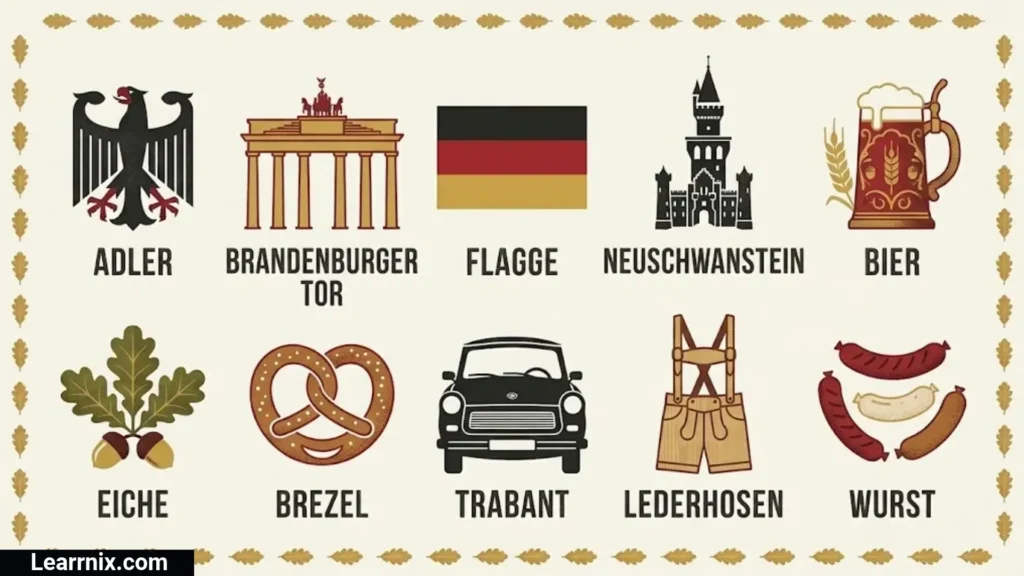
Germany has several famous symbols that represent its political history, national identity, culture, and architectural heritage.
Some are official national emblems, while others are recognized cultural landmarks.
1. German Federal Eagle
The eagle is one of Germany’s oldest and most recognizable state symbols. It appears on the federal coat of arms and many official government documents.
2. Brandenburg Gate
Located in Berlin, the Brandenburg Gate is an internationally recognized landmark associated with German history and reunification.
3. German National Flag
The black, red, and gold flag represents modern Germany and its democratic identity.
4. Iron Cross
This historic military decoration has been part of German military history since the early 19th century.
5. Berlin Wall
The Berlin Wall became a powerful symbol of division during the Cold War. Its fall in 1989 became an important moment in the movement toward German reunification.
6. German Oak
Oak imagery has a long association with German cultural and national traditions.
Together, these symbols help explain Germany’s changing identity across different historical periods.
Medieval German Symbols
Medieval German symbols developed during the Middle Ages, when heraldry, religious art, royal authority, and regional identities became increasingly important.
The Holy Roman Empire included many territories, cities, noble families, and religious institutions. Each could have its own distinctive emblems.
Important Medieval Symbols
Double-Headed Eagle: The double-headed eagle became strongly associated with the imperial authority of the Holy Roman Empire, particularly in its later history.
Single-Headed Eagle: The eagle was another important emblem of imperial power and sovereignty.
Heraldic Lion: Lions appeared on numerous coats of arms and represented courage, authority, and noble identity.
Cross: Christian crosses appeared on churches, religious objects, banners, and medieval artwork.
Shield Designs: Heraldic shields displayed distinctive colors, animals, and patterns to identify families and territories.
Castle Emblems: Castles represented fortified settlements, noble residences, and regional authority.
Medieval German Heraldry
Heraldic designs followed recognizable visual conventions. Colors, animals, shapes, and arrangements helped distinguish one coat of arms from another.
Common heraldic colors included:
- Gold: Traditionally called or.
- Silver: Traditionally called argent.
- Red: Traditionally called gules.
- Blue: Traditionally called azure.
- Black: Traditionally called sable.
- Green: Traditionally called vert.
These terms are still used when describing historical European coats of arms.
German Symbols WW1
German symbols from World War I reflect the country’s imperial government, military traditions, and political identity between 1914 and 1918.
At that time, Germany was an empire ruled by Kaiser Wilhelm II. Its national symbols were different from those used by modern Germany.
Important WWI German Symbols
Imperial German Flag: The black, white, and red horizontal stripes were the national colors of the German Empire.
Imperial Eagle: The eagle appeared on government buildings, official documents, military equipment, and imperial insignia.
Iron Cross: This military decoration was widely associated with German soldiers and military service during the First World War.
Pickelhaube: The distinctive spiked helmet became a recognizable feature of the Prussian and German military uniform.
Military Cockades: Circular colored insignia were used on military headgear to identify German states and military affiliations.
Prussian Symbols: The black-and-white colors and Prussian eagle were important in the military and political traditions of the empire.
After Germany’s defeat in 1918, the monarchy ended and the Weimar Republic adopted black, red, and gold as its national colors.
This change marked an important transition from imperial rule to a republican government.
East German Symbols
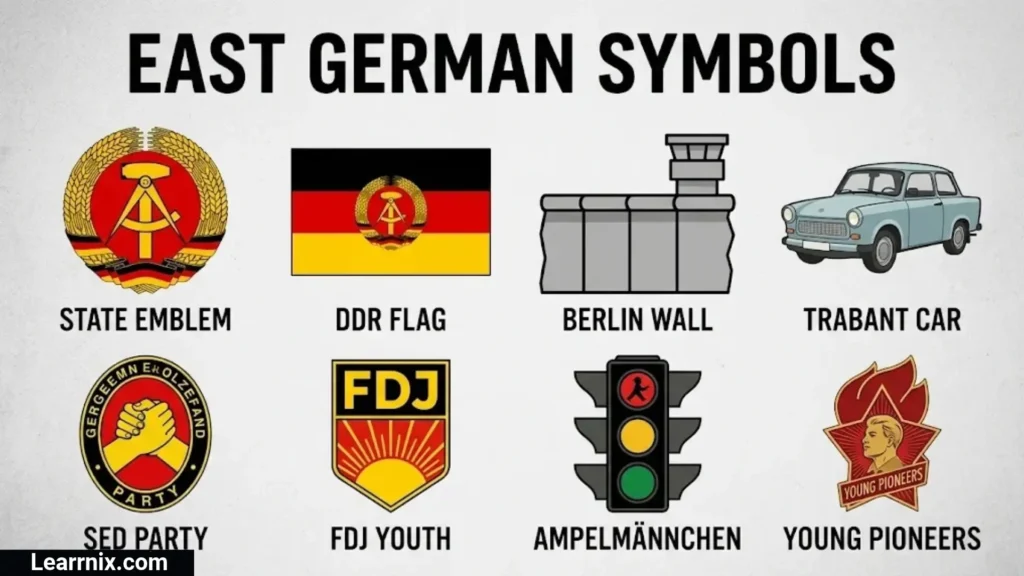
East German symbols belonged to the German Democratic Republic (GDR), which existed from 1949 until German reunification in 1990.
Although East Germany initially used the same black, red, and gold flag as West Germany, it introduced a distinctive national emblem in 1959.
East German Flag
The East German flag contained three horizontal stripes:
- Black at the top.
- Red in the middle.
- Gold at the bottom.
At the center was the state emblem, which made it different from the flag used by West Germany.
East German National Emblem
The GDR emblem contained three main elements:
| Symbol | Meaning |
| Hammer | Industrial workers |
| Compass | Intellectuals and technical professions |
| Wreath of Grain | Farmers and agricultural workers |
Together, these elements represented the socialist worker-and-peasant identity promoted by the East German government.
The emblem was introduced on the national flag in 1959 and remained until the GDR ceased to exist in 1990.
The East German emblem is an important historical symbol of the Cold War and should not be confused with the current German federal coat of arms.
Popular German Symbols
Popular German symbols include national emblems, traditional cultural designs, historical objects, and characters associated with the German language.
Here are some widely recognized examples:
| Symbol | Name | Association |
| 🇩🇪 | German Flag | National identity |
| 🦅 | Eagle | State authority |
| 🌳 | Oak Tree | Strength |
| ✠ | Cross | Christian heritage |
| ⚔ | Crossed Swords | Military history |
| 🛡 | Shield | Protection |
| Ä | A Umlaut | German language |
| Ö | O Umlaut | German language |
| Ü | U Umlaut | German language |
| ß | Eszett | German language |
| ᚠ | Fehu | Historical rune |
| ᛏ | Tiwaz | Historical rune |
| 🍺 | Beer Mug | Beer culture |
| 🥨 | Pretzel | German food traditions |
Some of these are official or historical emblems, while others are modern emoji and decorative characters.
You can use them in educational content, digital designs, social media captions, and personal projects. Just remember that a popular German-related character is not automatically an official national symbol.
Frequently Asked Questions About German Symbols
What is the most famous German symbol?
The German federal eagle and the black, red, and gold national flag are among the country’s most recognizable symbols. Both have important connections with German national identity and history.
What do the three colors of the German flag mean?
Black, red, and gold are historically associated with German unity, freedom, and democratic movements. They became the official colors of modern Germany in 1949 and remained after reunification in 1990.
What are the ancient Germanic symbols?
Ancient Germanic symbols include runic characters, animal motifs, circular designs, and traditional decorative patterns. The Elder Futhark is one of the best-known early Germanic writing systems.
What symbol represents German family heritage?
A family coat of arms is one of the most recognizable representations of historical family heritage. Its design may include shields, animals, colors, and other elements connected with a particular family.
Are German runes and Nazi symbols the same?
No. Germanic runes are historical writing characters that existed long before the Nazi regime. However, Nazi organizations appropriated certain runic designs for their insignia. Their original history and later political use must be distinguished.
Conclusion
German symbols tell an interesting story about the country’s identity, traditions, and historical changes. From the black, red, and gold national flag to the federal eagle, medieval shields, ancient runes, and traditional cultural designs, each symbol offers a different perspective on German history.
Historical symbols from World War I, World War II, and East Germany also help explain how political systems and national identities changed over time. Understanding their origins is essential, especially when dealing with symbols associated with Nazi Germany and other controversial periods.
If you want German symbols for copying, tattoos, family heritage, educational projects, or decorative text, always check their meanings and historical backgrounds first. Choosing the right symbol makes your design more meaningful and helps preserve its cultural significance.

I am Charlotte Anderson, an education writer who is passionate about creating meaningful learning resources for students and lifelong learners.
I enjoy researching new educational approaches and sharing ideas that make studying easier and more effective.
Through my work, I aim to inspire curiosity, confidence, and a love for learning.
Books:
- The Complete Guide to Better Learning
- Building Skills for Academic Success
 Daniel Harper
 Michael Carter