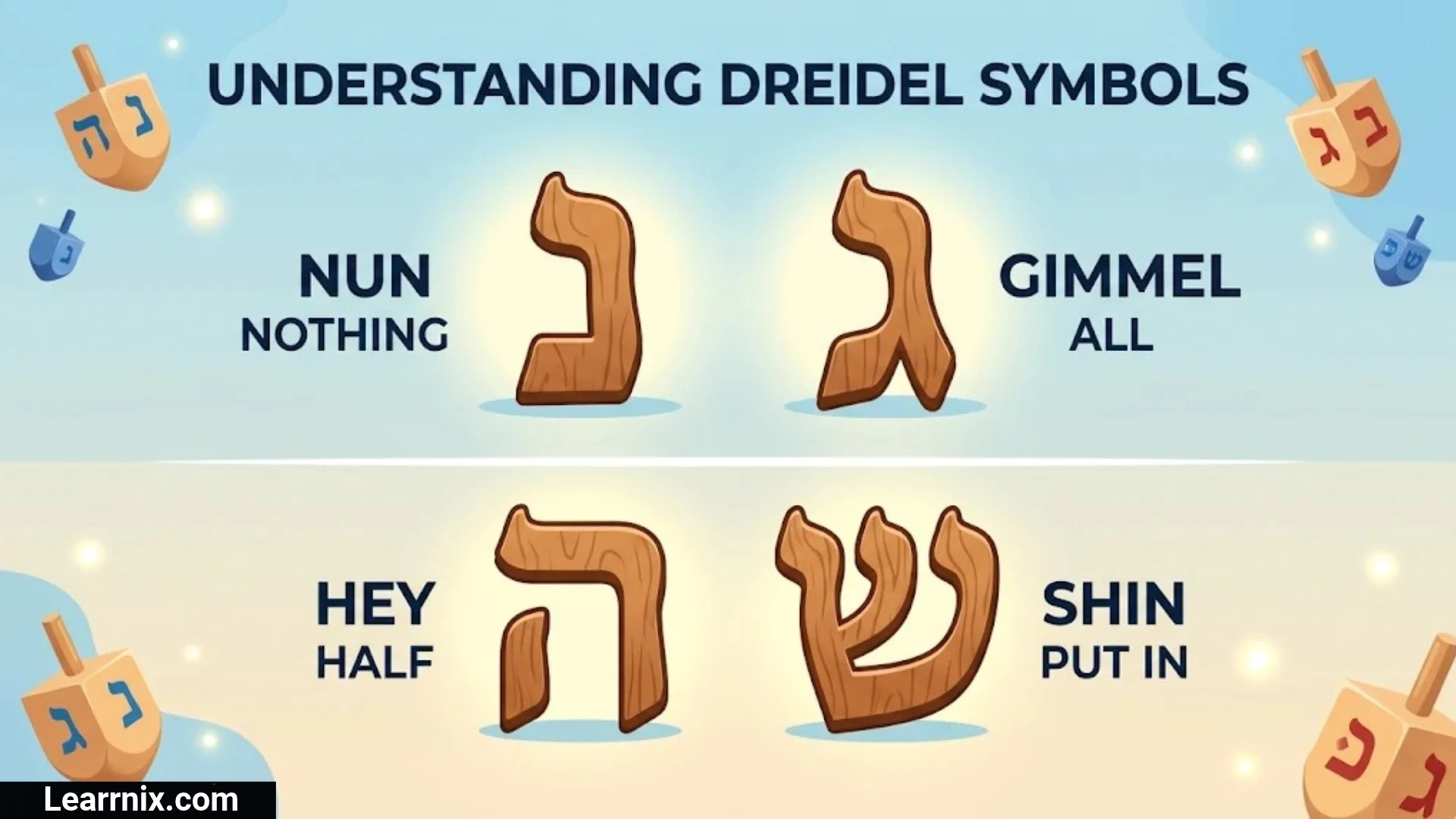
Dreidel symbols are an important part of Hanukkah celebrations and a traditional Jewish spinning-top game enjoyed by children and adults. Each dreidel has four Hebrew letters: נ (Nun), ג (Gimel), ה (Hei), and ש (Shin), or פ (Pei) on dreidels used in Israel. These letters represent a traditional phrase connected to the Hanukkah story.
Understanding dreidel symbols makes the game more interesting because every letter tells players what to do during a turn. Some letters mean taking nothing, while others allow players to collect part or all of the game pieces in the pot. The letters also carry cultural and historical significance beyond the game itself.
In this guide, you will discover dreidel symbols and their meanings, their correct order, the difference between Gimel and Shin, and their connection to Jewish traditions. You will also learn how to play the dreidel game, explore the popular dreidel song, and find simple explanations that children can easily understand.
Dreidel Symbols and Meanings
A traditional dreidel has four sides, and each side displays a different Hebrew letter. These letters are נ (Nun), ג (Gimel), ה (Hei), and ש (Shin). Together, they represent the Hebrew phrase Nes Gadol Haya Sham, meaning “A great miracle happened there.”
The phrase refers to the miracle of Hanukkah, which celebrates the Jewish victory over the Seleucid Greek forces and the rededication of the Second Temple in Jerusalem.
Here is a simple breakdown of the four main dreidel symbols:
| Symbol | Hebrew Name | Meaning in the Game |
| נ | Nun | Nothing |
| ג | Gimel | Everything |
| ה | Hei | Half |
| ש | Shin | Put one in |
Each letter has two important roles. First, it helps tell the story associated with Hanukkah. Second, it determines what a player must do when the dreidel stops spinning.
The game meanings are traditionally connected with Yiddish words:
- Nun (נ): Nisht, meaning nothing.
- Gimel (ג): Gantz, meaning everything.
- Hei (ה): Halb, meaning half.
- Shin (ש): Shtel, meaning put in.
These letters make the dreidel more than an ordinary spinning toy. They connect a fun family activity with Jewish language, history, and Hanukkah traditions.
What Do the Dreidel Symbols Mean
The four dreidel symbols have different meanings depending on whether you are looking at their religious significance or their role in the game.
In the traditional interpretation, the letters form the initials of a Hebrew sentence about a great miracle. During the game, however, each letter tells the player whether to take something from the central pot, leave it alone, or add another piece.
Here is what each symbol means in more detail.
Nun (נ) – Nothing
Nun is the first symbol players commonly learn. When the dreidel lands with Nun facing upward, the player does not take anything from the pot and does not need to add anything.
It represents the Yiddish word Nisht, meaning nothing. The player simply passes the turn to the next person.
Gimel (ג) – Everything
Gimel is usually the most exciting result in the game. When this letter appears, the player takes everything currently inside the central pot.
Its game meaning comes from the Yiddish word Gantz, which means everything or the whole amount.
Hei (ה) – Half
Hei means that the player receives half of the pieces in the pot. The Yiddish word Halb means half.
For example, if there are eight chocolate coins in the pot, the player takes four. If there is an odd number, players commonly round up or follow the house rules agreed upon before playing.
Shin (ש) – Put One In
Shin tells the player to add one playing piece to the central pot. This symbol is associated with the Yiddish phrase Shtel Arein, meaning put in.
It is different from the other letters because it requires the player to contribute something instead of collecting a reward.
Dreidel Jewish
The dreidel is a traditional Jewish spinning top closely associated with Hanukkah, also known as the Festival of Lights. Jewish families around the world play this game during the holiday as part of their celebrations.
The word dreidel comes from Yiddish and refers to a spinning top. In Hebrew, the toy is called sevivon (סביבון), a word associated with turning or spinning.
The four Hebrew letters on the traditional dreidel are connected to the Hanukkah story. They remind players of the miracle associated with the rededication of the Second Temple in Jerusalem.
Why Is the Dreidel Important in Jewish Culture?
The dreidel is important because it combines education, entertainment, and cultural tradition. Children learn Hebrew letters while playing, and adults can use the game to explain the history and meaning of Hanukkah.
A popular traditional story says that Jewish children secretly studied religious teachings during a period when such study was restricted. If authorities approached, they would hide their books and bring out spinning tops.
This story is widely repeated during Hanukkah, although historians do not consider it a firmly established explanation for the game’s origin.
Dreidel as a Hanukkah Tradition
Families often play dreidel after lighting the Hanukkah candles or during holiday gatherings. Chocolate coins, known as Hanukkah gelt, are popular playing pieces.
The game is also used in schools, community celebrations, and children’s activities to introduce Jewish traditions in an enjoyable way.
Hanukkah Dreidel Symbols
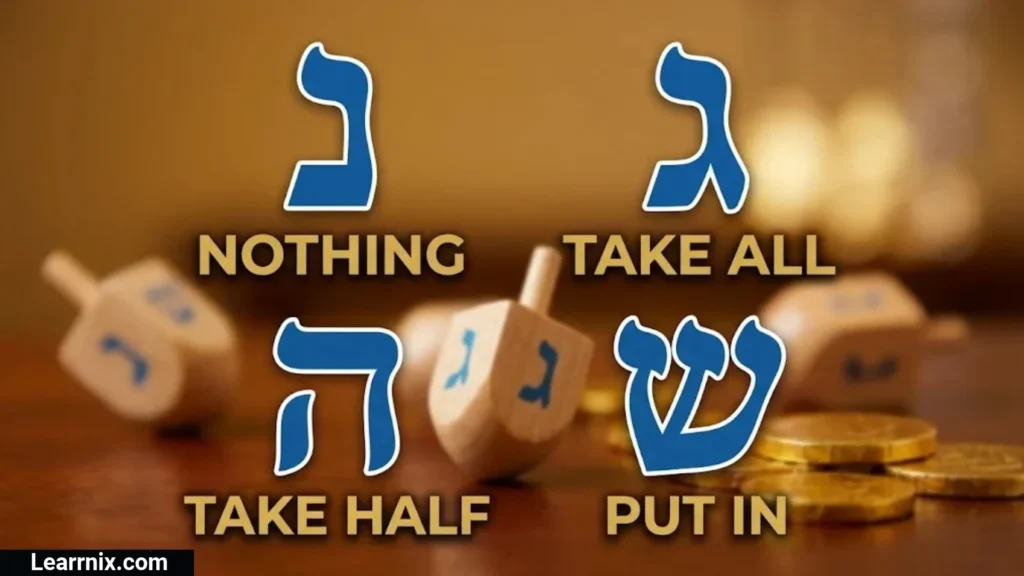
Hanukkah dreidel symbols represent the miracle remembered during the eight-day Jewish festival. The four Hebrew letters are traditionally associated with the phrase:
נֵס גָּדוֹל הָיָה שָׁם
Nes Gadol Haya Sham
A great miracle happened there.
The word Nes means miracle, Gadol means great, Haya means happened or was, and Sham means there.
Each word begins with one of the letters displayed on a traditional dreidel.
| Hebrew Letter | Word | English Meaning |
| נ | Nes | Miracle |
| ג | Gadol | Great |
| ה | Haya | Happened |
| ש | Sham | There |
The phrase points to the land of Israel, where the events remembered during Hanukkah took place.
The Israeli Dreidel Version
Dreidels made in Israel commonly use פ (Pei) instead of ש (Shin). This changes the final word of the phrase from Sham (there) to Po (here).
The Israeli phrase is:
נֵס גָּדוֹל הָיָה פֹּה
Nes Gadol Haya Po
It means “A great miracle happened here.”
This small difference gives the Israeli dreidel a special connection to the place where the Hanukkah story occurred.
Dreidel Symbols Order
The four traditional dreidel letters are Nun, Gimel, Hei, and Shin. They are not random decorations. Their order follows the Hebrew phrase Nes Gadol Haya Sham.
Here is the traditional sequence in an easy-to-read format:
Traditional Dreidel Symbols
נ
Nun
Nothing
ג
Gimel
Everything
ה
Hei
Half
ש
Shin
Put one in
Reading order of the four letters in the traditional Hebrew phrase.
The Israeli version follows the same order, except the final letter is Pei:
נ – ג – ה – פ
One detail worth remembering is that Hebrew is written from right to left. Therefore, the order of the letters in a Hebrew phrase should not be confused with the way English letters are arranged.
Also, a dreidel is a three-dimensional object. Its four letters are printed on four separate sides, so the exact position of a letter can look different depending on how the top is held or viewed.
Gimel Dreidel
Gimel (ג) is one of the four most recognizable dreidel symbols. It represents the word Gadol in the Hanukkah phrase and Gantz in the traditional game instructions.
In the game, Gimel means that the player takes the entire central pot. This makes it one of the best symbols to land on because the player collects all available playing pieces.
What Does Gimel Represent?
Gimel represents the idea of greatness in the phrase Nes Gadol Haya Sham. The word Gadol translates to great, describing the miracle associated with Hanukkah.
Its game meaning is different. The Yiddish word Gantz means everything, explaining why a player who spins Gimel collects the entire pot.
When Gimel Appears During the Game
Imagine that four players have placed chocolate coins into the center. The pot now contains twelve coins.
If your dreidel lands on Gimel, you collect all twelve coins. The other players do not receive anything from that particular pot.
Afterward, players usually place new pieces into the pot before the next round continues.
Copyable Gimel Symbol: ג
Shin Dreidel
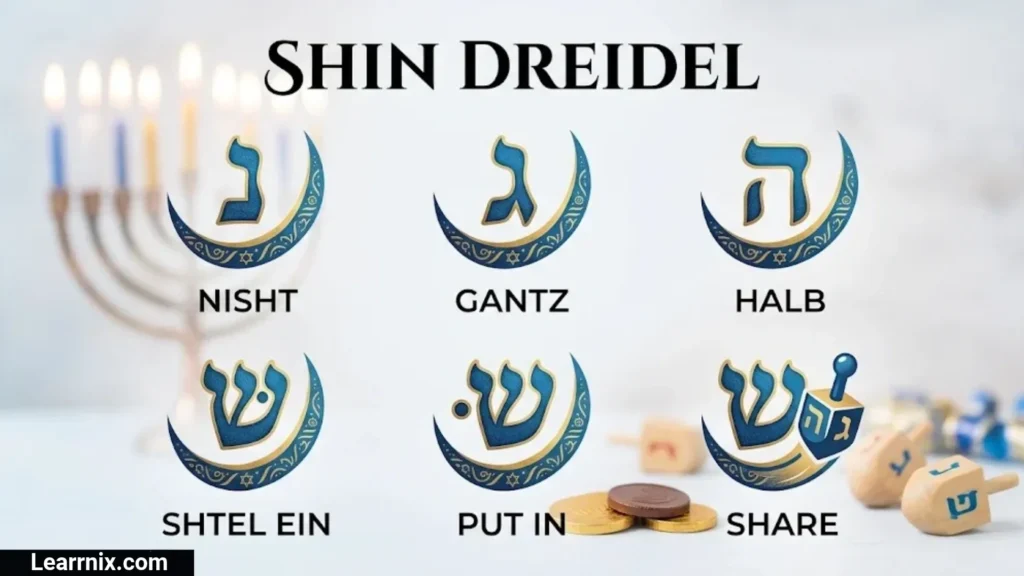
Shin (ש) is another important Hebrew letter found on traditional dreidels outside Israel. It represents the word Sham, meaning there, in the Hanukkah phrase.
In the game, Shin means that the player must put one playing piece into the central pot.
This makes Shin different from Gimel and Hei because it requires the player to contribute rather than collect coins.
Shin in the Hanukkah Phrase
The letter Shin completes the phrase Nes Gadol Haya Sham, meaning “A great miracle happened there.”
It connects the dreidel to the historical and religious events associated with Hanukkah.
Shin in the Dreidel Game
When a player spins Shin, they add one coin, button, candy, or another agreed playing piece to the pot.
For example, if the pot contains six chocolate coins and the player spins Shin, they add another coin. The pot then contains seven coins.
Copyable Shin Symbol: ש
Shin and Pei: What Is the Difference?
Shin and Pei are sometimes confused because both can appear as the final letter on a Hanukkah dreidel.
| Letter | Name | Hebrew Word | Meaning |
| ש | Shin | Sham | There |
| פ | Pei | Po | Here |
Traditional dreidels generally use Shin, while Israeli dreidels commonly use Pei. Both versions are associated with the same Hanukkah miracle.
How to Play Dreidel
Playing dreidel is simple once you understand what each Hebrew letter means. The game can be played by two or more people, making it suitable for families, friends, and children during Hanukkah.
You do not need expensive equipment. A dreidel and a collection of small playing pieces are enough to get started.
What You Need to Play
Before beginning, collect these basic items:
- One four-sided dreidel.
- Two or more players.
- Small coins, buttons, nuts, candies, or chocolate gelt.
- A small space in the middle for the shared pot.
Each player should receive an equal number of playing pieces. Ten to fifteen pieces per person is a common starting amount, although you can choose a different number.
Step-by-Step Playing Instructions
- Choose the players: Sit together around a table or another flat playing surface.
- Distribute the pieces: Give each player an equal number of coins or other playing items.
- Create the pot: Every player puts one piece into the center.
- Choose the first player: Decide who spins first using an agreed method.
- Spin the dreidel: Hold the top by its handle and give it a quick spin.
- Check the letter: Once it stops, look at the Hebrew letter facing upward.
- Follow the instruction: Take nothing, collect everything, take half, or add one piece depending on the result.
- Continue playing: Move to the next player and repeat the process.
What Each Spin Requires
| Dreidel Letter | Player’s Action |
| נ Nun | Do nothing |
| ג Gimel | Take the entire pot |
| ה Hei | Take half the pot |
| ש Shin | Add one piece |
If the pot is empty, players commonly agree that everyone must contribute another piece before continuing.
How Does the Game End?
There are different ways to finish a dreidel game. One common method is to continue until one player has collected all the playing pieces.
You can also set a time limit and declare the player with the most pieces the winner.
The most important thing is to agree on the rules before starting, especially when playing with young children.
Dreidel Game
The dreidel game is a traditional Hanukkah activity that combines luck, simple rules, and friendly competition. It is especially popular among children because the spinning top makes every turn unpredictable.
The game uses a shared collection of playing pieces called the pot. Players take turns spinning the dreidel, and the letter facing upward determines what happens next.
Understanding the Game Pot
The pot is the collection of coins or other items placed in the middle of the playing area.
Players contribute to it at the beginning of the game. Depending on the letter they spin, they can collect some or all of its contents or add more pieces.
Popular items used as playing pieces include:
- Chocolate coins or Hanukkah gelt.
- Small candies.
- Pennies or other coins.
- Buttons.
- Nuts and raisins.
- Small plastic tokens.
Using chocolate coins is particularly popular because they make the game feel festive and give children a fun reward.
Tips for a Fair Dreidel Game
A few simple rules can make the game easier and more enjoyable:
- Give every player the same number of starting pieces.
- Make sure everyone understands the four letters.
- Use a flat surface so the dreidel can spin properly.
- Decide how to divide an odd number of pieces.
- Agree on what happens when the pot becomes empty.
- Use candies or buttons instead of money when playing with children.
Remember that dreidel is primarily a traditional holiday activity. The purpose is to enjoy time together and learn about Hanukkah, not to win valuable prizes.
Dreidel Symbols for Kids
Dreidel symbols are a great way to introduce children to Hebrew letters and Hanukkah traditions. Instead of memorizing complicated explanations, children can learn each letter through a simple action.
There are only four main symbols to remember, so even young players can understand the game after a few turns.
Easy Dreidel Symbol Chart for Children
| Symbol | Name | Easy Meaning |
| נ | Nun | Do nothing |
| ג | Gimel | Get everything |
| ה | Hei | Get half |
| ש | Shin | Put one in |
| פ | Pei | Israeli version of Shin |
A Simple Way to Remember the Letters
You can teach children the symbols using four short instructions:
- Nun: Nothing happens.
- Gimel: Get everything.
- Hei: Half goes to you.
- Shin: Share one with the pot.
Ask children to identify each letter before spinning the dreidel. This makes the activity both entertaining and educational.
Fun Learning Activities
Parents and teachers can use dreidel symbols in several creative ways:
- Letter matching: Write the Hebrew letters on paper and ask children to match them with their names.
- Symbol coloring: Draw four simple boxes and let children decorate each Hebrew letter.
- Meaning practice: Ask children what happens when the dreidel lands on Gimel or Nun.
- Counting game: Use chocolate coins to practice counting halves and whole amounts.
- Memory challenge: Cover the meanings and ask children to remember the correct action for each letter.
These activities help children become familiar with the symbols before they play the actual game.
Dreidel Symbols Pictures
People often search for dreidel symbols pictures to identify the Hebrew letters, understand their meanings, or use them in Hanukkah learning activities.
Although the letters appear on a physical spinning top, you can understand their basic appearance through this simple text reference:
| Hebrew Symbol | English Name | What to Look For |
| נ | Nun | A Hebrew letter with a vertical form and a curved base in its standard printed form |
| ג | Gimel | A Hebrew character with a distinctive right-facing shape |
| ה | Hei | A character with an open structure and two main vertical strokes |
| ש | Shin | A recognizable three-pronged Hebrew letter |
| פ | Pei | A Hebrew letter with a rounded body and an opening |
Hebrew letters have different printed and handwritten forms. Their exact appearance can also change slightly between fonts and decorative designs.
How Dreidel Letters Appear on the Top
A traditional dreidel has four separate sides, with one Hebrew letter displayed on each side. When the toy spins and falls, one of those letters faces upward.
Some dreidels use engraved letters, while others have painted, printed, or decorative designs. The material can also vary, including wood, plastic, metal, and clay.
For learning purposes, the most useful detail is recognizing the Hebrew character rather than memorizing the shape of a particular toy.
Picture of Dreidel Symbols
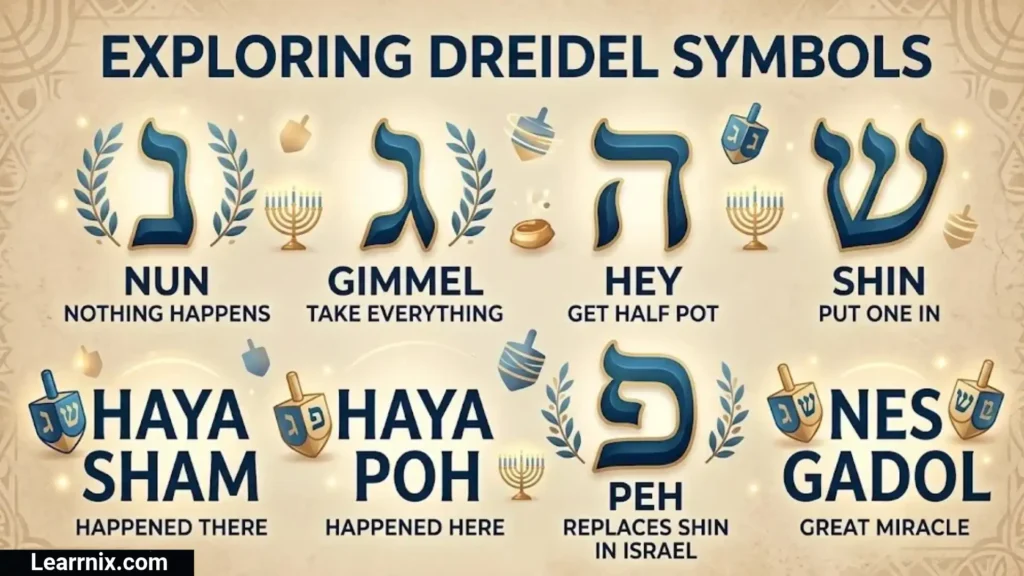
A picture of dreidel symbols is especially helpful when someone wants to compare the letters or understand how they appear on an actual spinning top.
Think of a traditional dreidel as a four-sided object with one symbol on each face:
- First side: נ (Nun)
- Second side: ג (Gimel)
- Third side: ה (Hei)
- Fourth side: ש (Shin)
An Israeli dreidel replaces the fourth symbol with פ (Pei).
The letters are not arranged like the numbers on a clock. They are written on separate faces of the spinning top, and their visible positions change as the toy rotates.
How to Recognize a Traditional Dreidel
When identifying a dreidel, look for these features:
- A four-sided body.
- A handle at the top for spinning.
- A pointed bottom that helps the toy rotate.
- Four Hebrew letters, one on each side.
- A different letter on every face.
A dreidel can have colorful decorations, holiday patterns, or artistic designs, but the four Hebrew letters are what make it recognizable as the traditional Hanukkah game.
Dreidel Song
The dreidel song is a popular Hanukkah children’s song traditionally sung while playing with a spinning top. One of the best-known songs is “I Have a Little Dreidel.”
The song describes a child making a dreidel from clay and enjoying the toy during the holiday. Its simple melody and repeated references to the dreidel make it easy for children to learn and sing.
What Is the Meaning of the Dreidel Song?
The song celebrates the fun of making, spinning, and playing with a dreidel. It also introduces children to a familiar Hanukkah tradition.
Its main themes include:
- Creativity and making handmade toys.
- Enjoying traditional Jewish holiday activities.
- Playing games with family and friends.
- Learning about Hanukkah through music.
- Celebrating Jewish culture and childhood memories.
When Is the Dreidel Song Sung?
The song is commonly sung during Hanukkah celebrations, particularly in schools, homes, and children’s holiday gatherings.
Teachers may sing it while introducing the four Hebrew letters. Families may also sing it while playing dreidel or participating in other holiday activities.
Why Is the Song Popular?
Its popularity comes from its simple melody, memorable subject, and connection to a familiar holiday game. Children can easily connect the song with the spinning top they use during Hanukkah.
The song is also a useful educational activity because it introduces children to the dreidel tradition through music.
FAQ About Dreidel Symbols
What are the four symbols on a dreidel?
The four traditional dreidel symbols are Nun (נ), Gimel (ג), Hei (ה), and Shin (ש). They represent the Hebrew phrase Nes Gadol Haya Sham, meaning “A great miracle happened there.”
What does Gimel mean on a dreidel?
Gimel (ג) means that the player takes everything from the central pot. It is associated with the Yiddish word Gantz, which means everything or the whole amount.
Why does an Israeli dreidel have a different symbol?
An Israeli dreidel commonly uses Pei (פ) instead of Shin (ש). Pei represents the Hebrew word Po, meaning here, changing the traditional phrase to “A great miracle happened here.”
What does Nun mean in the dreidel game?
Nun (נ) means nothing happens. When a player spins Nun, they neither collect anything from the pot nor add another piece. Their turn simply passes to the next player.
Are dreidel symbols Hebrew letters?
Yes, the traditional dreidel symbols are Hebrew letters. Nun, Gimel, Hei, and Shin are used as the initials of a phrase associated with Hanukkah. They also determine the actions players take during the game.
Conclusion
Dreidel symbols are an important part of Hanukkah traditions, combining Hebrew letters, cultural history, and a fun family game. The four main symbols Nun, Gimel, Hei, and Shin—represent a phrase meaning “A great miracle happened there.” Each letter also has a specific meaning that determines what happens during a dreidel game.
Understanding these symbols makes it easier to recognize traditional and Israeli dreidels, explain their differences, and teach children how to play. From Gimel collecting the entire pot to Shin adding another piece, every letter has a simple purpose that makes the game enjoyable.
If you are learning about Jewish traditions, preparing a Hanukkah activity, or helping children recognize Hebrew letters, dreidel symbols offer an easy and meaningful way to explore the holiday. Remember the four letters, learn their meanings, and enjoy the tradition with family and friends.

I am Daniel Harper, an education enthusiast and writer who enjoys creating helpful content to make learning more accessible and engaging.
I focus on sharing knowledge about effective study methods, educational growth, and skills that help learners succeed in a changing world.
Through my writing, I aim to inspire students to explore new ideas and develop a passion for learning.
Books by Daniel Harper:
- The Path to Lifelong Learning
- Unlocking Your Learning Potential
 Charlotte Anderson
 Michael Carter