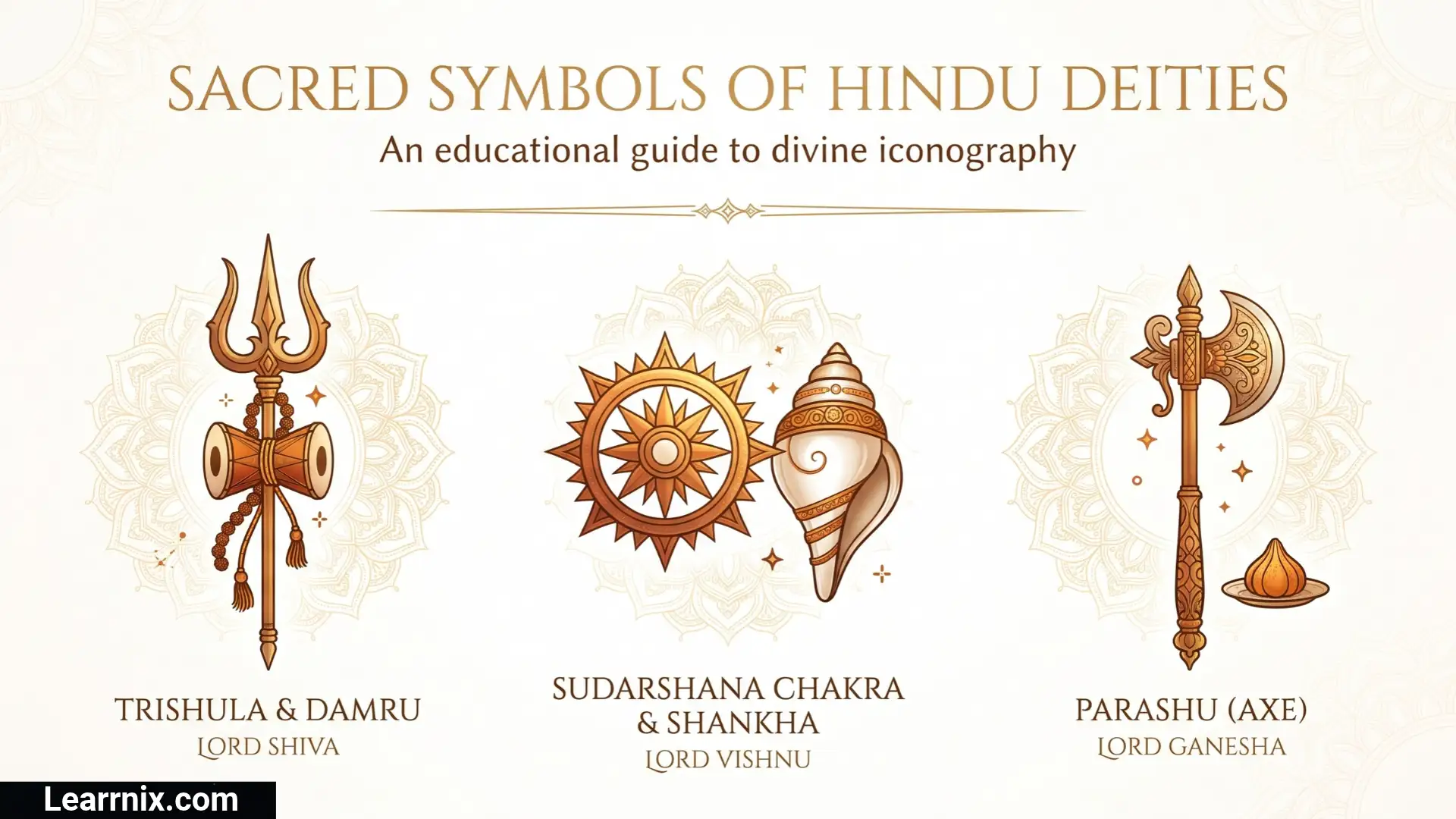
Hinduism has a rich collection of symbols that represent spiritual beliefs, divine powers, religious traditions, and the connection between humans and the universe. These symbols have been used for thousands of years in temples, religious ceremonies, artwork, meditation, and everyday life. Each one carries a special meaning that helps explain different aspects of Hindu philosophy.
Some of the most recognized Hinduism symbols include Om (ॐ), the swastika (卐), the lotus (🪷), the trishula (🔱), and the sacred tilak. While some represent the Supreme Reality, others are connected with particular Hindu gods, protection, prosperity, knowledge, and spiritual growth.
In this guide, you will discover important Hindu symbols and their meanings, explore ancient religious signs, and learn how symbols such as Om, the swastika, and the lotus are used together. You will also find Hindu symbols in text format that you can copy and paste into messages, social media profiles, notes, and other digital content.
Hindu Symbols and Meanings
Hindu symbols are visual representations of religious ideas, spiritual teachings, and divine qualities. They help followers express beliefs that can sometimes be difficult to explain through words alone. Many symbols are associated with particular deities, while others represent universal concepts such as creation, preservation, purity, and liberation.
Here are some widely recognized Hindu symbols and their meanings.
| Symbol | Name | Meaning |
| ॐ | Om | Universal sound and ultimate reality |
| 卐 | Hindu Swastika | Auspiciousness, prosperity, and good fortune |
| 🪷 | Lotus | Purity, spiritual growth, and enlightenment |
| 🔱 | Trishula | Divine power and associated qualities of Shiva |
| कलश | Kalash | Abundance, prosperity, and auspicious beginnings |
| तिलक | Tilak | Devotion and religious identity |
| डमरू | Damru | Shiva’s cosmic rhythm and creation |
| शंख | Shankha | Purity, sacred sound, and divine presence |
| चक्र | Chakra | Divine protection and cosmic order |
| गाय | Cow | Nurturing, generosity, and nonviolence |
The meaning of a symbol can depend on the religious tradition, region, and context in which it appears. For example, the lotus can represent both divine beauty and the ability to remain spiritually pure despite difficult circumstances.
What is the Main Symbol of Hinduism
The main and most widely recognized symbol of Hinduism is Om (ॐ), also written as Aum. It represents the ultimate reality, known as Brahman, and the sacred sound associated with the universe.
Om is deeply connected with Hindu prayers, meditation, mantras, and religious ceremonies. It appears at the beginning of many sacred chants and is commonly used by people seeking concentration and spiritual awareness.
What Does Om Represent?
Om is traditionally explained through three sounds:
- A: Associated with creation and the waking state of consciousness.
- U: Associated with preservation and the dreaming state.
- M: Associated with dissolution and deep sleep.
The silence that follows the sound is also significant. In some philosophical interpretations, it represents pure consciousness or a state beyond ordinary experiences.
Why Is Om So Important?
Om is important because it represents more than a religious sign. It is connected with the Hindu understanding of existence and the relationship between individual consciousness and universal reality.
People commonly use Om during:
- Meditation and yoga practices.
- Hindu prayers and devotional chanting.
- Religious festivals and ceremonies.
- Sacred writings and spiritual artwork.
- Personal symbols of faith and devotion.
Although Om is especially important in Hinduism, it also has a significant place in Buddhism and Jainism, where its use and interpretation can differ.
Buddhism Symbol
Buddhism and Hinduism share some historical and cultural connections, but they are separate religious traditions with different teachings. Some symbols appear in both traditions, although their meanings and religious importance may vary.
The most recognized symbol associated with Buddhism is the Dharma Wheel (☸), also known as the Dharmachakra.
Important Buddhist Symbols
| Symbol | Name | Meaning |
| ☸ | Dharma Wheel | Buddha’s teachings and the Noble Eightfold Path |
| 🪷 | Lotus | Purity and spiritual awakening |
| ☯ | Yin-Yang | Balance in Chinese philosophy, not an exclusively Buddhist symbol |
| 🕉 | Om | A sacred syllable used in some Buddhist traditions |
| 🐚 | Conch Shell | The spreading of Buddhist teachings in Tibetan traditions |
| ☂ | Parasol | Spiritual protection and dignity in Buddhist symbolism |
The lotus is especially interesting because it appears in both Hindu and Buddhist traditions. In Hinduism, it is connected with deities such as Lakshmi and Saraswati. In Buddhism, it commonly represents purity, compassion, and the journey toward awakening.
The Dharma Wheel, however, is more specifically associated with Buddhist teachings. Its eight spokes are commonly connected with the Noble Eightfold Path.
Therefore, although Hinduism and Buddhism share certain symbols, it is important not to assume that every Buddhist symbol has the same meaning in Hindu religious practice.
Hindu God Symbols
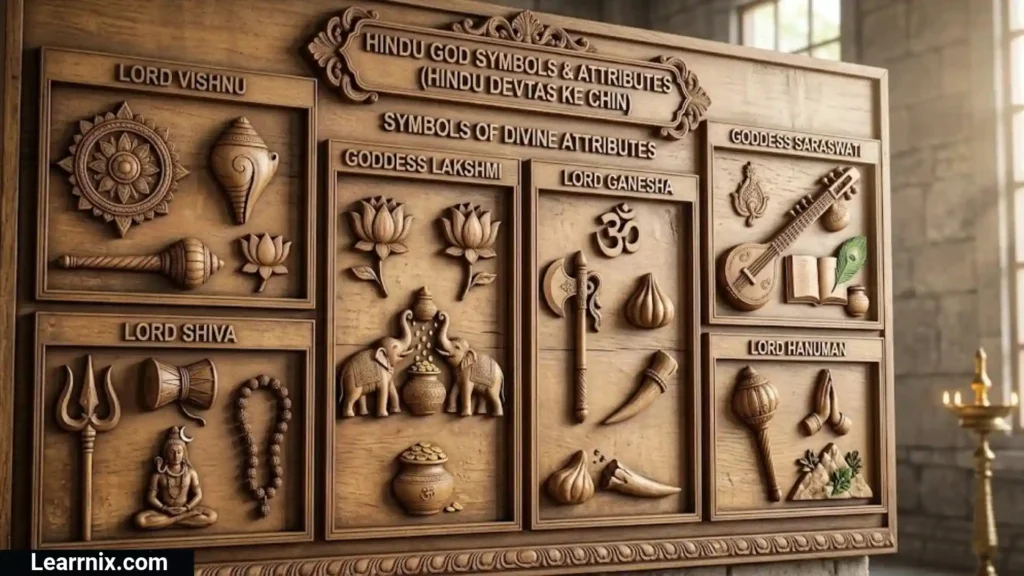
Many Hindu symbols are directly connected with individual gods and goddesses. These signs help identify their qualities, powers, stories, and responsibilities within Hindu religious traditions.
Here are some important symbols associated with popular Hindu deities.
Symbols of Lord Shiva
- 🔱 Trishula: Shiva’s three-pronged weapon, associated with divine authority and different philosophical interpretations of existence.
- 🌙 Crescent Moon: Represents the passage of time and is traditionally shown in Shiva’s hair.
- 🐍 Serpent: Represents mastery over fear, death, and destructive forces.
- Damru (डमरू): A small drum associated with cosmic rhythm and creation.
- Ganga: The sacred river Ganga is traditionally depicted flowing from Shiva’s matted hair.
Symbols of Lord Vishnu
- 🪷 Lotus: Represents purity and divine beauty.
- Sudर्शन Chakra (चक्र): A divine discus associated with protection and the destruction of evil.
- 🐚 Shankha: A sacred conch connected with the announcement of divine presence.
- Gada (गदा): A mace representing strength and authority.
Symbols of Goddess Lakshmi
- 🪷 Lotus: Represents purity, prosperity, and spiritual beauty.
- Elephants: Often symbolize royal power, abundance, and auspiciousness in Lakshmi imagery.
- Gold Coins: Represent wealth, generosity, and material prosperity.
Symbols of Goddess Saraswati
- वीणा (Veena): A musical instrument representing knowledge, creativity, and the arts.
- 📖 Books: Represent learning and wisdom.
- 🦢 Swan: Associated with discernment and the ability to distinguish between what is valuable and what is not.
- 🪷 Lotus: Represents purity and spiritual understanding.
Symbols of Lord Ganesha
- 🐘 Elephant Head: Represents wisdom, intelligence, and strength.
- Modak: A sweet associated with spiritual rewards and devotion.
- Mouse: Ganesha’s vehicle, traditionally interpreted in connection with desires and their control.
- Broken Tusk: Associated with sacrifice, determination, and the story of writing the Mahabharata.
These symbols make it easier to recognize Hindu deities in statues, paintings, temples, and religious illustrations.
Ancient Hindu Symbols and Meanings
Ancient Hindu symbols have developed through centuries of religious practice, sacred literature, art, and cultural traditions. Many are still used in modern Hindu ceremonies and festivals.
Some symbols have Vedic associations, while others became especially prominent through later religious traditions and temple practices.
| Ancient Symbol | Meaning | Traditional Use |
| ॐ | Sacred universal sound | Meditation and chanting |
| 卐 | Auspiciousness and well-being | Religious ceremonies and decorations |
| 🪷 | Purity and spiritual growth | Temple artwork and deity representations |
| स्वस्तिक | Good fortune and prosperity | Weddings and festivals |
| शंख | Sacred sound and purity | Worship and religious rituals |
| कलश | Abundance and auspiciousness | Ceremonies and celebrations |
| यंत्र | Sacred geometric representation | Meditation and worship |
| त्रिशूल | Divine power | Shiva-related religious artwork |
The Historical Importance of Hindu Symbols
The Om syllable has a significant place in ancient Indian philosophical and religious literature, including the Upanishads. It is discussed as a sacred sound and a way of understanding ultimate reality.
The swastika is another ancient sign found in South Asian religious and cultural traditions. In Hindu settings, it has traditionally represented auspiciousness and good fortune.
Sacred geometric designs, including yantras and mandalas, are also important. They use organized shapes and patterns to represent spiritual concepts and support focused meditation.
These symbols have survived because they are meaningful parts of religious identity, cultural heritage, and devotional practice.
Hindu Symbols Text
If you are searching for Hindu symbols that you can copy and paste, this section provides commonly used characters and religious signs in one place.
Popular Hindu Symbols to Copy and Paste
| Symbol | Name |
| ॐ | Om Symbol |
| 🕉 | Om Emoji |
| 卐 | Hindu Swastika |
| 卍 | Swastika Variant |
| 🪷 | Lotus Emoji |
| 🔱 | Trident Symbol |
| ☸ | Dharma Wheel |
| 🐚 | Conch Shell Emoji |
| 🕯 | Candle Emoji |
| 🪔 | Diya Lamp |
| 🙏 | Folded Hands |
| ✨ | Sparkles |
| ☼ | Sun Symbol |
| ☾ | Crescent Moon |
| ◉ | Circle Symbol |
Hindu Religious Text Characters
You can also use traditional Sanskrit and Devanagari characters in religious text, designs, and devotional writing.
- ॐ — Om
- श्री — Shri
- स्वस्तिक — Swastika
- नमः — Namah
- शिव — Shiva
- राम — Rama
- कृष्ण — Krishna
- गणेश — Ganesha
- देवी — Devi
- शान्तिः — Shantih
These are text characters and words rather than all being standalone Unicode symbols.
How to Use Hindu Symbols
You can copy these characters and paste them into different types of digital content, including:
- Social media bios and usernames.
- WhatsApp messages and personal statuses.
- Religious greetings and festival wishes.
- Digital invitations and decorative text.
- Personal notes and spiritual journals.
Keep in mind that some characters may appear differently depending on the font, operating system, and application. Emoji versions can also have different artwork across devices.
Hindu Symbols of Protection
Protection is an important theme in Hindu religious traditions. Several symbols are associated with divine strength, the removal of obstacles, spiritual safety, and protection from negative influences.
These symbols are commonly seen in homes, temples, religious artwork, and ceremonial decorations.
Important Protection Symbols
1. Trishula (🔱)
The trishula is associated with Lord Shiva. Its three prongs are interpreted in different ways, including the three gunas: sattva, rajas, and tamas. It represents divine authority and the power to overcome destructive forces.
2. Swastika (卐)
The Hindu swastika traditionally represents auspiciousness, well-being, and good fortune. It is often drawn during religious ceremonies and placed near entrances or on ceremonial objects.
3. Om (ॐ)
Om is used in prayers and meditation. Many Hindus associate chanting it with spiritual concentration, inner peace, and connection with the divine.
4. Sudarshan Chakra (चक्र)
The Sudarshan Chakra is the divine discus associated with Lord Vishnu. It represents protection, the restoration of righteousness, and the destruction of evil.
5. Hanuman Symbol
Images and representations of Lord Hanuman are associated with courage, devotion, strength, and protection from difficulties.
Where Are Protection Symbols Used?
Hindu protection symbols can be found in several settings:
- At the entrance of houses and temples.
- On religious objects and prayer spaces.
- During festivals and auspicious ceremonies.
- In traditional artwork and devotional decorations.
- On objects used during religious worship.
Their meanings are rooted in faith and cultural tradition. They should not be treated as scientifically proven methods of physical protection.
Important Hinduism Symbols
Some Hindu symbols are especially important because they represent major religious beliefs and are recognized across different Hindu communities.
The following symbols provide a useful overview of Hindu religious and cultural identity.
| Symbol | Name | Main Significance |
| ॐ | Om | Ultimate reality and sacred sound |
| 卐 | Swastika | Auspiciousness and well-being |
| 🪷 | Lotus | Purity and spiritual development |
| 🔱 | Trishula | Shiva’s divine power |
| 🐚 | Shankha | Sacred sound and religious purity |
| 🪔 | Diya | Light, knowledge, and the victory of good over darkness |
| चक्र | Chakra | Divine order and protection |
| कलश | Kalash | Prosperity and abundance |
| तिलक | Tilak | Devotion and religious identity |
| गाय | Sacred Cow | Nurturing and nonviolence |
Why Are These Symbols Important?
Hindu symbols help communicate religious teachings in a visual form. A person may recognize a deity through a particular object, animal, or mark without needing a written explanation.
They also play a role in cultural identity. Families may use particular symbols during weddings, festivals, housewarming ceremonies, and daily worship.
However, Hinduism is diverse. Different communities may emphasize different symbols, and their interpretations are not always identical.
Hinduism Symbols Om and Swastika
Om and the swastika are two of the most recognizable symbols in Hinduism. Both are considered auspicious in Hindu religious contexts, but they represent different ideas.
Om (ॐ) is primarily associated with sacred sound, ultimate reality, and spiritual consciousness. It is commonly chanted during prayers, meditation, and religious ceremonies.
Swastika (卐) traditionally represents good fortune, prosperity, auspiciousness, and well-being. It is frequently used in Hindu celebrations and ceremonial decorations.
Difference Between Om and Swastika
| Feature | Om (ॐ) | Swastika (卐) |
| Main Meaning | Sacred sound and ultimate reality | Auspiciousness and well-being |
| Main Association | Spiritual consciousness | Good fortune |
| Common Use | Chanting and meditation | Religious ceremonies |
| Visual Form | Curved sacred character | Four-armed cross-like design |
| Religious Role | Mantra and spiritual symbol | Auspicious religious sign |
Both symbols may appear together in Hindu homes, temples, invitations, and religious artwork. Their combination expresses devotion and the wish for auspicious beginnings.
Important Historical Distinction
The traditional Hindu swastika must be understood in its cultural and religious context. It is an ancient symbol used in several cultures before the twentieth century.
However, the Nazi Party appropriated a rotated version of the swastika as its political emblem. Because of its association with Nazi Germany, genocide, and antisemitism, the symbol has a deeply painful meaning in many modern contexts.
The traditional Hindu religious use and the Nazi emblem are historically and contextually different. Understanding this distinction is essential when discussing the symbol respectfully.
Hinduism Symbols Om Lotus
Om and the lotus are two important symbols that represent different aspects of Hindu spirituality. When shown together, they can express the relationship between spiritual awareness and purity.
Om (ॐ) represents the sacred sound associated with ultimate reality. It is used in mantras, meditation, and worship.
Lotus (🪷) represents purity, beauty, spiritual growth, and the ability to remain unaffected by negative surroundings.
What Does the Lotus Mean in Hinduism?
The lotus grows in muddy water but produces a beautiful flower above the surface. This natural quality makes it a powerful symbol of spiritual purity.
In Hindu traditions, the lotus is closely associated with several deities:
- Goddess Lakshmi: The lotus represents prosperity, purity, and divine beauty.
- Goddess Saraswati: It represents wisdom, knowledge, and spiritual understanding.
- Lord Brahma: The lotus is traditionally associated with his appearance and the symbolism of creation.
Why Are Om and Lotus Used Together?
The combination of Om and the lotus is popular in devotional artwork, meditation designs, religious decorations, and spiritual illustrations.
Om represents the sacred foundation of existence, while the lotus represents the growth of spiritual understanding. Together, they create a meaningful visual expression of devotion, peace, and purity.
Hinduism Symbols Om Aum
Om and Aum are two ways of writing and referring to the same sacred syllable in Hindu traditions. The Sanskrit form is commonly represented by the character ॐ.
The spelling Aum makes the three vocal sounds more visible, while Om is the more familiar English spelling used in everyday religious and spiritual contexts.
Is Om Different From Aum?
No. In common Hindu usage, Om and Aum refer to the same sacred syllable. However, the spelling Aum is useful when explaining its traditional three-part pronunciation.
| Form | Explanation |
| ॐ | Sacred Devanagari character |
| Om | Common English spelling |
| Aum | Spelling that emphasizes the three sounds |
| A | First sound |
| U | Second sound |
| M | Final sound |
Spiritual Meaning of Aum
The three sounds are often connected with different states of consciousness:
- A: Waking consciousness.
- U: Dreaming consciousness.
- M: Deep sleep.
In the Mandukya Upanishad, Om is explored through these states and a fourth state called Turiya, associated with consciousness beyond the ordinary three states.
Om in Daily Life
People use Om in several spiritual activities, such as:
- Beginning or ending meditation sessions.
- Chanting religious mantras.
- Practicing yoga.
- Performing Hindu worship.
- Creating devotional artwork.
When using the character digitally, remember that ॐ is the actual text character, while some applications may display a decorative or emoji-style version.
Hinduism Symbols Om Swastika
Om and the swastika are sometimes displayed together as a combined religious design. This combination is particularly recognizable in Hindu ceremonial artwork, traditional decorations, and devotional settings.
Although the two symbols are often placed next to each other, each has its own identity and meaning.
Meaning of the Combined Symbols
The combination of Om and the swastika can represent:
- Spiritual Awareness: Om expresses the sacred sound and ultimate reality.
- Auspicious Beginnings: The swastika traditionally represents good fortune and well-being.
- Religious Devotion: Together, they can express faith and respect for Hindu traditions.
- Positive Intentions: Their combination is commonly used in ceremonies to express wishes for prosperity and auspiciousness.
How Are Om and Swastika Used Together?
These symbols may appear on wedding invitations, festival decorations, prayer materials, temple artwork, and traditional household designs.
In some Hindu ceremonies, the swastika is drawn using red or vermilion-colored powder, while Om may be written or displayed nearby.
There is no single mandatory design for combining them. Their arrangement and decoration can differ between families and regional traditions.
When using these symbols online or in public designs, consider the audience and surrounding context. This is especially important because the swastika has a separate and harmful association with Nazi ideology in many parts of the world.
FAQs About Hinduism Symbols
What are the five most important symbols of Hinduism?
Five widely recognized Hindu symbols are Om, the swastika, the lotus, the trishula, and the shankha. They represent spiritual reality, auspiciousness, purity, divine power, and sacred sound.
Why is Om considered sacred in Hinduism?
Om is considered sacred because it represents ultimate reality and the universal sound. It has an important place in Hindu prayers, mantras, meditation, and ancient philosophical teachings.
Is the swastika a Hindu religious symbol?
Yes. The traditional swastika is an ancient auspicious symbol in Hinduism. It represents well-being, prosperity, and good fortune, although its meaning differs significantly from the Nazi emblem.
What flower is considered sacred in Hinduism?
The lotus is one of the most sacred flowers in Hindu traditions. It represents purity, spiritual growth, beauty, and divine qualities. It is particularly associated with Goddess Lakshmi and Goddess Saraswati.
Can Hindu symbols be used in social media usernames?
Yes. Many Hindu text symbols, including ॐ, can be used in social media names, bios, and messages if the platform supports the character. However, some applications may not display every symbol correctly, so it is useful to test the character before publishing.
Conclusion
Hinduism symbols represent a deep connection between religious beliefs, spiritual teachings, and cultural traditions. From the sacred sound of Om to the auspicious swastika and the pure lotus, each symbol communicates an idea that has been meaningful to generations of Hindu followers.
Symbols associated with Shiva, Vishnu, Lakshmi, Saraswati, and Ganesha provide further insight into Hindu religious stories and divine qualities. Other signs, such as the trishula, shankha, kalash, and diya, continue to play important roles in worship, festivals, and everyday traditions.
Understanding these symbols makes it easier to appreciate Hindu culture and its spiritual heritage. Whether you are studying their meanings, exploring ancient traditions, or copying Hindu text symbols for personal use, always consider their religious significance and cultural context.

I am Michael Carter, an educational content creator who believes that knowledge has the power to transform lives.
I create resources focused on modern education, digital learning, and building essential skills for the future.
I love helping readers discover simple and effective ways to improve their learning journey.
Books by Michael Carter:
- Modern Education for Tomorrow’s World
- Learning Skills for Future Success
 Charlotte Anderson