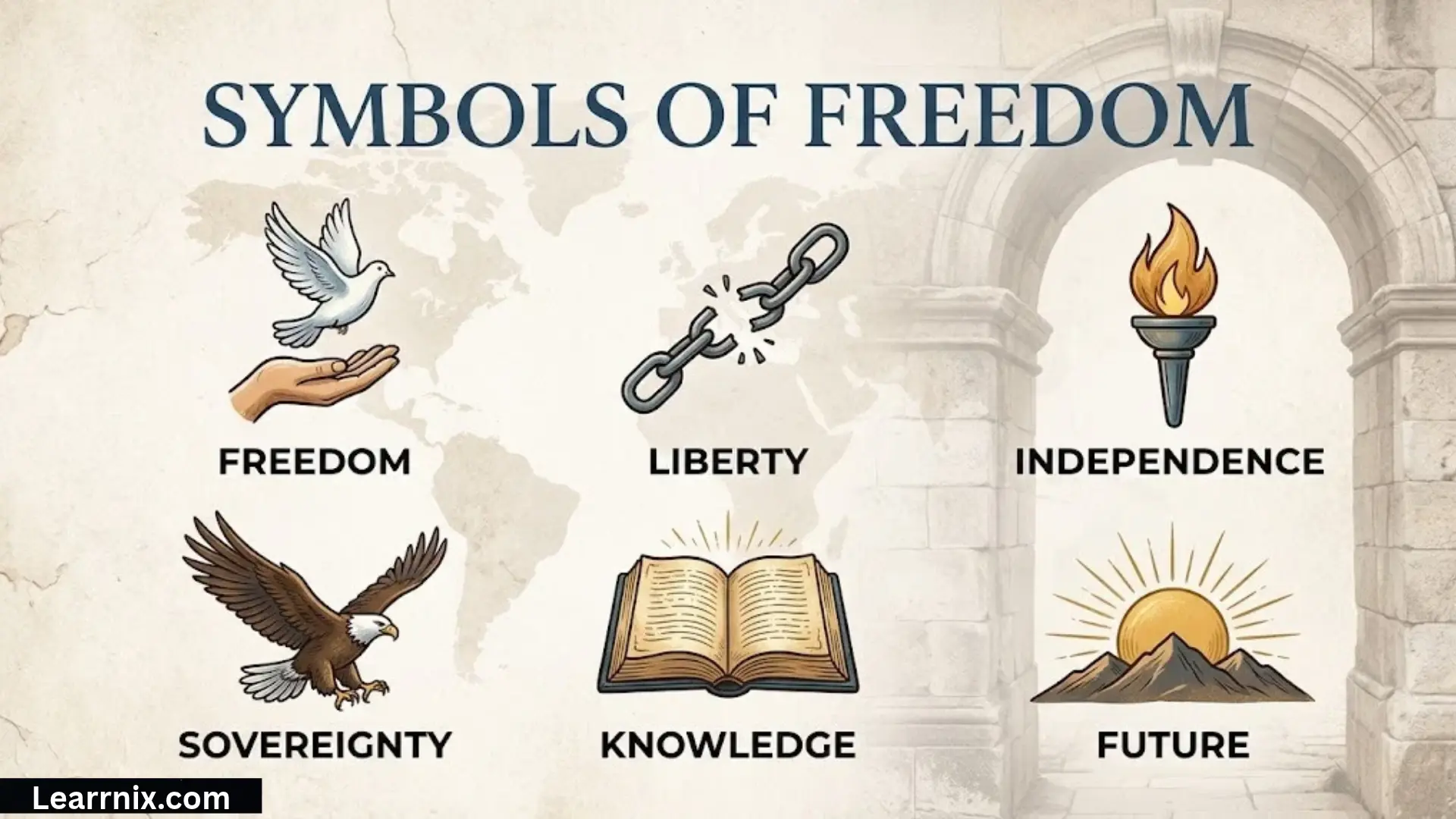
Freedom is one of the most powerful ideas in human life. It represents independence, equality, courage, hope, and the right to make personal choices. Across different cultures, people have used symbols to express these values, from birds flying across an open sky to flags raised during revolutions.
The symbols of freedom collection includes meaningful characters, historical emblems, natural images, artistic designs, and spiritual signs. Some represent the struggle for independence, while others express freedom of speech, personal growth, or the desire to live without oppression.
In this guide, you will discover popular freedom symbols, their meanings, and their cultural backgrounds. You will also find copy-and-paste characters, tattoo ideas, drawing inspiration, and examples of how freedom symbols appear in mythology, literature, art, and everyday communication.
What Are Symbols of Freedom
Symbols of freedom are images, objects, signs, or characters that represent independence, liberation, equal rights, and the ability to live without unnecessary restrictions. Their meanings often come from historical events, cultural traditions, religious beliefs, or personal experiences.
Some freedom symbols are widely recognized, while others have special meanings within particular communities. For example, a broken chain commonly represents release from oppression, while an open birdcage can suggest escaping limitations.
Here are some popular symbols of freedom that you can copy and use in text or creative projects.
| Symbol | Name | Common Meaning |
| 🕊️ | Dove | Peace and hope |
| 🦅 | Eagle | Independence and strength |
| 🦋 | Butterfly | Transformation and personal growth |
| 🔓 | Unlocked Lock | Freedom and access |
| ⛓️ | Chains | Bondage or restrictions |
| 🪽 | Wing | Flight and liberation |
| ☮ | Peace Symbol | Peace and opposition to violence |
| 🗽 | Statue of Liberty | Liberty and welcoming ideals |
| 🏳️ | White Flag | Surrender or a request for peace |
The best symbol depends on the message you want to communicate. A dove suits peaceful freedom, an eagle suggests strength, and an unlocked lock works well when expressing independence or a fresh start.
Universal Symbol of Freedom
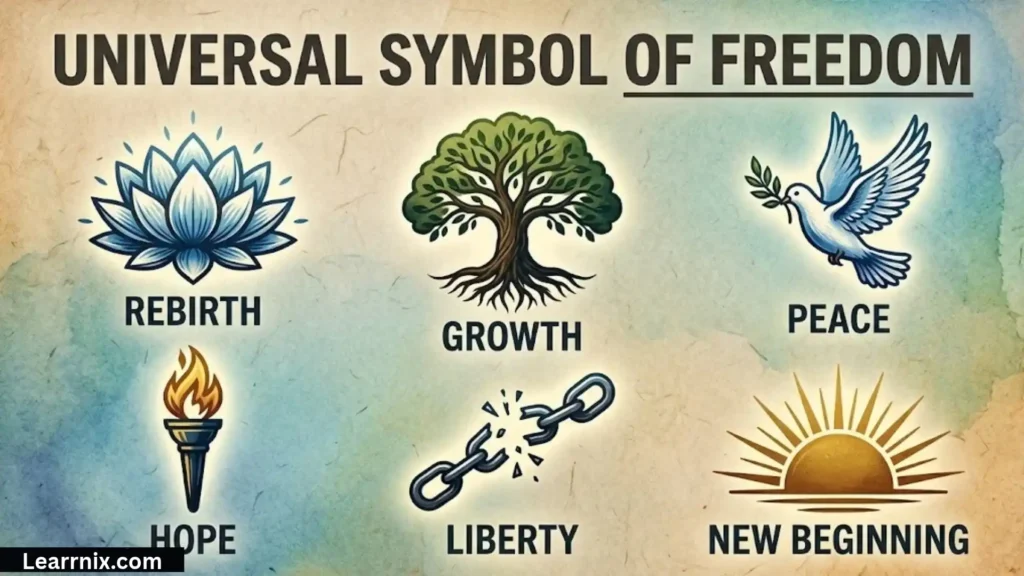
There is no single symbol that represents freedom universally. Different societies interpret freedom through their own histories and values. However, several images are widely associated with liberation and independence.
- 🕊️ Dove: Represents peace, hope, and reconciliation. It is useful when freedom means living without violence or conflict.
- 🦅 Eagle: Often symbolizes strength, independence, and authority. It appears on national emblems and other official designs.
- 🔓 Unlocked Lock: Represents access, release, and the removal of restrictions.
- 🦋 Butterfly: Suggests transformation, personal development, and the ability to begin again.
- ⛓️💥 Broken Chain: Represents liberation from control, oppression, or difficult circumstances.
- 🪽 Wing: Suggests movement, flight, and the desire to rise above limitations.
The dove and unlocked lock communicate different sides of freedom. One emphasizes peace, while the other focuses on the removal of barriers. Choose a symbol that reflects your intended message instead of assuming every freedom symbol has the same meaning.
Symbols of Freedom in Nature
Nature provides some of the clearest images of freedom. Birds move through the sky, butterflies change form, and rivers follow their natural courses. These images inspire people to think about independence, movement, and personal growth.
Birds are especially common in freedom-themed art because flight represents the ability to move beyond physical boundaries.
- 🕊️ Dove: A peaceful life without fear or conflict.
- 🦅 Eagle: Independence, courage, and the power to overcome challenges.
- 🦋 Butterfly: Change, renewal, and freedom from an old identity.
- 🌅 Sunrise: A new beginning after a difficult period.
- 🌊 Wave: Movement, adaptability, and the power of nature.
- 🌳 Tree: Growth, stability, and the freedom to develop strong roots.
- 🌈 Rainbow: Hope, diversity, and the possibility of a brighter future.
- 🪶 Feather: Lightness, flight, and spiritual freedom in some traditions.
These symbols work well in journals, posters, social media bios, and personal artwork. A butterfly can represent emotional growth, while a flying bird may express the desire to travel, explore, or live independently.
Natural symbols are especially effective when you want to communicate freedom without referring to a particular country or political movement.
Ancient Symbols of Freedom
Ancient civilizations used symbols to express victory, authority, protection, and liberation. Although some historical symbols were not created specifically to represent freedom, their associations with independence and resistance developed through cultural traditions and later interpretations.
- Phrygian Cap: An ancient-style soft cap associated with liberty in Roman imagery. It later became a prominent emblem of freedom during the French Revolution.
- Laurel Wreath: In ancient Greece and Rome, it represented victory and achievement. Today, it can suggest overcoming oppression or winning a struggle for independence.
- Roman Eagle: The eagle served as an emblem of Roman military power and authority. Modern interpretations often connect eagles with national sovereignty.
- Olive Branch: An ancient emblem of peace, frequently associated with reconciliation and the hope of living without conflict.
- Ankh (☥): An ancient Egyptian sign associated with life. It is not exclusively a freedom symbol, although modern spiritual interpretations may connect it with liberation and vitality.
- Winged Sun Disc: Used in ancient Egyptian and other Near Eastern traditions, it was associated with divine power and protection rather than freedom alone.
Historical context matters when using these symbols. The Phrygian cap has a particularly strong association with political liberty, whereas the ankh primarily represents life and should not be described as a universal ancient emblem of freedom.
Symbols of Freedom in Mythology
Mythology contains stories about breaking boundaries, escaping captivity, challenging authority, and seeking independence. These stories have inspired freedom symbols in paintings, books, sculptures, and modern designs.
- Prometheus: In Greek mythology, Prometheus gave fire to humanity and was punished by Zeus. His story is often interpreted as a struggle against authority and a sacrifice for human advancement.
- Pegasus: The winged horse represents flight, imagination, and the ability to rise above ordinary limitations.
- Icarus: His flight toward the sun can symbolize ambition and the desire to escape restrictions. His fall also warns about the risks of ignoring limits.
- Garuda: In Hindu and Buddhist traditions, Garuda is a powerful birdlike figure associated with strength and, in important stories, liberation from bondage.
- Phoenix: This mythical bird rises again after its destruction in many versions of the legend. It represents renewal, resilience, and the freedom to begin again.
These figures offer different perspectives on freedom. Pegasus expresses the joy of flight, Prometheus represents resistance and sacrifice, and the phoenix suggests liberation through renewal.
Mythological symbols are particularly useful for fantasy artwork, book illustrations, personal emblems, and tattoos with deeper meanings.
Symbols of Freedom in Literature
Writers use symbols to explore freedom, oppression, rebellion, and the search for identity. A character may seek physical escape, intellectual independence, or the right to make decisions without interference.
Common literary symbols of freedom include:
- Birds in Flight: Represent escape, possibility, and the desire to overcome restrictions.
- Open Doors: Suggest new opportunities, personal choice, and the beginning of a different life.
- Broken Chains: Represent the end of captivity, slavery, or an oppressive system.
- Roads and Open Paths: Symbolize independence, exploration, and the freedom to choose one’s direction.
- Light: Often represents knowledge, truth, hope, and release from ignorance.
- The Sea: Can represent an expansive world beyond social rules or familiar surroundings.
In The Shawshank Redemption, escape and the open world beyond prison walls become powerful images of hope and freedom. In The Adventures of Huckleberry Finn, the river serves as an important setting for escape from restrictive social expectations.
When analyzing a literary symbol, consider what happens in the story and how the character responds to it. A locked door may represent oppression in one passage but safety in another.
Symbols of Freedom in Art
Artists express freedom through visual contrasts, movement, color, and composition. A painting may show liberation through a person breaking chains, a bird leaving its cage, or a crowd moving toward an open horizon.
Popular visual elements include:
- Open Sky: Suggests limitless possibilities and independence.
- Broken Shackles: Communicate release from oppression.
- Raised Hands: Can represent protest, victory, solidarity, or the demand for rights.
- Flying Birds: Suggest peace, movement, and personal liberty.
- Sunlight: Often conveys hope, renewal, and a brighter future.
- Open Gates: Represent access to new opportunities and freedom of movement.
- Flags: May represent national independence, collective identity, or resistance.
Color can strengthen the message. White may suggest peace, blue can communicate calm or hope, and red may express sacrifice, courage, or revolution. These meanings are not fixed, however, and vary across cultures.
For a freedom-themed artwork, combine one main symbol with a clear visual setting. A broken chain against an open sky, for instance, communicates liberation more directly than a design crowded with unrelated images.
Symbol of Freedom Drawing
A freedom symbol drawing can be simple enough for a school project or detailed enough for a poster, mural, or personal artwork. The strongest drawings usually focus on one recognizable idea.
Here are five drawing concepts:
- A Dove With Open Wings: Draw a dove flying upward with a small olive branch in its beak. This design emphasizes peace and hope.
- A Broken Chain: Sketch a chain with one separated link in the center. Add light behind it to suggest release from oppression.
- A Bird Leaving a Cage: Draw an open cage below a bird in flight. The contrast makes the message easy to understand.
- A Butterfly Over Flowers: Use a butterfly emerging from a cocoon to represent transformation and personal growth.
- A Sunrise Over Mountains: Draw the sun rising behind an open landscape to communicate a new beginning.
For beginners, start with simple outlines and avoid adding too many details. Use a pencil to plan the main shapes, then darken the lines and add color if needed.
If the drawing is for a school assignment, include a short caption explaining the chosen symbol. This helps viewers understand why it represents freedom rather than simply seeing it as decoration.
Symbols of Freedom Tattoo
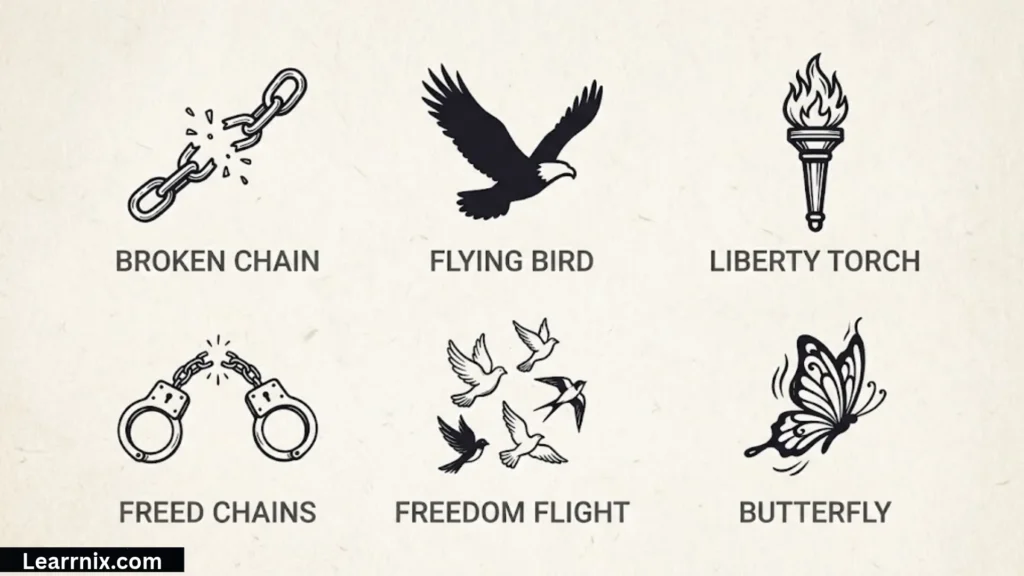
Freedom tattoos can represent independence, survival, personal growth, or a major life change. Some people choose a small symbol with a private meaning, while others prefer detailed artwork that tells a story.
Popular freedom tattoo ideas include:
- Flying Bird: Represents independence and the desire to explore life without unnecessary restrictions.
- Butterfly: Symbolizes transformation after a difficult experience.
- Broken Chain: Represents release from a limiting situation or the end of a personal struggle.
- Semicolon (;): Commonly associated with mental health awareness and continuing one’s story. It is not exclusively a freedom symbol.
- Feather: Can express lightness, movement, or spiritual connection.
- Phoenix: Represents resilience, renewal, and rising after hardship.
- Compass: Suggests self-direction and choosing your own path.
- Open Cage: Represents escaping control and reclaiming personal choice.
Before choosing a tattoo, consider whether you want a universal message or a meaning that is personal to you. A small bird may look simple, but its significance can be deeply individual.
Think about placement, size, line detail, and how the design may age. If the tattoo includes a symbol from a particular culture or religion, research its traditional meaning before using it.
Revolutionary War Symbols of Freedom
During revolutionary movements, symbols help people communicate shared goals and build a collective identity. Flags, clothing, slogans, and national emblems can become powerful reminders of the struggle for independence.
In the American Revolutionary War, several symbols became associated with resistance to British rule.
- The Liberty Tree: A symbol of colonial protest and resistance. It became a gathering point for people opposing British policies.
- The Liberty Pole: A pole raised as a sign of political opposition and support for liberty.
- The Gadsden Flag: A yellow flag featuring a coiled rattlesnake and the words “DON’T TREAD ON ME.” It became associated with resistance and has since acquired additional political meanings.
- The Betsy Ross Flag: Commonly associated with early American national identity and the Revolutionary era, although some traditional claims about its creation remain historically disputed.
- The American Flag: Represents the United States and is associated with independence, national identity, and civic ideals.
- The Liberty Bell: An enduring American emblem of liberty, although its association with abolition and broader freedom struggles developed over time.
These symbols were used in different ways and should not be treated as interchangeable. Some primarily represented protest against government policies, while others became national emblems after independence.
American Symbols of Freedom
American freedom symbols reflect the country’s founding ideals, political history, and continuing debates about rights and equality. Some are official national emblems, while others gained their meaning through public movements and historical events.
- 🗽 Statue of Liberty: Represents liberty and has become a powerful symbol of welcome, hope, and freedom.
- 🇺🇸 American Flag: Represents the United States, its national identity, and the ideals associated with its founding.
- Liberty Bell: Associated with independence, abolition, and the broader struggle for equal rights.
- Bald Eagle: The national bird of the United States, representing strength and sovereignty.
- The Constitution: A foundational legal document that establishes the structure of the federal government and protects certain rights.
- The Liberty Tree: Represents colonial resistance and the demand for political liberty.
- The National Anthem: Expresses national identity and refers to the American flag during the War of 1812.
The Statue of Liberty is particularly recognizable because it connects liberty with hope and the promise of a new life. The Constitution, by contrast, represents the legal framework through which many American freedoms are defined and protected.
Symbols of Freedom in America
Symbols of freedom in America extend beyond national monuments and flags. They also include people, movements, and public memorials associated with the expansion of civil rights.
The meaning of these symbols has changed throughout American history.
- The Emancipation Memorial: Associated with emancipation and the end of slavery, although its imagery and historical interpretation have been debated.
- The Freedom Riders: The activists who challenged racial segregation in interstate travel during the civil rights movement became symbols of courage and nonviolent resistance.
- The March on Washington: The 1963 demonstration became a major symbol of the struggle for civil rights and economic justice.
- The National Mall: A public space associated with national ceremonies, political demonstrations, and movements demanding equal rights.
- The American Flag: Used by people with different political beliefs to express patriotism, national unity, or demands for the country to fulfill its stated ideals.
American freedom is often understood through the tension between founding principles and the historical exclusion of certain groups. Studying these symbols helps explain how the meaning of liberty has developed through political debate and social change.
Symbols of Freedom Around the World
Freedom symbols differ across countries because nations have different histories, traditions, and experiences of oppression. Some represent independence from colonial rule, while others emphasize peace, democratic rights, or resistance.
| Symbol | Cultural or Historical Association | Meaning |
| 🇫🇷 French Tricolour | French Revolution and modern France | Citizenship, national identity, and republican ideals |
| 🇿🇦 South African Flag | Democratic transition in South Africa | Unity and a shared national future |
| Phrygian Cap | French republican imagery | Liberty and emancipation |
| Broken Chains | International liberation imagery | Freedom from oppression |
| 🕊️ Dove | Widely used across cultures | Peace and reconciliation |
| ☮ Peace Symbol | Modern international peace movements | Peace and opposition to war |
| National Independence Flags | Various countries | Sovereignty and self-determination |
The French Tricolour is associated with the revolutionary tradition of liberty, equality, and fraternity. South Africa’s national flag reflects the country’s democratic transition and the aspiration to unite people from different backgrounds.
A symbol’s meaning can also change over time. A flag that once represented resistance may later become an official national emblem, while a peace symbol may be adopted by movements with different political goals.
African American Symbols of Freedom
African American freedom symbols are deeply connected to the history of slavery, emancipation, racial justice, and the civil rights movement. These symbols reflect the struggle to secure equal rights and the determination of communities to challenge discrimination.
- Juneteenth Flag: Represents the celebration of emancipation and the continuing significance of freedom in African American history.
- The Emancipation Proclamation: A historic presidential proclamation issued by Abraham Lincoln in 1863 that declared enslaved people in designated areas rebelling against the United States to be free. It did not immediately end slavery everywhere.
- The Underground Railroad: A network of routes, safe houses, and people who helped enslaved African Americans escape bondage. It has become a symbol of courage, solidarity, and resistance.
- Raised Fist: Associated with solidarity, resistance, and demands for racial justice. Its meaning depends on the movement and context.
- The March on Washington: A landmark 1963 event that strengthened public calls for civil rights and economic opportunity.
- Freedom Quilts: Quilts are sometimes discussed in accounts of African American history as possible communication tools, but claims that specific quilt patterns formed a systematic Underground Railroad code remain disputed.
These symbols represent different aspects of freedom, from legal emancipation to political participation and equal treatment. They also remind readers that the end of slavery did not automatically bring racial equality.
Spiritual Symbols of Freedom
Spiritual freedom can mean release from fear, attachment, ignorance, guilt, or limiting beliefs. Different religious and philosophical traditions express this idea through symbols associated with renewal, enlightenment, peace, and liberation.
- ☯ Yin-Yang: A Chinese philosophical symbol representing the relationship between complementary forces. It can inspire reflection on balance, although it does not specifically mean freedom.
- 🪷 Lotus Flower: Associated with purity, spiritual development, and awakening in several Asian religious traditions.
- ☥ Ankh: An ancient Egyptian symbol of life that may be used in modern spiritual contexts to express vitality and continuity.
- 🕉 Om: A sacred syllable and symbol in Hindu traditions, also significant in some other Indian religious traditions. It is associated with spiritual practice rather than being a universal sign of freedom.
- ☸ Dharma Wheel: Associated with Buddhist teachings and the path toward liberation from suffering.
- Feather: In some cultural and spiritual interpretations, it represents connection, flight, or transcendence.
- Phoenix: A mythological emblem of renewal that can represent leaving the past behind.
Spiritual symbols should be used with an understanding of their origins. The lotus and Dharma Wheel, for example, have specific religious associations that go beyond general ideas of independence.
Symbols of Freedom of Speech
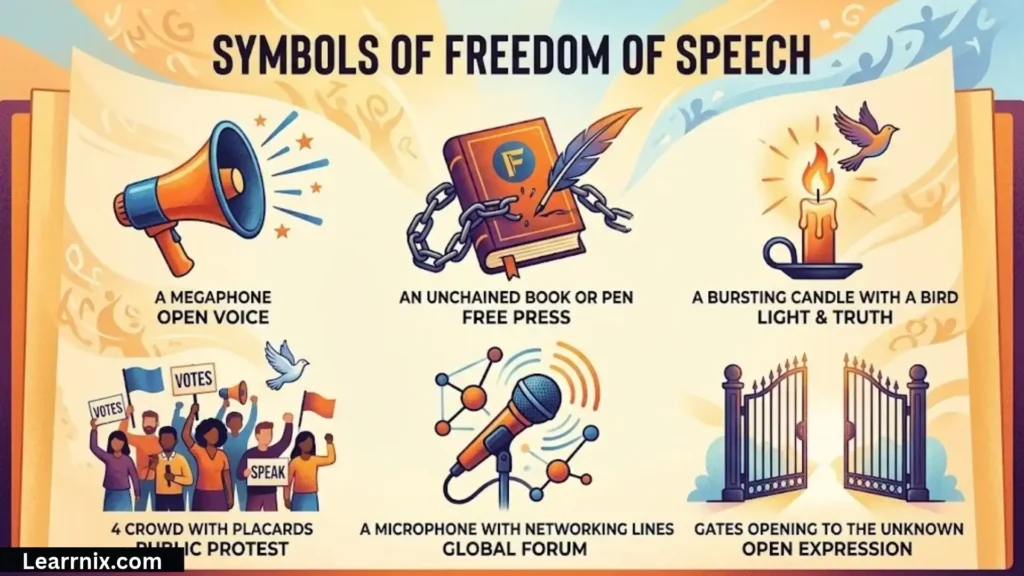
Freedom of speech is the right to express opinions, communicate ideas, and participate in public discussion, subject to applicable laws and limitations. Symbols associated with this right often represent open communication, access to information, and resistance to censorship.
- 🗣️ Speaking Head: Represents speaking, expressing opinions, and sharing ideas.
- 💬 Speech Bubble: Commonly used to represent conversation, discussion, and communication.
- 📰 Newspaper: Represents journalism, public information, and the sharing of ideas.
- ✍️ Writing Hand: Suggests written expression, authorship, and the freedom to communicate through words.
- 🎤 Microphone: Represents public speaking, broadcasting, and making one’s voice heard.
- 🔓 Unlocked Lock: Can symbolize open access to information and freedom from restrictions.
- 📢 Loudspeaker: Represents announcements, public campaigns, and the communication of messages to a wider audience.
These symbols are useful for educational posters, journalism projects, digital content, and campaigns about human rights. A speech bubble is suitable for a general discussion, while a microphone can communicate public expression more directly.
Freedom of speech does not mean that every form of expression is legally protected in every circumstance. Its scope and limitations differ across countries and legal systems.
Symbols of Freedom and Liberty
Freedom and liberty are closely related concepts. Freedom often describes the ability to act, choose, or live without unnecessary restrictions. Liberty frequently refers to the rights and protections that allow people to make those choices.
Symbols of freedom and liberty can represent personal independence, legal rights, political self-determination, or release from oppression.
| Symbol | Main Association | Best Use |
| 🗽 Statue of Liberty | Liberty and hope | American history and national ideals |
| 🔓 Unlocked Lock | Release from restrictions | Personal messages and digital designs |
| Broken Chain | Liberation from oppression | Historical artwork and awareness projects |
| 🕊️ Dove | Peaceful freedom | Posters, cards, and social media |
| 🦅 Eagle | Strength and sovereignty | National or patriotic designs |
| Phrygian Cap | Political liberty | Historical and revolutionary artwork |
| 🦋 Butterfly | Personal transformation | Tattoos and inspirational messages |
| ☮ Peace Symbol | Peace and nonviolence | Activism and peace-related designs |
For copy-and-paste use, the unlocked lock, dove, butterfly, and peace symbol are convenient choices. You can combine them with short phrases such as “Freedom to grow 🦋,” “Choose peace ☮,” or “Live without fear 🕊️.”
Remember that emoji appearance can vary by device, app, and operating system. Some historical symbols, such as the Phrygian cap, may require an image or illustration rather than a dedicated Unicode character.
Symbols of Freedom Archival Collection
A symbols of freedom archival collection brings together historical documents, photographs, flags, posters, artwork, and objects that show how different communities have expressed the idea of liberty.
An archival collection may include materials from revolutionary movements, abolition campaigns, civil rights demonstrations, peace movements, or national independence celebrations. Its purpose is to preserve evidence of how people understood and communicated freedom at a particular time.
Useful items in such a collection include:
- Historical Flags: Show how national identity and political independence were represented.
- Protest Posters: Reveal the language, images, and messages used by social movements.
- Letters and Documents: Record personal experiences, political demands, and historical decisions.
- Photographs: Capture demonstrations, public celebrations, and moments of resistance.
- Badges and Medals: Show how movements and governments used visual emblems.
- Paintings and Prints: Preserve artistic interpretations of liberation and human rights.
When researching an archival collection, check the creator, date, location, and original purpose of each item. A symbol’s meaning may differ from its modern interpretation, so historical descriptions are essential for understanding it accurately.
FAQs
What is the most recognized symbol of freedom?
The Statue of Liberty is one of the most recognized symbols of freedom, especially in the United States. Globally, birds in flight, broken chains, and the Phrygian cap also communicate liberation and independence.
Which emoji represents freedom?
There is no single official freedom emoji. Popular choices include 🕊️ for peace, 🦋 for transformation, 🦅 for independence, 🪽 for flight, and 🔓 for release from restrictions.
What flower symbolizes freedom?
The lotus is associated with spiritual growth and awakening, while the butterfly’s connection to transformation makes it a popular freedom-related image. Flower meanings vary across cultures, and no single flower universally represents freedom.
What does a broken chain symbolize?
A broken chain commonly represents liberation from slavery, oppression, control, or restrictive circumstances. It can also express personal recovery and the ability to move forward after a difficult experience.
Which freedom symbol is best for a tattoo?
A flying bird is a popular choice for independence, a butterfly represents transformation, and a broken chain suggests release from restrictions. The best design is one that reflects your personal experience and the message you want to express.
Conclusion
Symbols of freedom help people express independence, hope, peace, courage, and the desire for equal rights. From the Statue of Liberty and the Phrygian cap to birds, butterflies, and broken chains, each symbol offers a different way to communicate what freedom means.
Their meanings become richer when viewed through history, mythology, literature, art, and spiritual traditions. Understanding the cultural background of a symbol also helps prevent confusion between an established historical meaning and a modern personal interpretation.
When choosing a freedom symbol for a tattoo, drawing, poster, or social media post, focus on the message you want to share. A simple character or familiar image can communicate a powerful idea when its meaning matches your purpose.

I am Michael Carter, an educational content creator who believes that knowledge has the power to transform lives.
I create resources focused on modern education, digital learning, and building essential skills for the future.
I love helping readers discover simple and effective ways to improve their learning journey.
Books by Michael Carter:
- Modern Education for Tomorrow’s World
- Learning Skills for Future Success
 Charlotte Anderson
 Daniel Harper